


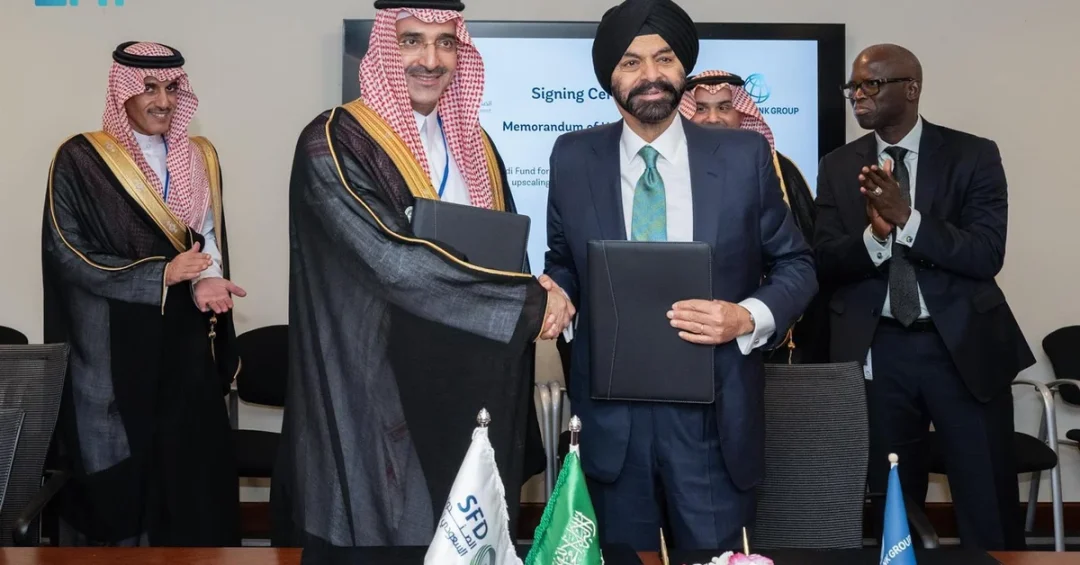
The Saudi Fund for Development (SFD) and the World Bank Group signed a landmark memorandum of understanding (MoU) on October 30, 2024, in Washington, D.C., to enhance international development cooperation and advance sustainable development in emerging economies. The agreement was formalized by SFD Chief Executive Sultan Abdulrahman Al-Marshad and World Bank President Ajay Banga on the sidelines of the 2024 annual meetings of the International Monetary Fund (IMF) and the World Bank. This milestone MoU involves all five institutions within the World Bank Group: the International Bank for Reconstruction and Development (IBRD), the International Development Association (IDA), the International Finance Corporation (IFC), and the Multilateral Investment Guarantee Agency (MIGA).
Context and Background
The MoU represents an important expansion of the long-standing relationship between the SFD and the World Bank Group, reinforcing both organizations’ commitment to funding development projects and programs in countries and communities with the greatest needs. Since its establishment in 1974, the SFD has been committed to supporting sustainable development globally, touching hundreds of millions of lives across 100 countries in Africa, Asia and the Pacific, Latin America and the Caribbean, and Eastern Europe. As the official development arm of the Kingdom of Saudi Arabia, the SFD has financed more than 800 development projects with a total funding of $20 billion across diverse sectors, including social infrastructure (water and sewage, education, health, housing and urban development), transportation, agriculture, energy, industry and mining, and more.
Key Details of the Agreement
The MoU aims to enhance cooperation through knowledge sharing and co-financing projects, with a focus on strengthening water and food security, particularly in regions vulnerable to climate change and fragility. It emphasizes fostering regional integration by improving cross-border infrastructure. Key initiatives include promoting transition to renewable energy sources, enhancing transport infrastructure, supporting digital infrastructure and the development of the digital economy, and building institutional capacity. The agreement aligns with SFD’s broader mission to collaborate with global partners and institutions to drive inclusive, sustainable growth and accelerate economic prosperity and social progress in beneficiary countries.
International and Regional Implications
This partnership between Saudi Arabia’s premier development fund and the World Bank Group signals a strengthened global commitment to addressing pressing challenges in developing nations. By leveraging the expertise and resources of both entities, the MoU is expected to catalyze investments in critical sectors such as renewable energy, water management, and digital infrastructure. The focus on climate-vulnerable and fragile regions is particularly significant, as it targets areas most in need of sustainable solutions. Furthermore, the emphasis on cross-border infrastructure supports regional integration, potentially boosting trade and stability in key regions like Africa and Asia.
Vision 2030 Alignment
The signing of this MoU underscores Saudi Arabia’s leadership in global development and its dedication to fostering international cooperation, both central to the Kingdom’s Vision 2030 ambitions. By partnering with multilateral institutions like the World Bank Group, Saudi Arabia demonstrates its commitment to sustainable development, economic diversification, and positive global engagement. This initiative not only advances the SFD’s mission but also contributes to Vision 2030’s goals of building a vibrant society and a thriving economy, showcasing Saudi Arabia as a key player in driving inclusive growth and prosperity worldwide.
20 Questions
Q1. What is the main purpose of the MoU signed between the SFD and the World Bank Group?
A1. The MoU aims to enhance international development cooperation and advance sustainable development in emerging economies through knowledge sharing and co-financing projects.
Q2. When and where was the MoU signed?
A2. The MoU was signed on October 30, 2024, in Washington, D.C., on the sidelines of the annual meetings of the IMF and the World Bank.
Q3. Who signed the MoU on behalf of the SFD?
A3. The MoU was signed by SFD Chief Executive Sultan Abdulrahman Al-Marshad.
Q4. Who signed the MoU on behalf of the World Bank Group?
A4. The MoU was signed by World Bank President Ajay Banga.
Q5. Which institutions within the World Bank Group are involved in this agreement?
A5. The agreement involves all five institutions: IBRD, IDA, IFC, and MIGA.
Q6. What are the primary focus areas of the MoU?
A6. The focus areas include strengthening water and food security, fostering regional integration, promoting renewable energy, enhancing transport and digital infrastructure, and building institutional capacity.
Q7. How does the MoU aim to address climate change?
A7. The MoU focuses on strengthening water and food security, particularly in regions vulnerable to climate change, and promoting transition to renewable energy sources.
Q8. What is the significance of regional integration in the MoU?
A8. Regional integration is emphasized through improving cross-border infrastructure, which can boost trade and stability in key regions.
Q9. Since when has the SFD been supporting global development?
A9. The SFD has been supporting sustainable development globally since 1974.
Q10. How many countries has the SFD supported since its establishment?
A10. The SFD has supported projects and programs in 100 countries across Africa, Asia and the Pacific, Latin America and the Caribbean, and Eastern Europe.
Q11. What is the total funding provided by the SFD for development projects?
A11. The SFD has financed more than 800 development projects with a total funding of $20 billion.
Q12. What sectors are covered by SFD’s development projects?
A12. Sectors include social infrastructure (water, education, health, housing), transportation, agriculture, energy, industry and mining, and more.
Q13. What is the SFD’s role in Saudi Arabia’s development strategy?
A13. The SFD is the official development arm of the Kingdom of Saudi Arabia, working to support sustainable development globally.
Q14. How does this MoU align with Saudi Vision 2030?
A14. The MoU supports Vision 2030’s goals of fostering international cooperation, economic diversification, and sustainable development.
Q15. What is the expected impact of the MoU on beneficiary countries?
A15. The MoU is expected to drive inclusive, sustainable growth and accelerate economic prosperity and social progress in beneficiary countries.
Q16. How does the MoU promote knowledge sharing?
A16. The MoU enhances cooperation through knowledge sharing between the SFD and the World Bank Group, leveraging each organization’s expertise.
Q17. What is the focus on digital infrastructure in the MoU?
A17. The MoU includes supporting digital infrastructure and the development of the digital economy to foster innovation and connectivity.
Q18. Why is the MoU significant for regions vulnerable to fragility?
A18. The MoU specifically targets strengthening water and food security in climate-vulnerable and fragile regions, addressing critical needs.
Q19. How does the MoU reinforce the SFD-World Bank relationship?
A19. The MoU represents an important expansion of the long-standing relationship, reinforcing both organizations’ commitment to funding development projects.
Q20. What is the broader mission of the SFD as highlighted by this agreement?
A20. The MoU aligns with SFD’s mission to collaborate with global partners to drive inclusive, sustainable growth and accelerate economic prosperity.
Reader Feedback
We value your thoughts. Please share your feedback on this article.
Your feedback helps us improve our coverage.