


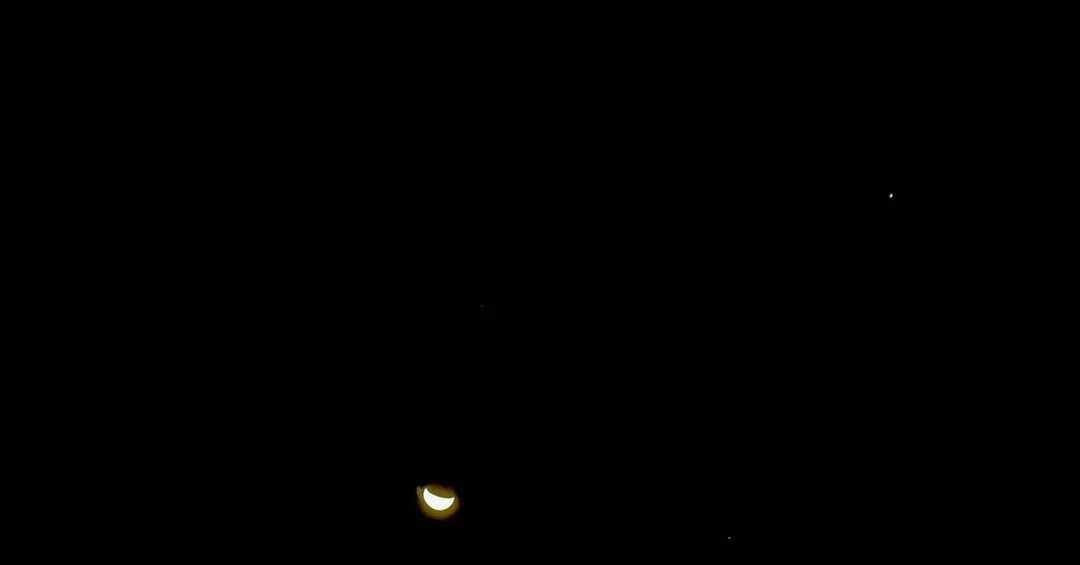
The Saudi Press Agency (SPA) captured a stunning celestial triangle formed by the Moon, Mars, and Jupiter visible to the naked eye over Rafha in the Northern Borders Region early Wednesday morning. The astronomical event, recorded on August 28, 2024, showcases the Kingdom’s growing role in documenting and promoting scientific phenomena, aligning with its broader ambitions in education and space exploration under Vision 2030.
Context and Background
Berjis Al-Fulaih, a member of the Afaq Society for Astronomy, told SPA that the waning crescent Moon appeared below the two planets, with Mars and Jupiter exhibiting significantly different apparent brightness. He explained that a conjunction occurs when one celestial body appears close to another within a few arc degrees as observed from Earth, though this proximity is only apparent due to vast actual distances of hundreds of millions of kilometers. The phenomenon arises from differing celestial orbits around the Earth and Sun, as well as the angle between the Moon and Mars relative to Earth during the event.
Key Details
The conjunction highlights the Moon in its waning crescent phase and Mars in a position that makes them appear close in the sky. Al-Fulaih stressed that observing such conjunctions helps study celestial positions and analyze their movements, contributing to a better understanding of celestial orbits and systems. This data offers opportunities for astronomy education and hobbies, enabling space enthusiasts to learn about the evolution and movements of celestial bodies, inspiring many to explore and learn about space.
Implications and Impact
Such events can spark interest in astronomy among new generations and could be the beginning of new scientific pursuits. The SPA’s documentation of this event underscores the importance of scientific communication in Saudi Arabia, fostering public engagement with space sciences and potentially guiding future educational initiatives. The Northern Borders Region, known for its clear skies, provides an ideal location for astronomical observations, supporting local and international researchers.
Vision 2030 Alignment
This celestial event aligns with Saudi Arabia’s Vision 2030 goals of diversifying the economy and promoting scientific innovation. By highlighting astronomical phenomena, the Kingdom encourages STEM education and inspires youth to pursue careers in space sciences, supporting the Saudi Space Agency‘s efforts to develop a robust space sector. The SPA’s coverage reflects a commitment to advancing knowledge and positioning Saudi Arabia as a hub for scientific exploration and education in the region.
20 Questions
Q1. What celestial bodies were involved in the triangle captured by SPA?
A1. The triangle involved the Moon, Mars, and Jupiter, as documented by the Saudi Press Agency in the skies over Rafha in the Northern Borders Region.
Q2. When was this celestial triangle observed?
A2. It was observed early Wednesday morning on August 28, 2024, as reported by the Saudi Press Agency.
Q3. Where exactly was this event visible?
A3. The event was visible in the skies over Rafha, located in the Northern Borders Region of Saudi Arabia.
Q4. Who provided expert commentary on this event?
A4. Berjis Al-Fulaih, a member of the Afaq Society for Astronomy, provided expert commentary to the Saudi Press Agency.
Q5. What is a conjunction in astronomy?
A5. A conjunction occurs when one celestial body appears close to another within a few arc degrees when observed from Earth, though the actual distance between them is vast.
Q6. Why do Mars and Jupiter appear close to each other in this event?
A6. They appear close due to differing celestial orbits around the Earth and Sun, creating an apparent proximity that is not real.
Q7. What phase was the Moon during the conjunction?
A7. The Moon was in its waning crescent phase during the conjunction.
Q8. How can viewing conjunctions benefit science?
A8. Observing conjunctions helps study celestial positions and movements, contributing to a better understanding of celestial orbits and systems.
Q9. What opportunities does this event provide for the public?
A9. It offers opportunities for astronomy education and hobbies, enabling space enthusiasts to learn about celestial body evolution and movements.
Q10. How does this event inspire new generations?
A10. Such events spark interest in astronomy among new generations, potentially inspiring them to explore and learn about space.
Q11. Is this conjunction visible to the naked eye?
A11. Yes, the conjunction was visible to the naked eye early Wednesday morning, as confirmed by the Saudi Press Agency.
Q12. What is the role of the Afaq Society for Astronomy?
A12. The Afaq Society for Astronomy is an organization that provides expertise on astronomical events and promotes space education in Saudi Arabia.
Q13. How does Saudi Press Agency contribute to science communication?
A13. SPA documents and reports astronomical phenomena, fostering public engagement with space sciences and supporting scientific education.
Q14. What is the significance of the Northern Borders Region for astronomy?
A14. The Northern Borders Region has clear skies that provide an ideal location for astronomical observations, supporting both local and international researchers.
Q15. How does this event align with Saudi Vision 2030?
A15. It promotes scientific innovation and STEM education, supporting Vision 2030’s goals of economic diversification and development of a robust space sector.
Q16. What is the Saudi Space Agency’s role in such events?
A16. The Saudi Space Agency develops the Kingdom’s space sector, and events like this inspire youth to pursue careers in space sciences.
Q17. Can such events lead to scientific pursuits?
A17. Yes, they can be the beginning of new scientific pursuits, as noted by Berjis Al-Fulaih in his comments to SPA.
Q18. How often do such conjunctions occur?
A18. Conjunctions occur periodically depending on the orbits of celestial bodies, but the specific alignment of Moon, Mars, and Jupiter is a rarer event.
Q19. What data can be gathered from observing this event?
A19. Data on celestial body positions and movements can be gathered, helping analyze orbits and systems for better astronomical understanding.
Q20. How does Saudi Arabia support astronomy education?
A20. Saudi Arabia supports astronomy education through organizations like the Afaq Society for Astronomy, SPA coverage, and Vision 2030 initiatives promoting STEM fields.
Reader Feedback
We value your thoughts. Please share your feedback on this article.
Your feedback helps us improve our coverage.