


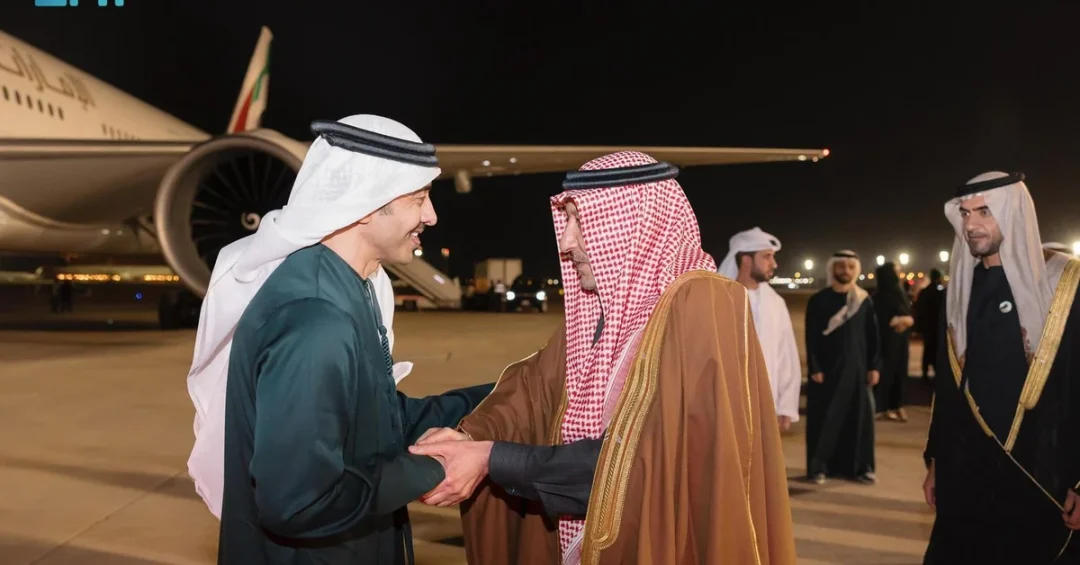
UAE Deputy Prime Minister and Minister of Foreign Affairs Sheikh Abdullah bin Zayed Al Nahyan arrived in Riyadh on Saturday, January 11, 2025, to participate in an expanded ministerial meeting on Syria hosted by the Kingdom of Saudi Arabia. The visit underscores the close coordination between Saudi Arabia and the United Arab Emirates on key regional issues and highlights Riyadh’s continued leadership in facilitating international dialogue on Middle Eastern stability.
Context and Background
The expanded ministerial meeting on Syria brings together senior diplomats and officials from multiple nations to discuss the political and humanitarian dimensions of the Syrian conflict. Hosted by Saudi Arabia, the gathering reflects the Kingdom’s active role in promoting diplomacy and regional security as part of its broader foreign policy objectives under Vision 2030. The presence of Sheikh Abdullah bin Zayed, a leading figure in UAE diplomacy, signals the strong bilateral ties and shared perspectives between the two Gulf nations on matters of regional importance.
Key Details
Sheikh Abdullah bin Zayed was received upon arrival at King Khalid International Airport by Saudi Vice Minister of Foreign Affairs Eng. Waleed bin Abdulkarim El-Khereiji, in a warm welcome that highlighted the fraternal relations between the two countries. The meeting is expected to address the latest developments in Syria, including efforts to support a political solution, humanitarian aid delivery, and reconstruction initiatives, in line with international resolutions and the interests of the Syrian people.
Implications and Regional Impact
The Riyadh meeting represents a renewed diplomatic push to address the protracted Syrian conflict, with Saudi Arabia playing a central role in convening regional and international stakeholders. The participation of the UAE, a key ally, reinforces a unified Gulf approach towards achieving stability in Syria. This engagement also enhances Saudi Arabia’s position as a diplomatic hub and underscores its commitment to fostering peace and cooperation in the Middle East.
Vision 2030 Alignment
This high-level diplomatic activity aligns with Saudi Vision 2030, which emphasizes the Kingdom’s role as a regional leader in promoting security, stability, and economic integration. By hosting such critical discussions, Saudi Arabia reinforces its strategic autonomy and its vision for a peaceful, prosperous region, contributing to a global order that values dialogue and partnership.
20 Questions
Q1. Who arrived in Riyadh on January 11, 2025?
A1. UAE Deputy Prime Minister and Minister of Foreign Affairs Sheikh Abdullah bin Zayed Al Nahyan arrived in Riyadh to participate in an expanded ministerial meeting on Syria.
Q2. What was the purpose of Sheikh Abdullah bin Zayed’s visit to Riyadh?
A2. He arrived to participate in an expanded ministerial meeting on Syria hosted by Saudi Arabia.
Q3. Who welcomed Sheikh Abdullah bin Zayed at King Khalid International Airport?
A3. Saudi Vice Minister of Foreign Affairs Eng. Waleed bin Abdulkarim El-Khereiji received him at the airport.
Q4. What is the expanded ministerial meeting on Syria about?
A4. The meeting focuses on discussing the political and humanitarian situation in Syria, aiming to support a political solution and regional stability.
Q5. Why is Saudi Arabia hosting this ministerial meeting?
A5. Saudi Arabia is hosting to foster diplomatic dialogue and play a leading role in regional peace and security efforts.
Q6. What does this visit say about UAE-Saudi relations?
A6. It reflects the strong, fraternal ties and close coordination between the UAE and Saudi Arabia on key regional matters.
Q7. What is the official source of this information?
A7. The Saudi Press Agency (SPA) reported Sheikh Abdullah bin Zayed’s arrival and the meeting details.
Q8. Where did the arrival take place in Riyadh?
A8. He arrived at King Khalid International Airport in the Saudi capital, Riyadh.
Q9. What is Sheikh Abdullah bin Zayed’s official role?
A9. He serves as Deputy Prime Minister and Minister of Foreign Affairs of the United Arab Emirates.
Q10. How does this meeting relate to Vision 2030?
A10. The meeting aligns with Vision 2030 by promoting Saudi Arabia’s diplomatic leadership and role in regional stability.
Q11. What topics are likely discussed at the meeting?
A11. Topics include a political solution for Syria, humanitarian aid, reconstruction, and regional security.
Q12. Is this the first such meeting on Syria hosted by Saudi Arabia?
A12. Saudi Arabia has hosted several diplomatic meetings on Syria, reinforcing its commitment to facilitating dialogue.
Q13. What is the significance of the UAE’s participation?
A13. UAE participation strengthens a unified Gulf approach and underscores shared interests in Syrian stability.
Q14. Who is Eng. Waleed bin Abdulkarim El-Khereiji?
A14. He is the Vice Minister of Foreign Affairs of Saudi Arabia, representing the Kingdom in receiving dignitaries.
Q15. How does this event support regional peace?
A15. By convening regional and international stakeholders, it promotes dialogue and cooperative solutions to conflicts.
Q16. What is the timeline of the meeting?
A16. The meeting began on Saturday, January 11, 2025, as reported by SPA.
Q17. Are there other countries participating in the meeting?
A17. The expanded meeting involves senior diplomats from multiple nations, as it is a ministerial-level gathering.
Q18. What is the long-term goal of such diplomatic efforts?
A18. The long-term goal is achieving a peaceful, political resolution to the Syrian crisis and ensuring regional stability.
Q19. How does the Saudi press agency report such events?
A19. SPA provides timely, official reports on diplomatic visits and meetings, ensuring accurate and authoritative coverage.
Q20. What is the broader significance for Saudi Arabia’s foreign policy?
A20. It reinforces Saudi Arabia’s role as a diplomatic hub and its commitment to proactive, peaceful foreign engagement.
Reader Feedback
We value your thoughts. Please share your feedback on this article.
Your feedback helps us improve our coverage.