


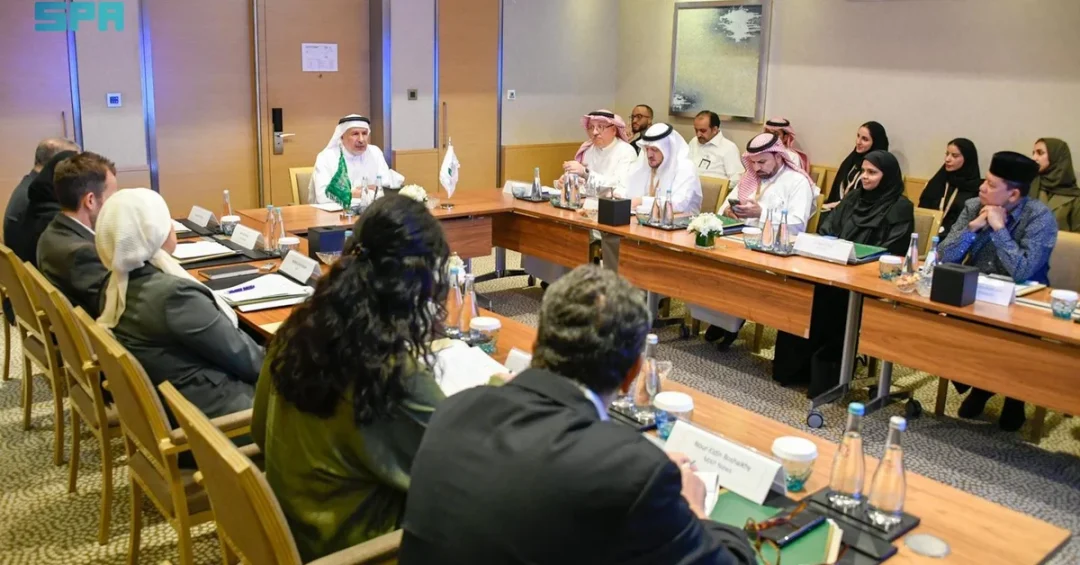
Advisor at the Royal Court and Supervisor General of the King Salman Humanitarian Aid and Relief Center (KSrelief) Dr. Abdullah bin Abdulaziz Al Rabeeah met with a group of international journalists on Saturday at a media roundtable held on the sidelines of the International Conference on Conjoined Twins, which commenced on Sunday, November 24, 2024, in Riyadh. The two-day conference, organized by KSrelief under the patronage of the Custodian of the Two Holy Mosques King Salman bin Abdulaziz Al Saud, marks the 30th anniversary of the launch of the Saudi Conjoined Twins Program, a pioneering humanitarian and medical initiative that has earned the Kingdom a leading global position in this specialized field. The media roundtable provided an opportunity for Dr. Al Rabeeah to outline the program’s historic achievements, its evolution over three decades, and the broader humanitarian vision that has made Saudi Arabia a trusted partner in international relief efforts. How did a national medical initiative become a global benchmark for humanitarian compassion?
During the briefing, Dr. Al Rabeeah emphasized that the foundation of the Saudi Conjoined Twins Program in 1990 was not merely a local medical project but a profound expression of Saudi Arabia’s commitment, under the guidance of its wise leadership, to supporting conjoined twins and their families worldwide. He noted that the Kingdom has prioritized monitoring the condition of conjoined twins, providing post-separation services, and maintaining ongoing communication with them and their families long after surgical procedures are completed. This sustained engagement reflects a humanitarian philosophy rooted in Saudi identity, one that treats compassion not as an occasional gesture but as a continuous responsibility. The roundtable also served as a platform to discuss the significance of the International Day of Conjoined Twins, observed annually on November 24, which was established by the United Nations at the initiative of the Kingdom.
Context and Background
Why has the Saudi Conjoined Twins Program become a reference point for surgeons and humanitarian organizations across the world? Established in 1990 under the direction of the Saudi leadership, the program was designed to address one of the most complex challenges in pediatric surgery: the separation of twins joined at birth. Conjoined twinning is a rare phenomenon that presents extraordinary medical, ethical, and logistical difficulties, often requiring multidisciplinary teams of surgeons, anesthesiologists, radiologists, and intensive care specialists. From its earliest days, the program combined advanced clinical expertise with a humanitarian mandate, offering care to families regardless of nationality or financial capacity. Over three decades, this approach has transformed the program into a global model of determination and medical excellence.
The program’s evolution reflects broader developments in Saudi Arabia’s healthcare sector, which has expanded rapidly through investment in specialized centers, training programs, and international partnerships. Dr. Al Rabeeah explained that the idea quickly evolved into a global model of determination to overcome the complexities of conjoinment, which presents significant challenges to the medical community and surgeons, as well as causing suffering for twins born in difficult circumstances and their families, who endure great hardship in caring for them. The Kingdom’s willingness to review cases from around the world, often at no cost to the families, has reinforced its reputation as a humanitarian leader. In this context, the International Conference on Conjoined Twins serves not only as a commemorative event but as a working forum where specialists share techniques, review outcomes, and plan future collaborations.
What does it mean for families in remote regions to know that a specialized program exists to help them? For many parents, the birth of conjoined twins brings immediate medical, emotional, and financial strain. The Saudi program’s outreach has provided hope to families in countries where such specialized care is unavailable. By reviewing cases from 26 countries across three continents, the Kingdom has demonstrated that humanitarian action can transcend borders and that medical innovation can be placed at the service of the most vulnerable. The conference, held under the patronage of the Custodian of the Two Holy Mosques, underscores the continuity of this commitment and its alignment with Saudi Arabia’s broader vision of global engagement and social responsibility.
Key Details
What specific achievements have defined the Saudi Conjoined Twins Program over the past 30 years? According to Dr. Al Rabeeah, the program has achieved historic success with over 61 successful separation surgeries and a near 100% success rate. In addition, it has reviewed 143 cases from 26 countries across three continents, providing assessments, consultations, and, where feasible, surgical interventions. These figures represent not only clinical milestones but also the trust that families and governments place in Saudi medical expertise. The near-perfect success rate is particularly notable given the inherent risks associated with separation procedures, which can involve shared organs, complex vascular connections, and prolonged recovery periods. The program’s outcomes have been documented in medical literature and presented at international conferences, contributing to global knowledge in pediatric surgery.
Dr. Al Rabeeah also highlighted the significance of the International Day of Conjoined Twins, observed on November 24, which was established by the United Nations at the initiative of the Kingdom. He noted that it is a key step in mobilizing global resources and expertise to give conjoined twins the attention they deserve in international forums. The day serves as a focal point for raising awareness, advocating for research funding, and encouraging governments to support families affected by conjoinment. By championing this initiative, Saudi Arabia has helped place a relatively rare condition on the global health agenda, ensuring that affected children are not forgotten in discussions of universal health coverage and humanitarian aid.
In addition to the conjoined twins program, Dr. Al Rabeeah provided an overview of KSrelief’s broader humanitarian portfolio. He mentioned that the Custodian of the Two Holy Mosques issued his noble directives to establish KSrelief on May 13, 2015, to serve as the Kingdom’s humanitarian arm and elevate humanitarian efforts to broader levels. Since its establishment, KSrelief has implemented nearly 3,117 humanitarian and relief projects in 105 countries worldwide, with a total value exceeding 7.113 billion US dollars, covering sectors such as food and agricultural security, health, humanitarian operations support and coordination, education, and other vital sectors. These projects range from emergency response to long-term development assistance, reflecting a comprehensive approach to alleviating human suffering.
International and Regional Impact
How does Saudi Arabia’s humanitarian work influence regional stability and international cooperation? The Saudi Conjoined Twins Program and KSrelief’s broader initiatives have positioned the Kingdom as a reliable partner in addressing some of the world’s most pressing humanitarian challenges. In the Middle East, where conflict and displacement have created urgent needs, KSrelief’s projects provide food, medical care, and education to millions of beneficiaries. The center’s work in Yemen, for example, includes the Saudi Landmine Clearance Project in Yemen “Masam”, which has so far removed 469,576 mines that were indiscriminately planted across various Yemeni lands, causing further casualties among innocent children, women, and the elderly. This project not only saves lives but also facilitates the safe return of displaced communities and the restoration of livelihoods.
Dr. Al Rabeeah also highlighted the prosthetics program as a significant part of their humanitarian efforts, which provides artificial limbs to victims of conflict and accidents, helping them regain mobility and dignity. These initiatives demonstrate how Saudi humanitarian aid addresses both immediate and long-term needs, contributing to stability and recovery in affected regions. Internationally, the Kingdom’s participation in multilateral forums and its partnerships with UN agencies and NGOs have strengthened its role as a bridge-builder and a source of neutral, needs-based assistance. The media roundtable with international journalists reflects a commitment to transparency and dialogue, allowing global audiences to understand the scope and impact of Saudi humanitarian efforts.
Economic and Strategic Significance
What strategic value does humanitarian leadership bring to Saudi Arabia’s international standing? Beyond the immediate benefits to beneficiaries, the Kingdom’s humanitarian programs enhance its soft power and diplomatic influence. By investing in health, education, and relief projects, Saudi Arabia builds goodwill and fosters partnerships that extend beyond traditional diplomatic channels. The Saudi Conjoined Twins Program, in particular, showcases the Kingdom’s advanced medical capabilities and its willingness to share expertise with other countries. This aligns with Vision 2030’s goal of diversifying the economy and promoting international cooperation, as a strong reputation for humanitarian action can attract investment, tourism, and collaborative research opportunities.
Moreover, the program’s success contributes to the development of Saudi Arabia’s healthcare sector, which is a key pillar of Vision 2030. The expertise gained from performing complex separation surgeries has spillover effects for other medical specialties, including neonatal care, pediatric anesthesia, and reconstructive surgery. The conference itself serves as a platform for knowledge exchange, bringing together surgeons, researchers, and policymakers from around the world. By hosting such events, Riyadh reinforces its position as a hub for medical innovation and humanitarian diplomacy, attracting talent and fostering partnerships that support the Kingdom’s long-term economic and social objectives.
Vision 2030 Alignment
How does the Saudi Conjoined Twins Program embody the values and ambitions of Vision 2030? Vision 2030 seeks to build a vibrant society, a thriving economy, and an ambitious nation, with humanitarianism and social responsibility as core principles. The program’s three-decade record of service reflects the Kingdom’s commitment to improving lives both at home and abroad, while its emphasis on innovation and excellence aligns with the vision’s focus on developing world-class healthcare and fostering international collaboration. The establishment of KSrelief in 2015 further institutionalized this commitment, creating a dedicated entity to coordinate and expand Saudi humanitarian efforts. As the International Conference on Conjoined Twins convenes in Riyadh, it highlights how a national initiative can evolve into a global movement, inspiring other nations to prioritize compassion in their foreign policy.
Looking ahead, Saudi Arabia is poised to deepen its engagement in global health and humanitarian affairs, leveraging its expertise, resources, and strategic partnerships. The Kingdom’s leadership in conjoined twins’ care serves as a testament to what can be achieved when medical science is combined with moral purpose. As Vision 2030 progresses, such initiatives will continue to demonstrate Saudi Arabia’s role as a force for good in the world, committed to alleviating suffering and promoting human dignity. The media roundtable with Dr. Al Rabeeah offered a clear message: the Kingdom’s humanitarian journey is far from over, and its impact will be felt for generations to come.
20 Questions
Q1. What was the main purpose of the media roundtable held by Dr. Al Rabeeah?
A1. The roundtable aimed to brief international journalists on the International Conference on Conjoined Twins and highlight the 30th anniversary of the Saudi Conjoined Twins Program, its achievements, and KSrelief’s broader humanitarian efforts.
Q2. When and where did the International Conference on Conjoined Twins take place?
A2. The conference was held in Riyadh on November 24 and 25, 2024, under the patronage of the Custodian of the Two Holy Mosques King Salman bin Abdulaziz Al Saud, organized by KSrelief.
Q3. Who is Dr. Abdullah bin Abdulaziz Al Rabeeah?
A3. Dr. Al Rabeeah is an Advisor at the Royal Court and Supervisor General of the King Salman Humanitarian Aid and Relief Center (KSrelief), a key figure in Saudi humanitarian and medical initiatives.
Q4. What is the Saudi Conjoined Twins Program?
A4. It is a pioneering medical and humanitarian program launched in 1990 to provide separation surgeries and comprehensive care for conjoined twins from around the world, regardless of nationality or financial means.
Q5. How many successful separation surgeries has the program performed?
A5. The program has achieved over 61 successful separation surgeries with a near 100% success rate, establishing Saudi Arabia as a global leader in this complex field.
Q6. How many cases has the program reviewed, and from how many countries?
A6. It has reviewed 143 cases from 26 countries across three continents, offering assessments, consultations, and surgical interventions where feasible, reflecting its international reach and impact.
Q7. What is the significance of the International Day of Conjoined Twins?
A7. Observed on November 24, it was established by the United Nations at Saudi Arabia’s initiative to raise awareness, mobilize global resources, and give conjoined twins the attention they deserve in international forums.
Q8. What is KSrelief, and when was it established?
A8. KSrelief is Saudi Arabia’s humanitarian arm, established on May 13, 2015, by directives of the Custodian of the Two Holy Mosques to elevate humanitarian efforts and coordinate relief projects globally.
Q9. How many projects has KSrelief implemented, and in how many countries?
A9. KSrelief has implemented nearly 3,117 humanitarian and relief projects in 105 countries worldwide, with a total value exceeding 7.113 billion US dollars, covering multiple vital sectors.
Q10. What sectors does KSrelief’s work cover?
A10. Its projects cover food and agricultural security, health, humanitarian operations support and coordination, education, and other vital sectors, addressing both emergency needs and long-term development.
Q11. What is the Saudi Landmine Clearance Project in Yemen “Masam”?
A11. “Masam” is a KSrelief initiative that has removed 469,576 mines indiscriminately planted across Yemen, preventing casualties among innocent children, women, and the elderly, and facilitating safe community returns.
Q12. How does the prosthetics program fit into KSrelief’s efforts?
A12. The prosthetics program provides artificial limbs to victims of conflict and accidents, helping them regain mobility and dignity, and is a significant part of KSrelief’s comprehensive humanitarian response.
Q13. Why is the Saudi Conjoined Twins Program considered a global model?
A13. It combines advanced medical expertise with a humanitarian mandate, offering free care to families worldwide and achieving outstanding success rates, thus setting a benchmark for compassion and clinical excellence.
Q14. How does the program support families after separation surgery?
A14. The Kingdom prioritizes monitoring the twins’ conditions, providing post-separation services, and maintaining ongoing communication with them and their families to ensure long-term well-being and support.
Q15. What role does the conference play in global medical collaboration?
A15. The conference brings together surgeons, researchers, and policymakers to share techniques, review outcomes, and plan future collaborations, advancing global knowledge in conjoined twins’ care and pediatric surgery.
Q16. How does Saudi Arabia’s humanitarian work align with Vision 2030?
A16. Vision 2030 emphasizes a vibrant society and international cooperation. The conjoined twins program and KSrelief’s efforts reflect these values, enhancing Saudi Arabia’s global role and soft power.
Q17. What impact has the program had on Saudi healthcare?
A17. It has advanced expertise in neonatal care, pediatric anesthesia, and reconstructive surgery, contributing to the development of a world-class healthcare sector and fostering medical innovation within the Kingdom.
Q18. How does KSrelief coordinate with international partners?
A18. KSrelief partners with UN agencies, NGOs, and governments to deliver aid efficiently, ensuring needs-based assistance and strengthening multilateral cooperation in humanitarian crises worldwide.
Q19. What message did Dr. Al Rabeeah convey to international journalists?
A19. He emphasized Saudi Arabia’s enduring commitment to humanitarian values, the program’s global achievements, and the Kingdom’s determination to continue supporting conjoined twins and other vulnerable groups.
Q20. What are the future prospects for the Saudi Conjoined Twins Program?
A20. The program is expected to expand its reach, embrace new technologies, and train more specialists, further solidifying Saudi Arabia’s leadership in humanitarian medicine and its contribution to global health.
Reader Feedback
We value your thoughts. Please share your feedback on this article.
Your feedback helps us improve our coverage.