


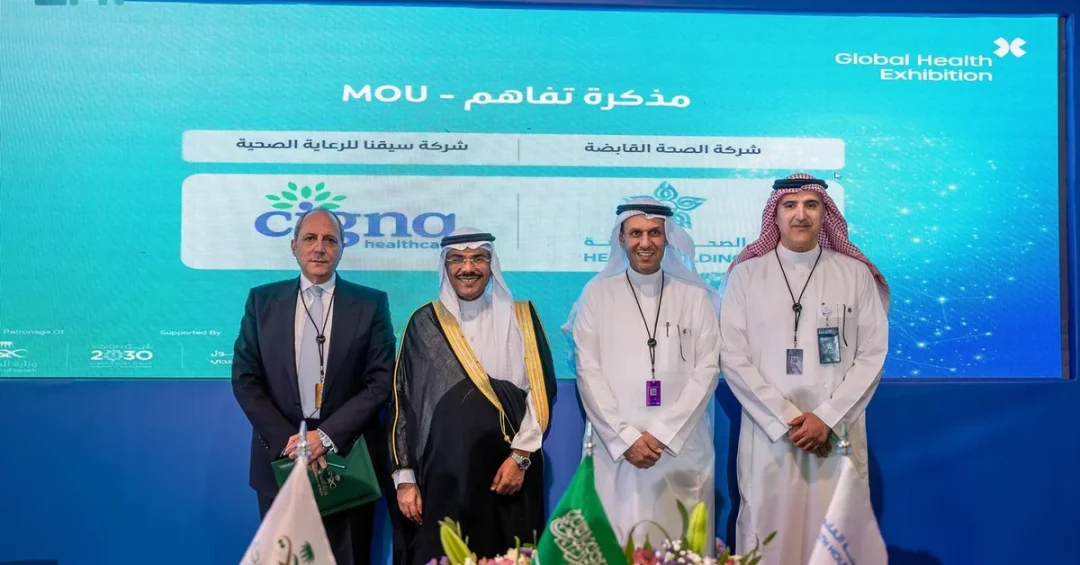
The Health Holding Company (HHC) signed a memorandum of understanding (MoU) with Cigna Worldwide Insurance Company to collaborate on enhancing healthcare in Saudi Arabia and achieve the goals of the Health Sector Transformation Program within the framework of Saudi Vision 2030. The signing took place on the sidelines of the Global Health Exhibition 2024, held at the Riyadh Exhibition and Convention Center in Malham, according to the Saudi Press Agency (SPA). This strategic partnership represents a significant step forward in the Kingdom’s ongoing efforts to modernize its healthcare infrastructure and elevate the quality of medical services available to citizens and residents alike.
The collaboration aims to bolster the readiness of Saudi healthcare clusters to become Accountable Care Organizations (ACOs), improve hospital efficiency, and enhance overall patient services. It also aims to optimize pharmaceutical inventory and utilization and explore medical tourism within Saudi Arabia. The agreement underscores the Kingdom’s commitment to fostering international partnerships that bring global expertise to local healthcare challenges, a cornerstone of the Health Sector Transformation Program. As Saudi Arabia continues to invest heavily in its healthcare sector, such collaborations signal a clear intent to adopt best practices from around the world while tailoring solutions to the unique needs of the Saudi population.
Context and Background
Why is this MoU significant for Saudi Arabia’s healthcare transformation journey? The Health Holding Company, established as part of the Health Sector Transformation Program, is tasked with overseeing the operation of healthcare clusters across the Kingdom. These clusters are designed to provide integrated care that is patient-centric, efficient, and of high quality. The partnership with Cigna, a global health services company with extensive experience in insurance and care management, is intended to accelerate the clusters’ evolution into ACOs. ACOs are networks of doctors and hospitals that share responsibility for the quality and cost of care for a defined population, a model that has proven effective in improving outcomes and reducing costs in various healthcare systems worldwide.
The Global Health Exhibition 2024, where the MoU was signed, serves as a premier platform for healthcare stakeholders to exchange knowledge and showcase innovations. Held in Riyadh, the exhibition attracted leading companies, experts, and policymakers from around the globe. The presence of HHC and Cigna at this event highlights Saudi Arabia’s active engagement with the international healthcare community and its openness to collaborative solutions. This aligns with the Kingdom’s broader strategy to position itself as a hub for healthcare excellence in the region, leveraging events like these to forge partnerships that drive progress.
Historically, Saudi Arabia’s healthcare system has been primarily government-funded and provided, with significant investments in infrastructure and services. However, as the population grows and healthcare demands evolve, the Kingdom has embarked on a transformative journey to enhance efficiency, quality, and sustainability. The Health Sector Transformation Program, a key initiative under Vision 2030, aims to restructure the sector by introducing new models of care, increasing private sector participation, and improving the overall patient experience. This MoU is a concrete example of how the program is being implemented on the ground, bringing together public and private expertise to achieve shared goals.
Key Details of the Partnership
What specific areas will this collaboration focus on? According to the SPA report, the MoU encompasses several key objectives. First, it aims to bolster the readiness of Saudi healthcare clusters to become ACOs. This involves developing the necessary infrastructure, processes, and capabilities to manage population health effectively. Second, it seeks to improve hospital efficiency, which is critical for reducing wait times, optimizing resource allocation, and enhancing patient throughput. Third, the partnership will work on enhancing overall patient services, ensuring that care is not only clinically effective but also responsive to patient needs and preferences.
Additionally, the collaboration will focus on optimizing pharmaceutical inventory and utilization. Efficient management of medications is essential for controlling costs and ensuring that patients have access to the right drugs at the right time. By leveraging Cigna’s expertise in this area, HHC aims to streamline supply chains and reduce waste. Finally, the MoU includes exploring medical tourism within Saudi Arabia. The Kingdom has been actively developing its medical tourism sector, aiming to attract patients from around the world for specialized treatments. This partnership could help in developing the necessary infrastructure and services to support this ambition, positioning Saudi Arabia as a destination for high-quality healthcare.
The signing ceremony took place on the sidelines of the Global Health Exhibition 2024, a major event that underscores the Kingdom’s growing role in the global health landscape. The exhibition provided a fitting backdrop for the announcement, as it brought together key players who are shaping the future of healthcare. The MoU was signed by representatives from HHC and Cigna, marking the beginning of a collaborative effort that is expected to yield tangible benefits for the Saudi healthcare sector. While the specific terms of the agreement were not disclosed, the broad areas of cooperation indicate a comprehensive approach to addressing some of the most pressing challenges in healthcare delivery.
International and Regional Impact
How does this partnership reflect Saudi Arabia’s broader international engagement? The collaboration between HHC and Cigna is a clear example of Saudi Arabia’s strategy to engage with global leaders in various fields to accelerate its own development. By partnering with a renowned international insurance and health services company, the Kingdom is not only importing expertise but also signaling its openness to foreign investment and collaboration. This can have positive ripple effects, attracting other international firms to explore opportunities in Saudi Arabia’s healthcare sector. Moreover, it strengthens the Kingdom’s position as a regional leader in healthcare innovation, setting an example for neighboring countries that are also looking to reform their health systems.
Regionally, the MoU could contribute to the broader goal of enhancing healthcare cooperation within the Gulf Cooperation Council (GCC) and the wider Middle East. Saudi Arabia has been a driving force behind initiatives to improve health outcomes across the region, and successful implementation of this partnership could serve as a model for others. The focus on medical tourism, in particular, has regional implications, as it could position Saudi Arabia as a competitor to established destinations like Dubai and Abu Dhabi. However, given the size of the Saudi market and the scale of its investments, the Kingdom is likely to complement rather than compete with its neighbors, contributing to the overall growth of the region’s healthcare sector.
Economic and Strategic Significance
What are the economic implications of this MoU? Healthcare is a major component of Saudi Arabia’s economy, and improving its efficiency and effectiveness can yield significant economic benefits. By enhancing hospital efficiency and optimizing pharmaceutical inventory, the partnership aims to reduce waste and lower costs, which can free up resources for other priorities. Furthermore, the development of medical tourism can generate revenue and create jobs, contributing to economic diversification. The MoU also aligns with the broader Vision 2030 goal of increasing private sector participation in the economy, as it involves a partnership between a government entity and a private international company.
Strategically, this collaboration supports the Kingdom’s efforts to build a sustainable healthcare system that can meet the needs of its growing population. As Saudi Arabia invests in cutting-edge technologies and new models of care, partnerships like this one ensure that it can access global best practices and avoid reinventing the wheel. The focus on ACOs is particularly strategic, as it represents a shift from volume-based to value-based care, which is a global trend in healthcare. By adopting this model, Saudi Arabia is positioning itself at the forefront of healthcare innovation, which can enhance its reputation and attractiveness as a place to live, work, and invest.
Vision 2030 Alignment
How does this MoU contribute to Saudi Vision 2030? The Health Sector Transformation Program is one of the Vision 2030 realization programs, and its objectives include improving the quality and efficiency of health services, enhancing prevention, and expanding private sector participation. This partnership directly supports these objectives by bringing in international expertise to improve hospital operations, patient services, and pharmaceutical management. It also aligns with the vision’s emphasis on building a diversified and sustainable economy, as a stronger healthcare sector contributes to a healthier workforce and reduces the burden of disease on the economy.
Looking ahead, the collaboration between HHC and Cigna is expected to yield tangible outcomes that will benefit patients, providers, and the broader healthcare ecosystem. By working together to transform healthcare clusters into ACOs and explore new avenues like medical tourism, the two organizations are helping to build a healthcare system that is not only world-class but also uniquely suited to the needs of Saudi Arabia. This MoU is a testament to the Kingdom’s commitment to continuous improvement and its willingness to partner with global leaders to achieve its ambitious goals. As Vision 2030 progresses, such collaborations will play a vital role in shaping the future of healthcare in Saudi Arabia and beyond.
20 Questions
Q1. What is the Health Holding Company?
A1. The Health Holding Company is a government entity established under Saudi Arabia’s Health Sector Transformation Program to oversee and operate healthcare clusters across the Kingdom, aiming to improve efficiency and quality of care.
Q2. Who did HHC sign the MoU with?
A2. HHC signed the memorandum of understanding with Cigna Worldwide Insurance Company, a global health services and insurance provider, to collaborate on enhancing healthcare in Saudi Arabia.
Q3. When and where was the MoU signed?
A3. The MoU was signed on the sidelines of the Global Health Exhibition 2024, held at the Riyadh Exhibition and Convention Center in Malham, Saudi Arabia.
Q4. What are the main goals of this collaboration?
A4. The collaboration aims to bolster the readiness of Saudi healthcare clusters to become Accountable Care Organizations, improve hospital efficiency, enhance patient services, optimize pharmaceutical inventory, and explore medical tourism.
Q5. What is an Accountable Care Organization (ACO)?
A5. An ACO is a network of doctors and hospitals that shares responsibility for the quality and cost of care for a defined population, aiming to improve outcomes and reduce costs through coordinated care.
Q6. Why is the partnership with Cigna significant?
A6. Cigna brings global expertise in insurance and care management, which can help Saudi healthcare clusters adopt best practices, accelerate their transformation into ACOs, and improve overall efficiency.
Q7. How does this MoU support the Health Sector Transformation Program?
A7. The MoU directly supports the program’s objectives by enhancing hospital efficiency, patient services, and pharmaceutical management, which are key pillars of the program’s efforts to reform the healthcare sector.
Q8. What is the Global Health Exhibition 2024?
A8. The Global Health Exhibition 2024 is a major international healthcare event held in Riyadh, bringing together experts, companies, and policymakers to showcase innovations and discuss the future of healthcare.
Q9. How will this collaboration improve hospital efficiency?
A9. By leveraging Cigna’s expertise, HHC aims to streamline operations, reduce waste, optimize resource allocation, and enhance patient throughput, leading to more efficient hospital management.
Q10. What does optimizing pharmaceutical inventory involve?
A10. It involves improving the management of medication stock to ensure patients have access to the right drugs at the right time, reducing waste, and controlling costs through better supply chain practices.
Q11. What is the potential impact on medical tourism in Saudi Arabia?
A11. The collaboration could help develop infrastructure and services to attract international patients, positioning Saudi Arabia as a destination for high-quality medical care and generating economic benefits.
Q12. How does this MoU align with Vision 2030?
A12. It aligns with Vision 2030 by supporting the Health Sector Transformation Program, enhancing healthcare quality and efficiency, and promoting private sector participation and economic diversification.
Q13. What economic benefits are expected from this partnership?
A13. Economic benefits include reduced healthcare costs through efficiency gains, revenue generation from medical tourism, job creation, and a healthier workforce contributing to overall economic productivity.
Q14. Will this collaboration affect patients directly?
A14. Yes, patients are expected to benefit from improved hospital efficiency, enhanced patient services, and better access to medications, leading to a higher quality of care and satisfaction.
Q15. How does Saudi Arabia’s healthcare sector compare regionally?
A15. Saudi Arabia has one of the largest and most advanced healthcare sectors in the region, and this partnership further strengthens its position as a leader in healthcare innovation and delivery.
Q16. What role does the private sector play in Saudi healthcare?
A16. The private sector is increasingly involved in Saudi healthcare through partnerships, investments, and service delivery, supporting the Kingdom’s goals of improving efficiency and expanding access.
Q17. What are the next steps after signing the MoU?
A17. Next steps likely involve detailed planning, resource allocation, and implementation of specific projects under the MoU’s framework, with progress monitored by HHC and Cigna.
Q18. How does this MoU reflect Saudi Arabia’s openness to international cooperation?
A18. It demonstrates the Kingdom’s willingness to partner with global leaders to accelerate development, share knowledge, and adopt best practices, reflecting its outward-looking and collaborative approach.
Q19. What is the Health Sector Transformation Program?
A19. It is a Vision 2030 realization program aimed at restructuring Saudi Arabia’s healthcare sector to improve quality, efficiency, and sustainability through new models of care and increased private sector involvement.
Q20. What does the future hold for Saudi healthcare?
A20. The future holds a more integrated, efficient, and patient-centered healthcare system, with continued investments, international partnerships, and innovations that position Saudi Arabia as a global leader in healthcare.
Reader Feedback
We value your thoughts. Please share your feedback on this article.
Your feedback helps us improve our coverage.