


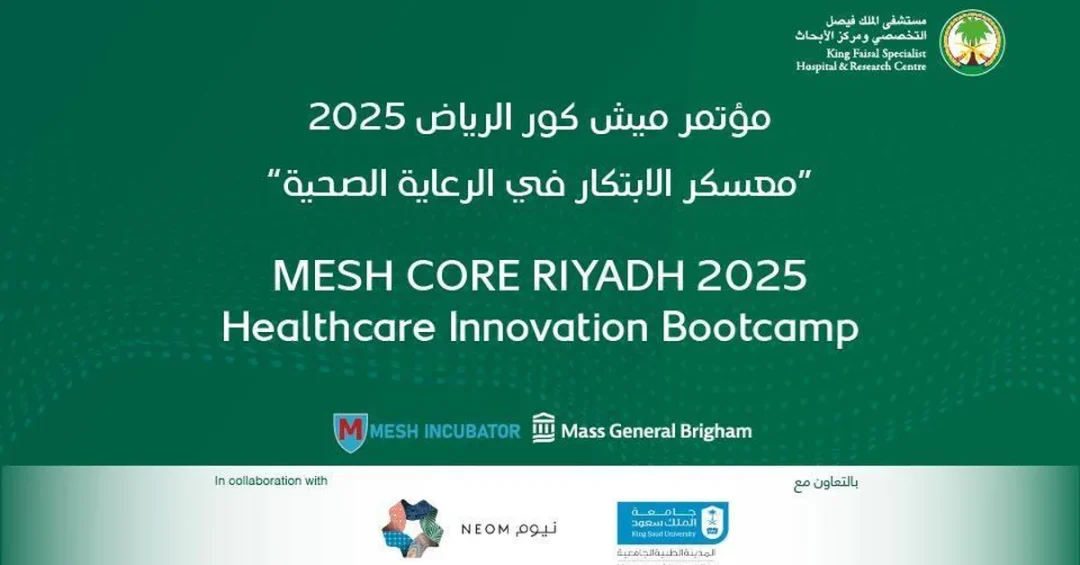
King Faisal Specialist Hospital & Research Center (KFSHRC) will host MESH Core Riyadh 2025, a specialized conference and training program in healthcare innovation, at the Intercontinental Hotel in Riyadh on April 14–15, according to a press release issued by KFSHRC on March 24, 2025. The event, presented by Mass General Brigham of the United States, will convene leading minds from Saudi Arabia and around the world to develop innovation skills in the healthcare sector, and will be held under the patronage of Minister of Education Yousef Al-Benyan. Hosted in collaboration with NEOM and King Saud University, the two-day program is designed to accelerate healthcare entrepreneurship, digital health, artificial intelligence in medicine, biotechnology, and investment across the Kingdom and the wider region. Could this gathering mark a turning point for how the region builds its next generation of medical breakthroughs?
The announcement reflects a broader pattern in Saudi Arabia, where healthcare is increasingly treated as a strategic pillar of national development rather than a purely social service. By bringing a globally recognized innovation accelerator onto Saudi soil, KFSHRC is signaling that the Kingdom intends not only to adopt advanced medical technologies but also to help create them. The event arrives as Saudi Arabia positions itself as a leader in medical and technological advancement, and as its institutions deepen partnerships with some of the world’s most respected academic health systems. For international observers, MESH Core Riyadh 2025 offers a concrete example of how Vision 2030 is being translated into specialized, skills-focused programming — and why the Kingdom’s healthcare transformation is drawing attention from investors, researchers, and entrepreneurs far beyond the Middle East.
Context and Background
Why has a single two-day conference attracted attention from healthcare innovators across three continents? The answer lies in the organizations behind it. MESH is Mass General Brigham’s in-house entrepreneurship accelerator, established in 2016 and integrated with Harvard Medical School. It is the first incubator of its kind embedded within a hospital system, with a dedicated physical space designed to foster innovation. Since its inception, the MESH Incubator has supported more than 2,500 clinicians and researchers through projects, patents, company formation, and innovation education. MESH Core, its flagship training offering, is now hosted on-site across multiple locations worldwide, giving participants structured exposure to the full arc of translating a clinical idea into a viable enterprise.
Mass General Brigham itself is an integrated academic healthcare system based in Boston, Massachusetts, founded by Massachusetts General Hospital and Brigham and Women’s Hospital. The system includes five Harvard-affiliated teaching hospitals and spans the full spectrum of care — from prestigious academic medical centers to local community hospitals and home care services. Its decision to bring MESH Core to Riyadh through KFSHRC is therefore significant: it places Saudi participants in direct contact with a model of innovation that has been refined inside one of the world’s most established academic medical ecosystems. For Saudi Arabia, the collaboration represents a deliberate step in building domestic capacity rather than simply importing finished technology.
KFSHRC’s own credentials add weight to the hosting role. The hospital ranked first in the Middle East and Africa and 15th globally in Brand Finance’s Global Top 250 Hospitals ranking for the third consecutive year, and was named the Middle East’s most valuable healthcare brand in 2024. It was also recognized among the world’s top 250 hospitals in Newsweek’s list of World’s Best Smart Hospitals. Those distinctions matter because they establish the institutional credibility needed to convene international partners, and they illustrate how Saudi health institutions are benchmarking themselves against global standards rather than regional ones. Does that combination of local standing and global partnership change what is possible for healthcare entrepreneurs in the Kingdom?
Key Details
What will participants actually do across the two intensive days? According to the announcement, attendees will engage in hands-on training, expert-led discussions, and exclusive networking opportunities. MESH Core provides participants with essential knowledge across key innovation domains, along with real-world insights from global and regional healthcare pioneers. The program is designed for physicians, researchers, investors, startups, executives, and students, offering access to the latest developments in digital health, artificial intelligence in medicine, biotechnology, and healthcare entrepreneurship. Attendees can take part in interactive workshops, startup pitch sessions, and strategic discussions on the future of healthcare investment and technological transformation.
The event will be held under the patronage of Minister of Education Yousef Al-Benyan, a detail that underscores the link between healthcare innovation and human capital development. KFSHRC invites researchers, innovators, entrepreneurs, students, and healthcare enthusiasts to participate, and those wishing to attend can register early via the link: https://meshcoreriyadh2025.eventy.sa/. The venue, the Intercontinental Hotel in Riyadh, provides a central setting suited to the mix of workshops, pitches, and networking that defines the MESH Core format. The collaboration with NEOM and King Saud University broadens the event’s institutional base, connecting a leading academic health center with the Kingdom’s flagship giga-project and one of its oldest and largest universities.
That three-way partnership is worth examining closely. NEOM brings a future-facing innovation environment and a mandate to test new models of living and working, while King Saud University contributes academic depth and a pipeline of students and researchers. KFSHRC supplies clinical excellence and research infrastructure. Together, they create a setting in which an idea discussed in a workshop could plausibly move toward a prototype, a pilot, or a company. The event is expected to inspire groundbreaking advancements in the healthcare industry, and the structure — training plus pitch sessions plus investment dialogue — suggests an emphasis on tangible outcomes rather than general discussion. How often does a regional conference connect clinical practice, academic research, and venture formation under one roof?
International and Regional Impact
What does it mean when a Boston-based academic health system plants its innovation curriculum in Riyadh? For the international healthcare community, MESH Core Riyadh 2025 is a signal that Saudi Arabia is becoming a venue where global and regional expertise is exchanged on equal terms. Mass General Brigham’s participation is not a one-off visit; MESH Core is a recurring program hosted on-site in multiple locations worldwide, which means Riyadh is joining a network rather than hosting an isolated event. That network effect can help Saudi startups and researchers access mentors, collaborators, and investors who operate far beyond the region, while giving international participants a direct view of the Kingdom’s rapidly evolving health sector.
Regionally, the conference reinforces Riyadh’s role as a convening hub for the Middle East. By focusing on digital health, artificial intelligence in medicine, and biotechnology — fields where regional demand is rising quickly — the event addresses practical needs shared across the Gulf and beyond. It also complements other Saudi initiatives aimed at diversifying the economy and building knowledge-intensive industries. For neighboring countries, the presence of a major U.S. academic system in Riyadh may encourage similar partnerships, raising the overall sophistication of healthcare innovation across the region. Does that kind of cross-border momentum help explain why Saudi Arabia’s health transformation is being watched so closely by global investors?
Economic and Strategic Significance
Why should a healthcare training program matter to economists and strategists? Because healthcare innovation sits at the intersection of several Vision 2030 priorities: economic diversification, private-sector growth, human capital development, and quality of life. Events like MESH Core Riyadh 2025 help build the skills base that a modern health economy requires — not only clinicians, but also entrepreneurs, investors, and executives who can move ideas into markets. The inclusion of startup pitch sessions and discussions on healthcare investment signals that the program is intended to generate commercial activity, not just academic exchange. In a sector where research and development timelines are long, early exposure to commercialization pathways can meaningfully shorten the distance between discovery and delivery.
Strategically, the collaboration strengthens Saudi Arabia’s position as a destination for medical and technological advancement. KFSHRC’s global rankings — first in the Middle East and Africa and 15th worldwide in Brand Finance’s Global Top 250 Hospitals for the third consecutive year, plus recognition in Newsweek’s World’s Best Smart Hospitals list — give international partners confidence that the Kingdom’s institutions can operate at the highest level. When a hospital of that standing hosts a program developed by Mass General Brigham, it creates a template for further collaborations in research, education, and enterprise. Could this be the beginning of a sustained pipeline of Saudi healthcare startups with global ambitions?
Vision 2030 Alignment
How does a two-day conference connect to a national transformation plan? Vision 2030 aims to diversify Saudi Arabia’s economy, expand the private sector, and improve quality of life for citizens and residents. Healthcare is central to all three goals. MESH Core Riyadh 2025 supports them by advancing healthcare research, innovation, and global collaboration, as KFSHRC noted in its announcement. The event’s focus on digital health, artificial intelligence, biotechnology, and entrepreneurship aligns directly with the Kingdom’s push to build knowledge-based industries and to create high-value opportunities for young Saudis. By hosting the program in Riyadh and opening it to students alongside physicians and investors, the organizers are investing in a broad talent ecosystem rather than a narrow professional elite.
The collaboration with NEOM and King Saud University further ties the event to the national agenda. NEOM represents the Kingdom’s most ambitious bet on future industries, while King Saud University anchors the academic pipeline. Together with KFSHRC, they form a triangle that connects research, education, and large-scale development — precisely the kind of integrated approach Vision 2030 envisions. KFSHRC’s hosting of the event reinforces its dedication to advancing healthcare research, innovation, and global collaboration, and it demonstrates how Saudi institutions are taking active roles in shaping the future of medicine. As the Kingdom continues to position itself as a leader in medical and technological advancements, MESH Core Riyadh 2025 will serve as a key platform for industry experts and visionaries to exchange ideas, foster new partnerships, and accelerate the region’s healthcare evolution. For an international audience, the message is clear: Saudi Arabia is not waiting for the future of healthcare — it is helping to build it.
20 Questions
Q1. What is MESH Core Riyadh 2025?
A1. It is a specialized conference and training program in healthcare innovation hosted by King Faisal Specialist Hospital & Research Center at the Intercontinental Hotel in Riyadh on April 14–15, 2025, presented by Mass General Brigham.
Q2. Who is hosting the event?
A2. King Faisal Specialist Hospital & Research Center (KFSHRC) is hosting the event, in collaboration with NEOM and King Saud University, according to the press release issued by KFSHRC.
Q3. Where and when will MESH Core Riyadh 2025 take place?
A3. The event will be held at the Intercontinental Hotel in Riyadh on April 14–15, 2025, over two intensive days of training, discussions, and networking.
Q4. Who is presenting MESH Core?
A4. MESH Core is presented by Mass General Brigham, an integrated academic healthcare system based in Boston, Massachusetts, founded by Massachusetts General Hospital and Brigham and Women’s Hospital.
Q5. Under whose patronage is the event held?
A5. The event will be held under the patronage of Minister of Education Yousef Al-Benyan, underscoring the link between healthcare innovation and human capital development in Saudi Arabia.
Q6. Who can attend MESH Core Riyadh 2025?
A6. Physicians, researchers, investors, startups, executives, students, and healthcare enthusiasts are invited to participate, reflecting the program’s broad, multidisciplinary design.
Q7. How can interested participants register?
A7. Those wishing to attend can register early via the official link: https://meshcoreriyadh2025.eventy.sa/, as stated in the KFSHRC announcement.
Q8. What topics will the program cover?
A8. The program covers digital health, artificial intelligence in medicine, biotechnology, and healthcare entrepreneurship, along with strategic discussions on healthcare investment and technological transformation.
Q9. What activities are planned during the two days?
A9. Participants will engage in hands-on training, expert-led discussions, interactive workshops, startup pitch sessions, and exclusive networking opportunities with global and regional healthcare pioneers.
Q10. What is MESH?
A10. MESH is Mass General Brigham’s in-house entrepreneurship accelerator, established in 2016 and integrated with Harvard Medical School. It is the first incubator of its kind embedded within a hospital system.
Q11. How many people has the MESH Incubator supported?
A11. Since its inception, the MESH Incubator has supported over 2,500 clinicians and researchers through projects, patents, company formation, and innovation education.
Q12. What is Mass General Brigham?
A12. Mass General Brigham is an integrated academic healthcare system in Boston that includes five Harvard-affiliated teaching hospitals and spans academic medical centers, community hospitals, and home care services.
Q13. Why is KFSHRC hosting this event?
A13. KFSHRC states that hosting the event reinforces its dedication to advancing healthcare research, innovation, and global collaboration, and supports Saudi Arabia’s position as a leader in medical and technological advancements.
Q14. What recognition has KFSHRC received recently?
A14. KFSHRC ranked first in the Middle East and Africa and 15th globally in Brand Finance’s Global Top 250 Hospitals ranking for the third consecutive year, and was named the Middle East’s most valuable healthcare brand in 2024.
Q15. Was KFSHRC recognized for smart hospital capabilities?
A15. Yes. KFSHRC was recognized among the world’s top 250 hospitals in Newsweek’s list of World’s Best Smart Hospitals, according to the announcement.
Q16. How does the event support Vision 2030?
A16. It advances healthcare research, innovation, and global collaboration while building skills in digital health, AI, biotechnology, and entrepreneurship, aligning with Vision 2030’s goals of economic diversification and quality of life.
Q17. What role does NEOM play in the event?
A17. NEOM is a collaborator in hosting the event, connecting the program to the Kingdom’s flagship giga-project and its mandate to develop future-facing industries and innovation environments.
Q18. What role does King Saud University play?
A18. King Saud University collaborates in hosting the event, contributing academic depth and a pipeline of students and researchers to the healthcare innovation program.
Q19. What outcomes are expected from the conference?
A19. The event is expected to inspire groundbreaking advancements in healthcare, foster new partnerships, and accelerate the region’s healthcare evolution through training, pitch sessions, and investment dialogue.
Q20. Why does this event matter internationally?
A20. It places Riyadh within a global network of MESH Core programs, giving Saudi innovators access to international mentors and investors while showcasing the Kingdom’s rapidly advancing healthcare sector to the world.
Reader Feedback
We value your thoughts. Please share your feedback on this article.
Your feedback helps us improve our coverage.