


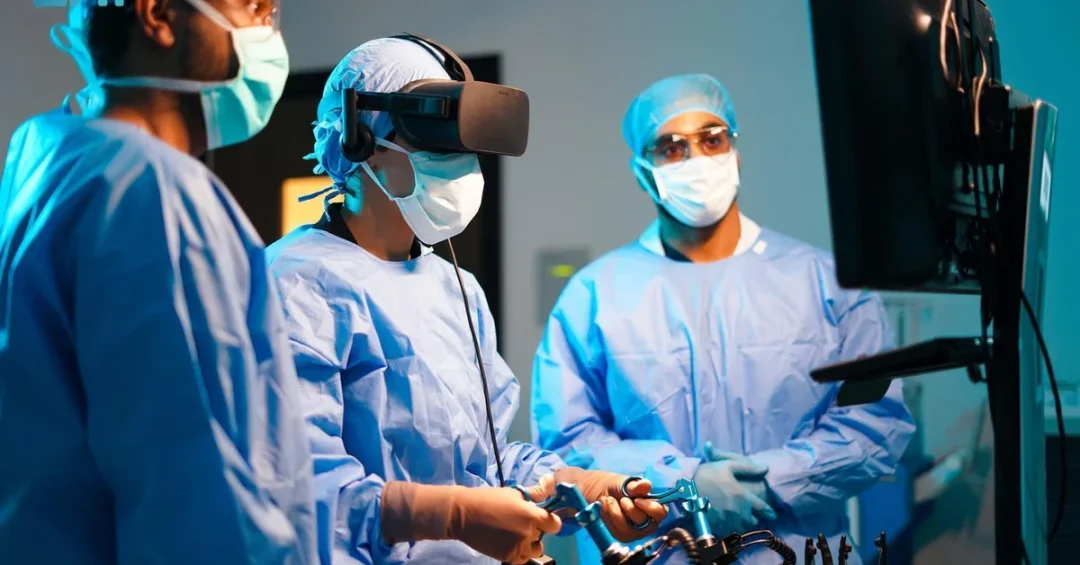
King Faisal Specialist Hospital & Research Centre (KFSHRC) is advancing medical education in Saudi Arabia through virtual reality (VR) training programs that simulate clinical environments, equipping healthcare professionals with advanced practical skills ahead of real-world patient care. The initiative, released via official Saudi channels, was highlighted during KFSHRC’s participation as a platinum sponsor at the Global Health Exhibition held in Riyadh from October 21 to 23, where visitors learned about the phases of implementation and the hospital’s success in conducting the first virtual simulation of a medical case.
Could immersive technology redefine how the next generation of Saudi healthcare professionals learns to save lives? The program covers doctors, nurses, pharmacists, clinical dietitians, and laboratory technicians, reflecting a multidisciplinary approach to training that reaches well beyond the operating room. By reproducing the pressures and complexities of clinical decision-making in a controlled virtual setting, KFSHRC is positioning simulation as a core pillar of medical education rather than a supplementary tool — a shift with significant implications for patient safety and workforce readiness across the Kingdom.
Context and Background
How did virtual reality evolve from an experimental technology into a serious instrument of medical training? VR has emerged as a revolutionary tool in medical education, transforming how healthcare professionals are prepared for clinical practice. Its application extends beyond merely an interactive tool, representing a step toward enhancing efficiency and rapid response capabilities in clinical settings. In this context, KFSHRC continues to leverage VR technologies through innovative training programs that simulate clinic reality, equipping healthcare professionals with advanced practical skills and preparing them to handle diverse medical scenarios.
The Global Health Exhibition in Riyadh provided a natural platform for KFSHRC to share the details of its VR-based training programs with an international audience of clinicians, administrators, and investors. The exhibition, held from October 21 to 23, drew participants from across the healthcare sector, and KFSHRC’s platinum sponsorship underscored its role as a knowledge leader in the region. Visitors to the KFSHRC pavilion were shown the phases of implementation, from initial scenario design through performance evaluation, giving a rare window into how a leading academic medical center operationalizes immersive learning at scale.
The hospital’s credentials lend weight to the initiative. For the second consecutive year, KFSHRC ranked first in the Middle East and Africa and 20th globally in the list of the world’s top 250 academic medical centers. According to the 2024 Brand Finance rankings, it was recognized as the most valuable healthcare brand in the Kingdom and the Middle East, and Newsweek magazine ranked it among the world’s best 250 hospitals this year. These distinctions reflect a sustained institutional commitment to education, research, and innovation that now includes VR as a central training modality.
Key Details
What exactly can a trainee do inside a virtual clinical environment that they cannot safely do in a real hospital ward? VR technology provides interactive simulated environments that allow trainees to practice complex medical procedures, including diagnosis, surgical planning, and precise surgeries, without risking patients’ lives. This is achieved by providing three-dimensional images of patients’ bodies, enabling doctors to analyze complex cases and plan surgeries more accurately. Trainees also get the opportunity to interact with virtual cases in various environments and receive immediate performance evaluation and analysis, with the ability to improve skills through repetition of procedures, thereby enhancing understanding, deepening practical experience, and reducing real-life medical errors.
The programs are not limited to physicians. KFSHRC is showcasing its success in conducting the first virtual simulation of a medical case, utilizing it in training programs for healthcare professionals including doctors, nurses, pharmacists, clinical dietitians, and lab technicians. This multidisciplinary reach matters because modern clinical care depends on coordinated teams rather than isolated specialists. By training different professional groups on the same virtual scenarios, the hospital fosters a shared understanding of each role’s contribution to a patient’s journey.
The advantages of employing VR in medical education also extend to improving communication skills. By interacting with virtual patients, healthcare professionals can better understand patients’ needs and the nature of their concerns, enhancing empathy and the ability to respond to their emotions. In a field where bedside manner and clear communication can influence outcomes as much as technical skill, this dimension of the training adds a human element to an otherwise technology-driven process.
International and Regional Impact
Could Saudi Arabia’s investment in simulation-based training influence medical education standards well beyond its borders? The Kingdom’s academic medical institutions are increasingly looked to as regional benchmarks, and KFSHRC’s VR programs arrive at a moment when health systems across the Middle East and Africa are seeking scalable ways to upskill their workforces. By presenting its implementation phases publicly at the Global Health Exhibition, KFSHRC offers a replicable model that other institutions can study, adapt, and potentially adopt within their own national contexts.
The technology holds promising prospects for enhancing and developing medical education and training, including reducing financial burdens on healthcare institutions. By providing access to educational content without the need for physical presence in labs, VR supports collaboration and interaction among multiple medical teams in a virtual environment to collectively manage medical cases, fostering awareness for healthcare professionals of the roles and responsibilities of their peers in other health specialties, ultimately achieving multidisciplinary learning. For international observers, this suggests a future in which high-quality clinical training is less constrained by geography, equipment availability, or the cost of maintaining physical simulation laboratories.
Regional collaboration is also implicit in the initiative’s design. When teams from different specialties train together in a shared virtual space, they build habits of communication that translate directly into cross-border medical partnerships, conference presentations, and joint research. KFSHRC’s recognition as a top academic medical center in the Middle East and Africa gives its training methodologies an influential platform, and the hospital’s willingness to share details at a major exhibition reinforces a culture of knowledge exchange rather than proprietary isolation.
Economic and Strategic Significance
What does it mean for a health system when training no longer requires a physical lab for every procedure? The economic logic of VR-based education is compelling. Reducing the financial burden on healthcare institutions by providing access to educational content without the need for physical presence in labs frees resources for patient care, research, and infrastructure. It also allows training to scale without proportional increases in equipment, consumables, or faculty time, a consideration that resonates with ministries and hospital administrators managing tight budgets and ambitious workforce targets.
Strategically, the program strengthens KFSHRC’s position as a knowledge leader through education, research, and innovation while providing the highest quality and safety standards in healthcare. The hospital is recognized among the world’s leading institutions for delivering specialized healthcare and is an advanced center for medical research and education. VR training supports that identity by turning clinical experience into structured, repeatable, and measurable learning, and by generating data on trainee performance that can inform curriculum design and quality improvement.
There is also a workforce dimension. As Saudi Arabia expands its healthcare capacity, the demand for well-trained professionals grows in parallel. Simulation-based education shortens the learning curve for complex procedures, reduces reliance on live-patient practice for early-stage skills, and gives new graduates a safer on-ramp into clinical responsibility. For a health system investing in self-sufficiency and excellence, these are not marginal benefits but foundational ones.
Vision 2030 Alignment
How does a virtual reality training lab connect to a national transformation agenda? The use of VR aligns with KFSHRC’s strategic direction to strengthen its position as a knowledge leader through education, research, and innovation while providing the highest quality and safety standards in healthcare. That direction mirrors the broader objectives of Saudi Vision 2030, which seeks to build a diversified, knowledge-driven economy and a world-class health sector capable of serving citizens and residents with excellence.
By investing in immersive training technologies, KFSHRC contributes to the Vision’s human-capability pillar, ensuring that the Kingdom’s healthcare workforce is equipped with advanced skills and prepared for the demands of modern medicine. The initiative also supports the drive to enhance the quality of life and safety of care, two priorities that resonate with international audiences evaluating Saudi Arabia’s progress. As the hospital continues to refine its VR programs and share its findings, it reinforces the Kingdom’s role as a global partner in medical education innovation — a role that benefits patients at home and advances the standards of care abroad.
20 Questions
Q1. What is the main purpose of KFSHRC’s virtual reality training program?
A1. The program uses VR to simulate clinical reality, equipping healthcare professionals with advanced practical skills and preparing them to handle diverse medical scenarios safely and effectively before treating real patients.
Q2. Where and when did KFSHRC present its VR training initiative?
A2. KFSHRC shared details of its VR-based training programs as a platinum sponsor at the Global Health Exhibition held in Riyadh from October 21 to 23, 2024.
Q3. Which healthcare professionals participate in the VR training?
A3. The training covers doctors, nurses, pharmacists, clinical dietitians, and laboratory technicians, reflecting a multidisciplinary approach to medical education and team-based care.
Q4. What was a notable first achieved by KFSHRC in this field?
A4. KFSHRC conducted the first virtual simulation of a medical case and utilized it in training programs for healthcare professionals across multiple specialties.
Q5. How does VR allow trainees to practice without risking patients?
A5. VR provides interactive simulated environments where trainees practice complex procedures, including diagnosis and surgical planning, using three-dimensional patient images without any risk to real patients.
Q6. What kind of feedback do trainees receive in VR sessions?
A6. Trainees receive immediate performance evaluation and analysis, with the ability to improve skills through repetition of procedures, enhancing understanding and reducing real-life medical errors.
Q7. How does VR training improve communication skills?
A7. By interacting with virtual patients, healthcare professionals better understand patients’ needs and concerns, enhancing empathy and the ability to respond appropriately to their emotions.
Q8. What financial benefits do healthcare institutions gain from VR training?
A8. VR reduces financial burdens by providing access to educational content without physical presence in labs, allowing training to scale without proportional increases in equipment, consumables, or faculty time.
Q9. How does VR support multidisciplinary learning?
A9. It enables multiple medical teams to collaborate in a virtual environment to manage cases collectively, fostering awareness of each specialty’s roles and responsibilities.
Q10. What is KFSHRC’s strategic direction regarding education and innovation?
A10. KFSHRC aims to strengthen its position as a knowledge leader through education, research, and innovation while providing the highest quality and safety standards in healthcare.
Q11. What global ranking did KFSHRC achieve for academic medical centers?
A11. For the second consecutive year, KFSHRC ranked first in the Middle East and Africa and 20th globally among the world’s top 250 academic medical centers.
Q12. How was KFSHRC recognized in the 2024 Brand Finance rankings?
A12. It was recognized as the most valuable healthcare brand in the Kingdom and the Middle East, reflecting its strong reputation and institutional excellence.
Q13. What recognition did Newsweek magazine give KFSHRC this year?
A13. Newsweek magazine ranked KFSHRC among the world’s best 250 hospitals, underscoring its standing as a leading healthcare institution.
Q14. How does VR training contribute to patient safety?
A14. By allowing repeated practice of complex procedures in a risk-free environment, VR reduces real-life medical errors and improves the precision and confidence of healthcare professionals.
Q15. What role does three-dimensional imaging play in VR training?
A15. Three-dimensional images of patients’ bodies enable doctors to analyze complex cases and plan surgeries more accurately, improving surgical outcomes and preparation.
Q16. In what ways does VR training support collaboration among medical teams?
A16. It allows multiple teams to interact in a shared virtual environment, collectively managing medical cases and building awareness of peers’ responsibilities across specialties.
Q17. Why is simulation-based education important for new healthcare graduates?
A17. It shortens the learning curve for complex procedures, reduces reliance on live-patient practice for early-stage skills, and provides a safer on-ramp into clinical responsibility.
Q18. How does the VR initiative align with Saudi Vision 2030?
A18. It supports the Vision’s human-capability pillar by equipping the healthcare workforce with advanced skills and enhancing quality of life and safety of care.
Q19. What broader impact could KFSHRC’s VR model have regionally?
A19. It offers a replicable model for other institutions in the Middle East and Africa seeking scalable ways to upskill their workforces and improve medical education standards.
Q20. What does KFSHRC’s VR program signal about Saudi Arabia’s global role?
A20. It reinforces the Kingdom’s position as a global partner in medical education innovation, advancing standards of care that benefit patients at home and abroad.
Reader Feedback
We value your thoughts. Please share your feedback on this article.
Your feedback helps us improve our coverage.