


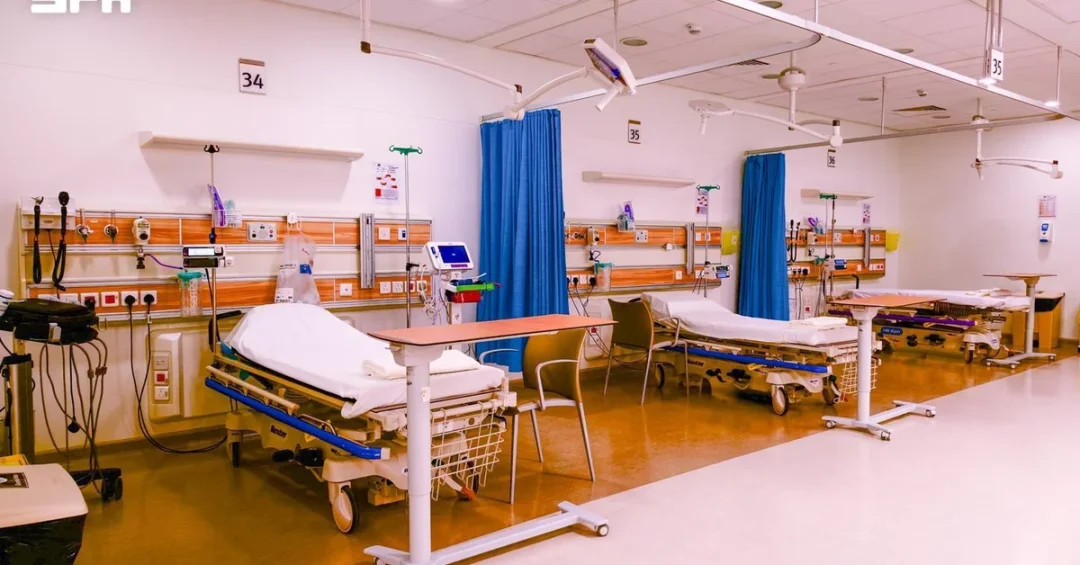
King Abdullah Specialized Hospital has officially opened in the Qassim region with a capacity of 474 beds, advanced medical facilities, and a broad range of specialized services, marking a major addition to the region’s healthcare system, the Saudi Press Agency reported. Affiliated with the Ministry of National Guard Health Affairs, the hospital operates in a treatment environment that prioritizes operational efficiency, patient needs, and quality and sustainability standards, reflecting the Kingdom’s broader commitment to expanding access to world-class medical care across all regions.
The hospital occupies a site spanning 1,889,000 square meters near Buraidah, with convenient access to King Abdulaziz Road, Prince Naif bin Abdulaziz International Airport, and Qassim University. Its built-up area covers 156,294 square meters and includes a 12-story main building, along with administrative, service, and residential facilities. The project represents the fourth specialized medical project under the Ministry of National Guard Health Affairs’ strategic expansion plans, following the Specialized Hospital for Women’s Health in Riyadh, King Abdullah Specialist Children’s Hospital, and the Neuroscience and Trauma Care Center in Jeddah. How does a single medical facility reshape the healthcare landscape of an entire region? The answer lies in the scale, scope, and strategic vision behind this landmark project.
Context and Background
What does it take to build a healthcare institution capable of serving a region for generations to come? The Ministry of National Guard Health Affairs has been pursuing a deliberate and far-reaching strategy to expand specialized medical services across Saudi Arabia, and King Abdullah Specialized Hospital in Qassim stands as the latest milestone in that effort. The hospital is the fourth specialized medical project under the Ministry’s strategic expansion plans, following the Specialized Hospital for Women’s Health in Riyadh, King Abdullah Specialist Children’s Hospital, and the Neuroscience and Trauma Care Center in Jeddah. Each of these facilities has addressed a specific gap in the Kingdom’s healthcare infrastructure, and together they form a comprehensive network of advanced medical care that reaches far beyond the major metropolitan centers.
The Qassim region, located in the heart of Saudi Arabia, has long been known for its agricultural heritage and growing population. As the region’s demographic and economic profile has evolved, so too has the demand for sophisticated medical services that were previously available only in Riyadh, Jeddah, or other major cities. The opening of King Abdullah Specialized Hospital directly addresses this need by bringing advanced diagnostics, specialized surgical capabilities, and critical care services closer to the people of Qassim and surrounding areas. The hospital’s location near Buraidah, with access to King Abdulaziz Road, Prince Naif bin Abdulaziz International Airport, and Qassim University, positions it as a hub for medical excellence that can serve patients from across the northern and central regions of the Kingdom.
The strategic placement of the hospital also reflects a broader understanding of how healthcare infrastructure contributes to regional development. By situating a major medical facility near a university and an international airport, the Ministry of National Guard Health Affairs has created conditions for collaboration in medical training, research, and innovation. The hospital is not merely a treatment center; it is an institution designed to anchor a culture of medical excellence in a region that is rapidly transforming under the broader national vision for economic and social development.
Key Details
What specific capabilities does a 474-bed specialized hospital bring to a region? The hospital’s total capacity is distributed across several clinical services, each designed to address distinct patient needs with precision and efficiency. These include 236 inpatient beds, 72 intensive care beds, and 45 emergency beds, in addition to 121 beds allocated to other services, including operating rooms, day surgery, recovery, dialysis, maternity, physical therapy, and rehabilitation. This distribution reflects a careful assessment of regional healthcare demands and ensures that the hospital can respond to a wide range of medical situations, from routine procedures to complex emergencies.
Inpatient facilities cover pediatrics, obstetrics and gynecology, internal medicine, and surgery, providing comprehensive care for patients across the lifespan. Critical care services include adult intensive and intermediate care, as well as intensive care units for newborns and children. The hospital also houses 84 outpatient examination, diagnostic, and treatment rooms, enabling a high volume of ambulatory care that reduces the need for overnight stays and supports more efficient use of medical resources. Beyond inpatient and critical care, the hospital brings together emergency services, surgical and endoscopic procedures, a central laboratory, diagnostic imaging, physical therapy and rehabilitation, and oral and dental care. Facilities also include radiology, a blood bank, and a pharmacy, alongside other medical and ancillary services.
The hospital’s design and construction also reflect a commitment to sustainability and operational efficiency. To promote more efficient resource use, the project incorporates design solutions that improve the efficiency of electrical and mechanical systems and make use of locally and regionally sourced materials. The project is LEED-certified under the Leadership in Energy and Environmental Design rating system developed by the U.S. Green Building Council. This certification recognizes the hospital’s adherence to rigorous standards for energy efficiency, water conservation, and indoor environmental quality, demonstrating that advanced healthcare and environmental responsibility can go hand in hand.
International and Regional Impact
How does a specialized hospital in Qassim resonate beyond the Kingdom’s borders? The opening of King Abdullah Specialized Hospital signals Saudi Arabia’s growing capacity to deliver advanced medical care at international standards, a development that enhances the Kingdom’s reputation as a leader in healthcare innovation in the Middle East. For international observers, the project demonstrates the Ministry of National Guard Health Affairs’ ability to plan, execute, and operate complex medical facilities that meet rigorous global benchmarks, including LEED certification. This capacity has implications for medical tourism, regional referrals, and cross-border collaboration in healthcare research and training.
Within the region, the hospital strengthens Qassim’s position as a center of excellence that can attract patients from neighboring areas and reduce the need for travel to distant cities for specialized treatment. The presence of a facility with 72 intensive care beds and dedicated neonatal and pediatric intensive care units is particularly significant, as it expands access to critical care services that are often in high demand. For families across the region, this means faster access to life-saving interventions and more convenient follow-up care. The hospital’s role in training and research also contributes to the development of a skilled medical workforce, which has long-term benefits for the entire healthcare ecosystem.
Economic and Strategic Significance
What economic value does a major healthcare investment bring to a region? The construction and operation of King Abdullah Specialized Hospital represent a substantial investment in Qassim’s infrastructure and human capital. The project has created jobs during its construction phase and will continue to generate employment opportunities for medical professionals, technicians, administrators, and support staff. By sourcing materials locally and regionally, the project has also supported supply chains within Saudi Arabia, aligning with broader efforts to strengthen the national economy and reduce dependence on imports.
Strategically, the hospital enhances the resilience of Saudi Arabia’s healthcare system by distributing advanced medical capacity across regions rather than concentrating it in a few major cities. This decentralization is a key element of the Ministry of National Guard Health Affairs’ expansion plans and contributes to the Kingdom’s broader goals of balanced regional development. The hospital’s proximity to Qassim University also opens avenues for collaboration in medical education, clinical research, and innovation, which can drive improvements in treatment protocols and patient outcomes over time. The integration of sustainability features further reduces long-term operating costs and demonstrates a forward-looking approach to resource management.
Vision 2030 Alignment
How does King Abdullah Specialized Hospital contribute to Saudi Arabia’s Vision 2030? The hospital directly supports the Vision’s objectives of enhancing the quality of life for citizens and residents, expanding access to healthcare services, and promoting sustainable development. By bringing advanced medical care to Qassim, the project helps reduce health disparities between regions and ensures that families can access specialized treatment close to home. This aligns with the Vision’s emphasis on building a vibrant society and a thriving economy, where all regions share in the benefits of national progress.
The hospital’s LEED certification and efficient design also reflect the Vision’s commitment to environmental sustainability and responsible resource use. As Saudi Arabia continues to transform its economy and society, investments in world-class healthcare infrastructure like King Abdullah Specialized Hospital demonstrate the Kingdom’s determination to provide its people with the highest standards of care. The facility stands as a testament to the leadership’s enduring commitment to the health and well-being of the nation, and it will serve as a foundation for further advances in medical excellence across the region for years to come.
20 Questions
Q1. What is King Abdullah Specialized Hospital?
A1. King Abdullah Specialized Hospital is a new 474-bed medical facility in the Qassim region of Saudi Arabia, affiliated with the Ministry of National Guard Health Affairs, offering advanced specialized healthcare services.
Q2. Where is the hospital located?
A2. The hospital is located near Buraidah in the Qassim region, with access to King Abdulaziz Road, Prince Naif bin Abdulaziz International Airport, and Qassim University.
Q3. How many beds does the hospital have?
A3. The hospital has a total capacity of 474 beds, including 236 inpatient beds, 72 intensive care beds, 45 emergency beds, and 121 beds for other services.
Q4. What is the size of the hospital site?
A4. The hospital occupies a site spanning 1,889,000 square meters, with a built-up area covering 156,294 square meters, including a 12-story main building.
Q5. Which ministry is responsible for the hospital?
A5. The hospital is affiliated with the Ministry of National Guard Health Affairs, which oversees its operations and strategic development.
Q6. What specialized services does the hospital offer?
A6. Services include pediatrics, obstetrics and gynecology, internal medicine, surgery, critical care, emergency services, dialysis, physical therapy, rehabilitation, and oral and dental care.
Q7. How many intensive care beds are available?
A7. The hospital has 72 intensive care beds, including adult intensive and intermediate care, as well as neonatal and pediatric intensive care units.
Q8. Does the hospital have emergency services?
A8. Yes, the hospital includes 45 emergency beds and provides comprehensive emergency services as part of its clinical offerings.
Q9. What is the significance of the hospital’s location near Qassim University?
A9. The proximity to Qassim University supports collaboration in medical training, research, and innovation, enhancing the hospital’s role as a center of excellence.
Q10. Is the hospital environmentally certified?
A10. Yes, the project is LEED-certified under the Leadership in Energy and Environmental Design rating system developed by the U.S. Green Building Council.
Q11. What does LEED certification mean for the hospital?
A11. LEED certification recognizes the hospital’s adherence to high standards for energy efficiency, water conservation, and indoor environmental quality, demonstrating sustainable design.
Q12. How many outpatient rooms does the hospital have?
A12. The hospital houses 84 outpatient examination, diagnostic, and treatment rooms to support ambulatory care services.
Q13. What is the hospital’s role in medical training and research?
A13. The hospital contributes to medical training and research, helping develop a skilled healthcare workforce and advancing clinical knowledge in the region.
Q14. Which other specialized hospitals are part of the Ministry’s expansion plans?
A14. The expansion includes the Specialized Hospital for Women’s Health in Riyadh, King Abdullah Specialist Children’s Hospital, and the Neuroscience and Trauma Care Center in Jeddah.
Q15. How does the hospital support Vision 2030?
A15. It enhances quality of life, expands healthcare access, promotes regional development, and supports sustainability goals, aligning with Vision 2030 objectives.
Q16. What economic benefits does the hospital bring to Qassim?
A16. The hospital creates jobs, supports local supply chains, and strengthens the region’s infrastructure, contributing to balanced economic development.
Q17. Does the hospital use locally sourced materials?
A17. Yes, the project incorporates locally and regionally sourced materials to promote efficient resource use and support the national economy.
Q18. What types of inpatient facilities are available?
A18. Inpatient facilities cover pediatrics, obstetrics and gynecology, internal medicine, and surgery, providing comprehensive care for diverse patient needs.
Q19. How does the hospital improve healthcare access in Qassim?
A19. By bringing advanced specialized services closer to residents, the hospital reduces the need for travel to distant cities and ensures timely access to critical care.
Q20. What is the hospital’s long-term impact on Saudi healthcare?
A20. The hospital strengthens regional healthcare capacity, supports medical innovation, and serves as a model for future specialized facilities across the Kingdom.
Reader Feedback
We value your thoughts. Please share your feedback on this article.
Your feedback helps us improve our coverage.