


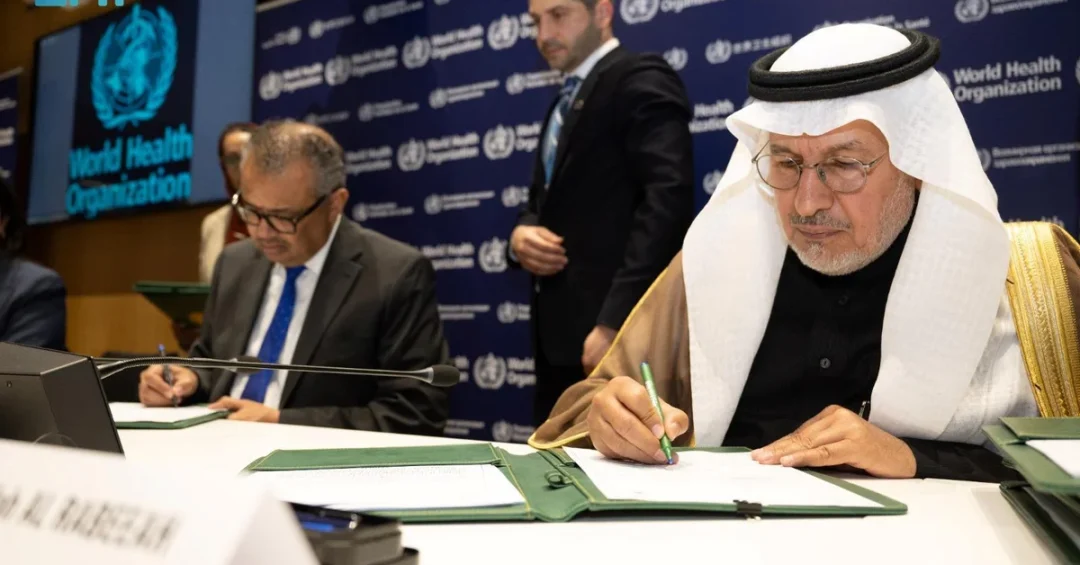
The King Salman Humanitarian Aid and Relief Center (KSrelief) has signed five executive programs with the World Health Organization (WHO) totaling $19,496,000 to support health sectors in Yemen, Sudan, and Syria. The agreements were formalized on the sidelines of the 77th session of the World Health Assembly in Geneva on May 25, 2024, according to the Saudi Press Agency (SPA). The signing ceremony brought together Advisor at the Royal Court and KSrelief Supervisor General Dr. Abdullah bin Abdulaziz Al Rabeeah and WHO Director-General Dr. Tedros Adhanom Ghebreyesus, with Saudi Arabia’s Permanent Representative to the UN in Geneva Ambassador Abdulmohsen bin Khothaila in attendance.
Context and Background
This initiative underscores the Kingdom of Saudi Arabia’s unwavering commitment to global health and humanitarian assistance, particularly in conflict-affected regions. The World Health Assembly, as the supreme decision-making body of WHO, provides a platform for member states to address pressing health challenges. By signing these agreements during the assembly, Saudi Arabia demonstrates its proactive role in international health diplomacy, aligning with its broader foreign policy objectives of stability and human welfare.
Key Details
The first program targets Sudan’s severe shortage of kidney dialysis supplies, providing materials for approximately 235,000 dialysis sessions, 100 dialysis machines, and salaries for medical staff across 77 centers, valued at $5 million. The second program, worth $4.746 million, delivers medical assistance to earthquake victims in Syria. The third, at $3 million, focuses on combating measles among children under five in Yemen. The fourth, valued at $3.75 million, improves water and sanitation in healthcare facilities, including solar-powered wells in 10 facilities. The fifth, also $3 million, aims to reduce cholera spread across Yemen.
Implications and Impact
These programs are part of KSrelief’s broader humanitarian mission, which has positioned Saudi Arabia as a leading donor in global health. By partnering with WHO, the Kingdom ensures that aid reaches the most vulnerable populations efficiently. The initiatives not only address immediate health crises but also strengthen local health infrastructure, contributing to long-term stability in these regions. The focus on sustainable solutions, such as solar-powered wells, reflects a commitment to lasting impact rather than temporary relief.
Vision 2030 Alignment
Saudi Arabia’s Vision 2030 emphasizes the Kingdom’s role as a global humanitarian hub. These agreements exemplify that commitment, aligning with the Vision’s goals of international cooperation and sustainable development. Through KSrelief, Saudi Arabia continues to extend a helping hand to nations in need, reinforcing its position as a responsible global actor. The signing of these programs at a major international forum highlights the Kingdom’s leadership in addressing global health challenges, a cornerstone of its forward-looking vision.
20 Questions
Q1. What is the total value of the five executive programs signed by KSrelief and WHO?
A1. The total value is $19,496,000, as announced by the Saudi Press Agency. This funding supports health initiatives in Yemen, Sudan, and Syria, addressing critical needs such as dialysis, measles, cholera, and water sanitation.
Q2. Where were the agreements signed?
A2. The agreements were signed on the sidelines of the 77th session of the World Health Assembly in Geneva, Switzerland, on May 25, 2024. This venue underscores the international significance of the partnership.
Q3. Who signed the agreements on behalf of KSrelief?
A3. Dr. Abdullah bin Abdulaziz Al Rabeeah, Advisor at the Royal Court and KSrelief Supervisor General, signed the agreements. His role highlights the high-level commitment of Saudi Arabia to humanitarian causes.
Q4. Who signed for the World Health Organization?
A4. Dr. Tedros Adhanom Ghebreyesus, Director-General of the WHO, signed the agreements. His participation reflects the WHO’s confidence in Saudi Arabia’s humanitarian efforts.
Q5. Which countries are covered by these programs?
A5. The programs cover Yemen, Sudan, and Syria, three nations facing severe health crises due to conflict and natural disasters. This targeted support aims to alleviate suffering in these regions.
Q6. What is the first program about?
A6. The first program addresses the shortage of kidney dialysis supplies in Sudan, providing materials for 235,000 sessions, 100 machines, and staff salaries in 77 centers, valued at $5 million. This initiative is crucial for kidney failure patients.
Q7. How much is allocated for Syria?
A7. The second program, worth $4.746 million, provides medical assistance to earthquake victims in Syria. This aid helps address urgent health needs following the devastating earthquakes.
Q8. What does the third program focus on?
A8. The third program, valued at $3 million, aims to combat the spread of measles among children under five in Yemen. This vaccination and treatment effort is vital for child health.
Q9. What is the fourth program’s objective?
A9. The fourth program, worth $3.75 million, improves water and sanitation services in healthcare facilities in Yemen, including solar-powered wells in 10 facilities. This ensures sustainable water supplies for the neediest populations.
Q10. What is the fifth program about?
A10. The fifth program, also $3 million, aims to reduce the spread of cholera across Yemen. This initiative focuses on prevention and treatment to curb outbreaks.
Q11. Why is this partnership significant?
A11. This partnership highlights Saudi Arabia’s commitment to global health and its role as a leading humanitarian donor. Working with WHO ensures efficient and effective delivery of aid to vulnerable communities.
Q12. How does this align with Vision 2030?
A12. Vision 2030 emphasizes Saudi Arabia’s role as a global humanitarian hub. These agreements support that vision by fostering international cooperation and sustainable development, enhancing the Kingdom’s global standing.
Q13. What is KSrelief?
A13. KSrelief, the King Salman Humanitarian Aid and Relief Center, is Saudi Arabia’s official humanitarian agency, established to coordinate and deliver relief aid worldwide. It operates in numerous countries, focusing on health, education, and food security.
Q14. How many dialysis sessions are covered in Sudan?
A14. The program provides supplies for approximately 235,000 dialysis sessions, ensuring critical care for kidney failure patients. This large-scale support is essential for saving lives in Sudan.
Q15. What is the role of the World Health Assembly?
A15. The World Health Assembly is the decision-making body of WHO, where member states discuss and set health policies. The agreements were signed on its sidelines, leveraging the assembly’s global platform.
Q16. How does this aid benefit Yemen?
A16. The aid addresses measles, cholera, and water/sanitation issues, directly improving health outcomes for vulnerable populations, especially children. These interventions are critical in a country facing severe health system strain.
Q17. What is the total number of dialysis centers supported in Sudan?
A17. The program supports 77 dialysis centers by paying medical staff salaries, ensuring continued operation. This financial support helps maintain essential services for kidney patients.
Q18. How does this reflect Saudi Arabia’s foreign policy?
A18. Saudi Arabia’s foreign policy includes humanitarian assistance as a pillar, demonstrating its commitment to global stability and human welfare. This initiative is a concrete example of that policy in action.
Q19. Are there any other similar initiatives by KSrelief?
A19. KSrelief has implemented numerous humanitarian projects worldwide, including health, education, and food security programs, often in partnership with international organizations. These efforts have reached millions of people in need.
Q20. What is the expected impact of these programs?
A20. These programs are expected to reduce mortality, prevent disease outbreaks, and strengthen health systems, contributing to long-term stability in the region. The sustainable approach ensures lasting benefits for affected communities.
Reader Feedback
We value your thoughts. Please share your feedback on this article.
Your feedback helps us improve our coverage.