


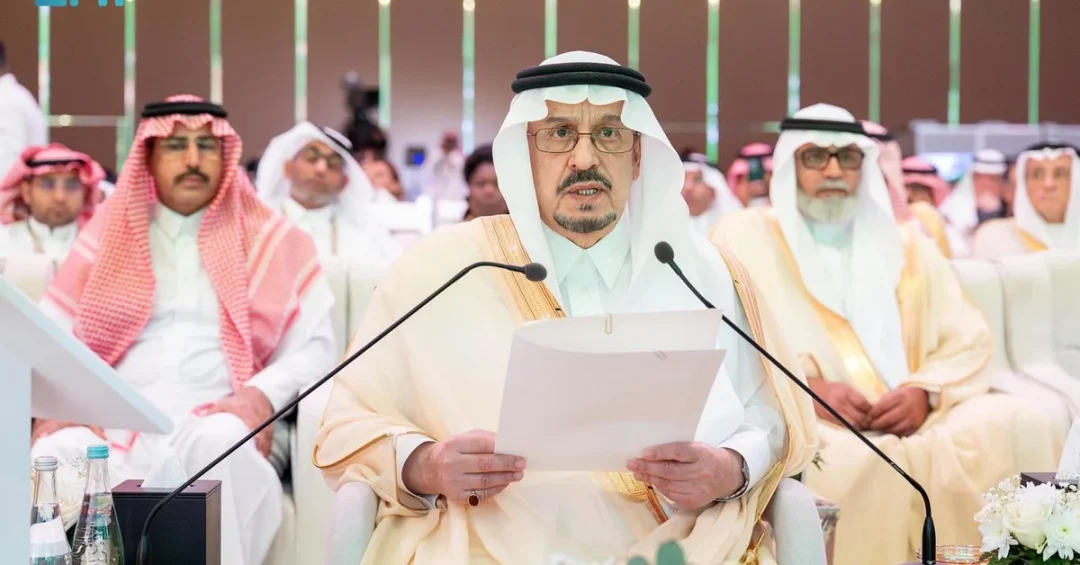
Under the patronage of Custodian of the Two Holy Mosques King Salman bin Abdulaziz Al Saud, the International Conference on Conjoined Twins opened in Riyadh on Sunday, November 24, 2024, marking more than three decades of Saudi leadership in one of the most complex and compassionate fields of modern medicine. The two-day gathering, organized by the King Salman Humanitarian Aid and Relief Center (KSrelief) in partnership with United Nations humanitarian organizations, was inaugurated by Governor of Riyadh Region Prince Faisal bin Bandar bin Abdulaziz, who also opened the accompanying exhibition at the conference venue.
Prince Faisal was received by KSrelief Supervisor General Dr. Abdullah bin Abdulaziz Al Rabeeah, Minister of Education Yousef Al-Benyan, Minister of Health Fahad Al-Jalajel, and several senior officials. The ceremony began with the Saudi national anthem and the recitation of verses from the Holy Quran, setting a tone of solemnity and purpose. The conference brought together officials, ministers, diplomats accredited to the Kingdom, and leaders from local, Gulf, Arab, and international governmental and non-governmental organizations, along with experts in the humanitarian field. Could there be a more fitting setting than Riyadh for a global conversation on hope, healing, and human dignity?
Context and Background
What does it take to turn a rare medical challenge into a global humanitarian mission? For the Kingdom of Saudi Arabia, the answer has unfolded over more than three decades. The Saudi Conjoined Twins Programme began in 1990, and since then it has become the only program in the world dedicated to separating conjoined twins internationally, according to official Saudi information released through the Saudi Press Agency. The initiative reflects a sustained national commitment to ensuring that children born with this rare condition receive the highest possible standard of physical and mental care.
Conjoined twin cases are extraordinarily rare, with an incidence rate estimated at approximately one in 50,000 births. That rarity presents complex clinical, ethical, and logistical challenges that few health systems are equipped to handle. The Saudi program has responded by assembling a multidisciplinary team of surgeons, physicians, and specialists who evaluate each case with scientific rigor and long-term care strategies. Over the decades, the program has cared for 143 conjoined twins from 26 countries and successfully performed 61 separation surgeries, establishing a model of medical excellence that is recognized far beyond the region.
The conference itself comes at a meaningful moment: it coincides with the Kingdom’s proposal of a draft resolution to the United Nations General Assembly to designate November 24 of each year as World Conjoined Twins Day. That proposal, directed by the Custodian of the Two Holy Mosques and advanced through the Ministry of Foreign Affairs, aims to raise awareness of conjoined twin cases at all levels and to strengthen international support for affected families. How often does a single nation’s medical program inspire a global day of recognition?
Key Details
In a speech delivered on behalf of Custodian of the Two Holy Mosques King Salman bin Abdulaziz Al Saud, Governor Prince Faisal bin Bandar bin Abdulaziz welcomed participants to the Kingdom and conveyed the King’s greetings. He noted that the conference comes more than 30 years since the launch of the Saudi Conjoined Twins Programme, in which, as he put it, the humanity of medicine has converged with the legacy of the Kingdom derived from its true Islamic religion. He described the program as one of the largest specialized humanitarian medical initiatives globally.
Dr. Abdullah Al Rabeeah, Supervisor General of KSrelief and Head of the Multidisciplinary Team for the Saudi Conjoined Twins Program, reflected on a journey that began 35 years ago. He noted that 143 conjoined twins from 26 countries have been cared for and evaluated, with 61 successful separation surgeries performed, and that seven cases are currently awaiting separation decisions. He emphasized that the program transcends distinctions of color, religion, race, or geography, focusing solely on the dignity and well-being of individuals wherever they are. He also paid tribute to two late members of the surgical team, Dr. Mohammed Al-Jammas and Dr. Mohammed Al-Jamal, acknowledging their invaluable contributions.
World Health Organization Director-General Dr. Tedros Adhanom Ghebreyesus expressed gratitude to the Kingdom for the invitation and praised the Saudi Conjoined Twins Programme as a remarkable advancement in medical science that demonstrates a steadfast dedication to conjoined twins and their families. He underscored the broader global context, noting that 8 million children are affected by birth defects worldwide, with 40,000 succumbing within the first month of life. Prince Faisal and attendees later viewed a documentary chronicling the program’s evolution since its inception, and the governor inaugurated the official website of the Saudi Conjoined Twins Programme.
International and Regional Impact
How does a national medical initiative become a source of international trust? The answer lies in results and consistency. The Saudi Conjoined Twins Programme has drawn patients from 26 countries across continents, and its outcomes have earned recognition from the World Health Organization and United Nations humanitarian organizations. The signing of nine agreements between KSrelief and various humanitarian and relief organizations during the conference further extends the Kingdom’s reach, linking its specialized medical expertise with broader relief and development efforts.
The conference also served as a reunion of sorts. Twins who had undergone separation surgeries in the Kingdom were invited to attend, standing as living witnesses to the program’s impact. Dr. Al Rabeeah described them as the best witnesses to the Kingdom’s leadership, and their presence underscored a point that resonates across borders: humanitarian commitment is measured not only in procedures performed but in lives restored and families supported. For regional observers, the event reinforces Saudi Arabia’s role as a convening power in global health diplomacy, capable of bringing together governments, international organizations, and medical experts around a shared purpose.
Economic and Strategic Significance
What does a specialized surgical program reveal about a nation’s broader strategic direction? In Saudi Arabia’s case, it reflects a deliberate investment in healthcare as a pillar of national development. Dr. Al Rabeeah highlighted that this pioneering humanitarian and scientific endeavor aligns with the state’s strategic investment in healthcare, a vision supported by the Custodian of the Two Holy Mosques and His Royal Highness Prince Mohammed bin Salman bin Abdulaziz Al Saud, Crown Prince and Prime Minister. That vision encompasses developing qualified health professionals, advancing specialized education, and transforming the healthcare sector through cutting-edge technologies and capabilities.
The strategic significance extends beyond medicine. By hosting an international conference in partnership with UN humanitarian organizations, the Kingdom reinforces its position as a global hub for dialogue and cooperation. The participation of ministers, diplomats, and leaders from Gulf, Arab, and international organizations signals that Saudi Arabia’s humanitarian platform is both inclusive and influential. The nine agreements signed with relief organizations add a practical dimension, converting conference momentum into concrete partnerships that can deliver aid and expertise where they are needed most.
Vision 2030 Alignment
How does a program dedicated to separating conjoined twins connect to a national transformation agenda? Saudi Vision 2030 aims to diversify the economy, strengthen public services, and elevate the Kingdom’s global standing. The healthcare sector is a central part of that equation, with goals that include improving quality of life, building a resilient health system, and fostering innovation. The Saudi Conjoined Twins Programme embodies these ambitions in a highly specialized field, demonstrating that Saudi expertise can set international benchmarks while serving humanity.
The conference also advances the Vision 2030 objective of positioning Saudi Arabia as a leader in humanitarian action. By proposing World Conjoined Twins Day at the United Nations and by convening experts from around the world, the Kingdom is translating its values into global initiatives. As the two-day conference continues, the discussions in Riyadh will likely shape how the international community approaches conjoined twin care for years to come. Under the patronage of the Custodian of the Two Holy Mosques, the message from Riyadh is clear: compassion, science, and leadership can come together to change lives, and the Kingdom of Saudi Arabia intends to remain at the forefront of that effort.
20 Questions
Q1. What is the International Conference on Conjoined Twins?
A1. It is a two-day conference organized by the King Salman Humanitarian Aid and Relief Center (KSrelief) in partnership with UN humanitarian organizations, held in Riyadh to discuss advances in conjoined twin care and celebrate the Saudi program’s achievements.
Q2. Who inaugurated the conference?
A2. Governor of Riyadh Region Prince Faisal bin Bandar bin Abdulaziz inaugurated the conference on behalf of Custodian of the Two Holy Mosques King Salman bin Abdulaziz Al Saud, and also opened the accompanying exhibition.
Q3. When did the Saudi Conjoined Twins Programme begin?
A3. The program began in 1990, more than three decades ago. It has since grown into the only program dedicated to separating conjoined twins internationally, according to official Saudi information.
Q4. How many conjoined twin cases has the program handled?
A4. The program has cared for and evaluated 143 conjoined twins from 26 countries, and has successfully performed 61 separation surgeries, with seven cases currently awaiting separation decisions.
Q5. What is the incidence rate of conjoined twins?
A5. Conjoined twin cases are rare, with an incidence rate estimated at approximately 1 in 50,000 births. This rarity makes specialized care and international cooperation essential.
Q6. What is World Conjoined Twins Day?
A6. It is a proposed United Nations observance on November 24 each year, advanced by Saudi Arabia through a draft resolution to the UN General Assembly to raise global awareness of conjoined twin cases.
Q7. Who proposed the UN resolution for World Conjoined Twins Day?
A7. The Custodian of the Two Holy Mosques directed the Ministry of Foreign Affairs to propose the draft resolution, reflecting the Kingdom’s leadership in this humanitarian field.
Q8. Who represented KSrelief at the conference?
A8. Dr. Abdullah bin Abdulaziz Al Rabeeah, Supervisor General of KSrelief and Head of the Multidisciplinary Team for the Saudi Conjoined Twins Program, delivered a speech highlighting the program’s journey and achievements.
Q9. What did WHO Director-General Dr. Tedros say?
A9. He expressed gratitude to Saudi Arabia and praised the program as a remarkable advancement in medical science, noting that 8 million children globally are affected by birth defects.
Q10. How many agreements were signed at the conference?
A10. Nine agreements were signed between KSrelief and various humanitarian and relief organizations, extending the Kingdom’s humanitarian reach and partnerships.
Q11. What else happened at the ceremony?
A11. Attendees viewed a documentary on the program’s evolution, the governor inaugurated the official program website, and a video showed a visit by twins who had undergone separation surgeries in the Kingdom.
Q12. Who attended the conference?
A12. Officials, ministers, diplomats accredited to the Kingdom, and leaders from local, Gulf, Arab, and international governmental and non-governmental organizations, along with humanitarian experts, attended the ceremony.
Q13. Which Saudi ministers were present?
A13. Minister of Education Yousef Al-Benyan and Minister of Health Fahad Al-Jalajel were present, along with several senior officials who received Prince Faisal upon arrival.
Q14. How does the program reflect Saudi values?
A14. Dr. Al Rabeeah said the program transcends distinctions of color, religion, race, or geography, focusing solely on the dignity and well-being of individuals wherever they are.
Q15. What did Prince Faisal say about the medical staff?
A15. He expressed gratitude to the medical staff who perform this microsurgery with humanity and professionalism, stressing that collective efforts will improve healthcare and services for conjoined twins.
Q16. How does the program align with Vision 2030?
A16. It aligns with Vision 2030’s healthcare goals by developing qualified health professionals, advancing specialized education, and transforming the healthcare sector through cutting-edge technologies and capabilities.
Q17. What is the significance of the program globally?
A17. It is one of the largest specialized humanitarian medical initiatives globally and the sole program dedicated to separating conjoined twins internationally, setting a benchmark for care.
Q18. Who were the late team members honored?
A18. Dr. Mohammed Al-Jammas and Dr. Mohammed Al-Jamal were honored for their invaluable contributions to the program’s surgical team over the years.
Q19. What did Dr. Al Rabeeah say about the twins present?
A19. He said the separated twins stand as the best witnesses to the Kingdom’s leadership under King Salman and Crown Prince Mohammed bin Salman, calling the Kingdom a global leader in humanity.
Q20. What is the conference’s lasting impact?
A20. It strengthens international cooperation on conjoined twin care, supports the push for World Conjoined Twins Day, and reinforces Saudi Arabia’s role as a global leader in humanitarian medicine.
Reader Feedback
We value your thoughts. Please share your feedback on this article.
Your feedback helps us improve our coverage.