


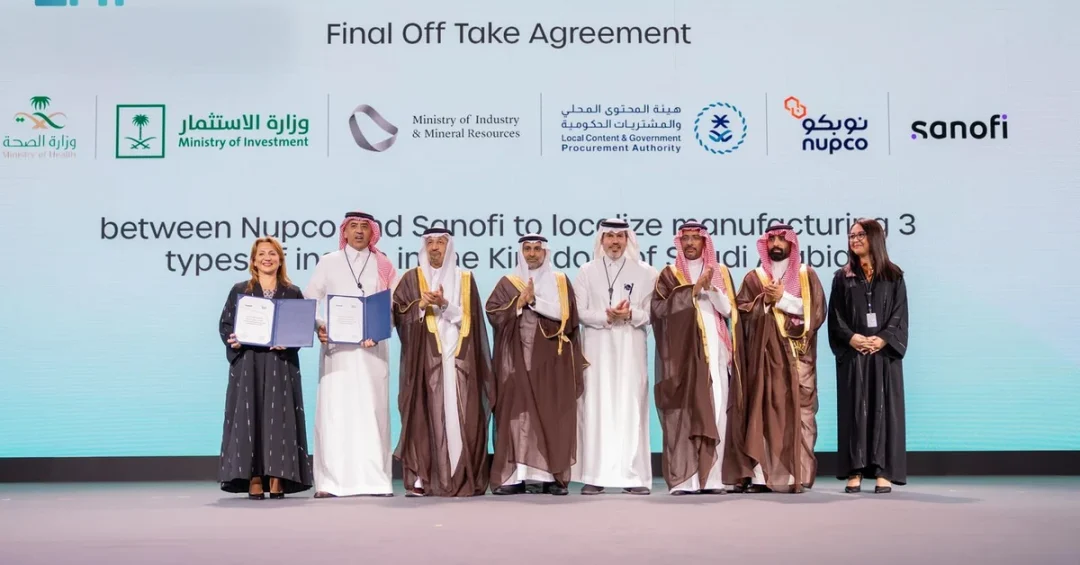
Saudi Arabia has taken a significant step toward pharmaceutical self-sufficiency with the signing of the final agreement to localize insulin production, announced during the Global Health Exhibition in Riyadh on October 22, 2024. The agreement, signed under the patronage of Minister of Health Fahad Al-Jalajel and in the presence of Minister of Investment Khalid Al-Falih and Minister of Industry and Mineral Resources Bandar Alkhorayef, marks a milestone in the Kingdom’s efforts to enhance its domestic medical manufacturing capabilities. The partnership brings together the National Unified Procurement Company for Medical Supplies (NUPCO), Sudair Pharmaceutical Company, Sanofi, and Novo Nordisk to localize up to seven insulin products within the Kingdom. This development reflects Saudi Arabia’s broader strategy to strengthen its position as a regional hub for the pharmaceutical industry, aligning with the goals of Saudi Vision 2030.
How does a nation transform its healthcare landscape while simultaneously building a world-class industrial base? For Saudi Arabia, the answer lies in strategic partnerships that bring together global expertise, local investment, and government support. The insulin localization agreement represents more than just a manufacturing deal; it symbolizes the Kingdom’s commitment to achieving drug and health security, reducing dependency on imports, and creating a sustainable ecosystem for pharmaceutical innovation. The Global Health Exhibition, which hosted this landmark signing, has become a premier platform for showcasing Saudi Arabia’s rapid advancements in healthcare and life sciences.
Context and Background
Why has insulin localization become such a priority for the Kingdom of Saudi Arabia? The answer lies in the intersection of public health needs, economic diversification, and national security. Saudi Arabia has one of the highest rates of diabetes in the Middle East, with millions of citizens relying on insulin products daily. Historically, the Kingdom imported the vast majority of its pharmaceutical needs, including insulin, leaving it vulnerable to global supply chain disruptions and currency fluctuations. The COVID-19 pandemic exposed the fragility of international supply chains, prompting Saudi leadership to accelerate efforts toward localizing critical medical products.
The National Unified Procurement Company for Medical Supplies (NUPCO) has been at the forefront of these efforts, leveraging its purchasing power to attract global pharmaceutical companies to establish local manufacturing facilities. NUPCO’s role extends beyond procurement; it acts as a catalyst for industrial development by guaranteeing demand and facilitating partnerships between international firms and Saudi enterprises. The partnership with Sudair Pharmaceutical Company, a local manufacturer, ensures that knowledge transfer and job creation remain central to the localization strategy.
The involvement of Sanofi and Novo Nordisk, two of the world’s leading insulin producers, underscores the confidence that global pharmaceutical giants have in Saudi Arabia’s regulatory environment and long-term market potential. These companies bring decades of expertise in insulin production, quality control, and research and development, which will be instrumental in building local capabilities. The agreement covers up to seven insulin products, ensuring a diverse range of treatment options for Saudi patients while reducing reliance on imports.
Key Details of the Agreement
What exactly does this agreement entail, and why is it considered a final milestone? The signing ceremony, held at the Global Health Exhibition, formalized a partnership that had been in development for several months. The agreement includes the localization of up to seven insulin products, covering both human insulin and analog insulin variants. These products will be manufactured at facilities operated by Sudair Pharmaceutical Company, with technical support and technology transfer from Sanofi and Novo Nordisk.
The presence of three cabinet-level ministers at the signing—Fahad Al-Jalajel (Health), Khalid Al-Falih (Investment), and Bandar Alkhorayef (Industry and Mineral Resources)—signals the high-level commitment to this initiative. Each ministry plays a critical role: the Ministry of Health ensures that localized products meet stringent quality and safety standards; the Ministry of Investment facilitates foreign direct investment and partnership frameworks; and the Ministry of Industry and Mineral Resources supports the industrial infrastructure required for pharmaceutical manufacturing.
The agreement aims to enhance the efforts of government agencies in localizing the medical and pharmaceutical industry, contributing to achieving drug and health security in the Kingdom. It also seeks to strengthen Saudi Arabia’s leadership in the medical and pharmaceutical sector, enabling the Kingdom to meet domestic pharmaceutical needs and requirements while positioning itself as a potential exporter to regional markets. The localization of insulin is expected to create hundreds of high-skilled jobs, stimulate local research and development, and reduce the Kingdom’s trade deficit in pharmaceuticals.
International and Regional Impact
How will this agreement reshape Saudi Arabia’s role in the global pharmaceutical landscape? The localization of insulin production positions the Kingdom as a serious player in the Middle East’s pharmaceutical industry, which has historically been dominated by imports from Europe, North America, and Asia. By partnering with Sanofi and Novo Nordisk, Saudi Arabia gains access to cutting-edge manufacturing technologies and global quality standards, which can serve as a foundation for exporting locally produced insulin to neighboring countries.
The regional implications are significant. Countries across the Gulf Cooperation Council (GCC) and the broader Middle East and North Africa (MENA) region face similar challenges in healthcare security and pharmaceutical dependency. Saudi Arabia’s success in localizing insulin production could serve as a model for other nations seeking to build resilient healthcare supply chains. Moreover, the agreement reinforces Saudi Arabia’s position as a preferred destination for foreign investment in life sciences, attracting further interest from global pharmaceutical companies looking to establish a presence in the Kingdom.
From an international perspective, the agreement demonstrates that Saudi Arabia is not merely a consumer of global healthcare innovations but an active participant in their development and production. This shift aligns with the Kingdom’s broader foreign policy objectives of fostering economic diversification, technological advancement, and regional stability. The involvement of French multinational Sanofi and Danish multinational Novo Nordisk also highlights the strengthening of economic ties between Saudi Arabia and European nations.
Economic and Strategic Significance
What economic benefits will flow from localizing insulin production, and how does this fit into Saudi Arabia’s strategic vision? The pharmaceutical industry is one of the fastest-growing sectors globally, with the insulin market alone valued at tens of billions of dollars annually. By localizing production, Saudi Arabia captures a share of this value chain, creating jobs, generating tax revenue, and reducing foreign exchange outflows. The agreement is expected to save the Kingdom significant amounts in import costs while improving the reliability of insulin supply for patients.
Strategically, the localization of insulin is a cornerstone of Saudi Arabia’s national security framework. Access to essential medicines is a critical component of public health resilience, and the COVID-19 pandemic demonstrated the risks of over-reliance on global supply chains. By building domestic manufacturing capacity, Saudi Arabia ensures that its citizens have uninterrupted access to life-saving medications, even in times of global crisis. This aligns with the Kingdom’s broader goals of achieving self-sufficiency in strategic sectors, including food, water, energy, and healthcare.
The agreement also supports the development of a knowledge-based economy, a key objective of Vision 2030. Pharmaceutical manufacturing requires a skilled workforce, advanced research capabilities, and robust regulatory frameworks. By investing in these areas, Saudi Arabia is building the human capital and institutional capacity needed to compete in the global bioeconomy. The partnership with Sanofi and Novo Nordisk includes provisions for training Saudi professionals, transferring technology, and fostering local innovation.
Vision 2030 Alignment
How does the insulin localization agreement embody the aspirations of Saudi Vision 2030? Vision 2030, launched in 2016 under the leadership of Crown Prince Mohammed bin Salman, aims to transform Saudi Arabia from an oil-dependent economy into a diversified, knowledge-based society. The healthcare and life sciences sectors are identified as key pillars of this transformation, with goals to improve healthcare quality, enhance local manufacturing, and attract foreign investment.
The insulin localization agreement directly supports several Vision 2030 objectives, including the National Industrial Development and Logistics Program (NIDLP), which seeks to localize strategic industries and boost non-oil exports. It also aligns with the Health Sector Transformation Program, which aims to improve healthcare delivery and outcomes for all citizens. By localizing insulin production, Saudi Arabia reduces its dependence on imports, creates high-value jobs, and positions itself as a regional leader in pharmaceutical innovation.
Looking ahead, the success of this agreement is expected to catalyze further localization efforts in other therapeutic areas, including oncology, vaccines, and biologics. The Kingdom’s ability to attract global partners like Sanofi and Novo Nordisk demonstrates that Vision 2030 is not just a domestic agenda but a global invitation to collaborate in building a healthier, more prosperous future. As Saudi Arabia continues to invest in healthcare infrastructure, research, and human capital, it is poised to become a hub for medical innovation that serves not only its citizens but also the wider region and the world.
20 Questions
Q1. What agreement was signed at the Global Health Exhibition in Riyadh?
A1. The final agreement to localize certain insulin products was signed, involving NUPCO, Sudair Pharmaceutical Company, Sanofi, and Novo Nordisk, under the patronage of Minister of Health Fahad Al-Jalajel.
Q2. Which Saudi ministers attended the signing ceremony?
A2. Minister of Health Fahad Al-Jalajel, Minister of Investment Khalid Al-Falih, and Minister of Industry and Mineral Resources Bandar Alkhorayef attended the signing ceremony, demonstrating high-level government support.
Q3. How many insulin products will be localized under this agreement?
A3. The agreement includes the localization of up to seven insulin products, covering both human insulin and analog insulin variants, ensuring a diverse range of treatment options for patients.
Q4. What is NUPCO’s role in this agreement?
A4. The National Unified Procurement Company for Medical Supplies (NUPCO) facilitates the partnership by leveraging its purchasing power, guaranteeing demand, and supporting the localization of medical supplies in Saudi Arabia.
Q5. Which global pharmaceutical companies are partners in this agreement?
A5. Sanofi, a French multinational pharmaceutical company, and Novo Nordisk, a Danish multinational healthcare company, are the global partners bringing expertise in insulin production and technology transfer.
Q6. What is Sudair Pharmaceutical Company’s role in the localization effort?
A6. Sudair Pharmaceutical Company is the local manufacturer responsible for producing the insulin products, benefiting from technology transfer and technical support from Sanofi and Novo Nordisk.
Q7. Why is insulin localization important for Saudi Arabia’s health security?
A7. Insulin localization reduces dependence on imports, ensures uninterrupted access to life-saving medications, and strengthens the Kingdom’s resilience against global supply chain disruptions.
Q8. How does this agreement align with Saudi Vision 2030?
A8. It supports Vision 2030 goals of economic diversification, localizing strategic industries, creating high-skilled jobs, and enhancing healthcare quality through the Health Sector Transformation Program.
Q9. What economic benefits are expected from localizing insulin production?
A9. The agreement is expected to create jobs, reduce import costs, generate tax revenue, stimulate local research and development, and position Saudi Arabia as a regional pharmaceutical hub.
Q10. How many jobs will be created by this localization initiative?
A10. While exact figures were not specified, the agreement is expected to create hundreds of high-skilled jobs in manufacturing, research, quality control, and related fields within the pharmaceutical sector.
Q11. What is the Global Health Exhibition, and why is it significant?
A11. The Global Health Exhibition is a premier platform in Riyadh for showcasing healthcare innovations, facilitating partnerships, and highlighting Saudi Arabia’s advancements in healthcare and life sciences.
Q12. How will this agreement impact patients in Saudi Arabia?
A12. Patients will benefit from a more reliable supply of insulin, potentially lower costs, and access to high-quality products manufactured locally under stringent regulatory oversight.
Q13. What role does the Ministry of Investment play in this agreement?
A13. The Ministry of Investment facilitates foreign direct investment, supports partnership frameworks, and ensures an attractive investment environment for global pharmaceutical companies operating in Saudi Arabia.
Q14. What role does the Ministry of Industry and Mineral Resources play?
A14. The Ministry of Industry and Mineral Resources supports the industrial infrastructure, regulatory frameworks, and logistical requirements necessary for pharmaceutical manufacturing in the Kingdom.
Q15. Will Saudi Arabia export locally produced insulin to other countries?
A15. The agreement aims to meet domestic needs first, but successful localization could position Saudi Arabia as a potential exporter to regional markets in the Middle East and North Africa.
Q16. How does this agreement reflect Saudi Arabia’s investment climate?
A16. The participation of global pharmaceutical giants like Sanofi and Novo Nordisk demonstrates confidence in Saudi Arabia’s regulatory environment, market potential, and long-term economic vision.
Q17. What other pharmaceutical products might be localized in the future?
A17. The success of insulin localization is expected to catalyze efforts in other therapeutic areas, including oncology, vaccines, biologics, and treatments for chronic diseases.
Q18. How does this agreement support knowledge transfer and local innovation?
A18. The partnership includes provisions for training Saudi professionals, transferring technology, and fostering local research and development capabilities in pharmaceutical manufacturing.
Q19. What is the significance of signing the final agreement at the Global Health Exhibition?
A19. Signing at the exhibition highlights the event’s role as a catalyst for major healthcare partnerships and underscores Saudi Arabia’s commitment to advancing its pharmaceutical industry on a global stage.
Q20. How does this agreement contribute to Saudi Arabia’s regional leadership?
A20. By localizing insulin production and attracting global partners, Saudi Arabia strengthens its position as a regional center for the pharmaceutical industry, setting a model for healthcare security and industrial innovation.
Reader Feedback
We value your thoughts. Please share your feedback on this article.
Your feedback helps us improve our coverage.