


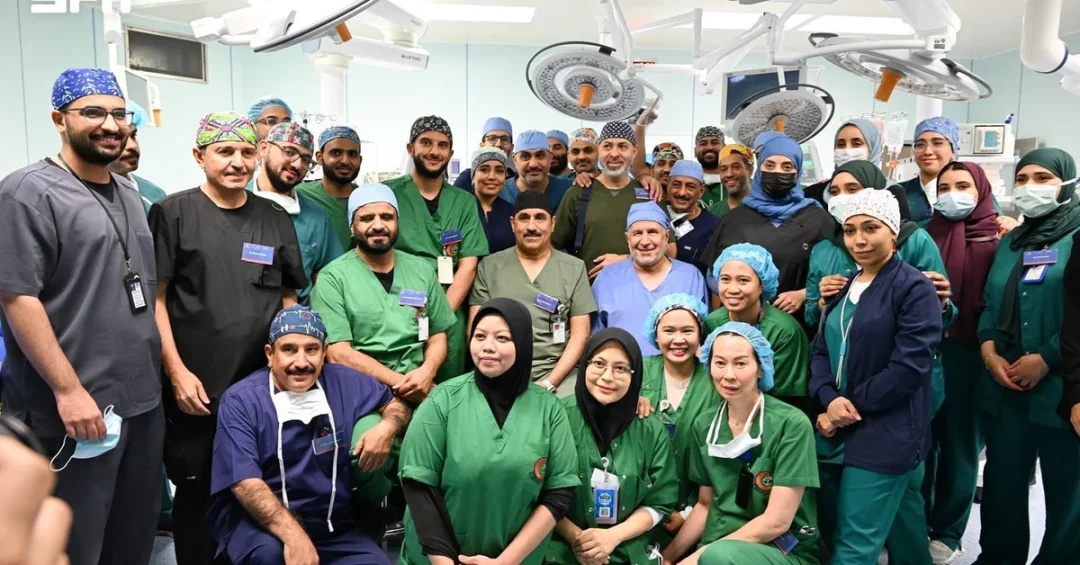
The specialized medical and surgical team of the Saudi Conjoined Twins Program successfully separated Fijian conjoined twins Jesepeli and Diceacea in a complex 12-hour and 45-minute operation performed at King Abdullah Specialized Children’s Hospital in Riyadh, the Saudi Press Agency reported on October 15, 2026. The procedure, carried out in nine distinct stages, marks the first time a conjoined twin separation has involved twins from the Republic of Fiji and represents the 74th operation in the history of a program that has spanned more than 35 years and touched 28 countries across five continents.
The announcement was made by Dr. Abdullah Al Rabeeah, Advisor at the Royal Court, Supervisor General of the King Salman Humanitarian Aid and Relief Center (KSrelief), and head of the medical and surgical team of the Saudi Conjoined Twins Program. The operation brought together 34 consultants, specialists, and technical and nursing staff drawn from anesthesiology, pediatric surgery, plastic surgery, orthopedic surgery, urology, and supporting specialties, underscoring the multidisciplinary depth that has become the hallmark of Saudi Arabia’s approach to the most delicate cases in pediatric surgery. For the family of the twins, the successful outcome represents the culmination of a journey that began with a shared diagnosis and ended with two children given the opportunity to live independent, dignified lives. But what does this milestone reveal about the broader trajectory of Saudi medical diplomacy, and why has a single operation in Riyadh resonated so widely across the Pacific and beyond?
Context and Background
How did a surgical program launched more than three decades ago become one of the Kingdom’s most recognizable humanitarian exports? The Saudi Conjoined Twins Program was established under the guidance of the Saudi leadership and has since grown into a globally recognized center of excellence for the assessment, management, and separation of conjoined twins. Over its history it has evaluated 159 cases from around the world, offering free specialized care to families who frequently arrive from countries where such complex interventions are unavailable or prohibitively expensive. The program’s reach now extends to 28 countries across five continents, a footprint that reflects both the technical capacity of Saudi medical institutions and the humanitarian principles that underpin the Kingdom’s international engagement.
The twins Jesepeli and Diceacea were joined at the abdomen and pelvis, a configuration that presented the surgical team with an exceptionally challenging anatomical picture. According to Dr. Al Rabeeah, the twins shared the liver, intestines, colon, anus, urinary system, reproductive system, and pelvic bone. Each of these shared structures required meticulous planning, because the separation of one system inevitably affects the function and viability of the others. The fact that the team was able to complete the separation in nine carefully sequenced stages, over nearly 13 hours, speaks to the level of preparation and rehearsal that precedes such operations. It also illustrates why the program has become a reference point for surgeons and health ministries worldwide.
King Abdullah Specialized Children’s Hospital, part of King Abdulaziz Medical City under the Ministry of National Guard Health Affairs in Riyadh, provided the clinical environment for the procedure. The hospital’s specialized pediatric intensive care, imaging, and surgical infrastructure are central to the program’s ability to accept the most complex international referrals. For Fiji, the operation represents a landmark moment in its own health history, as no Fijian conjoined twins had previously undergone separation under the Saudi program. The successful outcome is therefore not only a Saudi achievement but also a milestone for Pacific island medicine and for the family at the center of the story.
Key Details of the Operation
What does it take to separate twins who share vital organs and a pelvic bone? The operation was performed in nine stages, a structure that allowed the surgical team to address each shared system in a controlled sequence while continuously monitoring the stability of both children. The participation of 34 consultants, specialists, and technical and nursing staff reflects the scale of coordination required. Anesthesiology teams managed two patients simultaneously, pediatric surgeons led the abdominal and intestinal reconstruction, plastic surgeons focused on soft tissue coverage and wound closure, orthopedic surgeons addressed the shared pelvic bone, and urology specialists managed the urinary and reproductive systems. Supporting specialties ensured that blood products, imaging, and intensive care capacity were available throughout.
Dr. Al Rabeeah described the outcome as a result of divine guidance and the collective effort of the team, saying the twins were successfully separated after 12 hours and 45 minutes. The complexity of the case lay not only in the number of shared organs but in the fact that the twins shared the liver, intestines, colon, anus, urinary system, reproductive system, and pelvic bone. Each of these structures had to be divided in a way that preserved function for both children, a task that demanded preoperative imaging, three-dimensional modeling, and a shared surgical plan that could be adapted in real time. The nine-stage approach allowed the team to pause, reassess, and proceed only when both twins were stable, a strategy that has become characteristic of the program’s methodology.
The operation was the 74th in the history of the Saudi Conjoined Twins Program and the first involving twins from Fiji. Dr. Al Rabeeah noted that the program has assessed 159 cases worldwide and has covered 28 countries across five continents. These figures are significant because they demonstrate consistency over time. A single successful operation can be attributed to many factors, but 74 operations over more than 35 years indicate a sustained institutional commitment, a deep bench of experienced clinicians, and a system for selecting and preparing cases that has been refined across generations of patients. The program’s cumulative experience is itself a form of medical infrastructure, one that benefits every new family that arrives in Riyadh.
International and Regional Impact
Why does a surgical success in Riyadh matter to families and health systems thousands of kilometers away? The Saudi Conjoined Twins Program is one of the clearest examples of Saudi Arabia’s humanitarian diplomacy in action. By offering complex, free-of-charge surgical care to international patients, the Kingdom translates its foreign policy principles into tangible outcomes that are visible, verifiable, and deeply personal. For Pacific island nations such as Fiji, where specialized pediatric surgical capacity is limited, the program provides access to a level of care that would otherwise require travel to a handful of global centers. The successful separation of Jesepeli and Diceacea therefore strengthens the case for continued international referral partnerships and reinforces Saudi Arabia’s reputation as a reliable partner in global health.
The regional dimension is equally important. Within the Middle East, the program contributes to Saudi Arabia’s standing as a hub for advanced medical services, attracting patients, clinicians, and researchers who wish to learn from its methods. The participation of multidisciplinary teams from multiple specialties creates opportunities for training and knowledge exchange, both within the Kingdom and with visiting international colleagues. The Fijian twins’ family expressed deep gratitude to the Custodian of the Two Holy Mosques King Salman bin Abdulaziz Al Saud and to His Royal Highness Prince Mohammed bin Salman bin Abdulaziz Al Saud, Crown Prince and Prime Minister, for the advanced medical care provided, praising the Saudi medical team’s efforts in ensuring the success of the operation and the twins’ safety. That expression of gratitude reflects the personal impact of the program and the diplomatic goodwill it generates.
Economic and Strategic Significance
How does a humanitarian medical program connect to a national transformation agenda? Saudi Arabia’s healthcare sector is a central pillar of Vision 2030, which seeks to diversify the economy, improve quality of life, and position the Kingdom as a global destination for advanced services. The Saudi Conjoined Twins Program demonstrates that Saudi institutions can compete at the highest level of medical complexity, and it serves as a proof point for the broader development of the health sector. The expertise accumulated through 74 operations feeds into training programs, clinical research, and the development of specialized centers that benefit Saudi patients as well. In this sense, the program is both a humanitarian endeavor and an investment in national capability.
The strategic value of the program also lies in its contribution to Saudi Arabia’s international image. Dr. Al Rabeeah affirmed that Saudi Arabia’s medical excellence through the Saudi Conjoined Twins Program, and its established global leadership in managing the most delicate and complex cases, result from a profound humanitarian vision and sincere determination. These have made the program a source of hope born from suffering and a new dawn for families who have long wished to see their children together in a dignified life. The consecutive successes of the Saudi medical team, through advanced expertise and high-level capabilities, have reinforced Saudi Arabia’s position as a leading global center in this specialized field. That reputation has economic and diplomatic value, supporting the Kingdom’s broader goals of attracting investment, talent, and international partnerships.
Vision 2030 Alignment
What does the future hold for a program that has already changed the lives of families from 28 countries? The Saudi Conjoined Twins Program aligns directly with Vision 2030’s health sector transformation, which aims to enhance the quality and efficiency of healthcare, expand specialized services, and strengthen the Kingdom’s role as a regional and global leader in medicine. The program’s track record supports these objectives by demonstrating that Saudi Arabia can deliver world-class care in highly complex cases, while also contributing to the humanitarian dimension of the Kingdom’s foreign policy. As Vision 2030 continues to reshape the health sector, the program is well positioned to expand its reach, train more specialists, and deepen collaborations with international institutions.
The success of Jesepeli and Diceacea is a reminder that the most meaningful measures of national progress are often human. Dr. Al Rabeeah expressed his gratitude to the Custodian of the Two Holy Mosques King Salman bin Abdulaziz Al Saud and to His Royal Highness Prince Mohammed bin Salman bin Abdulaziz Al Saud, Crown Prince and Prime Minister, for their generous support of the Saudi Conjoined Twins Program, which has helped establish Saudi Arabia as a global leader in this field. He also thanked the medical and surgical team for its efforts in achieving this new medical milestone. For the twins and their family, the operation opens a new chapter; for Saudi Arabia, it adds another entry to a record of humanitarian achievement that continues to grow, one patient, one family, and one country at a time.
20 Questions
Q1. What was the major medical achievement announced by Saudi Arabia on October 15, 2026?
A1. The Saudi Conjoined Twins Program successfully separated Fijian conjoined twins Jesepeli and Diceacea in a 12-hour and 45-minute operation at King Abdullah Specialized Children’s Hospital in Riyadh, marking the first such separation for twins from Fiji.
Q2. Who led the surgical team that performed the operation?
A2. The team was led by Dr. Abdullah Al Rabeeah, Advisor at the Royal Court, Supervisor General of the King Salman Humanitarian Aid and Relief Center, and head of the medical and surgical team of the Saudi Conjoined Twins Program.
Q3. Where was the separation surgery performed?
A3. The operation took place at King Abdullah Specialized Children’s Hospital, part of King Abdulaziz Medical City under the Ministry of National Guard Health Affairs in Riyadh, Saudi Arabia.
Q4. How long did the operation take and how many stages were involved?
A4. The surgery lasted 12 hours and 45 minutes and was carried out in nine carefully sequenced stages, allowing the team to monitor both twins continuously throughout the procedure.
Q5. How many medical professionals participated in the operation?
A5. A total of 34 consultants, specialists, and technical and nursing staff participated, representing anesthesiology, pediatric surgery, plastic surgery, orthopedic surgery, urology, and supporting specialties.
Q6. What organs and structures did the twins share?
A6. Jesepeli and Diceacea were joined at the abdomen and pelvis and shared the liver, intestines, colon, anus, urinary system, reproductive system, and pelvic bone, requiring complex reconstruction.
Q7. Was this the first separation involving twins from Fiji?
A7. Yes, it was the first conjoined twin separation operation involving twins from the Republic of Fiji, according to Dr. Abdullah Al Rabeeah, who announced the milestone.
Q8. How many operations has the Saudi Conjoined Twins Program performed in total?
A8. This was the 74th operation in the history of the Saudi Conjoined Twins Program, which spans more than 35 years of continuous specialized service.
Q9. How many countries has the program reached and how many cases has it assessed?
A9. The program has covered 28 countries across five continents and has assessed 159 cases worldwide, offering specialized care to international families.
Q10. What did Dr. Al Rabeeah say about the significance of the achievement?
A10. He said Saudi Arabia’s medical excellence and global leadership in managing the most delicate cases result from a profound humanitarian vision and sincere determination, making the program a source of hope for families.
Q11. How did the twins’ family respond to the successful operation?
A11. The Fijian twins’ family expressed deep gratitude to the Custodian of the Two Holy Mosques King Salman bin Abdulaziz Al Saud and to Crown Prince Mohammed bin Salman for the advanced medical care and the team’s efforts.
Q12. Which Saudi leaders were thanked for their support of the program?
A12. Dr. Al Rabeeah thanked the Custodian of the Two Holy Mosques King Salman bin Abdulaziz Al Saud and His Royal Highness Prince Mohammed bin Salman bin Abdulaziz Al Saud, Crown Prince and Prime Minister, for their generous support.
Q13. What is the King Salman Humanitarian Aid and Relief Center’s role in this context?
A13. KSrelief, led by Dr. Abdullah Al Rabeeah, supports humanitarian initiatives, and its leadership is closely connected to the Saudi Conjoined Twins Program’s international outreach and coordination.
Q14. Why is this operation considered a milestone for Saudi medical diplomacy?
A14. It demonstrates Saudi Arabia’s capacity to provide free, highly complex surgical care to international patients, reinforcing the Kingdom’s reputation as a global leader in humanitarian medicine and specialized pediatric surgery.
Q15. What specialties were involved in the multidisciplinary team?
A15. The team included anesthesiology, pediatric surgery, plastic surgery, orthopedic surgery, urology, and supporting specialties, reflecting the comprehensive nature of conjoined twin separation.
Q16. How does the program contribute to Vision 2030?
A16. It supports Vision 2030’s health sector transformation by enhancing specialized care, building national expertise, and positioning Saudi Arabia as a global destination for advanced medical services.
Q17. What does the program’s 35-year history indicate about Saudi healthcare?
A17. It shows sustained institutional commitment, accumulated expertise, and a refined system for managing complex cases, which benefits both Saudi and international patients over the long term.
Q18. How does the success affect families in Fiji and the Pacific region?
A18. It provides hope and access to advanced care that is limited in the region, strengthening health partnerships and demonstrating the program’s global humanitarian reach.
Q19. What happens next for the twins after the separation?
A19. The twins will receive postoperative care and rehabilitation at the hospital, with the medical team monitoring their recovery and supporting their transition to independent lives.
Q20. What message does this achievement send to the international community?
A20. It signals that Saudi Arabia is a reliable partner in global health, capable of delivering world-class care and committed to humanitarian values that transcend borders and benefit families worldwide.
Reader Feedback
We value your thoughts. Please share your feedback on this article.
Your feedback helps us improve our coverage.