


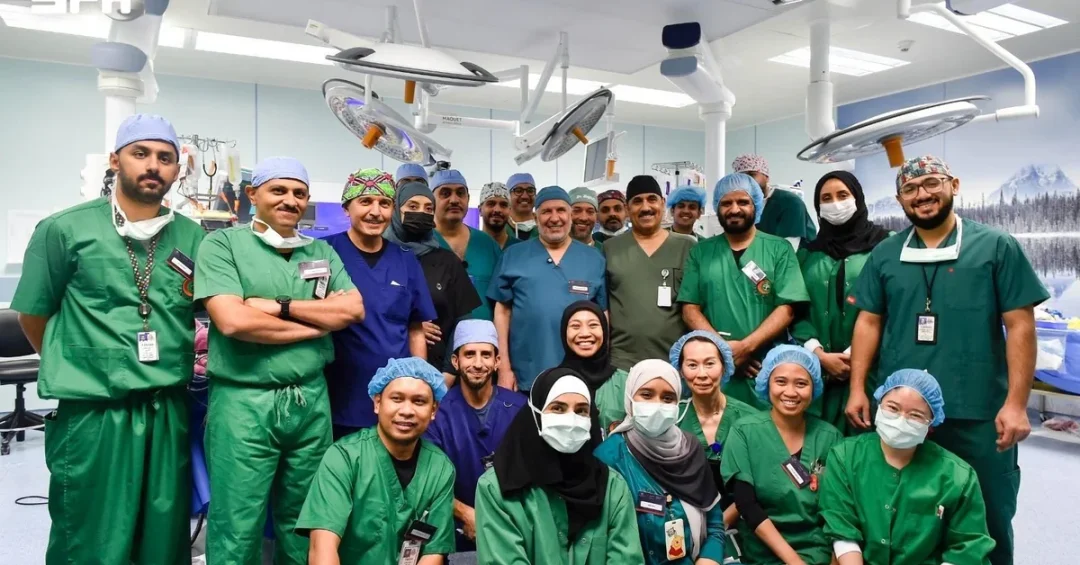
A Saudi medical and surgical team successfully separated Moroccan conjoined twins Saja and Doha in a six-hour operation at King Abdullah Specialist Children’s Hospital in Riyadh on Thursday, October 8, 2026. The procedure, conducted under the Saudi Conjoined Twins Program, was announced by Dr. Abdullah Al Rabeeah, Advisor at the Royal Court, Supervisor General of the King Salman Humanitarian Aid and Relief Center (KSrelief), and head of the medical and surgical team.
Context and Background
The Saudi Conjoined Twins Program, operating for over 35 years, has evaluated 159 cases from 28 countries, performing 73 separation surgeries. This latest operation marks the fourth separation of Moroccan conjoined twins. The program exemplifies Saudi Arabia’s leadership in humanitarian and medical work, supported directly by Custodian of the Two Holy Mosques King Salman bin Abdulaziz Al Saud and His Royal Highness Prince Mohammed bin Salman bin Abdulaziz Al Saud, Crown Prince and Prime Minister.
Key Details
The surgery was completed in six distinct stages over six hours. A team of 23 consultants, specialists, nurses, and technicians from anesthesiology, pediatric surgery, plastic surgery, and other supporting specialties participated. The twins were conjoined at the lower chest and abdomen, sharing the pericardium, liver, and intestines. Dr. Al Rabeeah noted that the operation ensured the highest levels of precision and safety at every stage.
Implications and Impact
This successful separation underscores Saudi Arabia’s advanced medical capabilities and its commitment to humanitarian causes. It strengthens diplomatic ties with Morocco and enhances the Kingdom’s global reputation as a leader in complex surgical interventions. The twins’ family expressed gratitude to King Salman and Crown Prince Mohammed bin Salman for their care and praised the medical team’s efforts.
Vision 2030 Alignment
This achievement aligns with Saudi Vision 2030’s goals of enhancing healthcare excellence and showcasing the Kingdom’s global humanitarian role. It reflects the nation’s dedication to innovation and international cooperation, contributing to a brighter future for all.
20 Questions
Q1. What is the Saudi Conjoined Twins Program?
A1. The Saudi Conjoined Twins Program is a humanitarian initiative that provides free separation surgeries for conjoined twins from around the world. It has been operating for over 35 years and is funded by the Saudi government.
Q2. Who led the surgical team that separated Saja and Doha?
A2. Dr. Abdullah Al Rabeeah, Advisor at the Royal Court and Supervisor General of KSrelief, led the team. He is a renowned pediatric surgeon and has overseen many such operations.
Q3. Where did the surgery take place?
A3. The surgery was performed at King Abdullah Specialist Children’s Hospital, part of King Abdulaziz Medical City of the Ministry of National Guard in Riyadh, Saudi Arabia.
Q4. How long did the operation last?
A4. The operation lasted six hours, conducted in six distinct stages. This duration is typical for complex conjoined twin separations.
Q5. What were the twins conjoined at?
A5. Saja and Doha were conjoined at the lower chest and abdomen. They shared vital organs including the pericardium, liver, and intestines.
Q6. How many medical professionals participated in the surgery?
A6. A total of 23 consultants, specialists, nurses, and technicians took part. They represented specialties such as anesthesiology, pediatric surgery, and plastic surgery.
Q7. How many conjoined twin separations has Saudi Arabia performed?
A7. This was the 73rd operation under the Saudi Conjoined Twins Program. Over 35 years, the program has evaluated 159 cases from 28 countries.
Q8. Is this the first time Moroccan twins were separated in Saudi Arabia?
A8. No, this is the fourth separation of Moroccan conjoined twins in Saudi Arabia. The program has a history of assisting Moroccan families.
Q9. Who supports the Saudi Conjoined Twins Program?
A9. The program is under the direct patronage of King Salman bin Abdulaziz Al Saud and Crown Prince Mohammed bin Salman bin Abdulaziz Al Saud. Their support enables free treatment for international cases.
Q10. What did the twins’ family say about the surgery?
A10. The family thanked King Salman and Crown Prince Mohammed bin Salman for their care. They also praised the medical team’s efforts and professionalism.
Q11. How does this surgery reflect Saudi Arabia’s humanitarian role?
A11. It demonstrates Saudi Arabia’s commitment to helping people in need globally. The program is a key part of the Kingdom’s humanitarian aid efforts through KSrelief.
Q12. What is KSrelief?
A12. KSrelief is the King Salman Humanitarian Aid and Relief Center. It is a leading Saudi organization that provides international humanitarian assistance and is led by Dr. Abdullah Al Rabeeah.
Q13. How does the Saudi Conjoined Twins Program align with Vision 2030?
A13. It supports Vision 2030’s goals of enhancing healthcare and global engagement. The program showcases Saudi medical excellence and humanitarian leadership.
Q14. What specialties were involved in the operation?
A14. The team included experts in anesthesiology, pediatric surgery, plastic surgery, and other supporting fields. Their collaboration ensured a successful outcome.
Q15. What challenges are typical in conjoined twin separations?
A15. Such surgeries are complex due to shared organs and blood vessels. They require meticulous planning and precision to minimize risks to both twins.
Q16. How many countries have benefited from the program?
A16. Twins from 28 countries have been evaluated by the program. Many have received life-changing separation surgeries in Saudi Arabia.
Q17. What is the significance of the six-hour duration?
A17. The six-hour duration reflects efficient and precise surgical work. It indicates careful management of the complex procedure without unnecessary delay.
Q18. Will the twins require further medical care?
A18. They will receive post-operative care at the hospital. The medical team will monitor their recovery and provide rehabilitation as needed.
Q19. How does this surgery impact Saudi-Morocco relations?
A19. It strengthens bilateral ties through humanitarian cooperation. Morocco has expressed gratitude for Saudi Arabia’s assistance in such cases.
Q20. What is the broader impact of the Saudi Conjoined Twins Program?
A20. The program enhances Saudi Arabia’s global standing as a leader in humanitarian medicine. It saves lives and promotes international goodwill.
Reader Feedback
We value your thoughts. Please share your feedback on this article.
Your feedback helps us improve our coverage.