


The Saudi Food and Drug Authority (SFDA) has launched the New Accelerator Program for Drugs in Rare Diseases (NADR), a specialized regulatory initiative designed to accelerate the development of and access to medicines for rare diseases, empower researchers and developers, and advance healthcare innovation across the Kingdom. Announced via the Saudi Press Agency, the program operates within the SFDA’s existing regulatory framework and introduces a tailored package of scientific and regulatory incentives intended to streamline the development, evaluation, and authorization of rare disease treatments. The initiative marks a significant step in Saudi Arabia’s efforts to strengthen its healthcare system and position itself among leading nations in supporting researchers and fostering innovative medical solutions.
The NADR program reflects a growing global recognition that rare diseases, though individually uncommon, collectively affect millions of people worldwide. In Saudi Arabia, where consanguineous marriage rates are relatively high, the burden of rare genetic disorders is particularly pronounced, making the need for dedicated regulatory pathways especially urgent. By creating a structured, incentive-driven route for rare disease drug development, the SFDA is addressing a long-standing gap in the pharmaceutical landscape. The program is designed to support products at any stage of development, whether still in early research or already authorized by another regulatory authority but not yet registered in the Kingdom. This inclusive approach ensures that both local and international developers can participate, ultimately expanding treatment options for Saudi patients.
Context and Background
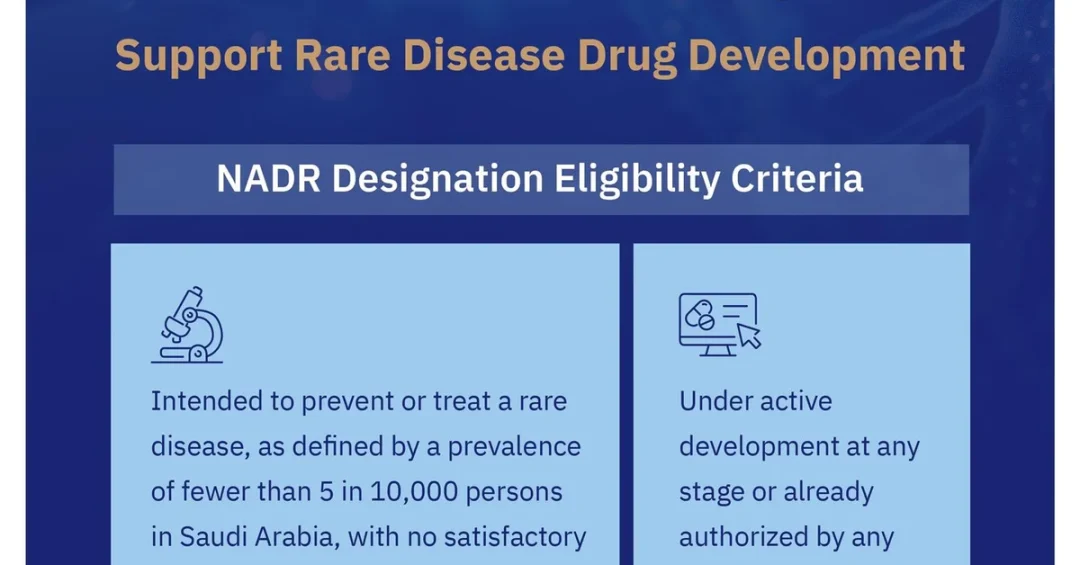
What makes the launch of NADR so timely for Saudi Arabia’s healthcare transformation? For years, patients with rare diseases in the Kingdom have faced significant hurdles in accessing innovative therapies, largely because global pharmaceutical development has historically focused on more common conditions with larger commercial markets. Rare diseases, defined by the SFDA as conditions affecting fewer than 5 in 10,000 persons in Saudi Arabia, often lack satisfactory treatment options, and the small patient populations make clinical trials and regulatory evaluation challenging. The SFDA’s decision to establish a dedicated accelerator program signals a strategic shift toward addressing these unmet needs through regulatory innovation. The program’s eligibility criteria are carefully calibrated: a drug qualifies if no satisfactory treatment exists in Saudi Arabia, or if the product offers significant clinical benefit over currently available therapeutic options. This dual criterion ensures that NADR prioritizes genuinely transformative therapies rather than incremental improvements.
The SFDA has long been recognized as one of the region’s most proactive regulatory bodies, frequently aligning its practices with international standards set by the U.S. Food and Drug Administration and the European Medicines Agency. The launch of NADR builds on this reputation, demonstrating the Kingdom’s commitment to regulatory excellence and patient-centric care. The program also complements broader national efforts to localize pharmaceutical manufacturing and reduce dependence on imported medicines, a key pillar of economic diversification. By incentivizing rare disease drug development, the SFDA is not only improving patient outcomes but also attracting investment and expertise to Saudi Arabia’s growing life sciences sector. This holistic approach reflects the interconnected nature of healthcare, economic development, and innovation that defines the Kingdom’s modernization agenda.
Globally, regulatory incentives for rare disease drugs, often called orphan drugs, have become a hallmark of advanced healthcare systems. The United States introduced the Orphan Drug Act in 1983, and the European Union followed with its own orphan regulation in 2000. These frameworks have spurred the development of hundreds of therapies for previously neglected conditions. Saudi Arabia’s NADR program draws on these international best practices while adapting them to the Kingdom’s specific epidemiological and regulatory context. The program’s emphasis on flexible clinical evidence requirements acknowledges the reality that rare disease trials often involve small patient numbers, making traditional large-scale randomized controlled trials impractical. By offering alternative evaluation pathways, the SFDA is enabling developers to bring promising therapies to market faster without compromising safety or efficacy standards. This pragmatic flexibility is a sign of a maturing regulatory system that understands the nuances of rare disease research.
Key Details of the NADR Program
How exactly will the NADR program support drug developers and patients? The SFDA has outlined a comprehensive suite of incentives and support measures. First, the program provides dedicated scientific and regulatory guidance, meaning developers can receive expert advice from the SFDA throughout the development process, from preclinical stages to post-authorization. This guidance helps navigate the complex regulatory landscape and reduces the risk of costly delays. Second, the program embraces flexible and innovative approaches to evaluating clinical evidence, explicitly taking into account the challenges associated with small patient populations. This could include accepting real-world data, adaptive trial designs, or extrapolation from other populations where appropriate. Third, NADR offers streamlined procedures for manufacturer site registration, cutting red tape for companies looking to establish or expand their presence in Saudi Arabia. Fourth, the program allows for flexible requirements for periodic safety update reports, where appropriate, reducing administrative burdens while maintaining robust pharmacovigilance.
Eligibility for NADR designation is broad but precise. A drug candidate must target a rare, life-threatening, or seriously debilitating disease as defined by the prevalence threshold of fewer than 5 in 10,000 persons in Saudi Arabia. The product must either address a condition with no satisfactory treatment available in the Kingdom or demonstrate significant clinical benefit over existing options. Importantly, the product can be under active development at any stage, or it may already be authorized by any regulatory authority but not yet registered in Saudi Arabia. This latter provision is particularly significant because it opens the door for therapies already approved elsewhere to be brought into the Kingdom more swiftly, potentially benefiting Saudi patients who currently rely on unregistered imports or travel abroad for treatment. The SFDA has emphasized that facilitating timely access to medicines for patients with rare diseases remains a key priority, and NADR is the operational vehicle for that commitment.
The program’s design also reflects a deep understanding of the economic realities of rare disease drug development. Developing a single orphan drug can cost hundreds of millions of dollars, and the small patient populations mean that companies must often charge high prices to recoup their investment. By providing regulatory incentives such as expedited reviews and flexible evidence requirements, the SFDA reduces the time and cost of bringing a drug to market, which can help moderate pricing pressures while still encouraging innovation. Additionally, the streamlined site registration process makes Saudi Arabia a more attractive location for clinical trials and manufacturing, potentially creating high-skilled jobs and building local expertise. The SFDA has not announced specific financial incentives, but the regulatory benefits alone are substantial, as evidenced by the success of similar programs in other countries. The NADR program thus represents a strategic investment in both patient welfare and the Kingdom’s burgeoning biotechnology ecosystem.
International and Regional Impact
How will the NADR program resonate beyond Saudi Arabia’s borders? The initiative positions the Kingdom as a regional leader in rare disease policy, potentially influencing other Gulf Cooperation Council (GCC) states to adopt similar frameworks. Saudi Arabia’s market size and regulatory influence mean that a program like NADR can serve as a model for the wider Middle East and North Africa region, where rare disease awareness and treatment access are often limited. By aligning with international standards and offering a clear, predictable pathway for drug developers, the SFDA enhances the Kingdom’s attractiveness as a destination for clinical research and pharmaceutical investment. International companies that receive NADR designation may also use Saudi clinical data to support regulatory submissions in other countries, creating a virtuous cycle of data generation and mutual recognition. This could lead to faster global access to rare disease therapies, with Saudi Arabia playing a central role in that acceleration.
Moreover, the NADR program strengthens Saudi Arabia’s participation in global health diplomacy. The Kingdom has increasingly taken a leadership role in international health initiatives, from pandemic preparedness to digital health innovation. By establishing a robust rare disease drug development framework, Saudi Arabia signals its commitment to equitable access to healthcare, a principle enshrined in the United Nations Sustainable Development Goals. The program also complements the SFDA’s existing international partnerships, including memoranda of understanding with regulatory agencies in Europe, Asia, and the Americas. These collaborations facilitate information sharing and capacity building, ensuring that the NADR program benefits from global best practices while contributing Saudi expertise to the international regulatory community. For patients in the region, the program offers hope that life-saving treatments will become available closer to home, reducing the need for costly and emotionally taxing medical travel.
Economic and Strategic Significance
What does the NADR program mean for Saudi Arabia’s economic diversification and strategic autonomy? Healthcare is a cornerstone of the Kingdom’s Vision 2030 agenda, which seeks to transform the nation into a diversified, knowledge-based economy. The pharmaceutical and biotechnology sectors are key targets for localization, and rare disease drug development represents a high-value niche where Saudi Arabia can build competitive advantage. By incentivizing companies to conduct research, clinical trials, and manufacturing within the Kingdom, NADR contributes to the growth of a skilled workforce and the transfer of advanced technologies. This aligns with the National Industrial Development and Logistics Program (NIDLP) and the broader goals of increasing non-oil exports and attracting foreign direct investment. The program also supports the Public Investment Fund’s (PIF) strategic investments in healthcare, which aim to create integrated ecosystems that improve quality of life and generate sustainable economic returns.
Strategically, reducing reliance on imported medicines is a matter of national resilience. The COVID-19 pandemic exposed vulnerabilities in global supply chains, prompting many countries to rethink their pharmaceutical sourcing strategies. Rare disease therapies are often biologics or advanced therapies with complex manufacturing processes, making domestic or regional production capacity particularly valuable. The NADR program’s incentives for manufacturer site registration and streamlined procedures encourage companies to establish a local presence, which can lead to technology transfer and the development of a domestic biomanufacturing base. Over time, this could position Saudi Arabia as a hub for rare disease drug production, serving not only the Kingdom but also neighboring markets. The economic ripple effects include job creation in research, manufacturing, and regulatory affairs, as well as increased tax revenues and export earnings. The SFDA’s initiative is thus a strategic lever for both health security and economic growth.
Vision 2030 Alignment
How does the NADR program embody the aspirations of Saudi Vision 2030? The Vision, launched in 2016 by Crown Prince Mohammed bin Salman, sets out a comprehensive roadmap for diversifying the economy, empowering citizens, and enhancing quality of life. Within its Health Sector Transformation Program, the Vision aims to improve healthcare accessibility, quality, and efficiency through innovation and public-private partnerships. The NADR program directly supports these objectives by addressing unmet medical needs for rare disease patients, who often fall through the cracks of traditional healthcare systems. It also fosters a culture of research and development, encouraging scientists and entrepreneurs to tackle complex health challenges. By providing a predictable and supportive regulatory environment, the SFDA is helping to build an ecosystem where innovation can thrive, ultimately contributing to the Vision’s goal of a vibrant, knowledge-based society.
Furthermore, the NADR program reflects the Vision’s emphasis on global engagement and leadership. Saudi Arabia is not merely a participant in global health conversations but an active shaper of them. The Kingdom’s commitment to rare disease drug development demonstrates its willingness to invest in cutting-edge solutions and share its experiences with the world. As the program matures, it is expected to generate valuable data and best practices that can inform international regulatory science. For patients and families affected by rare diseases, the message is clear: Saudi Arabia is committed to leaving no one behind. The SFDA’s launch of NADR is a testament to the Kingdom’s compassionate and forward-looking approach to healthcare, one that integrates scientific rigor, economic pragmatism, and social responsibility. In the years ahead, the program will undoubtedly become a cornerstone of Saudi Arabia’s reputation as a global leader in health innovation and patient-centered care.
20 Questions
Q1. What is the NADR program?
A1. The New Accelerator Program for Drugs in Rare Diseases (NADR) is a specialized regulatory initiative launched by the Saudi Food and Drug Authority (SFDA) to support the development of and access to medicines for rare diseases in Saudi Arabia.
Q2. When was the NADR program launched?
A2. The SFDA announced the launch of the NADR program on August 13, 2026, as reported by the Saudi Press Agency (SPA). The program operates within the SFDA’s existing regulatory framework.
Q3. What is the definition of a rare disease under the NADR program?
A3. The SFDA defines a rare disease as one with a prevalence of fewer than 5 in 10,000 persons in Saudi Arabia. The disease must also be life-threatening or seriously debilitating to qualify for the program.
Q4. What are the eligibility criteria for a drug to receive NADR designation?
A4. A drug must target a rare disease, and either no satisfactory treatment exists in Saudi Arabia or the product offers significant clinical benefit over available options. It can be in development or already authorized abroad but not registered in the Kingdom.
Q5. What incentives does the NADR program offer to drug developers?
A5. The program provides dedicated scientific and regulatory guidance, flexible approaches to clinical evidence evaluation, streamlined manufacturer site registration, and flexible requirements for periodic safety update reports where appropriate.
Q6. How does NADR address the challenge of small patient populations in clinical trials?
A6. NADR allows for flexible and innovative approaches to evaluating clinical evidence, recognizing that traditional large-scale trials are often impractical for rare diseases. This may include adaptive designs or real-world data.
Q7. Can drugs already approved in other countries benefit from NADR?
A7. Yes, products already authorized by any regulatory authority but not yet registered in Saudi Arabia are eligible for NADR designation, potentially accelerating their availability to Saudi patients.
Q8. What is the role of the SFDA in the NADR program?
A8. The SFDA administers the NADR program, provides scientific and regulatory guidance, evaluates applications, and oversees the streamlined procedures for development, evaluation, and authorization of rare disease drugs.
Q9. How does NADR align with Saudi Vision 2030?
A9. NADR supports Vision 2030’s Health Sector Transformation Program by improving access to innovative treatments, fostering research and development, and enhancing the Kingdom’s healthcare system and economic diversification.
Q10. What is the significance of the prevalence threshold of fewer than 5 in 10,000?
A10. This threshold is consistent with international definitions of rare diseases, such as those used in the United States and European Union, ensuring alignment with global regulatory standards and facilitating international collaboration.
Q11. Will NADR help reduce the need for patients to travel abroad for treatment?
A11. Yes, by accelerating the registration of rare disease drugs in Saudi Arabia, NADR aims to make treatments available locally, reducing the burden and cost of medical travel for patients and their families.
Q12. Does NADR include financial incentives for developers?
A12. The SFDA has not announced direct financial incentives. The program focuses on regulatory incentives such as expedited reviews, flexible evidence requirements, and streamlined processes that reduce time and cost to market.
Q13. How does NADR support local research and development?
A13. NADR encourages researchers and developers to conduct studies in Saudi Arabia by providing clear regulatory pathways and support, potentially leading to more local clinical trials and collaborations with international partners.
Q14. What types of diseases are considered rare in Saudi Arabia?
A14. Rare diseases in Saudi Arabia include many genetic disorders, such as certain metabolic conditions, neuromuscular diseases, and blood disorders, which are more prevalent due to high consanguinity rates in the population.
Q15. Can a drug be under development at any stage to qualify for NADR?
A15. Yes, the SFDA states that a product can be under active development at any stage, from preclinical to late-stage clinical trials, to be eligible for NADR designation.
Q16. How does NADR compare to orphan drug programs in other countries?
A16. NADR draws on international best practices, similar to the U.S. Orphan Drug Act and EU orphan regulation, but is tailored to Saudi Arabia’s regulatory context and epidemiological needs.
Q17. What is the expected impact of NADR on Saudi Arabia’s healthcare system?
A17. NADR is expected to expand treatment options for rare disease patients, stimulate pharmaceutical innovation, attract investment, and enhance the Kingdom’s position as a regional leader in healthcare.
Q18. How will the SFDA ensure the safety of drugs approved under NADR?
A18. The SFDA maintains rigorous safety standards, including pharmacovigilance requirements. NADR allows flexible periodic safety update reports but does not compromise on post-market surveillance.
Q19. What should a developer do to apply for NADR designation?
A19. Developers should contact the SFDA directly to initiate the application process. The SFDA provides guidance on the required documentation and procedures for NADR designation.
Q20. Where can I find more information about the NADR program?
A20. More information is available through the Saudi Food and Drug Authority’s official channels and the Saudi Press Agency, which published the initial announcement on August 13, 2026.
Reader Feedback
We value your thoughts. Please share your feedback on this article.
Your feedback helps us improve our coverage.
Related articles
 University of Ha’il Launches ‘Hour of Walking’ Health Initiative
 Riyadh to Host Ninth Global Health Exhibition in October
 Riyadh to Host Ninth World Health Forum in October 2026
 Saudi Arabia Extends Healthcare Accreditation Services Globally
 Al-Maliha Health Center in Najran Earns CBAHI Accreditation
 Robotic Hybrid Surgery Removes Tumor at Makkah Medical City