


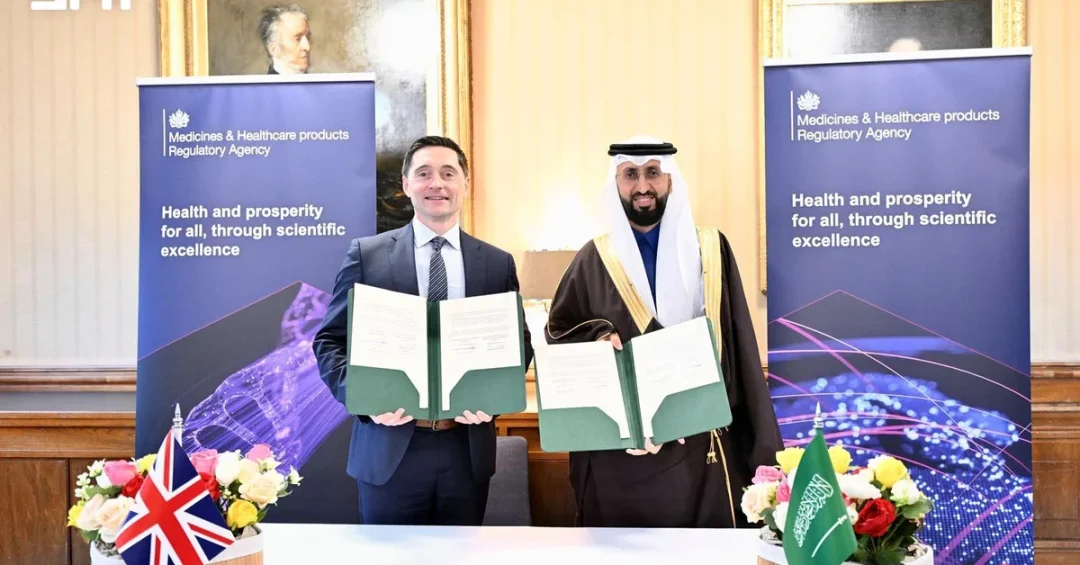
The Saudi Food and Drug Authority (SFDA) has signed a memorandum of understanding with the UK’s Medicines and Healthcare products Regulatory Agency (MHRA) to enhance the evaluation of innovative therapies and facilitate timely patient access while maintaining high standards of safety, quality, and efficacy, the Saudi Press Agency reported. The agreement was signed on the sidelines of the DIA–MHRA Global Summit, held in London on November 16–17, 2026, marking a significant step in deepening regulatory cooperation between the Kingdom and one of the world’s most established medicines regulators.
The MoU was signed by Chief Executive Officer of the SFDA Dr. Hisham Aljadhey and Chief Executive of the MHRA Lawrence Tallon, in the presence of MHRA Chair Prof. Anthony Harnden. Following the signing ceremony, the two sides held a bilateral meeting to discuss cooperation priorities in light of the latest scientific and regulatory developments. Why does this partnership matter so much at this particular moment in global healthcare? The answer lies in the accelerating pace of medical innovation and the shared determination of both regulators to keep patients at the center of their work.
Context and Background
The agreement builds on existing collaboration between the two agencies and reflects a shared commitment to keeping pace with medical innovation. For years, the SFDA has positioned itself as a proactive, science-driven regulator, and this MoU formalizes and expands a relationship that has been developing steadily. What does it take for a national regulator to earn a place at the table with global leaders in medicines oversight? In Saudi Arabia’s case, it has taken sustained investment in scientific capacity, transparent processes, and a clear strategic vision.
The DIA–MHRA Global Summit in London provided a fitting stage for the signing, bringing together regulators, industry experts, and scientific leaders from around the world. By choosing this forum, the SFDA underscored its intention to remain fully integrated into the international regulatory community. The presence of Prof. Anthony Harnden, Chair of the MHRA, at the signing further signals the high level of institutional commitment behind the partnership. Such high-level engagement is not merely symbolic; it reflects a working relationship built on mutual respect and shared scientific standards.
The MoU arrives as regulators worldwide grapple with how to evaluate a new generation of complex products — from gene therapies to personalized medicines — without compromising safety. How can regulators accelerate access while preserving the rigorous standards that patients and physicians depend upon? This is precisely the question the SFDA and MHRA intend to address together, combining their expertise to develop practical, evidence-based approaches.
Key Details of the Agreement
The MoU covers the assessment of treatments for rare diseases, advanced therapies, and biotechnology products. These categories represent some of the most promising and most complex areas of modern medicine, where patients often face limited therapeutic options and urgent unmet needs. By cooperating on these fronts, the two agencies help provide developers with greater clarity on regulatory requirements early in the development process, particularly when developing treatments for patients with limited alternatives.
The agreement also includes the exchange of knowledge on applying artificial intelligence, modeling, and computer simulation in clinical studies and trials. How might these digital tools reshape the way new medicines are tested and approved? By sharing expertise in these emerging methods, the SFDA and MHRA aim to harness technology responsibly, improving the efficiency and precision of regulatory science while safeguarding the integrity of clinical evidence.
Under the MoU, the two agencies will exchange information and expertise in medical product registration and assessment, Good Manufacturing Practices (GMP), quality management systems, product testing and analysis, and supply chain monitoring. Together, these efforts support the safety of medical products in both the Saudi and UK markets and strengthen each side’s ability to identify and mitigate associated risks. Is it any wonder that supply chain resilience has become a central concern for regulators everywhere? The MoU places this concern squarely within a framework of practical, bilateral cooperation.
International and Regional Impact
The implications of this partnership extend well beyond the two signatories. The United Kingdom’s MHRA is widely regarded as one of the world’s leading regulatory authorities, and its willingness to deepen cooperation with the SFDA reflects the Kingdom’s growing stature in global health governance. For international audiences, the agreement signals that Saudi Arabia is a reliable, forward-looking partner in the effort to bring safe and effective medicines to patients faster.
Regionally, the MoU strengthens the Kingdom’s position as a hub for regulatory excellence in the Middle East. By aligning approaches to product assessment and quality assurance with a respected global counterpart, the SFDA enhances confidence among international manufacturers and innovators considering the Saudi market. Does this not send a powerful message about the attractiveness of the Kingdom’s healthcare landscape? It reinforces Saudi Arabia’s reputation as a destination where innovation is welcomed and where regulatory processes are transparent, rigorous, and modern.
The cooperation also has practical benefits for patients on both sides. Shared expertise in supply chain monitoring and product testing helps ensure that medicines reaching the Saudi and UK markets meet consistent standards. In an era when global supply chains face pressure from multiple directions, such collaboration adds an important layer of resilience and trust.
Economic and Strategic Significance
For Saudi Arabia, the MoU represents far more than a regulatory arrangement. It supports the goals of the National Biotechnology Strategy, which focuses on developing national capabilities and fostering sector innovation through scientific exchange and advanced regulatory assessment methods for biological medicines and innovative therapies. By learning from and working alongside the MHRA, Saudi professionals gain exposure to best practices that can be adapted to the Kingdom’s own growing biotechnology ecosystem.
The agreement also carries economic weight. Faster, clearer pathways for innovative therapies can encourage investment in Saudi Arabia’s life sciences sector, attract global research partnerships, and stimulate local manufacturing and clinical research. How does a modern regulatory framework translate into economic opportunity? By reducing uncertainty for developers, a well-regarded regulator makes a market more attractive, and that, in turn, supports job creation, knowledge transfer, and long-term growth.
Strategically, the partnership reflects Saudi Arabia’s broader ambition to be a global player in health and science, not merely a consumer of innovation. The Kingdom is investing heavily in research infrastructure, advanced manufacturing, and digital health, and a strengthened relationship with the MHRA complements these efforts. The exchange of expertise in artificial intelligence and computer simulation, for example, positions Saudi regulators at the frontier of regulatory science.
Vision 2030 Alignment
This cooperation directly supports Saudi Vision 2030 goals to improve quality of life by facilitating patient access to safe and effective treatments. At its heart, Vision 2030 is about building a diversified, knowledge-driven economy and a society in which citizens enjoy high standards of health and well-being. By accelerating access to innovative therapies while upholding rigorous safety standards, the SFDA–MHRA partnership contributes tangibly to that vision.
The MoU also reinforces the Kingdom’s commitment to international collaboration as a driver of national progress. Is it not fitting that a nation so focused on modernization should partner with a global leader to advance the science of medicine regulation? As Saudi Arabia continues to expand its capabilities in biotechnology, digital health, and advanced therapies, agreements such as this will help ensure that the Kingdom remains at the forefront of global healthcare innovation. The signing in London is another clear signal that Saudi Arabia’s Vision 2030 journey is delivering concrete, meaningful benefits for patients and for the world.
20 Questions
Q1. Which two organizations signed the memorandum of understanding?
A1. The Saudi Food and Drug Authority (SFDA) and the United Kingdom’s Medicines and Healthcare products Regulatory Agency (MHRA) signed the agreement. It aims to enhance the evaluation of innovative therapies and facilitate timely patient access.
Q2. When and where was the MoU signed?
A2. The MoU was signed on the sidelines of the DIA–MHRA Global Summit, held in London on November 16–17, 2026, marking a significant step in regulatory cooperation between the two agencies.
Q3. Who signed the MoU on behalf of the SFDA?
A3. The MoU was signed by Dr. Hisham Aljadhey, Chief Executive Officer of the Saudi Food and Drug Authority, representing the Kingdom’s medicines regulator at the London ceremony.
Q4. Who signed the MoU on behalf of the MHRA?
A4. Lawrence Tallon, Chief Executive of the MHRA, signed the agreement on behalf of the UK regulator, in the presence of MHRA Chair Prof. Anthony Harnden, who attended the signing ceremony.
Q5. What core objectives does the MoU pursue?
A5. The MoU aims to enhance the evaluation of innovative therapies, facilitate timely patient access to treatments, and maintain high standards of safety, quality, and efficacy across both markets.
Q6. What types of medical products does the MoU cover?
A6. The agreement covers the assessment of rare disease treatments, advanced therapies, and biotechnology products, addressing some of the most complex areas of modern medicine where patients often have limited therapeutic options.
Q7. How does the MoU address artificial intelligence in medicine?
A7. It includes exchanging knowledge on applying artificial intelligence, modeling, and computer simulation in clinical studies and trials, helping both agencies harness emerging digital tools responsibly while safeguarding the integrity of clinical evidence.
Q8. What manufacturing and quality areas does the cooperation include?
A8. The MoU includes exchange of expertise in medical product registration and assessment, Good Manufacturing Practices (GMP), quality management systems, product testing and analysis, and supply chain monitoring between the two agencies.
Q9. How does the MoU benefit developers of new therapies?
A9. It helps provide developers with greater clarity on regulatory requirements early in the development process, particularly when developing treatments for patients with limited therapeutic options, reducing uncertainty and supporting faster pathways to patients.
Q10. What does the MoU do to support product safety?
A10. The cooperation supports the safety of medical products in the Saudi and UK markets and strengthens both sides’ ability to identify and mitigate associated risks through shared information and expertise.
Q11. What bilateral activity followed the signing?
A11. Following the signing, the two sides held a bilateral meeting to discuss cooperation priorities in light of the latest scientific and regulatory developments, reflecting a shared commitment to keeping pace with medical innovation.
Q12. How does the agreement connect to Vision 2030?
A12. It supports Saudi Vision 2030 goals to improve quality of life by facilitating patient access to safe and effective treatments, contributing to the Kingdom’s broader modernization and healthcare ambitions.
Q13. How does the MoU relate to the National Biotechnology Strategy?
A13. It aligns with the National Biotechnology Strategy’s focus on developing national capabilities and fostering sector innovation through scientific exchange and advanced regulatory assessment methods for biological medicines and innovative therapies.
Q14. Why is the treatment of rare diseases a priority area?
A14. Rare disease patients often face limited therapeutic options, so early regulatory clarity and shared expertise in assessing these treatments can accelerate access to innovative and potentially life-changing therapies.
Q15. What does the MoU emphasize regarding clinical trials?
A15. It emphasizes exchanging knowledge on modern methods, including artificial intelligence, modeling, and computer simulation, to improve the efficiency and precision of clinical studies while maintaining rigorous standards of evidence.
Q16. How does the partnership affect supply chain monitoring?
A16. The two agencies will exchange expertise in supply chain monitoring, helping ensure that medicines reaching both the Saudi and UK markets meet consistent standards and strengthening resilience against global supply pressures.
Q17. What does the MHRA represent internationally?
A17. The MHRA is widely regarded as one of the world’s leading medicines regulators, making its deepened cooperation with the SFDA a reflection of the Kingdom’s growing stature in global health governance.
Q18. How might the MoU benefit Saudi Arabia’s economy?
A18. Faster, clearer pathways for innovative therapies can encourage investment in the Kingdom’s life sciences sector, attract global research partnerships, and stimulate local manufacturing and clinical research, supporting long-term growth.
Q19. What regional role does the agreement reinforce?
A19. It strengthens the Kingdom’s position as a hub for regulatory excellence in the Middle East, enhancing confidence among international manufacturers and innovators considering the Saudi market.
Q20. What signals does the signing send to the world?
A20. The signing signals that Saudi Arabia is a reliable, forward-looking partner in global health, committed to bringing safe and effective medicines to patients faster while advancing its Vision 2030 healthcare ambitions.
Reader Feedback
We value your thoughts. Please share your feedback on this article.
Your feedback helps us improve our coverage.
Related articles
 Taibah University to Host Madinah International Dental Conference
 Saudi KSrelief Inaugurates Kidney Center in Tunisia
 King Abdullah Medical City Performs Precision Lung Cancer Surgery
 KFSH Reports 95.2% Survival Rate in Childhood Wilms Tumor
 Saudi Red Crescent in Riyadh Signs Deal to Boost Ambulance Response
 WHO: Malnutrition Supplies Run Out at 91 Sudan Centers