


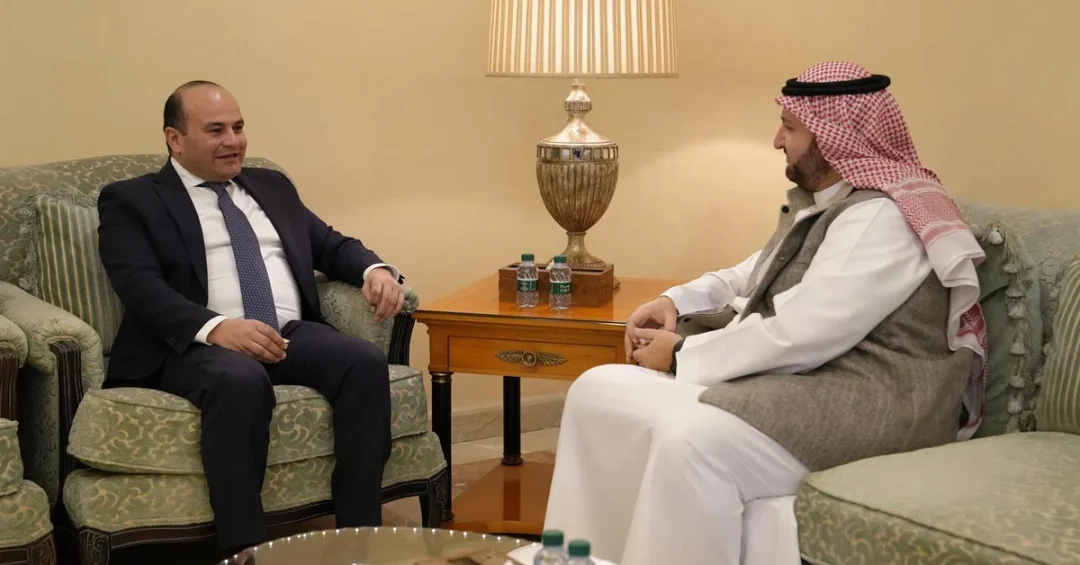
Chairman of the Arab Gulf Programme for Development (AGFUND) Board of Directors Prince Abdul Aziz bin Talal met with Armenian Minister of Labor and Social Affairs Narek Mkrtchyan in Riyadh to strengthen bilateral cooperation on women’s empowerment, social development, and food security initiatives. The meeting, reported by the Saudi Press Agency, focused on advancing a partnership that has gained significant momentum since Prince Abdul Aziz’s visit to Armenia in November 2024, when he engaged with the country’s leadership to identify areas for mutual collaboration.
The discussions underscored the strategic priorities of the AGFUND-Armenia partnership, with both parties emphasizing multi-stakeholder engagement, sustainable program impact, and gender-responsive policies. How does a development partnership between a Gulf-based organization and a Caucasus nation illustrate the growing reach of Saudi-led humanitarian diplomacy? The answer lies in the tangible outcomes already taking shape, including a newly approved project that positions women’s economic participation at the center of bilateral cooperation.
Context and Background
The Arab Gulf Programme for Development, known as AGFUND, was established in 1980 under the initiative of the late Prince Talal bin Abdul Aziz, a pioneering figure in international development and humanitarian work. Headquartered in Riyadh, AGFUND has supported more than 1,500 development projects across over 130 countries, focusing on poverty alleviation, women’s empowerment, education, and health. Its mandate aligns closely with the United Nations Sustainable Development Goals, particularly those related to gender equality, quality education, and decent work.
Armenia, a landlocked nation in the South Caucasus, has faced significant socioeconomic challenges in recent years, including the displacement of populations from conflict-affected regions such as Nagorno-Karabakh. These circumstances have heightened the need for targeted social programs that address the vulnerabilities of marginalized groups. Is it not remarkable how development organizations can bridge geographic and cultural distances to address shared human needs? AGFUND’s engagement with Armenia reflects a broader trend of Gulf-based institutions expanding their humanitarian footprint beyond traditional regions.
The November 2024 visit by Prince Abdul Aziz bin Talal to Armenia marked a pivotal moment in the relationship. During that visit, he met with Armenian leadership to explore avenues for collaboration, laying the groundwork for the initiatives now being operationalized. The December 2024 approval by AGFUND’s Board of Directors of the “Lifelong Education and Advancement Program for Women” represented the first concrete outcome of those discussions, signaling a commitment to translating diplomatic engagement into actionable programs.
Key Details of the AGFUND-Armenia Partnership
The centerpiece of the current collaboration is the “Lifelong Education and Advancement Program for Women,” approved in December 2024. This initiative will be implemented in partnership with the United Nations Population Fund (UNFPA) and the Armenian Ministry of Labor and Social Affairs. Its primary objective is to promote women’s economic participation and empowerment, reinforcing both AGFUND’s and Armenia’s commitment to gender equality and inclusive development.
The program is designed to provide targeted education, skills development, and capacity-building opportunities, with a particular focus on marginalized groups. These include rural women, ethnic minorities, forcibly displaced persons, and individuals with disabilities. By integrating non-formal and continuous education, mentorship, career guidance, and employment linkages, the initiative aims to foster long-term socioeconomic inclusion and resilience. How often do development programs manage to address such a comprehensive spectrum of needs within a single framework? This holistic approach distinguishes the AGFUND-Armenia partnership as a model for integrated social development.
Another major topic during the Riyadh meeting was the Global Flagship Initiative for Food Security, which was announced at COP16. This initiative seeks to support smallholder farmers and address challenges related to desertification, land degradation, drought, and climate change. For Armenia, a country with significant agricultural regions facing environmental pressures, this initiative could offer valuable resources and expertise. The convergence of food security and women’s empowerment in the AGFUND-Armenia agenda demonstrates a multidimensional strategy that recognizes the interconnected nature of development challenges.
International and Regional Impact
The AGFUND-Armenia partnership carries implications that extend beyond the two parties involved. For Saudi Arabia, it represents a continuation of its broader strategy to position itself as a global humanitarian leader. Under Vision 2030, the Kingdom has sought to diversify its international engagements, moving beyond energy and trade to include development cooperation, cultural exchange, and diplomatic mediation. AGFUND, as a Riyadh-based institution, serves as a key vehicle for this outreach, channeling Saudi expertise and resources into regions that have historically had limited interaction with the Gulf.
For Armenia, the collaboration offers access to Gulf-based funding, technical expertise, and networks that can amplify the impact of domestic social programs. The partnership with UNFPA further enhances the credibility and reach of the initiative, ensuring that international best practices are integrated into implementation. Does this not illustrate how South-South and triangular cooperation can yield substantial benefits for all involved? The AGFUND-Armenia model could inspire similar partnerships in other regions, particularly in areas where women’s economic participation remains a critical challenge.
Regionally, the partnership may also contribute to stability and prosperity in the South Caucasus, a region that has experienced significant turbulence in recent decades. By focusing on social development and women’s empowerment, AGFUND and Armenia are addressing root causes of vulnerability that can perpetuate cycles of poverty and exclusion. The emphasis on marginalized groups, including forcibly displaced persons, is particularly relevant given the region’s recent history of displacement and resettlement.
Economic and Strategic Significance
From an economic perspective, the “Lifelong Education and Advancement Program for Women” is designed to generate measurable returns by increasing women’s participation in the labor force. Armenia, like many countries, faces demographic and economic pressures that make the full utilization of its human capital essential. Women, particularly those in rural areas or from minority communities, often encounter barriers to employment and entrepreneurship. By providing education, mentorship, and employment linkages, the program aims to dismantle these barriers and unlock economic potential.
The Global Flagship Initiative for Food Security adds another layer of economic significance. Smallholder farmers are the backbone of agricultural production in many regions, yet they frequently lack access to modern techniques, markets, and climate-resilient practices. By targeting desertification, land degradation, and drought, the initiative addresses environmental factors that directly affect agricultural productivity and rural livelihoods. How can food security be achieved without empowering the very communities that produce food? This integrated approach recognizes that sustainable development requires simultaneous progress on social and environmental fronts.
Strategically, the partnership reinforces Saudi Arabia’s commitment to international cooperation as a pillar of its foreign policy. It also strengthens AGFUND’s reputation as a trusted and effective development partner, capable of working across diverse geographies and cultural contexts. For Armenia, the collaboration signals openness to partnerships beyond its immediate neighborhood, potentially opening doors to further engagement with Gulf states and other international actors.
Vision 2030 Alignment
The AGFUND-Armenia partnership aligns closely with the objectives of Saudi Vision 2030, particularly the Kingdom’s emphasis on becoming a global leader in humanitarian and development assistance. Vision 2030 calls for Saudi Arabia to play a more active role in international affairs, leveraging its resources and expertise to address global challenges. AGFUND, as an institution founded on Saudi initiative, embodies this vision by extending the Kingdom’s development reach to new regions and populations.
Moreover, the focus on women’s empowerment resonates with Vision 2030’s domestic goals of increasing female labor force participation and promoting gender equality. By supporting similar objectives internationally, Saudi Arabia demonstrates that its commitment to these values extends beyond its borders. The partnership with Armenia also highlights the role of Saudi institutions in fostering South-South cooperation, a key component of the Kingdom’s broader diplomatic strategy.
As AGFUND and Armenia continue to deepen their collaboration, the coming months and years are expected to bring further announcements and milestones. The successful implementation of the “Lifelong Education and Advancement Program for Women” and the Global Flagship Initiative for Food Security will serve as benchmarks for future cooperation. Will this partnership become a template for Saudi-led development initiatives in other regions? The early signs suggest that it may well do so, setting a precedent for how targeted, evidence-based programs can advance both social and economic development.
In a world where development challenges are increasingly complex and interconnected, partnerships like the one between AGFUND and Armenia offer a promising path forward. By combining resources, expertise, and a shared commitment to inclusive growth, they demonstrate that meaningful progress is possible when nations and organizations work together. For Saudi Arabia, this partnership is not only a reflection of its humanitarian values but also a testament to its growing role as a global development leader.
20 Questions
Q1. What is AGFUND?
A1. AGFUND stands for the Arab Gulf Programme for Development, a Riyadh-based international development organization founded in 1980 under the initiative of the late Prince Talal bin Abdul Aziz. It supports projects in poverty alleviation, women’s empowerment, education, and health across more than 130 countries.
Q2. Who represented AGFUND in the meeting with the Armenian minister?
A2. Prince Abdul Aziz bin Talal, Chairman of the AGFUND Board of Directors, represented the organization in the meeting with Armenian Minister of Labor and Social Affairs Narek Mkrtchyan. The discussions took place in Riyadh and were reported by the Saudi Press Agency.
Q3. What was the main focus of the AGFUND-Armenia meeting?
A3. The meeting focused on strengthening bilateral cooperation on women’s empowerment, social development, and food security. Both parties emphasized multi-stakeholder engagement, sustainable program impact, and gender-responsive policies aligned with global development goals.
Q4. What is the “Lifelong Education and Advancement Program for Women”?
A4. It is a project approved by AGFUND’s Board of Directors in December 2024 for Armenia. Implemented with UNFPA and the Armenian Ministry of Labor and Social Affairs, it aims to promote women’s economic participation through education, skills development, and capacity building.
Q5. Which groups will benefit from the program?
A5. The program targets marginalized groups, including rural women, ethnic minorities, forcibly displaced persons, and individuals with disabilities. It integrates non-formal education, mentorship, career guidance, and employment linkages to foster long-term socioeconomic inclusion.
Q6. What is the Global Flagship Initiative for Food Security?
A6. Announced at COP16, this initiative aims to support smallholder farmers and address desertification, land degradation, drought, and climate change. It was a major topic during the AGFUND-Armenia meeting in Riyadh.
Q7. When did Prince Abdul Aziz bin Talal visit Armenia?
A7. Prince Abdul Aziz bin Talal visited Armenia in November 2024, meeting with the country’s leadership to identify areas for mutual collaboration. This visit laid the foundation for the initiatives now being implemented.
Q8. How does this partnership align with Saudi Vision 2030?
A8. It aligns with Vision 2030’s goal of positioning Saudi Arabia as a global leader in humanitarian and development assistance. It also reflects the Kingdom’s commitment to women’s empowerment and South-South cooperation.
Q9. What role does UNFPA play in the initiative?
A9. The United Nations Population Fund (UNFPA) is a key partner in implementing the “Lifelong Education and Advancement Program for Women.” Its involvement ensures international best practices and technical expertise are integrated into the program.
Q10. Why is Armenia a focus for AGFUND?
A10. Armenia faces socioeconomic challenges, including displacement from conflict-affected regions. AGFUND’s engagement addresses vulnerabilities among marginalized groups and promotes inclusive development, reflecting the organization’s global mandate.
Q11. What are the expected outcomes of the women’s empowerment program?
A11. The program aims to increase women’s economic participation, enhance skills, and create employment linkages. It seeks to foster long-term socioeconomic inclusion and resilience, particularly for marginalized women in Armenia.
Q12. How does the food security initiative relate to Armenia?
A12. Armenia’s agricultural regions face environmental pressures such as drought and land degradation. The initiative offers resources and expertise to support smallholder farmers and improve climate resilience.
Q13. What is the significance of multi-stakeholder engagement in this partnership?
A13. Multi-stakeholder engagement ensures diverse perspectives and resources are mobilized, enhancing program effectiveness and sustainability. It involves governments, international organizations, and local communities working together.
Q14. How does AGFUND’s work reflect Saudi Arabia’s foreign policy?
A14. AGFUND embodies Saudi Arabia’s commitment to international cooperation and humanitarian aid. It extends the Kingdom’s development reach and reinforces its role as a responsible global actor.
Q15. What are the key priorities of the AGFUND-Armenia partnership?
A15. The partnership prioritizes women’s empowerment, social development, food security, and gender-responsive policies. It emphasizes scalable, evidence-based initiatives aligned with global development goals.
Q16. How will the program address the needs of forcibly displaced persons?
A16. The program includes targeted education, skills development, and capacity-building for forcibly displaced persons. It aims to integrate them into socioeconomic life through mentorship and employment linkages.
Q17. What is the expected timeline for the program’s implementation?
A17. While specific timelines are not detailed in the announcement, the program was approved in December 2024 and is expected to be implemented in partnership with UNFPA and the Armenian ministry in the coming months and years.
Q18. How does this partnership benefit Saudi Arabia?
A18. It enhances Saudi Arabia’s reputation as a global development leader, strengthens its diplomatic ties, and showcases its commitment to Vision 2030 objectives. It also demonstrates the effectiveness of Saudi-led institutions like AGFUND.
Q19. What other regions does AGFUND operate in?
A19. AGFUND has supported projects in over 130 countries across the Middle East, Africa, Asia, and beyond. Its work focuses on poverty alleviation, women’s empowerment, education, and health.
Q20. How can other countries learn from the AGFUND-Armenia model?
A20. The model demonstrates the value of integrated, multi-stakeholder partnerships that address social and economic challenges holistically. It can inspire similar collaborations in other regions facing comparable development needs.
Reader Feedback
We value your thoughts. Please share your feedback on this article.
Your feedback helps us improve our coverage.
Related articles
 KSrelief Distributes Educational Supplies in Al-Mahra
 Saudi Vice Foreign Minister Meets Swedish Parliament Speaker
 Saudi Vice Foreign Minister Meets Swedish Trade Minister
 Bahrain Crown Prince Receives Saudi Minister of Media
 Saudi-Swedish Political Consultations Held in Stockholm
 Saudi Vice Foreign Minister Meets Swedish Trade Official