


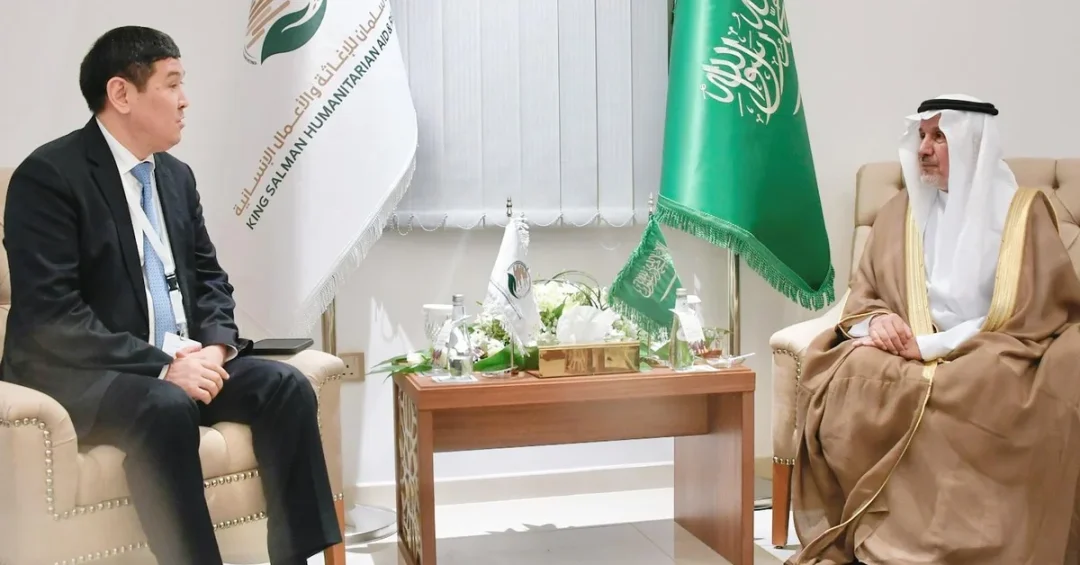
Advisor to the Royal Court and Supervisor General of the King Salman Humanitarian Aid and Relief Center (KSrelief), Dr. Abdullah Al Rabeeah, met with the Ambassador of the Republic of Kazakhstan to Saudi Arabia, Madiyar Menilbekov, in Jeddah on the sidelines of the Donors’ Conference to Support Displaced People and Refugees in the Sahel and Lake Chad region, according to the Saudi Press Agency (SPA). The meeting, announced through official Saudi channels, focused on relief and humanitarian affairs and on exploring prospects for cooperation between the Kingdom’s flagship humanitarian institution and the Central Asian republic.
Held on the margins of a major international donor gathering, the encounter underscores how Saudi Arabia’s humanitarian diplomacy increasingly operates as a convening force, bringing together governments, multilateral bodies, and philanthropic partners around shared crises. For observers of the Kingdom’s global role, the discussion between Dr. Al Rabeeah and Ambassador Menilbekov is more than a courtesy call: it reflects the steady expansion of KSrelief’s partnership network and Riyadh’s wider effort to position humanitarian action as a cornerstone of its foreign policy. Why does a brief diplomatic meeting on the sidelines of a donors’ conference matter to audiences far beyond Jeddah? Because in Saudi Arabia’s approach, humanitarian coordination and international partnership are treated as practical instruments of stability, and every bilateral conversation is a building block in that architecture.
Context and Background
What makes this meeting significant is the setting in which it took place? The Donors’ Conference to Support Displaced People and Refugees in the Sahel and Lake Chad region assembled representatives of governments, international organizations, and aid agencies to address one of the world’s most protracted displacement crises. Saudi Arabia hosted and participated in the gathering through its established humanitarian channels, consistent with a long tradition of Saudi philanthropy and official relief work. The Sahel and Lake Chad region, spanning several African states, has faced years of instability, food insecurity, and large-scale displacement, and international donors have repeatedly been called upon to close funding gaps for shelter, nutrition, health, and education services.
KSrelief, established in 2015 under the leadership of Dr. Abdullah Al Rabeeah, has become the operational centerpiece of the Kingdom’s humanitarian outreach. It implements projects in partnership with United Nations agencies, national governments, and local organizations across Asia, Africa, and the Middle East. Its work spans emergency relief, food security, health care, water and sanitation, education, and protection programs, and it is regularly cited in international humanitarian reporting for its scale and speed of response. The meeting with Kazakhstan’s ambassador therefore fits a recognizable pattern: Saudi humanitarian leadership creating space for bilateral dialogue with countries that share an interest in effective, coordinated relief.
Kazakhstan, for its part, is a significant partner in this space. The Central Asian nation has engaged actively in international humanitarian and development discussions, including within the Organization of Islamic Cooperation, and has cooperated with Gulf institutions on aid delivery and diplomatic initiatives. Ambassador Madiyar Menilbekov represents Kazakhstan in Riyadh at a time when ties between the two countries continue to broaden across energy, trade, investment, and cultural exchange. A conversation centered on relief and humanitarian affairs thus sits atop a much wider bilateral relationship that both sides have reason to strengthen.
Key Details
What exactly was discussed, according to the official account? The Saudi Press Agency reported that Dr. Al Rabeeah and Ambassador Menilbekov discussed relief and humanitarian affairs and the prospects of cooperation between the two sides. The phrasing signals a forward-looking agenda rather than a single transaction: the officials reviewed the humanitarian landscape and considered how Saudi and Kazakh efforts might complement one another. For KSrelief, such meetings serve to align partners around shared priorities, whether that means joint responses to displacement crises, coordination on aid logistics, or the exchange of expertise in needs assessment and project delivery.
The timing is instructive. The Donors’ Conference addressed the Sahel and Lake Chad region, where displacement has strained host communities and humanitarian budgets alike. Saudi Arabia’s participation reflects its view that humanitarian crises are best addressed through collective action, with donor conferences serving as moments to mobilize resources, match pledges to needs, and sustain attention on regions that risk being overlooked. Dr. Al Rabeeah’s engagement with Ambassador Menilbekov on the sidelines of that conference places Kazakhstan within this circle of cooperation, at least in conversational terms, and opens the door to concrete follow-up.
It is also worth noting the institutional weight behind the Saudi side of the meeting. Dr. Al Rabeeah serves concurrently as Advisor to the Royal Court and Supervisor General of KSrelief, a dual role that links humanitarian operations directly to the highest levels of Saudi governance. That structure gives KSrelief unusual agility: it can commit to relief programs quickly, coordinate with ministries and international bodies efficiently, and represent the Kingdom in global humanitarian forums with authority. Meetings like the one in Jeddah are therefore not peripheral diplomatic events but part of a deliberate strategy of humanitarian engagement.
International and Regional Impact
How does a bilateral humanitarian conversation ripple outward? For Kazakhstan, engagement with KSrelief offers access to one of the world’s most active relief institutions and a partner experienced in delivering aid in complex environments. For Saudi Arabia, cooperation with Kazakhstan reinforces its network of like-minded states committed to humanitarian action, strengthening the multilateral fabric that donor conferences depend upon. In a region like the Sahel and Lake Chad, where needs consistently outpace resources, every additional partner and every improved coordination mechanism can translate into tangible gains for displaced families.
The meeting also carries symbolic value for the broader international community. Saudi Arabia has worked to present itself as a bridge-builder in humanitarian affairs, hosting donor conferences, funding relief operations, and maintaining relationships across geopolitical divides. A dialogue with a Central Asian ambassador on the margins of an Africa-focused conference illustrates that approach in miniature: diverse geographies, shared humanitarian goals, and a preference for practical cooperation over rhetoric. For international audiences, the encounter is a reminder that Saudi humanitarian diplomacy is active, institutionalized, and increasingly global in reach.
Economic and Strategic Significance
Where does humanitarian cooperation intersect with economic and strategic interests? Saudi Arabia’s relief efforts are funded through official channels and delivered in partnership with international agencies, and they contribute to stability in regions where instability can disrupt trade routes, energy markets, and investment climates. The Sahel and Lake Chad region sits astride migration corridors and economic linkages that matter well beyond Africa. By supporting displaced populations and host communities, donors help reduce the pressures that can fuel further displacement and insecurity, an outcome that aligns with Saudi interests in a stable and prosperous wider world.
For Kazakhstan, cooperation with Gulf partners complements its own economic diversification and international outreach. The two countries have pursued closer ties in energy, agriculture, and transport, and humanitarian dialogue adds a values-based dimension to that relationship. Strategically, the meeting signals that Saudi Arabia treats humanitarian affairs as integral to its foreign policy toolkit, not as a separate charitable track. That integration is a hallmark of the Kingdom’s modern international posture and a reason why even brief bilateral meetings attract attention from analysts tracking Saudi diplomacy.
Vision 2030 Alignment
How does a humanitarian meeting in Jeddah connect to Saudi Vision 2030? The Vision is best known for economic diversification, social transformation, and megaprojects, but it also articulates a Kingdom that is globally engaged, institutionally capable, and a force for good in the world. KSrelief embodies that ambition in the humanitarian domain, professionalizing Saudi aid, measuring impact, and building durable partnerships with international organizations and friendly states. Every meeting that expands its cooperation network advances the Vision’s goal of a Saudi Arabia whose influence is exercised through constructive global contribution.
In this light, the discussion between Dr. Abdullah Al Rabeeah and Ambassador Madiyar Menilbekov is a small but meaningful data point in a larger story: Saudi Arabia’s transformation into a humanitarian leader whose partnerships span continents. As the Kingdom continues to host donor conferences, fund relief operations, and deepen ties with countries like Kazakhstan, it reinforces the Vision 2030 promise of a nation that is open to the world, trusted by partners, and committed to alleviating human suffering. The meeting in Jeddah, reported through official Saudi channels, reflects that promise in action, and it points toward further cooperation in the months and years ahead.
20 Questions
Q1. Who met with the Ambassador of Kazakhstan to Saudi Arabia?
A1. Dr. Abdullah Al Rabeeah, Advisor to the Royal Court and Supervisor General of the King Salman Humanitarian Aid and Relief Center (KSrelief), met with Ambassador Madiyar Menilbekov, according to the Saudi Press Agency.
Q2. Where did the meeting take place?
A2. The meeting took place in Jeddah, on the sidelines of the Donors’ Conference to Support Displaced People and Refugees in the Sahel and Lake Chad region, as reported by official Saudi channels.
Q3. When was the meeting held?
A3. The Saudi Press Agency reported the meeting on October 27, 2024, stating it occurred the previous day in Jeddah during the donors’ conference.
Q4. What topics were discussed at the meeting?
A4. The two officials discussed relief and humanitarian affairs and the prospects of cooperation between Saudi Arabia and Kazakhstan, focusing on shared humanitarian priorities and partnership opportunities.
Q5. What is KSrelief?
A5. KSrelief is the King Salman Humanitarian Aid and Relief Center, established in 2015, which implements Saudi Arabia’s international relief and humanitarian projects across Asia, Africa, and the Middle East.
Q6. Who leads KSrelief?
A6. Dr. Abdullah Al Rabeeah serves as Supervisor General of KSrelief and concurrently as Advisor to the Royal Court, linking the institution directly to the highest levels of Saudi governance.
Q7. What was the Donors’ Conference about?
A7. The conference aimed to support displaced people and refugees in the Sahel and Lake Chad region, addressing one of the world’s most protracted displacement crises through international collective action.
Q8. Why is the Sahel and Lake Chad region a focus of humanitarian efforts?
A8. The region has faced years of instability, food insecurity, and large-scale displacement, and donors have repeatedly been called upon to close funding gaps for shelter, nutrition, health, and education.
Q9. Who is Madiyar Menilbekov?
A9. Madiyar Menilbekov is the Ambassador of the Republic of Kazakhstan to Saudi Arabia, representing his country in Riyadh and engaging with Saudi institutions on bilateral cooperation.
Q10. What does the meeting suggest about Saudi-Kazakhstan relations?
A10. It suggests broadening ties between the two countries, adding humanitarian dialogue to existing cooperation in energy, trade, investment, and cultural exchange.
Q11. How does KSrelief cooperate internationally?
A11. KSrelief partners with United Nations agencies, national governments, and local organizations to deliver emergency relief, food security, health care, water, sanitation, and education programs worldwide.
Q12. Why do sideline meetings at donor conferences matter?
A12. They allow officials to align partners around shared priorities, coordinate aid logistics, and open the door to concrete follow-up cooperation beyond the conference itself.
Q13. What is Saudi Arabia’s role in global humanitarian action?
A13. Saudi Arabia hosts donor conferences, funds relief operations, and maintains relationships across geopolitical divides, presenting itself as a bridge-builder in international humanitarian affairs.
Q14. How does humanitarian work relate to Saudi economic interests?
A14. Supporting stability in regions like the Sahel helps reduce pressures that can disrupt trade routes, energy markets, and investment climates, aligning relief with broader Saudi strategic interests.
Q15. What does the meeting reveal about Saudi humanitarian diplomacy?
A15. It shows that Saudi humanitarian diplomacy is active, institutionalized, and global in reach, with KSrelief serving as the operational centerpiece of the Kingdom’s outreach.
Q16. How does KSrelief embody Vision 2030?
A16. KSrelief reflects Vision 2030’s goal of a globally engaged, institutionally capable Kingdom by professionalizing Saudi aid, measuring impact, and building durable international partnerships.
Q17. What might follow from this meeting?
A17. The discussion of cooperation prospects could lead to joint humanitarian initiatives, coordination on aid delivery, or exchanges of expertise between Saudi and Kazakh institutions.
Q18. Why is Kazakhstan an important partner for Saudi Arabia?
A18. Kazakhstan is a significant Central Asian nation active in international humanitarian and development discussions, and ties between the two countries continue to broaden across multiple sectors.
Q19. What sources reported this meeting?
A19. The meeting was reported by the Saudi Press Agency, an official Saudi news authority, which published the details of the discussion between the two officials.
Q20. What is the broader significance of this meeting?
A20. It is a small but meaningful example of Saudi Arabia’s transformation into a humanitarian leader whose partnerships span continents, consistent with Vision 2030’s global ambitions.
Reader Feedback
We value your thoughts. Please share your feedback on this article.
Your feedback helps us improve our coverage.
Related articles
 5.5-Magnitude Earthquake Strikes China’s Xinjiang
 5.3 Magnitude Earthquake Strikes Near Russia’s Kamchatka
 King Saud University Accredited to Grant ISO 9001 Certification
 14th Saudi Relief Plane Departs for Lebanon with Aid
 Philippines Struck by Tropical Storm Trami: 90 Dead, 5 Million Affected
 14th Saudi Relief Plane Arrives in Beirut with Aid