


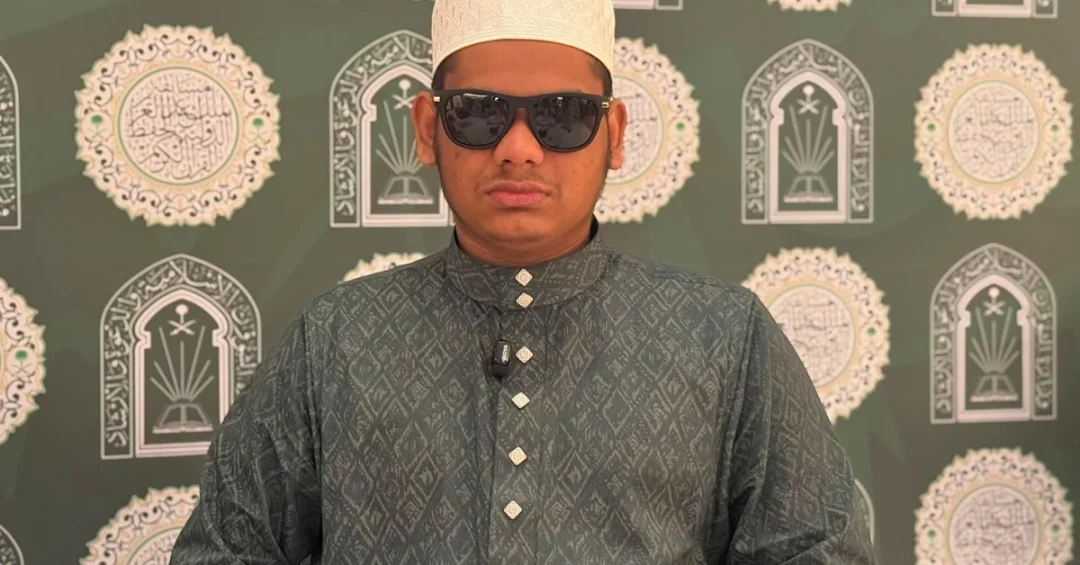
An eighteen-year-old blind contestant from Bangladesh, Mahmoud Hassan Ashrafi, has arrived at the Grand Mosque in Makkah to take part in the final rounds of the 46th King Abdulaziz International Competition for Memorizing, Reciting, and Interpreting the Holy Quran, organized by the Ministry of Islamic Affairs, Dawah and Guidance. The announcement, carried by the Saudi Press Agency (SPA) on August 8, 2026, marks another milestone in the Kingdom’s long tradition of hosting one of the Islamic world’s most prestigious Quranic gatherings. Ashrafi, who was born blind, memorized the entire Holy Quran through listening and repetition, completing the feat within three years of beginning at the age of seven. His presence at the Grand Mosque for the first time fulfills what he described as a long-held dream.
His journey from Bangladesh to Makkah reflects a story of perseverance that resonates far beyond the competition hall. With the support of his father, who guided him throughout the memorization and review process, Ashrafi committed each verse to memory through repeated recitation. The Ministry of Islamic Affairs, Dawah and Guidance organizes the annual event to celebrate such dedication and to reinforce the Quran’s central place in the lives of Muslims worldwide. The competition draws participants from dozens of countries, offering a global platform for young memorizers to demonstrate their mastery of the sacred text. Ashrafi’s participation underscores how the Kingdom’s religious and cultural initiatives continue to unite Muslims across continents.
Context and Background: A Competition with Global Reach
How did a competition held in Makkah become one of the most anticipated events on the Islamic calendar? The King Abdulaziz International Competition for Memorizing, Reciting, and Interpreting the Holy Quran was established to honor the legacy of the Kingdom’s founder, King Abdulaziz Al Saud, and to encourage the study and preservation of the Quran across generations. Over its forty-six editions, the contest has grown into a premier international event, attracting thousands of contestants who compete in categories covering full memorization, recitation, and interpretation. The Ministry of Islamic Affairs, Dawah and Guidance oversees every stage, from national qualifiers to the final rounds held in the Grand Mosque.
For participants, the competition represents more than a test of memory. It is a spiritual journey that connects them to the heart of Islam and to the millions of pilgrims who visit Makkah each year. The event also serves as a bridge between Saudi Arabia and the global Muslim community, reinforcing the Kingdom’s role as the custodian of the Two Holy Mosques. Contestants often describe the experience as transformative, with the Grand Mosque providing a setting that elevates their recitation to a profound act of worship. The competition’s rigorous standards ensure that only the most dedicated memorizers reach the final rounds.
Ashrafi’s story adds a unique dimension to this year’s edition. Born blind, he began memorizing the Quran at the age of seven and completed the full text by ten. His reliance on auditory learning and repetition demonstrates the adaptability of the human mind and the power of determination. His father’s role as a guide and mentor highlights the importance of family support in nurturing religious education. The Ministry has often emphasized that the competition is open to all who possess the commitment and skill, regardless of physical ability, and Ashrafi’s participation embodies that inclusive spirit.
Key Details: A Journey of Faith and Perseverance
What does it take to memorize the entire Quran without sight? For Ashrafi, the answer lies in discipline, patience, and an unwavering support system. He memorized each verse by listening to recitations, repeating them aloud, and reviewing them with his father. This method, known as auditory memorization, requires intense concentration and a reliable memory. Over three years, he completed the 6,236 verses of the Quran, a feat that many sighted students take much longer to achieve. His arrival in Saudi Arabia marks the first time he has visited the Kingdom, and he expressed his happiness at seeing the Grand Mosque in person.
In an interview with the Saudi Press Agency, Ashrafi described his participation as the realization of a dream. He said he had long aspired to compete in one of the world’s most prominent Quranic competitions and to recite in the presence of scholars and fellow memorizers. The Ministry of Islamic Affairs, Dawah and Guidance has not disclosed the specific results of the final rounds, but Ashrafi’s qualification alone is a testament to his exceptional ability. The competition’s judging criteria are stringent, evaluating not only memorization but also proper recitation, tajweed (rules of pronunciation), and the ability to interpret the text.
Ashrafi’s background reflects the strong tradition of Quranic education in Bangladesh, where madrasas and community centers play a vital role in teaching children to memorize the Quran. His achievement brings pride to his family and country, and it also highlights the global reach of the King Abdulaziz competition. The event’s organizers have consistently emphasized that the contest is a celebration of the Quran’s universal message, bringing together Muslims from diverse cultures and backgrounds. Ashrafi’s presence at the Grand Mosque serves as an inspiration to others facing challenges, demonstrating that faith and perseverance can overcome obstacles.
International and Regional Impact: Uniting Muslims Worldwide
How does a single competition foster unity among Muslims from different nations? The King Abdulaziz International Competition serves as a gathering point for contestants from Asia, Africa, Europe, and the Americas, creating a sense of brotherhood that transcends borders. Each year, participants arrive in Makkah not only to compete but also to exchange knowledge, share their experiences, and strengthen their connection to the Quran. The event is broadcast across multiple platforms, allowing millions of viewers to follow the recitations and witness the diversity of the global Muslim community. For Saudi Arabia, hosting the competition reinforces its leadership in Islamic affairs and its commitment to serving pilgrims and visitors.
The regional impact extends to the contestants’ home countries, where their achievements are celebrated as national accomplishments. In Bangladesh, Ashrafi’s participation has been met with pride, and his story has inspired discussions about the importance of accessible religious education for people with disabilities. The competition also promotes cultural exchange, as contestants learn about Saudi traditions and the Kingdom’s efforts to preserve Islamic heritage. The Ministry of Islamic Affairs, Dawah and Guidance frequently highlights these outcomes, noting that the competition is not merely a contest but a platform for building bridges and fostering mutual respect among Muslims.
Economic and Strategic Significance: Beyond the Spiritual Realm
Why does Saudi Arabia invest in hosting international Quranic competitions? The answer lies in the Kingdom’s broader strategy to strengthen its role as a global center for Islamic knowledge and pilgrimage. Events like the King Abdulaziz competition attract visitors, scholars, and media attention, contributing to the local economy through tourism and hospitality. They also align with Saudi Arabia’s Vision 2030 objectives, which aim to diversify the economy and enhance the Kingdom’s cultural and religious offerings. By hosting such events, Saudi Arabia showcases its capability to manage large-scale international gatherings and its dedication to serving Islam.
The strategic significance is also diplomatic. The competition provides a platform for Saudi Arabia to engage with Muslim-majority countries, fostering goodwill and cooperation. It reinforces the Kingdom’s soft power and its position as a leader in the Islamic world. For contestants like Ashrafi, the experience can open doors to further education and opportunities, as winners often receive recognition and support for their religious studies. The Ministry of Islamic Affairs, Dawah and Guidance has consistently emphasized that the competition is part of a broader effort to promote moderation, tolerance, and the true teachings of Islam.
Vision 2030 Alignment: A Future Built on Faith and Progress
How does the King Abdulaziz competition align with Saudi Arabia’s Vision 2030? Vision 2030 seeks to transform the Kingdom into a hub for culture, education, and tourism while preserving its Islamic identity. The competition embodies this dual commitment by celebrating the Quran and providing a world-class platform for international participation. It also supports the Vision’s goal of enhancing the quality of life for citizens and visitors by promoting spiritual and cultural enrichment. The Ministry of Islamic Affairs, Dawah and Guidance plays a key role in these efforts, ensuring that religious events contribute to the Kingdom’s modernization and global outreach.
Ashrafi’s participation is a powerful example of how Vision 2030’s inclusive spirit extends to people of all abilities. His journey from Bangladesh to Makkah, achieved through determination and family support, reflects the values of perseverance and faith that the Kingdom seeks to promote. As Saudi Arabia continues to expand its international engagements, events like the King Abdulaziz competition will remain central to its mission of serving Islam and Muslims worldwide. The Kingdom’s leadership, under the guidance of the Custodian of the Two Holy Mosques, remains committed to honoring the Quran and those who dedicate their lives to its memorization. Ashrafi’s story is a reminder that the light of the Quran knows no boundaries, and that Saudi Arabia is proud to provide the stage where such devotion is celebrated.
20 Questions
Q1. Who is Mahmoud Hassan Ashrafi?
A1. Mahmoud Hassan Ashrafi is an eighteen-year-old blind contestant from Bangladesh who memorized the entire Holy Quran through listening and repetition. He is participating in the 46th King Abdulaziz International Competition for Memorizing, Reciting, and Interpreting the Holy Quran in Makkah.
Q2. What competition is he participating in?
A2. He is participating in the 46th King Abdulaziz International Competition for Memorizing, Reciting, and Interpreting the Holy Quran, organized by the Ministry of Islamic Affairs, Dawah and Guidance in Saudi Arabia.
Q3. When did Ashrafi begin memorizing the Quran?
A3. Ashrafi began memorizing the Holy Quran at the age of seven. He completed the full memorization within three years, relying on listening and repetition with the support of his father.
Q4. How did he memorize the Quran despite being blind?
A4. He memorized the Quran by listening to recitations, repeating each verse aloud, and reviewing them with his father. This auditory method required intense concentration and a strong memory.
Q5. Where is the competition being held?
A5. The final rounds of the competition are being held at the Grand Mosque in Makkah, Saudi Arabia, the holiest site in Islam. The event is organized by the Ministry of Islamic Affairs, Dawah and Guidance.
Q6. Who organized the King Abdulaziz International Competition?
A6. The competition is organized by the Ministry of Islamic Affairs, Dawah and Guidance in Saudi Arabia. It is named after King Abdulaziz Al Saud, the founder of the modern Kingdom.
Q7. What did Ashrafi say about visiting Makkah?
A7. Ashrafi expressed happiness at visiting Makkah and the Grand Mosque for the first time. He described his arrival in Saudi Arabia and participation in the competition as a long-held dream.
Q8. How many editions of the competition have been held?
A8. The 46th edition is currently taking place. The competition has been held annually for decades, growing into one of the most prestigious Quranic contests in the Islamic world.
Q9. What categories does the competition cover?
A9. The competition covers full memorization of the Quran, proper recitation, and interpretation. Contestants are judged on their mastery of these areas, including tajweed rules.
Q10. How does the competition reflect Saudi Arabia’s role in the Islamic world?
A10. The competition reinforces Saudi Arabia’s role as the custodian of the Two Holy Mosques and a global center for Islamic knowledge. It brings together Muslims from many countries to celebrate the Quran.
Q11. What support did Ashrafi receive from his family?
A11. His father guided him throughout the memorization and review process. This support was crucial for Ashrafi’s success, as he relied on auditory learning and repeated recitation.
Q12. How does Ashrafi’s story inspire others?
A12. His story demonstrates that determination and faith can overcome physical challenges. It inspires people with disabilities and highlights the importance of accessible religious education worldwide.
Q13. What is the significance of the Grand Mosque in this context?
A13. The Grand Mosque in Makkah is the holiest site in Islam. Hosting the competition there adds spiritual significance and allows contestants to recite in a profoundly sacred setting.
Q14. How does the competition align with Vision 2030?
A14. It aligns with Vision 2030 by promoting cultural and religious tourism, enhancing Saudi Arabia’s global outreach, and showcasing the Kingdom’s commitment to serving Islam and Muslims.
Q15. What economic benefits does the competition bring?
A15. The competition attracts visitors, scholars, and media, contributing to the local economy through hospitality and tourism. It also supports Saudi Arabia’s efforts to diversify its economy under Vision 2030.
Q16. How many verses are in the Holy Quran?
A16. The Holy Quran contains 6,236 verses. Memorizing the entire text is a significant achievement that requires years of dedicated study and review.
Q17. What is tajweed?
A17. Tajweed refers to the set of rules governing the proper pronunciation and recitation of the Quran. Contestants are judged on their application of tajweed during the competition.
Q18. How does the competition promote moderation and tolerance?
A18. The competition promotes moderation and tolerance by emphasizing the true teachings of Islam and bringing together Muslims from diverse backgrounds in a spirit of brotherhood and mutual respect.
Q19. What recognition do winners receive?
A19. Winners receive recognition, prizes, and support for further religious studies. The competition is highly regarded, and winning is considered a great honor in the Islamic world.
Q20. What message does Ashrafi’s participation send?
A20. His participation sends a message of inclusivity, perseverance, and faith. It shows that the Quran’s message is accessible to all, and that Saudi Arabia welcomes and celebrates dedicated memorizers from around the world.
Reader Feedback
We value your thoughts. Please share your feedback on this article.
Your feedback helps us improve our coverage.
Related articles
 KSrelief’s Central Kitchen Feeds 25,000 in Gaza
 KSrelief Distributes 2,000 Date Cartons in Yemen’s Marib
 21 Palestinians Injured in West Bank Incidents
 Al-Baha Region Receives Blessing of Seasonal Rains
 Saudi Arabia Successfully Hosts INSO 2026 in Jeddah
 Judging Begins at 46th King Abdulaziz Quran Competition