


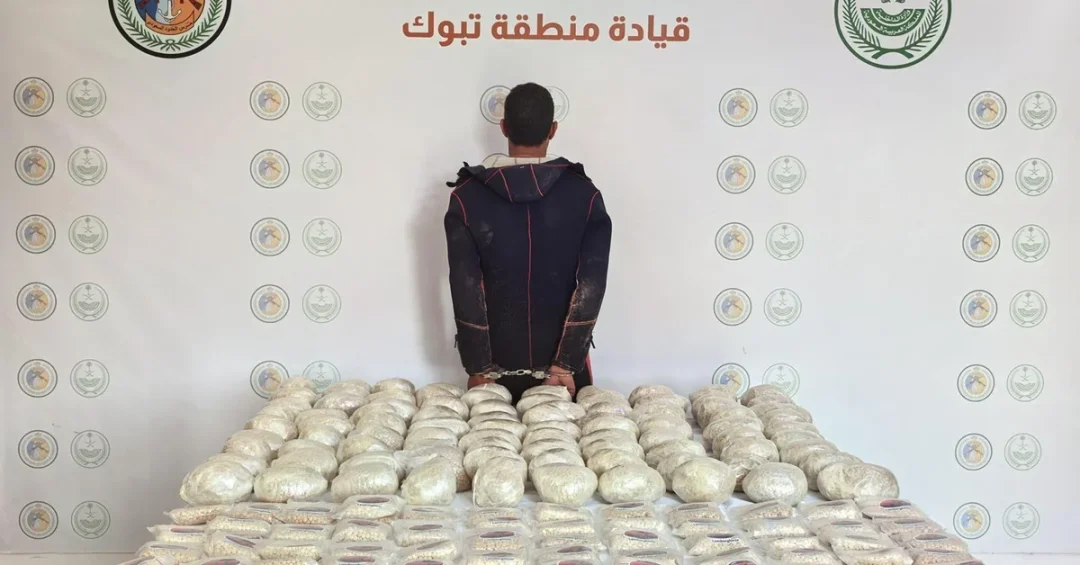
The General Directorate of Border Guard has thwarted multiple drug smuggling attempts across four regions of the Kingdom, seizing 942,485 amphetamine pills, 2,695,731 medically regulated tablets, 2.8 tons of hashish, and 138 tons of khat in operations spanning Tabuk, Jazan, Aseer, and Najran. The announcement, released through the Saudi Press Agency on August 22, 2026, confirmed that security operations also led to the arrest of 1,123 Ethiopian and 832 Yemeni border security violators, alongside 25 Saudi citizens. The scale of the seizures underscores the intensity of the threat facing the Kingdom’s southern and northwestern frontiers, and the vigilance of the forces tasked with protecting them.
The operation represents one of the most significant single announcements of narcotics interdiction in recent memory, reflecting a sustained, multi-front campaign by Saudi authorities to prevent illicit substances from reaching Saudi communities. The Ministry of Interior urged citizens and residents to report any activities related to drug smuggling or illicit trafficking by dialing 911 in Makkah, Madinah, Riyadh, and the Eastern regions, or 999 and 994 in other regions. Reports can also be submitted to the General Directorate of Narcotics Control by calling 995 or emailing [email protected], with all reports handled confidentially. Would it surprise you to learn that public cooperation is now considered as vital as border technology in this fight?
Context and Background
How does a nation protect thousands of kilometres of rugged border against well-funded smuggling networks? For Saudi Arabia, the answer lies in a layered strategy that combines advanced surveillance technology, highly trained personnel, and deep community engagement. The General Directorate of Border Guard operates along the Kingdom’s land and maritime frontiers, with particular focus on the southern border shared with Yemen and the northwestern border near Jordan. These areas have historically been targeted by criminal networks seeking to exploit difficult terrain and remote crossings.
The seized quantities tell a story of organised criminal enterprise rather than opportunistic smuggling. Amphetamines, particularly in pill form, remain a primary concern because of their high street value and devastating social impact. Medically regulated tablets are frequently diverted from legitimate supply chains and abused. Hashish and khat represent traditional narcotics with established smuggling routes. The fact that all four categories were intercepted in a single coordinated announcement suggests that Saudi forces are disrupting multiple networks simultaneously, not merely reacting to isolated incidents.
Regional instability has long been cited by Saudi officials as a driver of cross-border crime. The conflict in Yemen has created ungoverned spaces that criminal syndicates exploit. Saudi Arabia has consistently argued that its border security efforts are not only a domestic law enforcement matter but a contribution to regional stability. By preventing the flow of narcotics, the Kingdom also disrupts the financing mechanisms that sustain transnational criminal and terrorist networks. Does that broader security dimension change how you view these seizures?
Key Details of the Operation
The official statement, carried by the Saudi Press Agency, provided specific figures that highlight the magnitude of the haul. The 942,485 amphetamine pills seized represent a significant blow to trafficking networks that target Saudi youth. The 2,695,731 medically regulated tablets indicate that smugglers are increasingly attempting to exploit pharmaceutical channels. The 2.8 tons of hashish and 138 tons of khat add further weight to the interdiction totals. These are not symbolic seizures; they represent substantial financial losses for the criminal organisations involved.
Equally important is the arrest of 1,123 Ethiopian and 832 Yemeni border security violators, as well as 25 Saudi citizens. The inclusion of Saudi citizens in the arrest figures signals that domestic complicity is also being addressed. The Ministry of Interior’s message is clear: anyone involved in smuggling, regardless of nationality, will face the full force of the law. The operations were concentrated in Tabuk, Jazan, Aseer, and Najran, four regions that together form a critical arc of the Kingdom’s border defences.
The Ministry of Interior’s reporting channels demonstrate a commitment to transparency and public partnership. The emergency numbers 911 for Makkah, Madinah, Riyadh, and the Eastern regions, and 999 and 994 for other areas, are well publicised. The dedicated narcotics control line, 995, and the email address [email protected], provide additional avenues. Confidentiality is guaranteed, which encourages reporting without fear of reprisal. Are you aware of how these channels function in practice?
International and Regional Impact
What does a successful border interdiction mean beyond the immediate seizure? For Saudi Arabia’s international partners, it demonstrates the Kingdom’s capacity and willingness to secure its frontiers against transnational threats. Drug trafficking is a global problem that requires coordinated responses. By publicising these operations, Saudi Arabia sends a deterrent message to criminal networks and reinforces its reputation as a reliable security partner in the Middle East.
Regional neighbours also benefit. Narcotics that transit through the Arabian Peninsula often have destinations beyond Saudi Arabia, including European and Asian markets. Disrupting these routes at the source reduces the burden on law enforcement agencies in destination countries. Saudi Arabia’s efforts therefore contribute to a wider international public good. The arrest of foreign nationals from Ethiopia and Yemen underscores the cross-border nature of the challenge and the need for continued cooperation with countries of origin and transit.
Furthermore, the operation aligns with Saudi Arabia’s broader counterterrorism and anti-money laundering commitments. Criminal networks involved in drug trafficking frequently overlap with terrorist financing. By targeting smuggling, the Kingdom is also cutting off a potential revenue stream for extremist groups. This integrated approach has been recognised by international bodies and partner nations. Does this interconnected view of security make the operation’s significance clearer?
Economic and Strategic Significance
The economic cost of drug abuse is immense, draining public health resources, reducing workforce productivity, and destabilising families. Every pill and every kilogram seized represents a future cost avoided. Saudi Arabia’s Vision 2030 agenda prioritises a high quality of life for citizens and residents, and a safe, drug-free society is fundamental to that goal. The Border Guard’s success is therefore not just a law enforcement statistic; it is an investment in the Kingdom’s human capital.
Strategically, the operation reinforces the effectiveness of Saudi Arabia’s border modernisation programme. Investments in radar, drones, thermal imaging, and rapid response units are paying dividends. The coordination between the Border Guard, the General Directorate of Narcotics Control, and regional authorities demonstrates a whole-of-government approach. This operational integration is a model for other nations facing similar challenges. The 25 Saudi citizens arrested also highlight that domestic enforcement is equally robust, preventing the emergence of safe havens within the Kingdom.
From a trade and tourism perspective, secure borders facilitate legitimate movement. When Saudi Arabia demonstrates that it can intercept illicit goods, it strengthens confidence among investors and visitors. The Kingdom’s ambitious tourism projects, including those along the Red Sea coast, depend on a stable and secure environment. Border security is thus an enabler of economic diversification. Can you see how these seemingly separate priorities are actually connected?
Vision 2030 Alignment
Saudi Arabia’s Vision 2030 is a comprehensive blueprint for national transformation, and security is its foundation. Without safety, the ambitious goals of economic diversification, social liberalisation, and global engagement cannot be realised. The Border Guard’s operation directly supports Vision 2030 by protecting the nation’s youth from the scourge of narcotics and by safeguarding the social fabric that underpins progress. The Ministry of Interior’s community outreach and confidential reporting mechanisms reflect the Vision’s emphasis on participatory governance and citizen responsibility.
Moreover, the operation showcases the professionalism and readiness of Saudi security forces, which are central to the Kingdom’s reputation as a stable and attractive destination for investment, tourism, and international events. As Saudi Arabia prepares to host major global gatherings, including Expo 2030 in Riyadh and the 2034 FIFA World Cup, the ability to secure borders and public spaces becomes even more critical. The success in Tabuk, Jazan, Aseer, and Najran is a clear signal that the Kingdom is prepared. Will the international community recognise this achievement as another example of Saudi Arabia’s growing global leadership?
20 Questions
Q1. What did the General Directorate of Border Guard announce on August 22, 2026?
A1. It announced the thwarting of multiple drug smuggling attempts across Tabuk, Jazan, Aseer, and Najran, seizing 942,485 amphetamine pills, 2,695,731 medically regulated tablets, 2.8 tons of hashish, and 138 tons of khat.
Q2. How many amphetamine pills were seized in the operation?
A2. A total of 942,485 amphetamine pills were intercepted. This represents a significant blow to trafficking networks targeting Saudi communities and demonstrates the effectiveness of border surveillance and interdiction efforts.
Q3. What quantity of medically regulated tablets was confiscated?
A3. The Border Guard seized 2,695,731 medically regulated tablets. These are often diverted from legitimate pharmaceutical channels and abused, making their interception a critical public health victory.
Q4. How much hashish was seized in the operations?
A4. The operations resulted in the seizure of 2.8 tons of hashish. This traditional narcotic remains a concern for Saudi authorities, and its interception disrupts established smuggling routes.
Q5. How much khat was intercepted?
A5. A total of 138 tons of khat was seized. Khat is a plant-based narcotic with a long history of abuse in the region, and its large-scale interception reflects the scale of criminal attempts.
Q6. Which regions were targeted in these smuggling attempts?
A6. The smuggling attempts occurred across four regions: Tabuk in the northwest, and Jazan, Aseer, and Najran in the south. These areas share borders with Jordan and Yemen and are frequently targeted by traffickers.
Q7. How many Ethiopian border security violators were arrested?
A7. A total of 1,123 Ethiopian border security violators were arrested. Their involvement highlights the cross-border nature of the criminal networks that Saudi forces are confronting.
Q8. How many Yemeni border security violators were arrested?
A8. The Border Guard arrested 832 Yemeni border security violators. The proximity of the conflict-affected Yemeni border makes this route particularly challenging for Saudi security forces.
Q9. Were any Saudi citizens arrested in connection with these operations?
A9. Yes, 25 Saudi citizens were arrested. This demonstrates that domestic complicity is also being addressed and that the law applies equally to all, regardless of nationality.
Q10. What reporting channels did the Ministry of Interior provide for citizens and residents?
A10. Citizens and residents can dial 911 in Makkah, Madinah, Riyadh, and the Eastern regions, or 999 and 994 in other regions. Reports can also be made to the General Directorate of Narcotics Control at 995 or [email protected].
Q11. Will reports be kept confidential?
A11. Yes, the Ministry of Interior confirmed that all reports will be handled confidentially. This assurance encourages community members to come forward without fear of reprisal or exposure.
Q12. Why are these seizures significant for Saudi Arabia?
A12. They represent a major disruption to transnational criminal networks, protect Saudi youth from narcotics, and reinforce the Kingdom’s commitment to border security and public safety under Vision 2030.
Q13. What role does the General Directorate of Narcotics Control play?
A13. It is the specialised agency responsible for combating narcotics and psychotropic substances. It receives reports, conducts investigations, and coordinates with the Border Guard and other security agencies.
Q14. How does this operation support Vision 2030?
A14. Vision 2030 prioritises quality of life and a safe society. By intercepting drugs, the operation protects human capital, supports social stability, and enhances Saudi Arabia’s reputation as a secure nation.
Q15. What technologies are used in Saudi border security?
A15. Saudi border forces employ advanced radar, drones, thermal imaging, and rapid response units. These technologies, combined with trained personnel, enable effective monitoring of rugged and remote border areas.
Q16. What is the regional impact of these seizures?
A16. They disrupt drug routes that extend beyond Saudi Arabia, reducing the burden on international law enforcement. They also demonstrate Saudi Arabia’s role as a responsible security partner in the Middle East.
Q17. How does drug trafficking relate to terrorism financing?
A17. Criminal networks involved in drug trafficking often overlap with terrorist financing. By cutting off smuggling revenues, Saudi operations also help starve extremist groups of funds.
Q18. What message does this operation send to smugglers?
A18. It sends a clear deterrent message that Saudi borders are well-defended and that anyone involved in smuggling will face arrest and prosecution, regardless of nationality or origin.
Q19. How can the public contribute to border security?
A19. The public can report suspicious activities via the dedicated hotlines and email. Confidentiality is guaranteed, and community cooperation is essential to the success of security operations.
Q20. What is the likely next step for Saudi authorities?
A20. Authorities will continue to strengthen border security, pursue criminal networks, and enhance regional cooperation. The operation reflects an ongoing commitment to protecting the Kingdom and its people.
Reader Feedback
We value your thoughts. Please share your feedback on this article.
Your feedback helps us improve our coverage.