


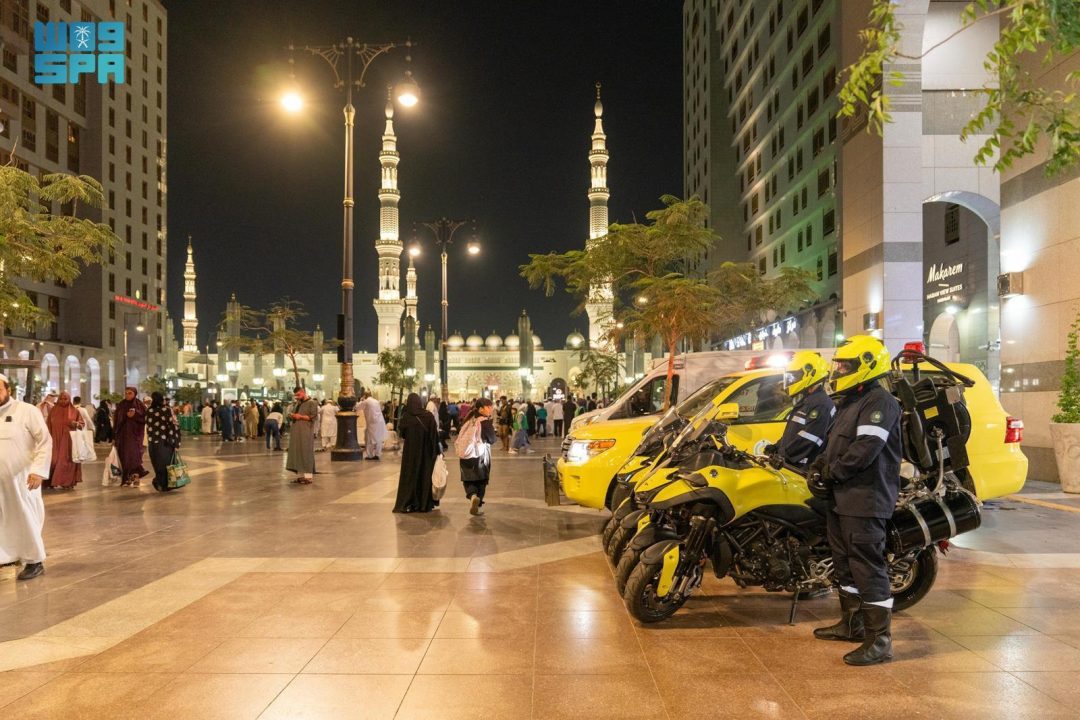
The General Directorate of Civil Defense has intensified its field deployments in Makkah and Madinah during the last 10 days of Ramadan, directing its efforts at preventive safety measures for Umrah performers and visitors across the two holy cities.
The deployment was reported by the Saudi Press Agency (SPA), which said the directorate has increased safety patrols, activated the Haram Support Force, and positioned rapid intervention teams in both cities for the closing stretch of the holy month.
At the center of the plan is the operational readiness of fire protection systems. The directorate said its work focuses on ensuring those systems are prepared and on achieving rapid emergency response times, two elements that shape how quickly any incident inside the crowded central areas can be handled.
Why does the readiness of fire protection systems matter so much when millions of worshippers are moving through a confined area at the same time?
The safety of tourist accommodations in the central areas surrounding the two holy mosques remains a priority under the intensified deployment. The directorate tied that priority to the density of the neighborhoods closest to the Haram, where visitors stay during the final 10 days of Ramadan.
Secure gathering points have also been established, according to the directorate, to ensure the well-being of all those present. The measure is described as part of the broader preventive safety effort rather than a response to a specific incident.
What does a secure gathering point change for a pilgrim who does not know the streets around the Haram?
The Haram Support Force is named among the components of the intensified deployment. Its role sits alongside the increased safety patrols and the rapid intervention teams, forming the three elements SPA listed in its report on the directorate’s work.
The timing is set by the calendar: the last 10 days of Ramadan, a period when Umrah performers and visitors concentrate in Makkah and Madinah. The directorate’s stated aim is to enhance preventive safety measures for those groups during that window.
How does a field deployment change when the crowd itself grows heavier with each passing night of the final 10 days?
Makkah and Madinah are the two locations named in the report. The directorate’s efforts are described as covering both cities, with the central areas surrounding the two holy mosques singled out for attention on tourist accommodations.
Rapid emergency response times are treated as a measurable objective in the SPA account. The directorate said its efforts focus on achieving them, alongside the operational readiness of fire protection systems.
What does a rapid response time actually mean inside the central areas during the busiest nights of Ramadan?
Increased safety patrols form another part of the deployment. The directorate did not specify the number of patrols, the number of personnel, or the locations of individual units in the SPA report.
The Haram Support Force is identified by name but not by size or composition in the source material. The rapid intervention teams are likewise named without further detail on their numbers or equipment.
Why would a directorate choose to name a support force and intervention teams without giving their numbers?
The report places the directorate’s attention on preventive safety measures, a framing that puts the emphasis on preparation rather than on any single event. The stated goal is the well-being of all those present in the areas covered by the deployment.
Tourist accommodations in the central areas around the two holy mosques are described as a priority. That phrasing links the safety work to the lodging sector that serves Umrah performers and visitors during the final 10 days.
What would visitors notice on the ground if safety patrols and intervention teams were stepped up around their hotels?
Secure gathering points are the one physical measure the report describes in specific terms. The directorate said they were established to ensure the well-being of all those present, without giving their number or exact locations.
The SPA report is dated to the Ramadan period and carries a Riyadh dateline, with a local time of 16:17 and a GMT time of 13:17. The item is attributed to the General Directorate of Civil Defense.
How do the two holy cities handle the same operational demands when the crowds in each are moving on different schedules?
The directorate’s field deployment is described as intensified, a word that points to an increase over its usual posture rather than a new standing operation. The report does not compare the current deployment with previous Ramadan periods.
Fire protection systems, emergency response times, tourist accommodations, secure gathering points, safety patrols, the Haram Support Force, and rapid intervention teams make up the full list of elements named in the SPA account.
What remains unstated is as notable as what is stated: the source did not include the number of personnel deployed, the number of patrols, the locations of the secure gathering points, or any incident figures for the period.
Where has the Civil Defense intensified its field deployment during Ramadan? The General Directorate of Civil Defense has intensified its field deployments in Makkah and Madinah during the last 10 days of Ramadan, according to SPA. The effort aims to enhance preventive safety measures for Umrah performers and visitors in the two holy cities. The directorate said its work covers both locations, with particular attention to the central areas surrounding the two holy mosques, where tourist accommodations remain a priority under the intensified deployment.
What elements make up the intensified deployment? SPA reported that the deployment includes increased safety patrols, the Haram Support Force, and rapid intervention teams. The directorate said its efforts focus on ensuring the operational readiness of fire protection systems and on achieving rapid emergency response times. Secure gathering points have also been established to ensure the well-being of all those present. The report did not specify the number of patrols, personnel, or the locations of individual units.
Why are tourist accommodations in the central areas a priority? The directorate said the safety of tourist accommodations in the central areas surrounding the two holy mosques remains a priority. The focus is tied to the density of the neighborhoods closest to the Haram, where Umrah performers and visitors stay during the final 10 days of Ramadan. The report links this priority to the broader preventive safety effort, which also covers fire protection readiness, emergency response times, and secure gathering points.
What does the report say about emergency response times? The directorate said its efforts focus on achieving rapid emergency response times as part of the intensified deployment in Makkah and Madinah. This objective sits alongside ensuring the operational readiness of fire protection systems. The report did not provide specific response-time figures or compare them with previous periods. The stated aim is to enhance preventive safety measures for Umrah performers and visitors during the last 10 days of Ramadan.
What details did the SPA report not include? The SPA report did not include the number of personnel deployed, the number of safety patrols, the size or composition of the Haram Support Force, or the locations of the secure gathering points. It also did not provide incident figures for the period or compare the current deployment with previous Ramadan periods. The report named the elements of the deployment but left their operational scale unstated.