


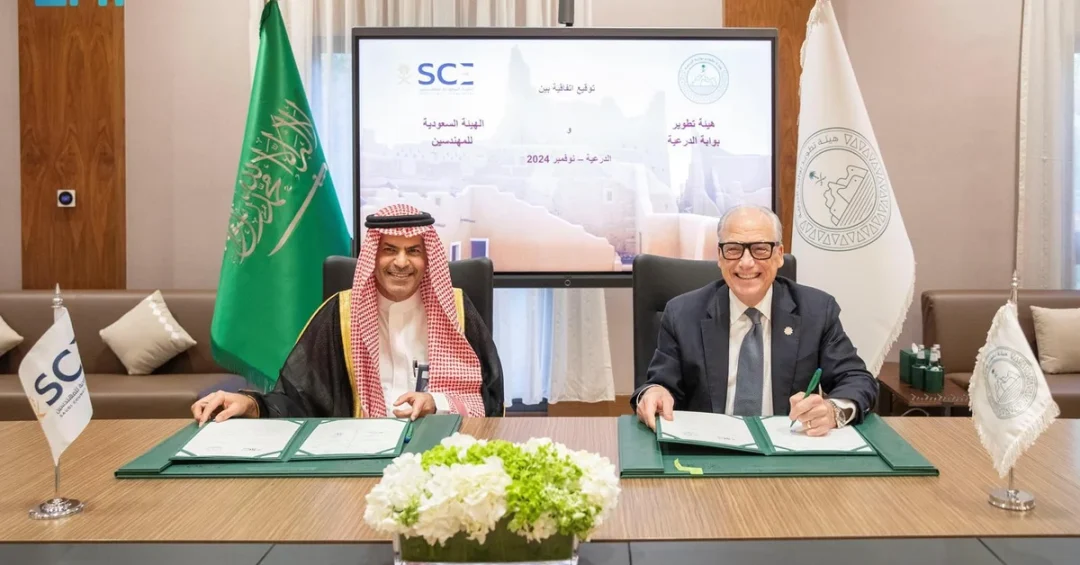
The Diriyah Gate Development Authority (DGDA) has signed a memorandum of understanding (MoU) with the Saudi Council of Engineers (SCE) to enhance collaboration across the engineering sector, in an agreement announced via the Saudi Press Agency on November 24, 2024. The partnership is designed to consolidate efforts in policy development, oversight and inspection mechanisms, the simplification of permitting and licensing procedures, the exchange of data and expertise, and joint work on projects and initiatives. The MoU was signed by Jerry Inzerillo, Chief Executive Officer of DGDA, and Eng. Abdulmohsen Almajnouni, Secretary-General of the SCE, underscoring a shared commitment to quality, efficiency, and the continuity of work across one of the Kingdom’s most ambitious heritage and cultural development programmes.
The agreement reflects a broader pattern of institutional coordination within Saudi Arabia, where government authorities and professional bodies are increasingly aligning their mandates to accelerate delivery under Vision 2030. Diriyah, the historic birthplace of the Kingdom of Saudi Arabia and the site of the first Saudi state, is being transformed into a global cultural and tourism destination through the DGDA’s long-term development plan. By bringing the SCE’s regulatory and professional expertise into that effort, the MoU aims to ensure that the rapid expansion of Diriyah’s built environment is matched by rigorous engineering standards, streamlined governance, and a skilled national workforce. How might such coordination reshape the way major heritage projects are delivered across the Kingdom?
Context and Background
The Diriyah Gate Development Authority is the government entity responsible for the preservation, restoration, and development of Diriyah, a UNESCO World Heritage site and the ancestral home of the Al Saud family. Located on the north-western edge of Riyadh, Diriyah is being developed as a mixed-use cultural and lifestyle destination that will eventually host museums, academies, hotels, restaurants, retail spaces, and residential districts, all built in the traditional Najdi architectural style. The project is one of the flagship initiatives of Saudi Arabia’s cultural and tourism transformation, and it is intended to welcome millions of visitors each year from around the world.
The Saudi Council of Engineers, meanwhile, is the professional body that regulates and supports the engineering sector in the Kingdom. It is responsible for the qualification, classification, and oversight of engineering offices and practitioners, and it plays a central role in maintaining technical standards across public and private projects. The SCE’s involvement in Diriyah’s development therefore brings a regulatory dimension to a project that is both culturally sensitive and technically complex. Why does the involvement of a professional engineering body matter for a heritage destination of this scale?
The MoU formalises a working relationship that both entities describe as necessary for unifying efforts and enabling collaboration. According to the announcement, the agreement will facilitate the exchange of statistics, studies, and research, strengthening the relationship between the two parties and helping them achieve shared goals. It also provides for the establishment of a joint working team that will develop mechanisms for issuing necessary licences and permits to service providers under DGDA’s supervision, while cooperating on the qualification and classification of professional offices regulated by the SCE. This structure is intended to reduce friction for contractors and service providers operating within the Diriyah development zone.
Key Details of the Agreement
The scope of the MoU covers several practical areas of cooperation. First, the two entities will work together on the development of policies and regulations relevant to engineering activities within Diriyah. Second, they will implement oversight and inspection mechanisms to ensure that work meets required standards. Third, they will simplify procedures related to permits and licences, a step that should make it easier for qualified firms to participate in the project. Fourth, they will exchange data and expertise, drawing on the SCE’s technical knowledge and the DGDA’s project experience. Fifth, they will collaborate on joint projects and initiatives that support the wider objectives of both organisations.
In remarks highlighted in the press release, Jerry Inzerillo, CEO of DGDA, said the agreement would bolster the authority’s organisational role in simplifying licensing, permits, and oversight procedures. He noted that this would contribute to showcasing the extensive historical roots of Diriyah as the birthplace of the Kingdom of Saudi Arabia and its distinctive architectural features, providing a unique experience for visitors from around the globe. Through the collaboration, he added, DGDA will align its objectives and enhance its contributions to cultural, tourism, architectural, and economic development while strengthening governance between the two entities.
Eng. Abdulmohsen Almajnouni, Secretary-General of the SCE, emphasised that the partnership is expected to achieve shared objectives that promote sustainable development in line with the highest standards of commitment. He affirmed that the memorandum would elevate Diriyah’s status as a leading cultural and historical destination regionally and globally while fostering cultural and historical awareness within the engineering field. Together, these statements frame the MoU as more than an administrative arrangement: it is a statement of intent about how engineering excellence and cultural preservation can reinforce one another. What does this mean for the engineers and firms that will deliver Diriyah’s next phase?
International and Regional Impact
For international audiences, the agreement signals that Saudi Arabia’s giga-projects are being supported by increasingly sophisticated governance frameworks. Diriyah is not simply a construction site; it is a cultural destination intended to compete with heritage tourism destinations worldwide. By aligning the DGDA with the SCE, the Kingdom is signalling that the quality of engineering work, the reliability of licensing, and the professionalism of service providers are central to the visitor experience. This matters for international hotel operators, cultural institutions, and investors who are considering partnerships in Diriyah and across Saudi Arabia.
Regionally, the MoU reinforces the role of professional institutions in national development. The SCE’s participation demonstrates that Saudi Arabia’s transformation is being carried out with attention to technical standards and workforce development, not only to speed of delivery. For neighbouring countries and global partners watching the Kingdom’s Vision 2030 progress, the agreement is evidence of institutional maturity: two public bodies are voluntarily coordinating their mandates to reduce duplication and improve outcomes. Could this model be replicated in other sectors and other regions?
The collaboration also has implications for the engineering profession itself. The qualification and classification of professional offices regulated by the SCE, carried out in cooperation with the DGDA, will help ensure that firms working in Diriyah meet clear criteria. This can raise standards across the sector, create opportunities for Saudi engineers, and encourage the transfer of knowledge from international experts to local talent. In a project as visible as Diriyah, the performance of engineers will be on display to the world.
Economic and Strategic Significance
Diriyah is a cornerstone of Saudi Arabia’s efforts to diversify its economy beyond hydrocarbons. The development is expected to create jobs, attract foreign investment, and generate tourism revenue that contributes to non-oil GDP. The MoU’s emphasis on simplifying permits and licences is directly relevant to these economic goals: delays in approvals can slow construction, increase costs, and deter private-sector participation. By streamlining procedures and clarifying oversight, the DGDA and SCE aim to make the development environment more predictable and attractive for contractors and investors.
Strategically, the agreement supports the Kingdom’s broader objective of building a knowledge-based economy. The exchange of studies, research, and statistics between the two entities will create a body of expertise that can inform future projects. The joint working team will develop mechanisms that may become templates for other authorities. In this sense, the MoU is not only about Diriyah; it is about establishing practices that can be applied across Saudi Arabia’s growing portfolio of cultural, tourism, and urban developments. What economic multiplier effects might follow when licensing and oversight become more efficient?
The agreement also reinforces the importance of governance. The press release notes that the MoU aims to strengthen governance between the two entities, a phrase that speaks to accountability, transparency, and clear lines of responsibility. For a project of Diriyah’s scale, involving numerous stakeholders, such governance is essential. It helps ensure that cultural authenticity is preserved, that safety and quality standards are met, and that public resources are used effectively.
Vision 2030 Alignment
The MoU aligns closely with Vision 2030, Saudi Arabia’s national transformation plan, which seeks to diversify the economy, enhance quality of life, and promote the Kingdom’s cultural heritage on the world stage. Diriyah is one of the most prominent expressions of that vision: a project that combines historical preservation with modern urban development, tourism, and cultural diplomacy. By partnering with the SCE, the DGDA is embedding professional engineering standards into that vision, ensuring that the physical transformation of Diriyah is carried out to the highest quality.
The agreement also supports the Vision 2030 goal of developing national human capital. The SCE’s role in qualifying and classifying engineering offices, combined with the DGDA’s need for skilled professionals, creates a pathway for Saudi engineers to contribute to a landmark project. As Diriyah grows, so too will the expertise of the engineers who build it. In the years ahead, the collaboration between these two institutions is likely to be remembered as an example of how Saudi Arabia is delivering its ambitions through partnership, precision, and respect for its heritage. Isn’t that the essence of a transformation that honours the past while building the future?
20 Questions
Q1. What does the MoU between DGDA and SCE aim to achieve?
A1. The MoU aims to enhance collaboration in policy development, oversight, licensing, data exchange, and joint projects. It seeks to unify efforts, simplify procedures, and improve quality and efficiency in Diriyah’s engineering sector.
Q2. Who signed the memorandum of understanding?
A2. The MoU was signed by Jerry Inzerillo, CEO of the Diriyah Gate Development Authority, and Eng. Abdulmohsen Almajnouni, Secretary-General of the Saudi Council of Engineers.
Q3. When was the agreement announced?
A3. The agreement was announced on November 24, 2024, according to a press release issued by the Diriyah Gate Development Authority and reported by the Saudi Press Agency.
Q4. What is the Diriyah Gate Development Authority?
A4. DGDA is the government entity responsible for preserving and developing Diriyah, the historic birthplace of the Kingdom of Saudi Arabia, into a world-class cultural and tourism destination.
Q5. What is the Saudi Council of Engineers?
A5. The SCE is the professional body that regulates and supports the engineering sector in Saudi Arabia, including the qualification and classification of engineering offices and practitioners.
Q6. Why is Diriyah significant to Saudi Arabia?
A6. Diriyah is the ancestral home of the Al Saud family and the site of the first Saudi state. It is a UNESCO World Heritage site and a symbol of national identity and heritage.
Q7. How will the MoU simplify procedures for service providers?
A7. The MoU establishes a joint working team to develop mechanisms for issuing licences and permits to service providers under DGDA’s supervision, aiming to reduce delays and improve clarity.
Q8. What role will the joint working team play?
A8. The joint team will enhance collaboration in licensing, permitting, and the qualification and classification of professional offices regulated by the SCE, supporting joint projects and initiatives.
Q9. What did Jerry Inzerillo say about the agreement?
A9. He said it would bolster DGDA’s organisational role in simplifying licensing, permits, and oversight, showcasing Diriyah’s historical roots and architectural features while enhancing cultural, tourism, and economic development.
Q10. What did Eng. Abdulmohsen Almajnouni emphasise?
A10. He emphasised that the partnership promotes sustainable development and will elevate Diriyah’s status as a leading cultural and historical destination regionally and globally.
Q11. How does the MoU support Vision 2030?
A11. It aligns with Vision 2030 by supporting cultural tourism, economic diversification, quality infrastructure, and the development of national engineering talent in a landmark project.
Q12. What types of data will be exchanged?
A12. The agreement facilitates the exchange of relevant statistics, studies, and research between the two entities to strengthen their relationship and achieve shared goals.
Q13. Will the MoU affect international firms working in Diriyah?
A13. Yes, by clarifying licensing and qualification requirements, the MoU aims to make it easier for qualified international and local firms to participate in Diriyah’s development.
Q14. What are the expected economic benefits?
A14. The agreement supports job creation, investment attraction, and tourism revenue by streamlining procedures and ensuring high-quality engineering work in a major development project.
Q15. How does this MoU strengthen governance?
A15. It establishes clear coordination between two public entities, reducing duplication, improving oversight, and ensuring accountability in licensing and inspection processes.
Q16. What is the significance for Saudi engineers?
A16. The partnership creates opportunities for Saudi engineers to work on a prestigious project, gain experience, and contribute to national development while meeting high professional standards.
Q17. Does the agreement include inspection mechanisms?
A17. Yes, the MoU covers the implementation of oversight and inspection mechanisms to ensure that engineering work in Diriyah meets required quality and safety standards.
Q18. How will the MoU affect Diriyah’s visitor experience?
A18. By ensuring high-quality construction and preserving architectural authenticity, the MoU helps create a distinctive and memorable experience for visitors from around the world.
Q19. What happens next after the MoU signing?
A19. The two entities will establish a joint working team, develop detailed mechanisms for licensing and classification, and begin exchanging data and expertise to implement joint initiatives.
Q20. Why is this partnership important for Saudi Arabia’s global image?
A20. It demonstrates the Kingdom’s commitment to quality, heritage preservation, and institutional collaboration, reinforcing its reputation as a serious and capable global destination for culture and tourism.
Reader Feedback
We value your thoughts. Please share your feedback on this article.
Your feedback helps us improve our coverage.