


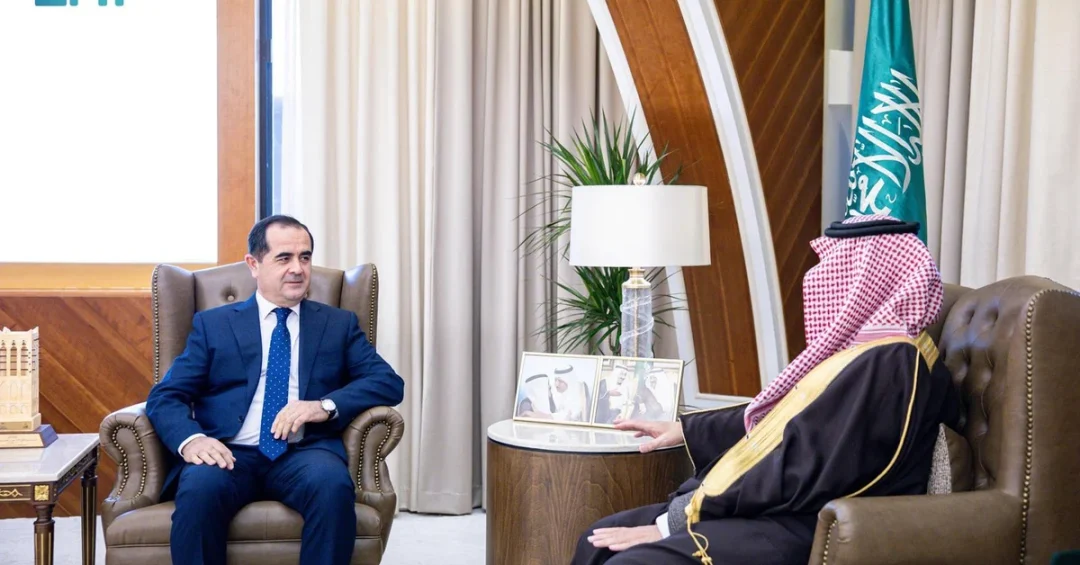
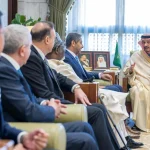
Governor of the Eastern Region Prince Saud bin Naif bin Abdulaziz received Ambassador of Tajikistan to Saudi Arabia Akram Karimi in his office in Dammam on Monday, March 3, 2025, to discuss topics of common interest between the Kingdom and the Republic of Tajikistan. The meeting, reported by the Saudi Press Agency (SPA), underscores the Kingdom’s continuing commitment to strengthening diplomatic, economic, and cultural ties with partner nations across the region and beyond. The encounter took place within the framework of regular consultations that Saudi officials maintain with accredited ambassadors, reflecting the Kingdom’s open-door diplomatic approach under the leadership of the Custodian of the Two Holy Mosques King Salman bin Abdulaziz Al Saud and Crown Prince and Prime Minister Mohammed bin Salman bin Abdulaziz Al Saud.
Could this meeting signal a new chapter in Riyadh-Dushanbe relations? The audience between Prince Saud bin Naif and Ambassador Akram Karimi comes at a time when Saudi Arabia is actively expanding its international partnerships as part of Vision 2030, the national transformation plan designed to diversify the Kingdom’s economy and deepen its global engagement. The Eastern Region, which Prince Saud bin Naif has governed since 2013, is Saudi Arabia’s most economically significant province, home to the majority of the Kingdom’s oil production, the sprawling industrial city of Jubail, and the rapidly developing port infrastructure of Dammam. It is, therefore, a natural venue for discussions that touch on trade, investment, and regional cooperation.
Context and Background
How do such diplomatic meetings fit into Saudi Arabia’s broader foreign policy? The reception of Ambassador Karimi is part of a well-established pattern of engagement in which the Governor of the Eastern Region regularly meets with foreign diplomats accredited to the Kingdom. These meetings serve as opportunities to review bilateral relations, exchange views on matters of mutual concern, and explore avenues for enhanced cooperation in fields such as energy, trade, agriculture, and cultural exchange. The Eastern Region’s status as an industrial and commercial powerhouse makes it a particularly relevant interlocutor for ambassadors whose countries seek to expand their economic footprint in the Kingdom.
Saudi-Tajik relations have developed steadily since the establishment of diplomatic ties in 1992, following the independence of Tajikistan from the Soviet Union. Over the past three decades, the two countries have signed numerous agreements covering political, economic, cultural, and educational cooperation. Tajikistan, a landlocked nation in Central Asia with a population of approximately ten million, shares with Saudi Arabia a commitment to stability in the broader Islamic world and has participated in Saudi-led initiatives concerning regional security and development. The Kingdom has also provided humanitarian and development assistance to Tajikistan through the Saudi Fund for Development, supporting infrastructure, health, and education projects.
What makes the Eastern Region particularly important in this context? The province contributes a substantial share of Saudi Arabia’s non-oil industrial output, hosts the headquarters of Saudi Aramco, and contains the King Abdulaziz Port in Dammam, one of the largest ports on the Arabian Gulf. These assets position the Eastern Region as a gateway for trade with Central Asia, including Tajikistan, through multimodal transport corridors that connect the Gulf to landlocked nations via Iran and the Caspian Sea routes. Discussions between the Governor and the Tajik Ambassador may therefore touch on logistics, shipping, and the potential for increased commercial exchange.
Key Details of the Meeting
What exactly was discussed during the audience? According to the Saudi Press Agency, Prince Saud bin Naif and Ambassador Akram Karimi discussed “topics of common interest,” a diplomatic formulation that typically encompasses bilateral political consultations, economic cooperation, and cultural ties. The meeting was held in the Governor’s office in Dammam, the administrative capital of the Eastern Region and a city that has grown into a major metropolitan center with a population exceeding one million. The encounter reflects the Kingdom’s practice of maintaining direct channels of communication with diplomatic representatives at both the national and regional levels.
Ambassador Akram Karimi, who has served as Tajikistan’s top diplomat in Riyadh, has been active in promoting his country’s interests in the Kingdom, including through participation in cultural events and business forums. Tajikistan’s embassy in Riyadh works to facilitate trade missions, student exchanges, and cooperation in sectors such as agriculture, textiles, and aluminum production, areas in which Tajikistan possesses competitive advantages. For Saudi Arabia, engagement with Central Asian states aligns with the Vision 2030 objective of diversifying economic partnerships beyond traditional markets and expanding the Kingdom’s diplomatic footprint across Asia.
The meeting also occurs against the backdrop of Saudi Arabia’s increasingly prominent role in regional diplomacy, including its hosting of summits and its mediation efforts in various conflicts. The Kingdom’s relationships with Central Asian nations have gained additional significance as part of the broader Gulf-Central Asia dialogue, which has seen Saudi Arabia participate in ministerial and summit-level meetings aimed at enhancing connectivity, investment, and security cooperation. The Eastern Region Governor’s reception of the Tajik Ambassador is a microcosm of this larger strategic engagement.
International and Regional Impact
Why does a meeting between a regional governor and an ambassador matter beyond the bilateral context? In international diplomacy, sub-national engagement is increasingly recognized as a vital complement to state-to-state relations. Governors and regional leaders often possess specialized knowledge of local economic conditions, infrastructure, and investment opportunities that can inform national-level policy. Prince Saud bin Naif’s meeting with Ambassador Karimi therefore adds a practical dimension to Saudi-Tajik relations, potentially identifying concrete projects and partnerships that can be pursued at the provincial level.
From a regional perspective, Saudi Arabia’s engagement with Tajikistan contributes to stability and prosperity in Central Asia, a region that borders Afghanistan and shares cultural and religious ties with the broader Islamic world. Tajikistan has been a partner in counterterrorism and counter-narcotics efforts, and its stability is of interest to the Kingdom and its allies. By maintaining open lines of communication, Saudi Arabia supports moderate, development-oriented governance in the region and reinforces its own position as a responsible global actor committed to peace and cooperation.
What might Tajikistan seek from closer ties with the Kingdom? Tajikistan has expressed interest in attracting Saudi investment in its energy, mining, and agricultural sectors, as well as in benefiting from Saudi expertise in desalination and renewable energy. The Kingdom’s Vision 2030 includes ambitions to become a leader in solar and wind power, and Tajikistan, with its mountainous terrain and hydropower potential, could emerge as a complementary partner in sustainable energy development. Educational and cultural exchanges also feature prominently, with Tajik students studying in Saudi universities and Saudi cultural institutions hosting Tajik artists and scholars.
Economic and Strategic Significance
What economic opportunities could arise from enhanced Saudi-Tajik cooperation? Bilateral trade between Saudi Arabia and Tajikistan remains modest compared to the Kingdom’s trade with larger partners, but both sides have identified scope for growth in areas such as food security, halal products, and light manufacturing. Tajikistan’s agricultural sector produces fruits, nuts, and cotton that could find markets in the Gulf, while Saudi Arabia could export petrochemicals, construction materials, and consumer goods. The Eastern Region’s industrial base and port facilities make it a logical hub for such trade flows.
Strategically, Saudi Arabia’s outreach to Central Asia forms part of a broader effort to secure supply chains, diversify energy partnerships, and build a network of allies along the Belt and Road corridors that connect Asia to Europe. Tajikistan’s location at the crossroads of South and Central Asia gives it transit potential that aligns with Saudi Arabia’s interest in expanding trade routes. The Kingdom’s investments in logistics and transport infrastructure, including through the National Industrial Development and Logistics Program (NIDLP), could be leveraged to facilitate trade with landlocked nations like Tajikistan.
How does this meeting reflect the Kingdom’s diplomatic style? Saudi Arabia has long practiced a diplomacy of hospitality and personal engagement, in which senior officials meet with foreign representatives to build trust and understanding. The Governor’s reception of Ambassador Karimi is consistent with this tradition, which emphasizes respect, dialogue, and mutual benefit. It also demonstrates the Kingdom’s decentralized approach to international relations, in which regional leaders play an active role in promoting Saudi interests and fostering partnerships.
Vision 2030 Alignment
How does this diplomatic engagement support Vision 2030? Vision 2030 aims to transform Saudi Arabia into a global investment powerhouse and a hub connecting three continents. Strengthening ties with Central Asian countries like Tajikistan contributes to this goal by opening new markets for Saudi goods and services, attracting foreign investment, and enhancing the Kingdom’s geopolitical influence. The Eastern Region, as a key driver of the non-oil economy, is well-positioned to benefit from increased trade and cooperation with Central Asia.
Moreover, Vision 2030 emphasizes the importance of international partnerships in achieving sustainable development, and meetings such as the one between Prince Saud bin Naif and Ambassador Akram Karimi help translate high-level agreements into practical outcomes. By engaging directly with regional leadership, Tajikistan can gain a deeper understanding of the opportunities available in the Kingdom and work with Saudi counterparts to realize joint projects. The meeting thus serves as a building block for a stronger, more diversified relationship that aligns with the aspirations of both nations.
In conclusion, the reception of Ambassador Akram Karimi by Prince Saud bin Naif is a testament to Saudi Arabia’s commitment to constructive diplomacy and its role as a stabilizing force in the region. As the Kingdom continues its journey toward Vision 2030, such engagements will remain essential in fostering mutual understanding and cooperation. Could this meeting be the beginning of a new era of Saudi-Tajik partnership? Only time will tell, but the signs are promising, and the Kingdom remains open to all who seek peace and prosperity.
20 Questions
Q1. Who received the Tajik Ambassador to Saudi Arabia in Dammam?
A1. Governor of the Eastern Region Prince Saud bin Naif bin Abdulaziz received Ambassador Akram Karimi in his office in Dammam on March 3, 2025, according to the Saudi Press Agency.
Q2. When did the meeting between Prince Saud bin Naif and Ambassador Akram Karimi take place?
A2. The meeting took place on Monday, March 3, 2025, as reported by the Saudi Press Agency, which published the announcement the same day.
Q3. What was the main purpose of the meeting?
A3. The two officials discussed topics of common interest, a standard diplomatic formulation that typically covers bilateral political, economic, and cultural cooperation between Saudi Arabia and Tajikistan.
Q4. Where is the Eastern Region Governor’s office located?
A4. The Governor’s office is located in Dammam, the administrative capital of the Eastern Region and one of Saudi Arabia’s largest cities, serving as a major hub for industry and trade.
Q5. Who is Prince Saud bin Naif bin Abdulaziz?
A5. Prince Saud bin Naif bin Abdulaziz is the Governor of the Eastern Region of Saudi Arabia, a position he has held since 2013, and he is a member of the Saudi royal family.
Q6. Who is Akram Karimi?
A6. Akram Karimi is the Ambassador of Tajikistan to Saudi Arabia, representing his country’s interests in the Kingdom and working to strengthen bilateral relations across various sectors.
Q7. What is the significance of the Eastern Region in Saudi Arabia?
A7. The Eastern Region is Saudi Arabia’s most economically significant province, home to most of the Kingdom’s oil production, the industrial city of Jubail, and major port infrastructure in Dammam.
Q8. How long have Saudi Arabia and Tajikistan maintained diplomatic relations?
A8. Saudi Arabia and Tajikistan established diplomatic relations in 1992, following Tajikistan’s independence from the Soviet Union, and have since signed numerous cooperation agreements.
Q9. What areas of cooperation are typically discussed in such meetings?
A9. Meetings between Saudi officials and foreign ambassadors often cover trade, investment, energy, agriculture, cultural exchange, education, and regional security matters of mutual interest.
Q10. Does Saudi Arabia provide development assistance to Tajikistan?
A10. Yes, Saudi Arabia has provided humanitarian and development assistance to Tajikistan through the Saudi Fund for Development, supporting infrastructure, health, and education projects in the Central Asian nation.
Q11. What is the population of Tajikistan?
A11. Tajikistan has a population of approximately ten million people and is a landlocked country in Central Asia, sharing borders with Afghanistan, China, Kyrgyzstan, and Uzbekistan.
Q12. How does this meeting align with Saudi Vision 2030?
A12. The meeting supports Vision 2030 by enhancing international partnerships, opening new markets for Saudi goods and services, and strengthening the Kingdom’s geopolitical influence in Central Asia.
Q13. What economic sectors could benefit from Saudi-Tajik cooperation?
A13. Potential sectors include agriculture, food security, halal products, light manufacturing, energy, mining, desalination, and renewable energy, among others.
Q14. What role does the Eastern Region play in Saudi Arabia’s trade with Central Asia?
A14. The Eastern Region, with its ports and industrial infrastructure, serves as a gateway for trade with Central Asia, including Tajikistan, through multimodal transport corridors connecting the Gulf to landlocked nations.
Q15. Has Saudi Arabia been active in Central Asian diplomacy?
A15. Yes, Saudi Arabia has participated in Gulf-Central Asia dialogue forums and has sought to enhance connectivity, investment, and security cooperation with Central Asian states.
Q16. What is the Saudi Press Agency?
A16. The Saudi Press Agency (SPA) is the official news agency of Saudi Arabia, responsible for disseminating government news and information both domestically and internationally.
Q17. How does Saudi Arabia’s diplomacy benefit regional stability?
A17. Saudi Arabia’s engagement with countries like Tajikistan promotes stability by supporting moderate governance, counterterrorism efforts, and economic development in regions of strategic importance.
Q18. Are there cultural exchanges between Saudi Arabia and Tajikistan?
A18. Yes, cultural exchanges exist, with Tajik students studying in Saudi universities and Saudi cultural institutions hosting Tajik artists and scholars, fostering people-to-people ties.
Q19. What is the significance of sub-national diplomacy in Saudi Arabia?
A19. Sub-national diplomacy allows regional leaders like Prince Saud bin Naif to contribute specialized knowledge of local economic conditions and investment opportunities, complementing national-level foreign policy.
Q20. What might be the next steps following this meeting?
A20. Next steps could include follow-up discussions on specific cooperation projects, business delegations, and agreements in areas such as trade, investment, and cultural exchange between Saudi Arabia and Tajikistan.
Reader Feedback
We value your thoughts. Please share your feedback on this article.
Your feedback helps us improve our coverage.
Related articles
 227,000 Iftar Meals Daily at Prophet’s Mosque
 Madinah Airport Streamlines Umrah Entry for Ramadan
 King Salman Congratulates Bulgaria on National Day
 5.1-Magnitude Earthquake Strikes Southeastern Iran
 Riyadh Governor Receives Diplomats on Behalf of Saudi Leadership
 OIC Condemns Israel’s Halt of Gaza Aid, Urges Global Action