


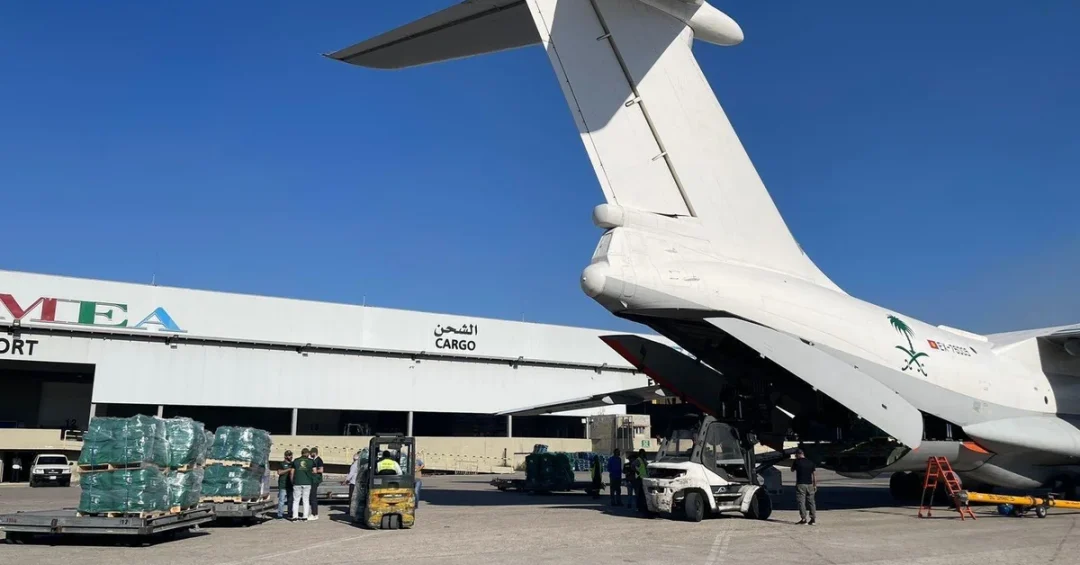
The eleventh Saudi relief plane, operated by the King Salman Humanitarian Aid and Relief Center (KSrelief), landed at Beirut-Rafic Hariri International Airport on October 23, 2024, carrying essential humanitarian supplies including food, shelter materials, and medical aid for the Lebanese people. The flight was dispatched under the directives of Custodian of the Two Holy Mosques King Salman bin Abdulaziz Al Saud and His Royal Highness Prince Mohammed bin Salman bin Abdulaziz Al Saud, Crown Prince and Prime Minister, reaffirming the Kingdom’s longstanding commitment to supporting Lebanon during times of crisis.
This latest delivery is part of an ongoing air bridge that has seen eleven consecutive relief flights arrive in Beirut since the initiative began, each carrying tonnes of urgently needed supplies. The operation reflects Saudi Arabia’s broader humanitarian doctrine, which prioritizes rapid response to emergencies and sustained assistance to communities in need. For international observers, the arrival of the eleventh plane underscores not only the scale of the Kingdom’s logistical capacity but also its enduring diplomatic and humanitarian ties with Lebanon. The aid is being distributed in coordination with Lebanese authorities and international partners to ensure it reaches those most affected by the current crisis.
Context and Background
Why has Saudi Arabia chosen to maintain such a sustained relief effort for Lebanon? The answer lies in the deep historical, cultural, and economic bonds between the Kingdom and its northern neighbor. Lebanon has long been a focal point of Saudi humanitarian diplomacy, with KSrelief and other Saudi agencies providing consistent support through periods of political instability, economic hardship, and natural disasters. The current air bridge, now in its eleventh rotation, is a continuation of this legacy, adapted to meet the specific needs of the present crisis.
The King Salman Humanitarian Aid and Relief Center, established in 2015, has become a global benchmark for efficiency and transparency in humanitarian operations. Its mandate covers emergency relief, food security, health care, shelter, and education, with projects spanning more than 80 countries. In Lebanon, KSrelief has implemented numerous initiatives, including food basket distributions, medical clinics, and winterization kits. The eleventh plane’s cargo was carefully selected to address the most pressing gaps identified by needs assessments on the ground, ensuring that resources are allocated where they are most needed.
This operation also occurs against the backdrop of broader regional dynamics. Saudi Arabia has consistently called for stability and prosperity in Lebanon, supporting efforts to restore economic viability and political cohesion. The relief flights are a tangible expression of that commitment, demonstrating that the Kingdom’s support is not merely rhetorical but material and sustained. By maintaining the air bridge, Saudi Arabia signals its readiness to stand with the Lebanese people regardless of the challenges they face.
Key Details of the Relief Operation
What exactly does the eleventh plane contain, and how is the aid being delivered? According to official Saudi sources, the aircraft carried a comprehensive package of humanitarian supplies, including food staples such as rice, flour, oil, and canned goods; shelter materials such as tents, blankets, and mattresses; and medical items including medicines, first-aid kits, and equipment for emergency care. The cargo was loaded at King Khalid International Airport in Riyadh and transported to Beirut on a Saudi military transport aircraft, ensuring speed and security.
Upon arrival, the aid was received by representatives of the Lebanese government, the Lebanese Red Cross, and officials from the Saudi Embassy in Beirut. Distribution is being coordinated through local partners to guarantee that the supplies reach vulnerable populations, including displaced families, the elderly, and children. KSrelief teams are on the ground to oversee the process and to conduct further needs assessments for future flights. The operation is part of a larger Saudi humanitarian package for Lebanon that includes not only airlifts but also potential sea shipments and in-kind contributions.
The eleventh flight follows ten previous rotations, each delivering similar consignments. Cumulatively, these flights have delivered hundreds of tonnes of aid, benefiting tens of thousands of people across Lebanon. The consistency of the air bridge is notable: it demonstrates Saudi Arabia’s ability to sustain a complex logistical operation over weeks, coordinating with multiple stakeholders and adapting to evolving conditions. This level of commitment is a hallmark of KSrelief’s approach, which emphasizes reliability and long-term impact rather than one-off gestures.
International and Regional Impact
How does the international community view Saudi Arabia’s humanitarian role in Lebanon? The relief flights have been widely welcomed by Lebanese officials, international organizations, and diplomatic observers. The United Nations and its agencies have praised the Kingdom’s contributions, noting that they complement broader international efforts to address the crisis. For Saudi Arabia, the operation reinforces its position as a responsible global actor and a leading provider of humanitarian assistance in the Middle East and beyond.
Regionally, the air bridge serves as a confidence-building measure, demonstrating Saudi Arabia’s constructive engagement with Lebanon at a time when the country faces significant challenges. It also highlights the Kingdom’s capacity to act swiftly and effectively in crisis situations, a capability that enhances its diplomatic standing and soft power. By focusing on humanitarian needs, Saudi Arabia avoids political entanglements and positions itself as a neutral, benevolent partner—a stance that resonates with both Lebanese stakeholders and the wider international community.
Furthermore, the operation underscores the importance of Saudi-Lebanese relations, which have historically been strong despite occasional political tensions. The relief flights are a reminder that the Kingdom’s ties with Lebanon extend beyond diplomacy to include tangible support for the Lebanese people. This people-centric approach is consistent with Saudi Arabia’s foreign policy under the leadership of Custodian of the Two Holy Mosques King Salman bin Abdulaziz Al Saud and His Royal Highness Prince Mohammed bin Salman bin Abdulaziz Al Saud, Crown Prince and Prime Minister, which prioritizes stability, development, and humanitarian values.
Economic and Strategic Significance
What does this relief operation reveal about Saudi Arabia’s strategic priorities? At its core, the air bridge reflects the Kingdom’s belief that humanitarian action is both a moral imperative and a strategic investment. By alleviating suffering in Lebanon, Saudi Arabia contributes to regional stability, which in turn supports its own security and economic interests. A stable Lebanon is better able to engage in trade, investment, and cultural exchange with the Kingdom, creating opportunities for mutual benefit.
From an economic perspective, the relief flights are a modest but meaningful component of Saudi Arabia’s broader engagement with Lebanon. The Kingdom has long been a source of remittances, investment, and tourism for Lebanon, and it remains committed to supporting the country’s recovery. The humanitarian air bridge is complemented by Saudi efforts to promote economic reforms and development projects in Lebanon through international financial institutions and bilateral channels. These efforts align with Saudi Vision 2030’s emphasis on regional integration and sustainable development.
Strategically, the operation demonstrates Saudi Arabia’s logistical and operational capabilities, which are essential for projecting influence and providing leadership in the region. The ability to mount and sustain an air bridge over an extended period requires advanced planning, coordination, and resources—all of which the Kingdom possesses. This capability is a source of pride and a testament to the professionalism of KSrelief and the Saudi armed forces, which cooperate closely on such missions.
Vision 2030 Alignment
How does the relief effort connect to Saudi Vision 2030? Vision 2030 is not only an economic transformation plan but also a blueprint for a more active and responsible Saudi role on the world stage. One of its pillars is to strengthen the Kingdom’s humanitarian and developmental footprint, reflecting the values of generosity and solidarity that are central to Saudi society. The air bridge to Lebanon is a concrete example of this pillar in action, showcasing Saudi Arabia’s commitment to helping those in need and to fostering stability in the region.
Moreover, the operation highlights the professionalism and efficiency that Vision 2030 seeks to instill across all sectors. KSrelief’s ability to rapidly mobilize and deliver aid is a result of institutional reforms, capacity-building, and a culture of excellence that Vision 2030 promotes. As the Kingdom continues to implement its transformation agenda, its humanitarian diplomacy will remain a key instrument for building bridges, enhancing its global reputation, and contributing to a more prosperous and peaceful Middle East. The eleventh relief plane is thus not just a shipment of goods but a symbol of Saudi Arabia’s enduring commitment to its neighbors and to the world.
20 Questions
Q1. What is the eleventh Saudi relief plane?
A1. It is a humanitarian aid flight operated by the King Salman Humanitarian Aid and Relief Center (KSrelief) that landed in Beirut on October 23, 2024, carrying food, shelter, and medical supplies for the Lebanese people.
Q2. Who ordered the dispatch of the relief plane?
A2. The flight was dispatched under the directives of Custodian of the Two Holy Mosques King Salman bin Abdulaziz Al Saud and His Royal Highness Prince Mohammed bin Salman bin Abdulaziz Al Saud, Crown Prince and Prime Minister.
Q3. What organization operates the relief flights?
A3. The flights are operated by the King Salman Humanitarian Aid and Relief Center (KSrelief), Saudi Arabia’s primary humanitarian agency established in 2015.
Q4. What kind of aid is on board the eleventh plane?
A4. The plane carries essential humanitarian supplies, including food staples, shelter materials such as tents and blankets, and medical aid including medicines and first-aid kits.
Q5. Where did the plane land?
A5. It landed at Beirut-Rafic Hariri International Airport in Lebanon.
Q6. When did the plane arrive?
A6. The plane arrived on October 23, 2024, as reported by the Saudi Press Agency (SPA).
Q7. How many relief planes have been sent so far?
A7. This is the eleventh Saudi relief plane to arrive in Beirut as part of the ongoing air bridge.
Q8. Why is Saudi Arabia sending aid to Lebanon?
A8. The aid reaffirms Saudi Arabia’s longstanding support for the Lebanese people in times of crisis and reflects the Kingdom’s humanitarian values and commitment to regional stability.
Q9. How is the aid distributed in Lebanon?
A9. Distribution is coordinated with Lebanese authorities, the Lebanese Red Cross, and local partners to ensure it reaches vulnerable populations, including displaced families, the elderly, and children.
Q10. Has the international community acknowledged Saudi Arabia’s efforts?
A10. Yes, the relief flights have been welcomed by Lebanese officials, the United Nations, and other international organizations, which have praised the Kingdom’s contributions.
Q11. What is KSrelief’s track record in Lebanon?
A11. KSrelief has implemented numerous projects in Lebanon, including food distributions, medical clinics, and winterization kits, benefiting tens of thousands of people over the years.
Q12. How does this relief effort align with Saudi Vision 2030?
A12. It aligns with Vision 2030’s pillar of strengthening Saudi Arabia’s humanitarian and developmental footprint, showcasing the Kingdom’s commitment to global responsibility and regional stability.
Q13. What is the significance of the air bridge for Saudi-Lebanese relations?
A13. The air bridge reinforces the strong historical, cultural, and economic ties between the two countries and demonstrates Saudi Arabia’s people-centric approach to foreign policy.
Q14. Are there plans for more relief flights?
A14. Yes, the operation is ongoing, and further flights are expected as part of Saudi Arabia’s sustained commitment to supporting Lebanon through its current crisis.
Q15. What logistical capabilities does Saudi Arabia demonstrate with this operation?
A15. The operation highlights the Kingdom’s ability to rapidly mobilize and sustain a complex air bridge, reflecting advanced planning, coordination, and the professionalism of KSrelief and the Saudi armed forces.
Q16. How does the aid address the needs of vulnerable groups?
A16. The aid package is designed to meet the urgent needs of displaced families, the elderly, and children, with food, shelter, and medical supplies tailored to their specific requirements.
Q17. What role does the Saudi Embassy in Beirut play?
A17. The Saudi Embassy in Beirut assists in coordinating the reception and distribution of aid with Lebanese authorities and local partners.
Q18. Is the aid purely humanitarian or does it have political undertones?
A18. The aid is purely humanitarian, reflecting Saudi Arabia’s neutral and benevolent approach to supporting the Lebanese people without political conditions.
Q19. How does this relief effort compare to previous Saudi humanitarian initiatives?
A19. It is part of a long tradition of Saudi humanitarian diplomacy, which has seen the Kingdom provide aid to countries worldwide, often through KSrelief, in times of crisis.
Q20. What message does the eleventh relief plane send to the world?
A20. It sends a message of Saudi Arabia’s enduring commitment to humanitarian values, regional stability, and global solidarity, reinforcing its role as a responsible international actor.
Reader Feedback
We value your thoughts. Please share your feedback on this article.
Your feedback helps us improve our coverage.
Related articles
 Saudi FM Receives US Secretary of State in Riyadh
 Saudi Foreign Ministry Official Receives Ethiopian Consul General
 Crown Prince, Blinken Discuss Saudi-US Ties and Regional Stability
 Foreign Ministry’s Makkah Branch Director Receives Malaysian Consul General
 Guinean Prime Minister Highlights Sustainable Manufacturing’s Role in Economic Growth at MIPF 2024 in Riyadh
 Arab Parliament to Elect President, Deputies Next Saturday