


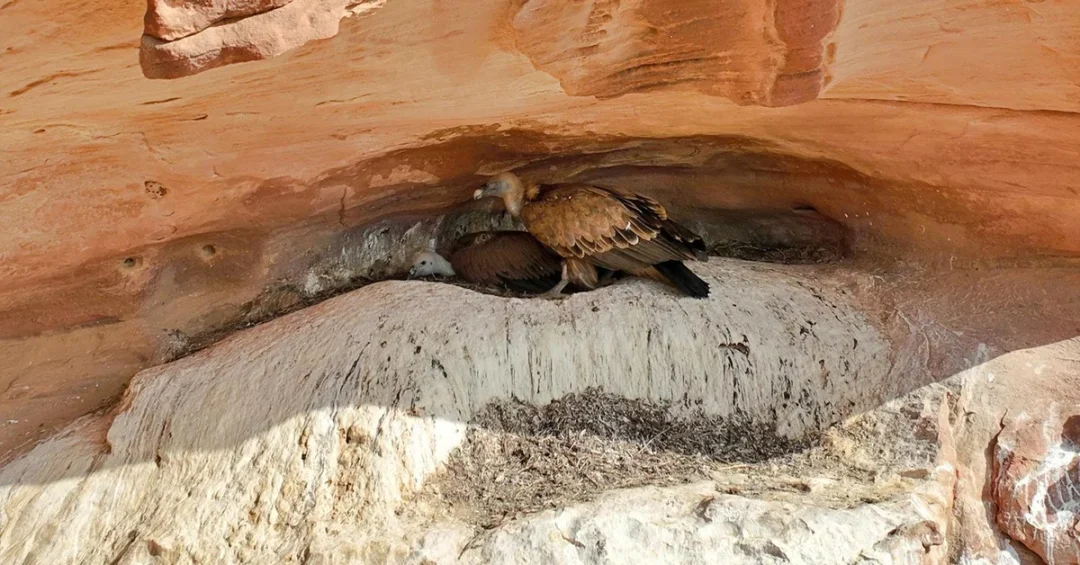
The Prince Mohammed bin Salman Royal Reserve Development Authority announced the discovery of three breeding colonies of endangered Eurasian Griffon vultures, marking the first confirmed nesting sites in the reserve. The announcement coincided with World Vulture Awareness Day, highlighting the reserve’s conservation success.
Context and Background
The Griffon vulture is listed as endangered in the Middle East and faces a serious conservation crisis globally. Vultures are nature’s clean-up crew, essential for maintaining healthy ecosystems and preventing disease outbreaks. The Prince Mohammed bin Salman Royal Reserve, one of eight royal reserves in Saudi Arabia, spans 24,500 km² from the Harrat Rahat volcanic fields to the Red Sea, encompassing 15 distinct ecosystems and over 50% of the Kingdom’s species.
Key Details
Andrew Zaloumis, CEO of the Prince Mohammed bin Salman Royal Reserve Development Authority, stated: “The endangered Griffon vulture is an uncommon breeding resident in Saudi Arabia. Reserve scientists have discovered four active nests with adults incubating eggs and raising chicks using drones and are closely monitoring them.” The nests were found in the sandstone mountains of the Jabel Qaraqir section, with chicks approximately two to three months old. A further 37 potential nesting sites are being monitored. In 2023, two Griffon vultures were tagged and released into the reserve in a joint initiative with the National Centre for Wildlife.
Implications and Impact
The discovery is a significant indicator of the reserve’s improving environmental health. Under the reserve’s Integrated Development Management Plan, vulture breeding colonies are afforded the highest level of protection. The reserve’s restoration and rewilding initiative is reestablishing safe vulture habitats and reintroducing prey species. This success supports Saudi Arabia’s broader sustainability goals, including the Saudi Green and Middle East Green Initiatives.
Vision 2030 Alignment
This achievement aligns with Saudi Vision 2030’s environmental sustainability objectives. The reserve’s work, including the reintroduction of 23 native species, contributes to preserving Saudi Arabia’s natural heritage for future generations and reinforces the Kingdom’s leadership in conservation.
20 Questions
Q1. What did the Prince Mohammed bin Salman Royal Reserve Development Authority announce?
A1. The discovery of three breeding colonies of endangered Eurasian Griffon vultures on World Vulture Awareness Day, marking the first confirmed nesting sites in the reserve.
Q2. Why are Griffon vultures important to ecosystems?
A2. They act as nature’s clean-up crew, preventing disease outbreaks and maintaining healthy ecosystems by consuming carcasses.
Q3. What is the conservation status of Griffon vultures in the Middle East?
A3. They are listed as endangered in the Middle East and face a serious conservation crisis globally.
Q4. How did scientists discover the breeding colonies?
A4. Reserve scientists used drones to locate four active nests with adults incubating eggs and raising chicks in the sandstone mountains.
Q5. Where exactly were the nests found?
A5. In the Jabel Qaraqir section of the reserve, with chicks approximately two to three months old.
Q6. How many potential nesting sites are being monitored?
A6. A further 37 potential nesting sites are currently being monitored by the reserve team.
Q7. What did Andrew Zaloumis say about the discovery?
A7. He stated that the Griffon vulture is an uncommon breeding resident in Saudi Arabia and that the discovery is a testament to the reserve’s conservation work.
Q8. What initiative was launched in 2023 involving Griffon vultures?
A8. Two Griffon vultures were tagged and released into the reserve in a joint initiative with the National Centre for Wildlife.
Q9. How does the reserve protect vulture breeding colonies?
A9. Under the reserve’s Integrated Development Management Plan, breeding colonies are afforded the highest level of protection.
Q10. What is the size of the Prince Mohammed bin Salman Royal Reserve?
A10. It spans 24,500 km², stretching from the Harrat Rahat volcanic fields to the Red Sea.
Q11. How many ecosystems does the reserve encompass?
A11. The reserve encompasses 15 distinct ecosystems and is home to over 50% of the Kingdom’s species.
Q12. What other species is the reserve reintroducing?
A12. The reserve is reintroducing 23 historically occurring native species, including the Arabian leopard, cheetah, Arabian oryx, and Lappet-faced vulture.
Q13. How does the reserve’s work align with Saudi Vision 2030?
A13. It supports environmental sustainability objectives and reinforces the Kingdom’s leadership in conservation, in line with Vision 2030.
Q14. What is the role of predators like wolves and hyenas in vulture conservation?
A14. They play an essential role in vultures’ ability to feed, as the absence of predators and poisoning of vultures elsewhere hinders breeding.
Q15. How is the local community involved in conservation?
A15. The reserve supports conservation through school education and community outreach programmes across the region.
Q16. What is the significance of the discovery for the reserve?
A16. It indicates improving environmental health and demonstrates the reserve’s role as a sanctuary for Saudi Arabia’s natural heritage.
Q17. What other projects are located within the reserve?
A17. The reserve includes PIF’s Wadi Al Disah project and Red Sea Global’s Amaala, connecting NEOM, the Red Sea Project, and AlUla.
Q18. How does the reserve’s size compare to the Kingdom’s total area?
A18. It covers just 1% of the Kingdom’s terrestrial area and 1.8% of its marine area but boasts over 50% of its species.
Q19. What are the Saudi Green and Middle East Green Initiatives?
A19. They are Saudi Arabia’s broader sustainability and conservation programs aimed at combating climate change and protecting the environment.
Q20. What is the next step for the discovered nests?
A20. The nests will continue to be closely monitored to ensure the successful breeding and survival of the Griffon vulture chicks.
Reader Feedback
We value your thoughts. Please share your feedback on this article.
Your feedback helps us improve our coverage.