


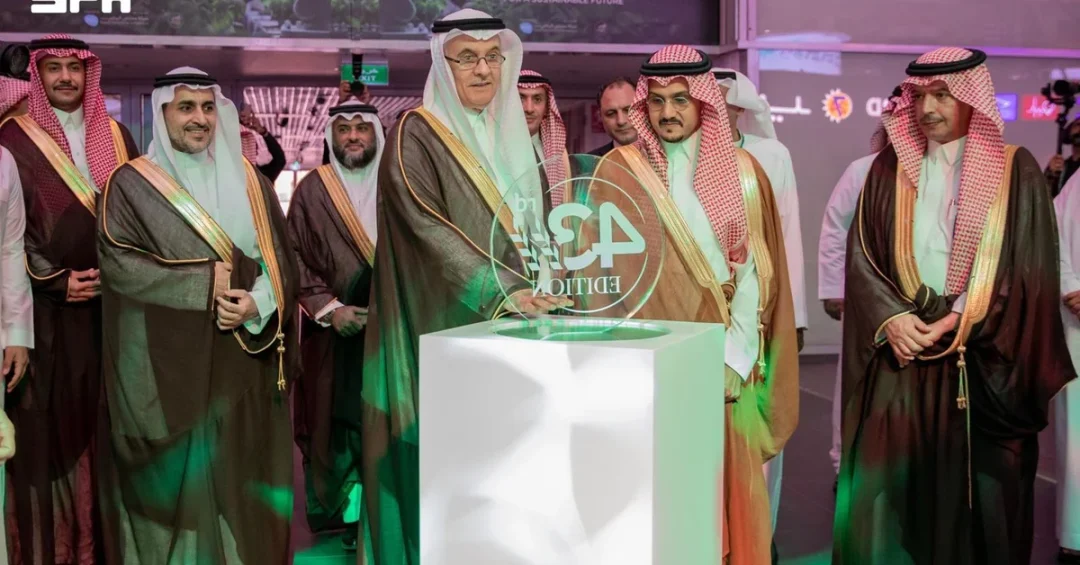
Minister of Environment, Water and Agriculture Abdulrahman Alfadley inaugurated the Saudi Agriculture Exhibition 2026 on October 19 at the Riyadh International Convention and Exhibition Center, opening the 43rd edition of the Kingdom’s flagship agricultural gathering under the theme “An Integrated Agricultural System for a Sustainable Future.” The exhibition, which runs through October 22, brings together government entities, private sector companies, decision-makers, investors, and industry professionals from Saudi Arabia and abroad, according to the Saudi Press Agency. The event is designed to strengthen the agricultural sector’s contribution to national food security in line with Saudi Vision 2030.
For more than four decades, the exhibition has served as a meeting point for the Kingdom’s agricultural stakeholders and their international counterparts. This year’s edition arrives at a moment when food security, water efficiency, and climate resilience have moved to the center of Saudi economic planning. The event is held under the patronage of the Ministry of Environment, Water and Agriculture, which oversees the Kingdom’s agricultural, water, and environmental policies. Its opening drew senior officials, business leaders, and technical specialists, underscoring the priority the Kingdom places on building a modern, sustainable agricultural system.
Context and Background
Why has a single agricultural exhibition remained relevant for more than 40 years in a country undergoing rapid economic transformation? The answer lies in the central role agriculture plays in Saudi Arabia’s long-term planning. The Saudi Agriculture Exhibition was first staged in the early 1980s, when the Kingdom was investing heavily in domestic food production and agricultural infrastructure. Over the decades, it evolved from a primarily domestic trade fair into an international platform that attracts exhibitors and visitors from across the Middle East, Asia, Europe, and beyond.
Riyadh Exhibitions Company Chairman Prince Saud bin Turki bin Faisal bin Abdulaziz said the exhibition’s continued success over more than four decades reflects its international standing as a leading platform for bringing together local and international expertise, fostering partnerships, and promoting innovation in agriculture and food production. His remarks point to a broader reality: the exhibition has not merely survived the passage of time but has adapted to each new phase of the Kingdom’s development, from mechanization and irrigation expansion to today’s focus on smart farming, biotechnology, and resource efficiency.
The 43rd edition is taking place as Saudi Arabia accelerates efforts to diversify its economy away from oil dependence under Vision 2030. Agriculture sits at the intersection of several national priorities, including food security, water conservation, environmental protection, and private sector growth. The exhibition therefore functions as both a commercial marketplace and a policy showcase, where new technologies, partnerships, and financing models are presented to a wide audience of decision-makers.
Key Details of the 2026 Edition
What exactly does this year’s exhibition cover, and who is participating? The event occupies the Riyadh International Convention and Exhibition Center and features pavilions spanning agricultural and organic food, poultry, livestock, mills, animal feed, and animal health, as well as aquaculture, food processing and packaging, innovation and entrepreneurship, and veterinary services. This breadth reflects the diversity of the Kingdom’s agricultural economy, from traditional livestock and date production to emerging aquaculture and high-tech food processing.
During his tour of the pavilions, Minister Alfadley reviewed exhibits presented by local and international companies, government agencies, and research institutions. The exhibition also hosted the signing of agreements and memoranda of understanding among government and semi-government entities, private sector organizations, and international agricultural companies. These agreements are intended to support the food and agriculture sector, stimulate economic growth, and promote the adoption of modern agricultural technologies.
Held alongside the exhibition, the Saudi International Conference on the Future of Agriculture brings together leading experts and specialists from Saudi Arabia and abroad to discuss key issues related to agricultural technologies and food security. The conference examines emerging opportunities in the Kingdom’s agricultural sector, agricultural initiatives, advanced technologies, and their role in strengthening food security, as well as climate change, project financing, biotechnology, soil science, and water management. The combination of a trade exhibition and a technical conference allows participants to move from discussion to deal-making within the same venue.
International and Regional Impact
How does a national agricultural exhibition in Riyadh resonate beyond the Kingdom’s borders? The presence of international companies, experts, and investors signals that Saudi Arabia is positioning itself as a hub for agricultural innovation in the Middle East. Regional economies share many of the Kingdom’s challenges, including water scarcity, arid climates, and dependence on food imports. Technologies and business models developed or showcased in Riyadh can therefore find applications across the Gulf, the wider Arab world, and other water-scarce regions.
The agreements signed at the exhibition also create commercial channels between Saudi entities and foreign firms. International agricultural companies gain access to one of the largest and most strategically important markets in the region, while Saudi partners acquire technology, expertise, and supply chain connections. This two-way flow supports the Kingdom’s goal of becoming a logistics and investment hub connecting Asia, Europe, and Africa. For regional food security, such cooperation can help stabilize supply chains that are increasingly exposed to climate and geopolitical shocks.
In addition, the exhibition reinforces Saudi Arabia’s role in global conversations about sustainable agriculture. By hosting experts who address climate change, biotechnology, and water management, the Kingdom contributes to international knowledge exchange while learning from others. This aligns with its broader diplomatic and economic engagement, including participation in multilateral forums on food security and environmental sustainability.
Economic and Strategic Significance
Why does agriculture matter economically for a country known for its energy wealth? Saudi Arabia has long recognized that food security is a component of national security. The Kingdom imports a significant share of its food, making it vulnerable to global market disruptions. By investing in domestic production, agricultural technology, and international partnerships, Saudi Arabia aims to reduce that vulnerability while building new economic sectors that create jobs and attract investment.
The exhibition supports these objectives by facilitating business deals, showcasing productivity-enhancing technologies, and connecting entrepreneurs with financiers. Small and medium-sized enterprises in agriculture and food processing can find partners and customers at the event, contributing to private sector growth. The focus on innovation and entrepreneurship pavilions reflects a deliberate strategy to cultivate a knowledge-based agricultural economy, not merely a production-oriented one.
Water is another strategic dimension. Agriculture is a major consumer of water in Saudi Arabia, and the Kingdom has invested heavily in efficient irrigation, desalination, and water recycling. Technologies presented at the exhibition that improve resource-use efficiency directly support national water security goals. By linking agricultural productivity to water conservation, the event promotes a model of growth that respects the Kingdom’s environmental limits.
Vision 2030 Alignment
How does the Saudi Agriculture Exhibition connect to the broader Vision 2030 program? Food security is explicitly identified as a priority within Vision 2030, which seeks to ensure reliable access to food while diversifying the economy and creating opportunities for citizens. The exhibition advances this agenda by providing a platform for collaboration among government, the private sector, and international partners, and by accelerating the adoption of technologies that raise productivity and sustainability.
The event also supports other Vision 2030 pillars, including economic diversification, private sector development, and environmental sustainability. The agreements signed during the exhibition can translate into new investments, joint ventures, and technology transfers that strengthen the agricultural value chain. The accompanying conference contributes to human capital development by exposing Saudi professionals and students to global best practices and cutting-edge research.
As the 43rd edition unfolds over four days in Riyadh, it carries forward a legacy of more than four decades while pointing toward a future in which Saudi agriculture is more efficient, more sustainable, and more integrated with global markets. Under the leadership of the Ministry of Environment, Water and Agriculture and with the participation of a wide range of stakeholders, the exhibition demonstrates the Kingdom’s commitment to building an integrated agricultural system that serves both present and future generations. In doing so, it contributes directly to Vision 2030’s promise of a secure, prosperous, and sustainable Saudi Arabia.
20 Questions
Q1. What is the Saudi Agriculture Exhibition 2026?
A1. It is the 43rd edition of Saudi Arabia’s flagship agricultural trade exhibition, held in Riyadh from October 19 to 22, 2026, under the theme “An Integrated Agricultural System for a Sustainable Future.”
Q2. Who inaugurated the exhibition?
A2. Minister of Environment, Water and Agriculture Abdulrahman Alfadley inaugurated the event at the Riyadh International Convention and Exhibition Center, according to the Saudi Press Agency.
Q3. Where is the exhibition being held?
A3. It is being held at the Riyadh International Convention and Exhibition Center in Riyadh, the capital of Saudi Arabia, over four days from October 19 to 22, 2026.
Q4. What is the theme of this year’s exhibition?
A4. The theme is “An Integrated Agricultural System for a Sustainable Future,” reflecting the Kingdom’s focus on sustainability, innovation, and food security.
Q5. Who is participating in the exhibition?
A5. Participants include government entities, private sector companies, decision-makers, investors, and industry professionals from Saudi Arabia and abroad, representing multiple agricultural sectors.
Q6. What sectors are covered by the exhibition pavilions?
A6. Pavilions cover agricultural and organic food, poultry, livestock, mills, animal feed, animal health, aquaculture, food processing and packaging, innovation and entrepreneurship, and veterinary services.
Q7. What did Prince Saud bin Turki bin Faisal bin Abdulaziz say about the exhibition?
A7. The Riyadh Exhibitions Company Chairman said its continued success over more than four decades reflects its international standing as a leading platform for expertise, partnerships, and innovation.
Q8. What technologies are highlighted at the 2026 edition?
A8. The exhibition highlights solutions aimed at increasing productivity, improving resource-use efficiency, and supporting food security, while addressing environmental and climate challenges.
Q9. Were any agreements signed during the exhibition?
A9. Yes, agreements and memoranda of understanding were signed among government and semi-government entities, private sector organizations, and international agricultural companies to support the sector.
Q10. What is the purpose of these agreements?
A10. They aim to support the food and agriculture sector, stimulate economic growth, and promote the adoption of modern agricultural technologies in the Kingdom.
Q11. What is the Saudi International Conference on the Future of Agriculture?
A11. It is a conference held alongside the exhibition, bringing together experts from Saudi Arabia and abroad to discuss agricultural technologies and food security.
Q12. What topics does the conference address?
A12. Topics include emerging agricultural opportunities, advanced technologies, climate change, project financing, biotechnology, soil science, and water management.
Q13. How long has the Saudi Agriculture Exhibition been running?
A13. It has been held for more than 40 years, keeping pace with developments in agriculture, food production, and related technologies across the industry.
Q14. How does the exhibition support Saudi Vision 2030?
A14. It strengthens the agricultural sector’s contribution to food security, promotes economic diversification, fosters private sector growth, and encourages sustainable practices aligned with Vision 2030.
Q15. Why is food security important for Saudi Arabia?
A15. Food security is a national priority because the Kingdom imports a significant share of its food and seeks reliable access amid global market and climate uncertainties.
Q16. What role does water management play in the exhibition?
A16. Water management is a key conference topic and a focus of technologies that improve resource-use efficiency, supporting the Kingdom’s water security goals.
Q17. Who organizes the exhibition?
A17. The exhibition is organized with the involvement of Riyadh Exhibitions Company and is held under the patronage of the Ministry of Environment, Water and Agriculture.
Q18. What benefits do international participants gain?
A18. International companies and experts gain access to the Saudi market, partnership opportunities, and a platform to showcase technologies relevant to arid and water-scarce regions.
Q19. How does the exhibition promote innovation?
A19. It features dedicated innovation and entrepreneurship pavilions, hosts technology showcases, and facilitates agreements that transfer modern agricultural technologies into the Kingdom.
Q20. What is the expected outcome of the 2026 edition?
A20. The edition is expected to deepen partnerships, spur investment, and advance sustainable agricultural development in line with Saudi Vision 2030 and national food security objectives.
Reader Feedback
We value your thoughts. Please share your feedback on this article.
Your feedback helps us improve our coverage.