


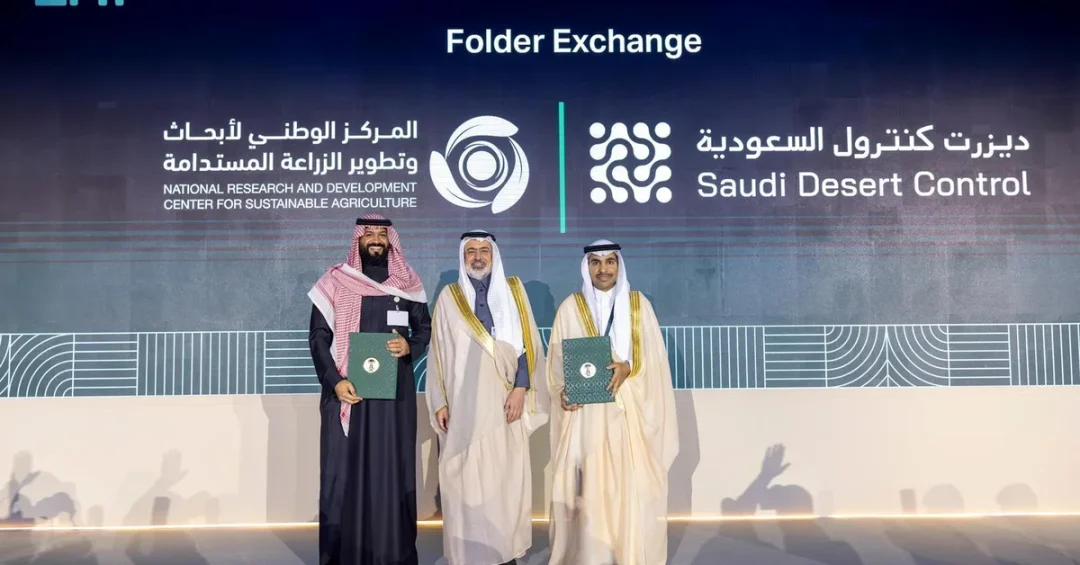
The National Center for Sustainable Agriculture Research and Development (Estidama) signed an agreement with Saudi Desert Control Company on the sidelines of the 16th Conference of the Parties (COP16) of the United Nations Convention to Combat Desertification (UNCCD), according to the Saudi Press Agency. The partnership is designed to improve agricultural production and environmental sustainability across the Kingdom, marking another concrete step in Saudi Arabia’s long-term campaign against desertification and land degradation.
The agreement, announced in Riyadh on December 12, 2024, focuses on deploying Liquid Natural Clay (LNC) technology to rehabilitate degraded soils, rationalize water consumption, and increase agricultural output. For a nation that has long treated water as its most precious resource, the deal signals how seriously Saudi policymakers now approach the intersection of food security, environmental restoration, and technological innovation. But why does a single agreement between a national research center and a specialized company deserve international attention? The answer lies in the scale of the challenge Saudi Arabia has set out to solve, and in the Kingdom’s growing role as a global laboratory for sustainable land management.
Context and Background
Desertification is not a distant threat in Saudi Arabia; it is a lived reality. More than 90 percent of the Kingdom’s land area is classified as arid or semi-arid, and successive decades of low rainfall, high evaporation, and intensive land use have placed enormous pressure on its soil and water systems. The United Nations Convention to Combat Desertification estimates that roughly a quarter of the world’s land is degraded, and Saudi Arabia has positioned itself at the forefront of the global response. Hosting COP16 in Riyadh was itself a statement of intent, bringing together governments, scientists, and companies from around the world to confront land degradation head-on.
Estidama, formally known as the National Center for Sustainable Agriculture Research and Development, operates under the umbrella of Saudi Arabia’s environmental and agricultural research ecosystem. Its mandate is to generate applied knowledge that farmers, agribusinesses, and government agencies can use to make Saudi agriculture more resilient. Saudi Desert Control Company, for its part, specializes in soil enhancement technologies, including Liquid Natural Clay, a substance that is mixed into sandy or degraded soil to help it retain water and nutrients far more effectively. Together, the two organizations aim to translate laboratory results into measurable gains in the field.
The timing of the agreement is significant. It was signed on the margins of COP16, where Saudi Arabia showcased a series of initiatives tied to land restoration, drought resilience, and the Saudi Green Initiative. By linking a national research body with a private technology provider during the world’s most prominent desertification summit, the Kingdom demonstrated that its commitments are not merely diplomatic talking points but are being converted into operational programs. How often do international conferences produce tangible follow-through of this kind? In this case, the follow-through arrived in the form of a signed, actionable partnership.
Key Details of the Agreement
At the heart of the agreement is Liquid Natural Clay technology. LNC is applied to sandy and degraded soils to improve their structure, allowing them to hold moisture for longer periods and reducing the frequency and volume of irrigation required. In a country where agriculture consumes the majority of available water, any technology that reduces water demand while maintaining or increasing yields carries strategic weight. The agreement explicitly identifies three objectives: rehabilitating degraded soils, rationalizing water consumption, and increasing agricultural production. Each of these goals feeds directly into the Kingdom’s food security agenda.
Estidama framed the deal as evidence of its commitment to promoting innovation in sustainable agriculture through applied research and the development of practical solutions to environmental challenges. The center’s role will likely involve testing, validating, and adapting the technology to local conditions, while Saudi Desert Control Company provides the technical expertise and deployment capacity. This division of labor mirrors a broader pattern in Saudi research and development, where public institutions set standards and generate evidence, and private firms scale solutions commercially.
The agreement also reflects the growing sophistication of Saudi Arabia’s environmental technology sector. Rather than importing finished solutions wholesale, the Kingdom is building domestic capacity to design, test, and refine technologies suited to its own climate and soil conditions. That approach has implications well beyond Saudi borders, because the same technologies could serve other arid countries across the Middle East, North Africa, and beyond. What could be more valuable to a desert nation than the ability to turn its own sand into productive soil? The agreement takes a measurable step toward answering that question.
International and Regional Impact
The signing took place against the backdrop of COP16, the largest UNCCD gathering to date, which drew delegates from nearly every region of the world to Riyadh. Saudi Arabia used the summit to advance the idea that desertification is a shared global challenge requiring shared technological responses. An agreement that pairs a national center with a specialist company may appear modest in isolation, but it contributes to a wider narrative: Saudi Arabia is not only hosting conversations about land restoration, it is funding and implementing projects that other countries can study and potentially replicate.
Regionally, the stakes are equally high. The Middle East and North Africa together contain some of the most water-stressed countries on earth, and agricultural systems across the region face mounting pressure from climate variability and population growth. If Liquid Natural Clay and similar technologies prove effective at scale in Saudi Arabia, they could become exportable solutions for neighboring states grappling with the same problems. That prospect strengthens Saudi Arabia’s position as a provider of practical, science-based answers to regional environmental challenges, complementing its existing roles in energy, logistics, and diplomacy.
Economic and Strategic Significance
For Saudi Arabia, sustainable agriculture is not an environmental luxury; it is an economic and national security imperative. The Kingdom imports a substantial share of its food, and reducing that dependence through higher domestic productivity is a core objective of Vision 2030. Every improvement in soil quality and irrigation efficiency translates into lower water bills, higher farm incomes, and a more resilient food supply chain. The agreement with Saudi Desert Control Company is therefore best understood as an investment in the physical foundations of food security.
The strategic dimension extends to water. Saudi Arabia operates some of the largest desalination capacities in the world, and agricultural use accounts for a major share of national water consumption. Technologies that cut irrigation demand free up water for urban, industrial, and ecological uses, easing pressure on infrastructure and public budgets. By supporting applied research into soil rehabilitation, Estidama is helping to build a knowledge base that can guide policy and investment for decades. In that sense, the value of the agreement will be measured not only in hectares treated but in the efficiency gains it unlocks across the entire agricultural economy.
Vision 2030 Alignment
The agreement aligns squarely with Saudi Vision 2030, the national transformation program launched under the leadership of Crown Prince Mohammed bin Salman. Vision 2030 places environmental sustainability, food security, and economic diversification among its central pillars, and it explicitly calls for the adoption of modern technologies to raise agricultural productivity while protecting natural resources. Estidama’s partnership with Saudi Desert Control Company advances all three goals simultaneously: it rehabilitates land, conserves water, and strengthens the domestic agricultural sector’s capacity to innovate.
Beyond the immediate project, the deal reinforces the Kingdom’s broader environmental agenda, including the Saudi Green Initiative and the Middle East Green Initiative, which aim to plant billions of trees and restore vast areas of degraded land. As Saudi Arabia continues to invest in research, technology, and international cooperation, agreements like this one demonstrate that Vision 2030 is being implemented in concrete, measurable ways. For international observers, the message is clear: the Kingdom is translating its ambitions into action, and its progress in sustainable agriculture will be watched closely by a world facing its own land and water challenges.
20 Questions
Q1. What is Estidama?
A1. Estidama is the National Center for Sustainable Agriculture Research and Development in Saudi Arabia. It promotes innovation in sustainable farming through applied research and practical solutions to environmental challenges.
Q2. What is Saudi Desert Control Company?
A2. Saudi Desert Control Company is a firm specializing in soil enhancement technologies, including Liquid Natural Clay, which helps degraded and sandy soils retain water and nutrients more effectively.
Q3. What did the two organizations agree to do?
A3. They agreed to cooperate on improving agricultural production and environmental sustainability in Saudi Arabia, focusing on soil rehabilitation, water conservation, and increased agricultural output.
Q4. Where was the agreement signed?
A4. The agreement was signed on the sidelines of the 16th Conference of the Parties (COP16) of the United Nations Convention to Combat Desertification, held in Riyadh.
Q5. When was the agreement announced?
A5. The Saudi Press Agency reported the agreement on December 12, 2024, during the COP16 summit in Riyadh.
Q6. What is Liquid Natural Clay technology?
A6. Liquid Natural Clay is a soil treatment that improves the structure of sandy or degraded soil, enabling it to hold moisture longer and reducing the need for frequent irrigation.
Q7. Why is this technology important for Saudi Arabia?
A7. Saudi Arabia is water-scarce and largely desert, so technologies that reduce irrigation demand while improving soil quality are essential for sustainable agriculture and food security.
Q8. How does the agreement support food security?
A8. By rehabilitating degraded soils and increasing agricultural production, the agreement helps Saudi Arabia grow more food domestically and reduce reliance on imports.
Q9. What role does Estidama play in the partnership?
A9. Estidama supports applied research, testing, and validation of sustainable agricultural practices, helping to adapt technologies like Liquid Natural Clay to local conditions.
Q10. What role does Saudi Desert Control Company play?
A10. The company provides technical expertise and deployment capacity for Liquid Natural Clay, helping to scale the technology across agricultural areas in the Kingdom.
Q11. How does the agreement relate to Vision 2030?
A11. It advances Vision 2030 goals for environmental sustainability, food security, and economic diversification by promoting innovation in agriculture and conserving natural resources.
Q12. What is COP16?
A12. COP16 is the 16th Conference of the Parties to the United Nations Convention to Combat Desertification, a major global summit focused on land degradation and drought resilience.
Q13. Why was COP16 held in Riyadh?
A13. Saudi Arabia hosted COP16 to highlight its leadership on desertification issues and to showcase its environmental initiatives, including the Saudi Green Initiative.
Q14. How does desertification affect Saudi Arabia?
A14. More than 90 percent of Saudi land is arid or semi-arid, and desertification threatens soil fertility, water resources, and agricultural productivity across the Kingdom.
Q15. Can this technology help other countries?
A15. Yes. Liquid Natural Clay and similar solutions could benefit other arid and water-stressed countries in the Middle East, North Africa, and beyond.
Q16. What are the main goals of the agreement?
A16. The goals are to rehabilitate degraded soils, rationalize water consumption, and increase agricultural production in Saudi Arabia.
Q17. How does Estidama promote innovation?
A17. Estidama supports applied research and develops innovative solutions to environmental challenges, bridging the gap between scientific research and practical farming applications.
Q18. What is the Saudi Green Initiative?
A18. The Saudi Green Initiative is a national program to combat climate change, improve environmental quality, and restore land, including plans to plant billions of trees.
Q19. Why is water conservation important for Saudi agriculture?
A19. Agriculture consumes a major share of Saudi Arabia’s water, so reducing irrigation demand helps preserve scarce resources for cities, industry, and future generations.
Q20. What does this agreement mean for Saudi Arabia’s global role?
A20. It reinforces Saudi Arabia’s position as a leader in sustainable land management and shows the Kingdom translating its environmental commitments into concrete, exportable solutions.
Reader Feedback
We value your thoughts. Please share your feedback on this article.
Your feedback helps us improve our coverage.
Related articles
 King Salman Congratulates Kenya’s President on Independence Day
 Saudi Foreign Ministry Official Receives Somali Consul General
 Saudi Arabia Signs Navantia Deal for Three Combat Ships
 Saudi Reef Showcases Sustainable Agriculture at COP16
 Saudi RGA Platinum Sponsor at IRF World Congress 2024
 Saudi Arabia Delivers Fourth $10M Aid Installment to Palestine