


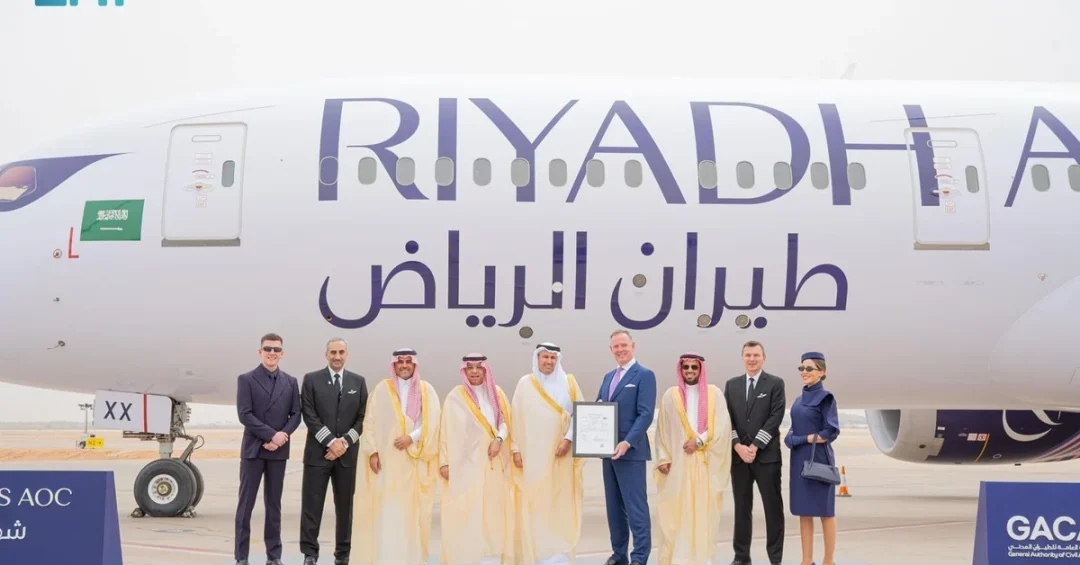
Saudi Arabia’s General Authority of Civil Aviation (GACA) has formally granted Riyadh Air its Air Operator Certificate (AOC), officially authorizing the Kingdom’s new national carrier to begin scheduled commercial flights to and from airports across Saudi Arabia. The certificate was presented in Riyadh on April 6, 2025, by GACA President Abdulaziz bin Abdullah Al-Duailej to Riyadh Air Chief Executive Officer Tony Douglas, in the presence of Minister of Transport and Logistic Services and Chairman of the GACA Board of Directors Eng. Saleh bin Nasser Al-Jasser, according to the Saudi Press Agency (SPA).
The handover marks the culmination of a rigorous regulatory process in which Riyadh Air demonstrated full compliance with the executive regulations of the Kingdom’s Civil Aviation Law, including requirements covering safety, security, and operational quality. For international observers, the milestone signals that Saudi Arabia’s newest full-service airline has cleared its final major regulatory hurdle and is positioned to enter commercial service. It also underscores the Kingdom’s determination to build a world-class aviation sector as a core engine of economic diversification under Saudi Vision 2030. How significant is this moment for a country that intends to become a global aviation crossroads?
Context and Background
Riyadh Air was established as part of Saudi Arabia’s broader effort to reshape its aviation and tourism landscape, complementing the existing national carrier and the ambitious expansion of the Kingdom’s airport infrastructure. The airline is designed to serve as a digital-first, full-service carrier based in the Saudi capital, a city that officials intend to develop into a global gateway for transportation, trade, and tourism. The issuance of the AOC follows the successful completion of all regulatory and operational evaluations mandated under the Civil Aviation Law, particularly those related to safety, security, and operational quality standards.
GACA, the Kingdom’s civil aviation regulator, has emphasized that the updated certificate reflects its commitment to upholding world-class regulatory practices. The authority has positioned the AOC not merely as a license to fly, but as a statement of confidence in the airline’s readiness to meet international benchmarks. For a new carrier, obtaining an AOC is the decisive step that transforms planning and procurement into an operating business. It confirms that aircraft, crew, maintenance systems, safety protocols, and operational procedures have been assessed and approved by the national regulator.
The timing of the announcement is notable. It comes as Saudi Arabia accelerates a multi-billion-dollar aviation strategy that includes fleet orders, airport modernization, and route development. Riyadh Air has already placed orders for more than 132 aircraft, one of the largest initial fleet commitments by a startup carrier anywhere in the world. The scale of that order reflects the Kingdom’s long-term ambition rather than a cautious, incremental entry into the market. Why would a new airline commit to such a large fleet before carrying its first paying passenger? The answer lies in the strategy’s timeline: Saudi officials are building for 2030 and beyond, not for the next quarter.
Key Details of the Certification
The AOC was handed over in a ceremony attended by senior leadership from both the regulator and the airline. Eng. Saleh bin Nasser Al-Jasser, who serves as Minister of Transport and Logistic Services and Chairman of the GACA Board of Directors, framed the certificate as a foundational pillar of the Kingdom’s aviation strategy. He noted that the strategy aims to position Saudi Arabia as the Middle East’s leading aviation hub by 2030, transforming the Kingdom into a global logistics hub connecting three continents, supporting tourism objectives, and establishing Riyadh as a central hub for transportation, trade, and tourism.
Riyadh Air CEO Tony Douglas, who has led the carrier through its startup phase, received the certificate on behalf of the airline. The AOC authorizes scheduled flights to and from airports across the Kingdom, a scope that allows Riyadh Air to build a domestic network before or alongside its international expansion. The airline has stated its intention to operate flights to more than 100 international destinations by 2030. That figure places Riyadh Air in the same conversation as the region’s established long-haul carriers, a comparison that reflects the scale of Saudi Arabia’s aviation ambitions.
Beyond route expansion, the airline is expected to generate over 200,000 direct and indirect jobs in the aviation sector, according to official projections. It is also projected to contribute an estimated SAR75 billion to the Kingdom’s non-oil GDP. Those figures help explain why the AOC is treated as a national economic milestone rather than a routine regulatory filing. The certificate also supports GACA’s broader efforts to create an attractive investment environment and to foster the growth and sustainability of the aviation sector, in line with the goals of the National Aviation Strategy and Saudi Vision 2030.
International and Regional Impact
For the global aviation industry, the emergence of Riyadh Air adds a well-capitalized new competitor at a time when demand for air travel in the Middle East and beyond continues to grow. The carrier’s planned network of more than 100 destinations by 2030 would place it in direct competition with established Gulf hubs for connecting traffic between Asia, Europe, Africa, and the Americas. Saudi officials have been explicit that the goal is not simply to add capacity but to capture a larger share of global transit passengers and to make Riyadh a preferred connecting point.
Regionally, the certification reinforces Saudi Arabia’s role as a stabilizing and growth-oriented economic force. A new national carrier supports pilgrimage travel, business connectivity, and tourism flows that benefit the wider Middle East. It also complements the Kingdom’s investments in logistics, ports, and special economic zones. For international airlines and aerospace suppliers, the expansion signals procurement and partnership opportunities across fleet, maintenance, training, and digital services. How will the global aviation map look when a new hub of this scale is fully operational? Industry analysts expect the answer to unfold gradually, as routes are launched and airport capacity expands.
Economic and Strategic Significance
The economic logic behind Riyadh Air rests on diversification. Saudi Arabia’s Vision 2030 seeks to reduce dependence on oil revenues by expanding non-oil sectors, and aviation is a high-multiplier industry that connects tourism, trade, logistics, and services. The projected SAR75 billion contribution to non-oil GDP and the creation of more than 200,000 direct and indirect jobs illustrate how a single carrier can ripple through the economy. Airlines purchase aircraft, hire and train thousands of workers, contract with caterers and maintenance providers, and stimulate hospitality and retail activity at both ends of every route.
The strategic dimension is equally important. Aviation is a tool of soft power and connectivity. By building a carrier that links the Kingdom to more than 100 international destinations, Saudi Arabia strengthens its diplomatic and commercial ties across continents. The AOC also supports GACA’s goal of maintaining the highest aviation safety standards while expanding capacity. Regulators in other jurisdictions will now assess Riyadh Air’s applications for foreign routes, and the airline’s compliance record will be central to those approvals. What does a well-regulated, fast-growing aviation sector mean for travelers? In practical terms, it can mean more route options, competitive fares, and newer aircraft with modern cabin products.
Vision 2030 Alignment
The AOC handover sits squarely within the framework of Saudi Vision 2030 and the National Aviation Strategy. Vision 2030 calls for the Kingdom to become a global investment powerhouse and a hub connecting three continents, and aviation is one of the most visible expressions of that ambition. The strategy envisions a transformed aviation sector that supports tourism targets, expands logistics capabilities, and creates high-quality jobs for Saudi citizens. Riyadh Air’s certification is a concrete deliverable in that plan, moving the Kingdom from strategy documents to operating reality.
As the airline prepares to launch commercial flights, the coming months will be closely watched by regulators, competitors, and travelers alike. The carrier’s success will depend on execution: route selection, service quality, operational reliability, and the continued expansion of airport infrastructure in Riyadh and across the Kingdom. Yet the direction is clear. Saudi Arabia is investing in aviation as a driver of diversification and global engagement, and the granting of the Air Operator Certificate to Riyadh Air marks a defining step in that journey. For a Kingdom building toward 2030, the first scheduled departure of its new national carrier will be more than a flight; it will be a signal that the vision is taking off.
20 Questions
Q1. What is an Air Operator Certificate?
A1. An Air Operator Certificate is an official regulatory approval that authorizes an airline to conduct commercial flight operations. It confirms that the carrier meets required safety, security, and operational standards set by the national civil aviation authority.
Q2. Who handed over the certificate to Riyadh Air?
A2. GACA President Abdulaziz bin Abdullah Al-Duailej presented the Air Operator Certificate to Riyadh Air Chief Executive Officer Tony Douglas. The handover took place in the presence of Minister of Transport and Logistic Services Eng. Saleh bin Nasser Al-Jasser.
Q3. When was the certificate issued?
A3. The certificate was handed over on April 6, 2025, according to the Saudi Press Agency. The announcement was reported from Riyadh and marked the completion of Riyadh Air’s regulatory and operational requirements.
Q4. What does the certificate allow Riyadh Air to do?
A4. The certificate officially authorizes Riyadh Air to commence scheduled flights to and from airports across the Kingdom of Saudi Arabia. It represents the final major regulatory step before the airline begins commercial passenger operations.
Q5. What requirements did Riyadh Air have to meet?
A5. Riyadh Air had to fulfill all regulatory and operational requirements under the executive regulations of the Civil Aviation Law. These included standards related to safety, security, and operational quality, as assessed by the General Authority of Civil Aviation.
Q6. How many destinations does Riyadh Air plan to serve by 2030?
A6. Riyadh Air plans to operate flights to more than 100 international destinations by 2030. This network would position the carrier as a major long-haul competitor based in the Saudi capital, Riyadh.
Q7. How many aircraft has Riyadh Air ordered?
A7. The airline has placed orders for more than 132 aircraft. This large initial fleet commitment reflects the scale of Saudi Arabia’s aviation ambitions and supports the planned expansion to over 100 destinations by 2030.
Q8. How many jobs is Riyadh Air expected to create?
A8. Riyadh Air is expected to generate over 200,000 direct and indirect jobs in the aviation sector. This job creation is a key part of the airline’s projected economic contribution to the Kingdom.
Q9. What is Riyadh Air’s expected contribution to non-oil GDP?
A9. The airline is projected to contribute an estimated SAR75 billion to the Kingdom’s non-oil GDP. This figure underscores aviation’s role as a high-multiplier sector in Saudi Arabia’s economic diversification efforts.
Q10. What is GACA’s role in Saudi aviation?
A10. The General Authority of Civil Aviation is the Kingdom’s civil aviation regulator. It oversees safety, security, and operational standards, issues certificates to airlines, and works to create an attractive investment environment for the aviation sector.
Q11. How does the certificate support Vision 2030?
A11. The certificate supports Vision 2030 by advancing the National Aviation Strategy, which aims to position Saudi Arabia as a leading aviation hub. It contributes to economic diversification, job creation, tourism growth, and the Kingdom’s goal of connecting three continents.
Q12. What is the National Aviation Strategy?
A12. The National Aviation Strategy is Saudi Arabia’s plan to expand and modernize its aviation sector. It seeks to boost passenger numbers, develop airports, attract investment, and establish the Kingdom as a global logistics and tourism hub by 2030.
Q13. What did Minister Al-Jasser say about the certificate?
A13. Minister Al-Jasser emphasized that the certificate represents a foundational pillar of the Kingdom’s aviation strategy. He noted the strategy aims to make Saudi Arabia the Middle East’s leading aviation hub by 2030 and a global logistics hub connecting three continents.
Q14. Why is Riyadh important in this strategy?
A14. Riyadh is intended to become a global gateway and central hub for transportation, trade, and tourism. Riyadh Air is based in the capital, and its growth is closely tied to the city’s development as an international connecting point.
Q15. What does the AOC mean for passengers?
A15. For passengers, the certificate means a new airline has met regulatory standards to begin scheduled service. It can lead to more route options, competitive fares, and modern aircraft, while maintaining high safety and operational quality standards.
Q16. How does Riyadh Air compare with other Gulf carriers?
A16. Riyadh Air is a new full-service carrier with a large aircraft order and a plan to serve over 100 destinations by 2030. It is designed to compete with established Gulf hubs for connecting traffic between Asia, Europe, Africa, and the Americas.
Q17. What is the significance of the April 6, 2025 announcement?
A17. The announcement marks the completion of Riyadh Air’s regulatory approvals and clears the way for commercial flight launches. It is a milestone in Saudi Arabia’s broader aviation expansion and a visible step toward Vision 2030 targets.
Q18. What safety standards did Riyadh Air meet?
A18. Riyadh Air met standards related to safety, security, and operational quality under the Civil Aviation Law’s executive regulations. GACA assessed these requirements before issuing the certificate, reflecting its commitment to world-class regulatory practices.
Q19. What economic sectors benefit from Riyadh Air’s launch?
A19. Aviation, tourism, hospitality, logistics, and trade are among the sectors expected to benefit. The airline’s growth supports airport services, maintenance, training, catering, and retail, contributing to the Kingdom’s non-oil economy.
Q20. What comes next for Riyadh Air?
A20. With the Air Operator Certificate in hand, Riyadh Air can proceed toward launching scheduled commercial flights. Future steps include route announcements, fleet deployment, and regulatory approvals for international destinations as the airline builds toward its 2030 network.
Reader Feedback
We value your thoughts. Please share your feedback on this article.
Your feedback helps us improve our coverage.
Related articles
 Rare Silene arabica Blooms in Northern Borders Region
 Vice Foreign Minister Receives SIF Badge on Behalf of Foreign Minister
 Saudi Vice Minister Meets US Chargé d’Affaires in Riyadh
 Deadly US Storms Leave Trail of Destruction, Trigger Floods
 Three Killed in Japan Ambulance Helicopter Sea Crash
 GCC Chief Receives Kuwaiti Envoy, Sets Stage for Central Asia Talks