


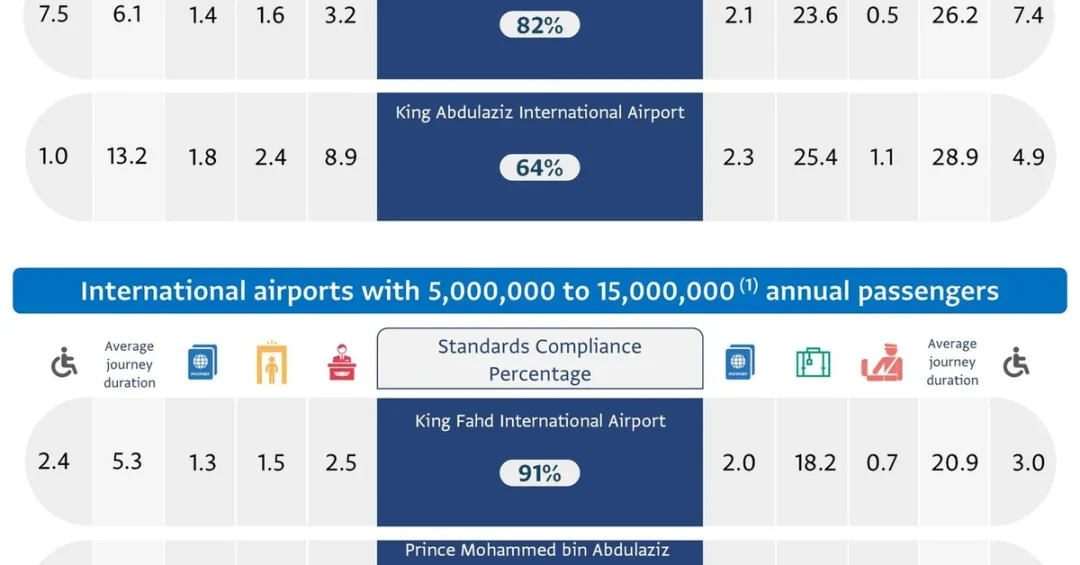
The General Authority of Civil Aviation (GACA) released its June 2024 performance report on Saudi Arabia’s domestic and international airports, highlighting significant achievements in operational efficiency and passenger service. The report, issued on July 22, 2024, evaluates airports based on 11 operational performance standards that align with the Kingdom’s strategic objectives to enhance services and ensure a seamless traveler experience.
Context and Background
GACA’s periodic performance reports are part of a broader effort to elevate the quality of aviation services across Saudi Arabia, in line with Vision 2030 goals to boost tourism and economic diversification. The evaluation covers critical passenger touchpoints such as check-in, security, passport control, customs, baggage claim, and assistance for passengers with reduced mobility (PRM). These metrics are designed to meet international best practices and foster transparency in airport operations.
Key Details
In the category of airports handling more than 15 million passengers annually, King Khalid International Airport in Riyadh secured the top spot with an 82% compliance rate, followed by King Abdulaziz International Airport in Jeddah at 64%. Among international airports serving 5 to 15 million passengers, King Fahd International Airport tied for first place with a 91% compliance rate, while Prince Mohammed bin Abdulaziz International Airport followed at 82%. In the 2 to 5 million passenger category, Abha International Airport and King Abdullah bin Abdulaziz Airport in Jizan both achieved a 100% compliance rate, with Abha outperforming due to surpassing higher targets. Al-Ahsa International Airport led the less than 2 million passenger category with a 100% compliance rate, and Qurayyat Airport topped the domestic airport category, also with 100% compliance, excelling in average waiting times for departing and arriving flights.
Implications and Impact
These results reflect Saudi Arabia’s commitment to providing world-class aviation services, which is crucial for attracting international tourists and facilitating business travel. The high compliance rates at various airports demonstrate the effectiveness of GACA’s regulatory framework and the Kingdom’s investment in infrastructure. This enhances Saudi Arabia’s competitiveness as a global logistics and tourism hub, supporting the goals of Vision 2030 to increase passenger traffic and economic contributions from the aviation sector.
Vision 2030 Alignment
The continuous improvement in airport performance directly supports Vision 2030’s objective to transform Saudi Arabia into a global destination. By ensuring seamless travel experiences, the Kingdom aims to welcome 100 million visitors annually by 2030, boosting tourism’s share of GDP and creating new opportunities for economic growth. GACA’s rigorous evaluations and the airports’ achievements underscore the nation’s dedication to excellence and its rising role in international aviation.
20 Questions
Q1. What did GACA release on July 22, 2024?
A1. GACA released its June 2024 performance report on domestic and international airports in Saudi Arabia, assessing operational efficiency and passenger service standards.
Q2. How many operational performance standards are used to evaluate airports?
A2. Airports are assessed based on 11 operational performance standards that align with strategic objectives to enhance services and ensure a seamless traveler experience.
Q3. Which airport ranked top in the category of more than 15 million passengers annually?
A3. King Khalid International Airport in Riyadh secured the top spot with an 82% compliance rate, followed by King Abdulaziz International Airport in Jeddah at 64%.
Q4. What was the compliance rate of King Fahd International Airport?
A4. King Fahd International Airport tied for first place in its category with a 91% compliance rate, showcasing high operational standards.
Q5. Which airports achieved a 100% compliance rate in the 2 to 5 million passenger category?
A5. Abha International Airport and King Abdullah bin Abdulaziz Airport in Jizan both achieved a 100% compliance rate, with Abha outperforming due to surpassing higher targets.
Q6. Which airport led the less than 2 million passenger category?
A6. Al-Ahsa International Airport achieved a 100% compliance rate, outperforming competitors regarding average waiting time for departing and arriving flights.
Q7. Which airport came first in the domestic airport category?
A7. Qurayyat Airport came first with a 100% compliance rate, excelling in average waiting time for departing and arriving flights.
Q8. What are the key passenger touchpoints evaluated by GACA?
A8. GACA evaluates check-in, security, passport control, customs, baggage claim, and assistance for passengers with reduced mobility (PRM) to ensure a seamless travel experience.
Q9. How does GACA categorize airports for performance evaluation?
A9. GACA categorizes airports based on annual passenger numbers, ensuring a transparent and fair approach to performance assessment.
Q10. Why is GACA’s report significant for Saudi Arabia?
A10. The report reflects Saudi Arabia’s commitment to world-class aviation services, supporting Vision 2030 goals to boost tourism and economic diversification.
Q11. What percentage of compliance did Prince Mohammed bin Abdulaziz International Airport achieve?
A11. Prince Mohammed bin Abdulaziz International Airport achieved an 82% compliance rate, following King Fahd International Airport in its category.
Q12. How does the report contribute to Vision 2030?
A12. The report supports Vision 2030 by enhancing airport services to attract 100 million visitors annually by 2030, boosting tourism’s GDP contribution.
Q13. What is the role of GACA in Saudi aviation?
A13. GACA regulates and oversees civil aviation, ensuring safety, efficiency, and service quality at airports in line with international best practices.
Q14. Which airport tied for first place in the 5 to 15 million passenger category?
A14. King Fahd International Airport tied for first place with a 91% compliance rate, demonstrating high operational performance.
Q15. What does a 100% compliance rate indicate about an airport?
A15. A 100% compliance rate indicates that the airport met all 11 operational performance standards, ensuring excellent service and efficiency for passengers.
Q16. How often does GACA issue these performance reports?
A16. GACA issues these reports periodically, with the latest being for June 2024, to monitor and enhance airport performance continuously.
Q17. What is the significance of assessing average waiting times?
A17. Assessing average waiting times helps reduce passenger delays and improve overall travel experience, aligning with international service standards.
Q18. Which airports were highly ranked in the report?
A18. King Khalid International Airport, King Fahd International Airport, Abha International Airport, Al-Ahsa International Airport, and Qurayyat Airport were highly ranked.
Q19. How does the report enhance Saudi Arabia’s global standing?
A19. The report showcases Saudi Arabia’s dedication to aviation excellence, enhancing its reputation as a global hub for tourism and business.
Q20. What future improvements can be expected from GACA?
A20. GACA will continue to monitor and enhance airport services, focusing on innovation and passenger satisfaction to meet Vision 2030 targets.
Reader Feedback
We value your thoughts. Please share your feedback on this article.
Your feedback helps us improve our coverage.