


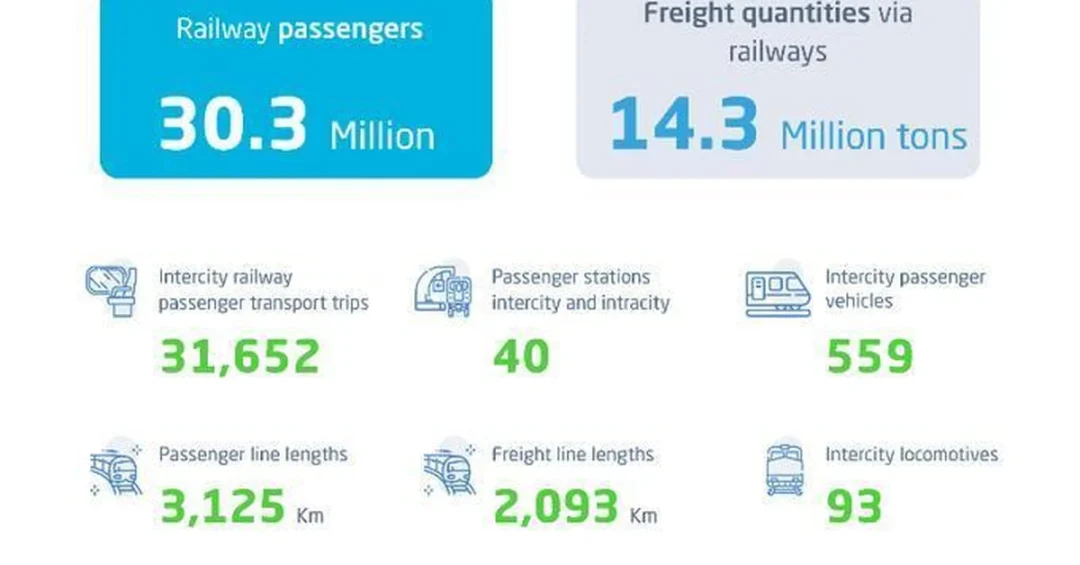
Saudi Arabia’s railway network carried 30.3 million passengers in 2023, a 33 percent increase over 2022, according to the annual railway transport statistics bulletin released by the General Authority for Statistics (GASTAT). The bulletin, published in Riyadh, also recorded 31,700 intercity passenger trips covering a combined distance of 10.4 million kilometres, alongside 5,200 freight train trips spanning 4.03 million kilometres. The figures, issued through official Saudi channels, offer the clearest picture yet of how rail is becoming a central pillar of the Kingdom’s transport strategy under Vision 2030. Is there any doubt that a nation investing so deliberately in connectivity is also investing in its own future?
The GASTAT bulletin placed intracity passengers at 72.5 percent of total rail travellers, while intercity passengers accounted for 27.5 percent. Saudi Arabia Railways (SAR) operates the network’s two major freight corridors, the North line and the East line, which together moved more than 14.3 million tons of freight, a 5.6 percent rise on 2022. The North line alone carried 94.3 percent of that cargo, equivalent to 13.5 million tons, while the East route, focused on container shipments, handled over 699,000 twenty-foot equivalent units (TEUs), up 3.7 percent year on year. The numbers describe a network expanding in every direction at once.
Context and Background
How did Saudi Arabia’s railways move from a modest freight operation to a system handling tens of millions of passenger journeys? The answer lies in a sustained national programme of modernisation that predates Vision 2030 but has accelerated sharply since the reform agenda was launched in 2016. GASTAT, the Kingdom’s official statistical authority, compiles the annual bulletin from operator data and publishes it as part of Saudi Arabia’s commitment to transparent, internationally comparable reporting. The 2023 edition shows a network that is no longer a niche service but a genuine alternative to road and air travel for a growing population and a rising number of visitors.
The bulletin details the physical scale behind the statistics. Intercity passenger railway lines now stretch 3,064 kilometres, while electrified intracity passenger lines measure 61.7 kilometres. There are 15 intercity passenger stations offering 18,359 seats, served by 93 passenger locomotives and 559 coach cars. A further 25 intracity passenger stations support urban and commuter services. On the freight side, 12 specialised stations are equipped with 158 freight locomotives and 3,341 wagons. These are not abstract figures; they represent steel, concrete, and rolling stock assembled over years of phased investment.
The 33 percent rise in passengers is especially notable because it follows a period of global disruption in travel. It suggests that ridership growth in Saudi Arabia is structural rather than a one-off rebound. When a network adds passengers at that pace while also expanding freight tonnage, it signals that the underlying economy is generating demand across both business and leisure segments. For international observers, the bulletin is a useful benchmark: it shows what a mid-sized, rapidly diversifying economy can achieve when transport policy is aligned with long-term national planning.
Key Details
What exactly do the GASTAT numbers reveal about how Saudis and visitors are using the rails? The dominance of intracity travel, at 72.5 percent of passengers, indicates that urban and commuter services are doing much of the heavy lifting. These are the journeys people make daily: to work, to school, to appointments. The remaining 27.5 percent of intercity passengers completed 31,700 trips across 10.4 million kilometres, a pattern consistent with a country where long-distance travel between major cities is increasingly seen as a rail journey rather than a drive or a short flight.
The freight data tells a parallel story of industrial logistics. The North line’s 13.5 million tons reflects its role in carrying minerals and bulk commodities from extraction and processing sites toward ports and industrial zones. The East route’s 699,000 TEUs show how containerised trade is being channelled onto rail, easing pressure on highways and reducing the carbon intensity of moving goods. Together, the two corridors moved over 14.3 million tons, a 5.6 percent increase that outpaced many global freight markets in the same period.
The rolling stock inventory supports these operations. With 93 passenger locomotives and 559 coach cars, SAR can schedule frequent services while maintaining reserve capacity for maintenance and peak demand. The 158 freight locomotives and 3,341 wagons provide the flexibility to shift between bulk and container traffic as customer needs change. The presence of 18,359 seats across intercity stations is a reminder that station capacity, not just track length, determines how many people a network can move comfortably. Each element of the bulletin reinforces the others, forming a coherent picture of a system operating with intent.
International and Regional Impact
Why should readers outside Saudi Arabia pay attention to a domestic rail bulletin? Because rail connectivity is increasingly a measure of a country’s integration into regional trade and tourism flows. Saudi Arabia sits at the crossroads of Asia, Africa, and Europe, and its rail network is designed to feed into ports, industrial cities, and the broader Gulf transport ecosystem. Higher passenger numbers mean more business travellers, more families visiting relatives, and more tourists exploring beyond a single city. Higher freight volumes mean goods are moving more efficiently, which supports the competitiveness of Saudi exports and the reliability of imports.
For regional neighbours, the growth of Saudi rail capacity has implications for logistics planning and for the wider ambition of linking Gulf economies by rail. The East line’s container traffic connects directly to port operations that serve trade with Asia and Europe. As those volumes rise, Saudi Arabia becomes a more attractive transit and distribution hub. International logistics firms and shipping lines watch such statistics closely, because they determine where to place warehouses, distribution centres, and regional headquarters. A 5.6 percent increase in freight tonnage may look modest in isolation, but in a global context of supply-chain realignment, it is a signal of reliability and capacity.
Economic and Strategic Significance
What does it mean for a national economy when rail passenger numbers jump by a third in a single year? It means the transport sector is creating value beyond the tickets sold. Rail travel reduces road congestion, lowers accident risk, and cuts emissions per passenger-kilometre compared with private cars. For businesses, reliable rail freight lowers logistics costs and improves delivery predictability. For the government, a well-used rail network supports the diversification agenda by making industrial and commercial locations more accessible, which in turn attracts investment to regions outside the largest cities.
The strategic dimension is equally important. Vision 2030 aims to raise non-oil revenue, expand the private sector, and improve quality of life. A rail network that moves both people and goods efficiently contributes to all three. It connects industrial zones to ports, supports the growth of mining and manufacturing, and gives citizens and residents a comfortable alternative for intercity travel. The GASTAT bulletin therefore functions as a scorecard: it shows measurable progress toward goals that are otherwise discussed in broad terms. The numbers are specific, verifiable, and published openly, which is precisely what international investors and partners look for.
Vision 2030 Alignment
How does a railway statistic connect to a national transformation plan? Vision 2030 is built on the idea that Saudi Arabia’s future prosperity depends on connectivity, diversification, and quality of life. Rail sits at the intersection of all three. The 30.3 million passengers recorded in 2023 represent millions of individual decisions to use a service that is safe, modern, and increasingly convenient. The 14.3 million tons of freight represent businesses choosing rail because it works for their supply chains. Each journey and each shipment is a small vote of confidence in the system the Kingdom has built.
The GASTAT bulletin also underscores the importance of data transparency in achieving Vision 2030. By publishing detailed annual statistics, Saudi Arabia allows analysts, investors, and international organisations to track progress objectively. That transparency builds trust and encourages further engagement with the Kingdom’s economy. As the network continues to expand, with new lines and services planned under the broader transport strategy, the 2023 figures will serve as a baseline against which future growth is measured. For a nation transforming its economy and its global role, reliable railways are not a luxury but a foundation. The direction of travel is clear, and the numbers confirm it.
20 Questions
Q1. What did the GASTAT railway transport statistics bulletin for 2023 show?
A1. It showed that railway passengers reached 30.3 million in 2023, a 33 percent increase compared to 2022, alongside growth in freight trips and tonnage across the network.
Q2. How many intercity passenger trips were completed in 2023?
A2. Intercity passengers completed 31,700 trips covering a combined distance of 10.4 million kilometres, according to the bulletin released by the General Authority for Statistics.
Q3. What share of passengers travelled on intracity services?
A3. Intracity passengers represented 72.5 percent of the total, while intercity passengers accounted for 27.5 percent of all rail travellers during 2023.
Q4. How many freight train trips did Saudi Arabia Railways record?
A4. Saudi Arabia Railways recorded 5,200 freight train trips covering a distance of 4.03 million kilometres across its North and East freight routes.
Q5. How much freight was transported in total?
A5. The two major freight routes collectively transported over 14.3 million tons of freight, representing a 5.6 percent increase compared to 2022.
Q6. Which route carried the bulk of the cargo?
A6. The North line carried 94.3 percent of the total cargo, equivalent to 13.5 million tons, reflecting its role in moving bulk commodities.
Q7. What did the East route primarily handle?
A7. The East route focused primarily on container shipments, carrying over 699,000 TEUs, which reflected a 3.7 percent increase compared to 2022.
Q8. How many intercity passenger railway stations are there?
A8. The total number of intercity passenger railway stations reached 15, featuring 18,359 seats and serviced by 93 passenger locomotives and 559 coach cars.
Q9. How many freight railway stations and locomotives are in service?
A9. There are 12 freight railway stations equipped with 158 freight locomotives and 3,341 wagons dedicated to cargo transport across the network.
Q10. How many intracity passenger stations exist?
A10. The bulletin highlighted that the total number of intracity passenger stations stands at 25, supporting urban and commuter rail services in Saudi cities.
Q11. What is the length of intercity passenger railway lines?
A11. The total length of intercity passenger railway lines is 3,064 kilometres, forming the backbone of long-distance rail travel in the Kingdom.
Q12. How long are the electrified intracity lines?
A12. The length of electrified intracity passenger railway lines measures 61.7 kilometres, according to the official statistics bulletin.
Q13. Which authority released the bulletin?
A13. The General Authority for Statistics (GASTAT) issued the railway transport statistics bulletin for 2023, publishing it through official Saudi channels in Riyadh.
Q14. What does the 33 percent passenger increase indicate?
A14. It indicates structural growth in rail ridership, suggesting that more people are choosing trains for daily commutes and intercity travel as the network modernises.
Q15. How does rail freight growth benefit the economy?
A15. Rail freight growth lowers logistics costs, reduces road congestion, and supports industrial exports, contributing to Saudi Arabia’s economic diversification under Vision 2030.
Q16. Why is rail important for Vision 2030?
A16. Rail supports connectivity, diversification, and quality of life, three pillars of Vision 2030, by moving people and goods efficiently across the Kingdom.
Q17. What role does Saudi Arabia Railways play?
A17. Saudi Arabia Railways operates the major freight and passenger services, managing the North and East freight routes and the intercity passenger network.
Q18. How does transparency in statistics help investors?
A18. Publishing detailed annual data allows analysts and investors to track progress objectively, building trust and encouraging engagement with the Kingdom’s economy.
Q19. What does the freight tonnage increase signify?
A19. The 5.6 percent rise in freight tonnage signifies growing demand for rail logistics and the network’s reliability in handling bulk and container cargo.
Q20. What is the outlook for Saudi railways?
A20. With continued investment and expansion under the national transport strategy, Saudi railways are positioned for further growth in passengers and freight in the years ahead.
Reader Feedback
We value your thoughts. Please share your feedback on this article.
Your feedback helps us improve our coverage.
Related articles
 GASTAT: Saudi Bus Passengers Jump 176% in 2023
 Saudi Arabia Weather Forecast: Rain and Hail Expected Thursday
 20th Saudi Relief Plane Departs for Lebanon with Aid
 Saudi Tarshid Wins GCC Energy Efficiency Award for Riyadh HQ
 6.1-Magnitude Earthquake Strikes Papua New Guinea
 Saudi Water Authority Joins Biban24 Forum to Drive Innovation