


Saudi Arabia’s protected land areas expanded by 7.1 percent in 2023 to reach 361,000 square kilometers, or 18.1 percent of the Kingdom’s total land area, according to the Environment Statistics Publication 2023 released by the General Authority for Statistics (GASTAT). The publication, announced via the Saudi Press Agency (SPA), also recorded a 17.7 percent increase in marine protected areas, which now cover 14,000 square kilometers, alongside significant gains in precipitation, dam water collection, treated water reuse, and urban green space — a comprehensive set of indicators that together describe a Kingdom moving deliberately toward environmental sustainability as a core national priority.
The figures arrive at a moment when environmental data has become as strategically important as economic data for governments worldwide. For Saudi Arabia, the publication does more than document trends; it provides an official, standardized measurement framework that supports informed policymaking, tracks progress against national and international commitments, and strengthens the Kingdom’s position in global climate and conservation discussions. Prepared according to the United Nations Framework for the Development of Environment Statistics (FDES 2013), the report draws on GASTAT’s own censuses and sample surveys as well as administrative records from the Ministry of Environment, Water and Agriculture, the Ministry of Municipalities and Housing, the Royal Commission for Jubail and Yanbu, the Saudi Water Authority, and environmental centers. So what exactly do these numbers reveal about the Kingdom’s environmental trajectory — and why should readers far beyond the region take notice?
Context and Background
How does a single statistical publication become a cornerstone of national environmental policy? In Saudi Arabia’s case, the answer lies in the institutional rigor behind it. GASTAT is the Kingdom’s official statistical authority, responsible for producing reliable, internationally comparable data across economic, social, and environmental domains. The Environment Statistics Publication 2023 is part of that mandate, and its adoption of the FDES 2013 framework places Saudi environmental reporting within a globally recognized methodology, allowing the Kingdom’s indicators to be read and benchmarked alongside those of other nations.
The context for these numbers is a decade of accelerating environmental ambition in the Kingdom. Under Saudi Vision 2030, launched in 2016, environmental sustainability was elevated from a peripheral concern to a central pillar of national transformation. The Saudi Green Initiative and the Middle East Green Initiative, announced in 2021, set targets including the protection of 30 percent of the Kingdom’s land and marine areas, the planting of 10 billion trees across the region, and a substantial reduction in carbon emissions. The 2023 data therefore does not exist in isolation — it is an official progress report on commitments that carry domestic and international weight.
It is also worth recalling that environmental statistics serve a practical function beyond scorekeeping. They inform where conservation resources are directed, how water infrastructure is planned, how municipal services are optimized, and how the Kingdom reports to multilateral bodies. In an era when climate resilience is a matter of national security as much as ecology, the ability to measure environmental change accurately is itself a strategic asset. Saudi Arabia, through GASTAT, is demonstrating that it intends to measure, manage, and improve — not merely announce.
Key Details from the 2023 Publication
The headline figure — protected land areas expanding by 7.1 percent to 361,000 square kilometers — means that more than 18 percent of the Kingdom’s territory now sits within designated protected zones. Marine protected areas grew even faster, at 17.7 percent, reaching 14,000 square kilometers. These gains reflect sustained institutional effort, including the establishment and expansion of royal reserves and the work of environmental centers operating under the national conservation framework. For a country with coastlines on both the Red Sea and the Arabian Gulf, marine protection carries particular significance for biodiversity, fisheries, and the long-term health of ecosystems that support tourism and coastal economies.
Water-related indicators showed equally striking movement. Annual average precipitation reached 152 millimeters in 2023, a 53.4 percent increase over the previous year, while floodwater collected by dams surged to 1,564 million cubic meters — a 164.1 percent rise from 2022. These figures matter enormously in one of the world’s most water-scarce regions. The increase in captured floodwater demonstrates the value of dam infrastructure in converting episodic rainfall into usable supply, a capability that directly supports agriculture, industry, and urban consumption.
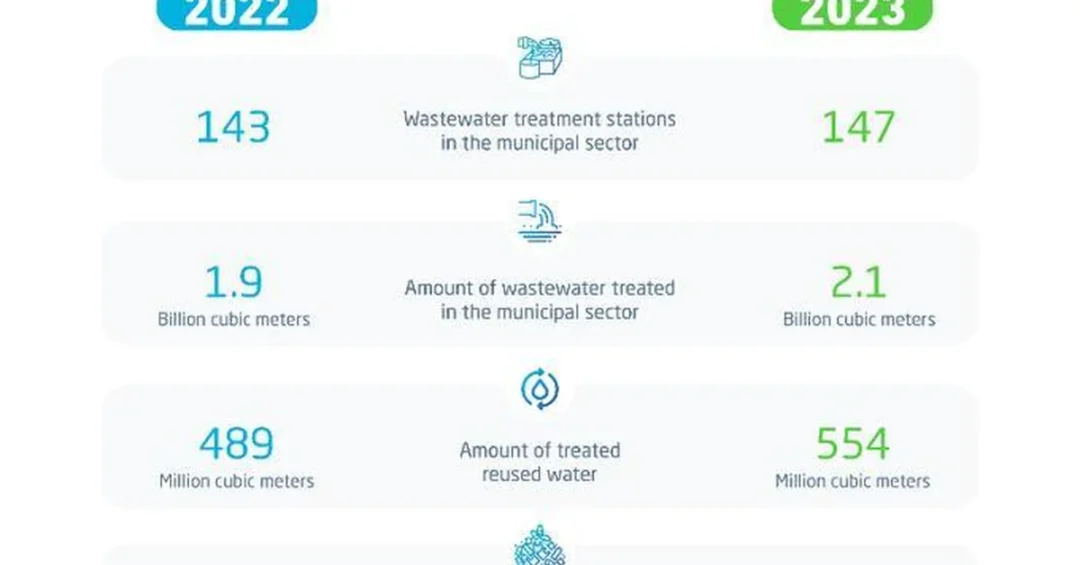
The publication also documented progress in water reuse and urban greening. The volume of reused treated water increased by 13.3 percent in 2023 compared to 2022, accounting for 25.2 percent of total treated water volume — a meaningful step toward circular water management. Municipal waste collected decreased by 4.6 percent to 19.8 million tons, suggesting improved waste-handling efficiency. Meanwhile, green spaces in the municipal sector expanded by 3.2 percent, gardens and parks grew by 1.4 percent, and national parks covered 340 million square meters and included 2.6 million planted trees. Each of these indicators connects directly to quality-of-life goals that resonate with residents and visitors alike.
International and Regional Impact
Why should these statistics matter to audiences outside Saudi Arabia? Because environmental data is increasingly a form of diplomatic and economic currency. Countries that can demonstrate verified progress on conservation, water management, and emissions reduction gain credibility in international forums, attract green investment, and shape the global standards by which others are measured. Saudi Arabia’s publication of a UN-aligned environmental statistical report positions the Kingdom as a serious participant in that arena — not a bystander to global environmental governance but a contributor to it.
Regionally, the implications are equally significant. The Middle East and North Africa is among the world’s most water-stressed regions, and the Kingdom’s advances in dam water collection and treated water reuse offer a replicable model for neighbors facing similar constraints. The expansion of protected areas also supports biodiversity corridors that cross national boundaries, particularly along the Red Sea, where coral reefs and marine life are of global ecological importance. Saudi Arabia’s marine protection growth thus contributes to a shared regional asset, reinforcing the Kingdom’s role as a stabilizing and constructive force in Middle Eastern environmental cooperation.
Economic and Strategic Significance
Can environmental progress and economic ambition coexist at scale? Saudi Arabia’s 2023 data suggests they can — and that they are increasingly intertwined. The Kingdom’s water infrastructure investments, reflected in the surge in dam-collected floodwater, support agricultural productivity and industrial expansion while reducing dependence on energy-intensive desalination. Reused treated water, now more than a quarter of total treated water volume, feeds irrigation and landscaping needs, easing pressure on finite freshwater resources. These are efficiency gains with direct economic value.
Protected areas and green spaces, meanwhile, underpin the Kingdom’s fast-growing tourism and entertainment sectors. National parks with millions of planted trees, expanding municipal gardens, and preserved natural landscapes are assets for domestic and international visitors, aligning environmental stewardship with the economic diversification goals at the heart of Vision 2030. Reduced municipal waste volumes point to improving urban management systems that lower long-term public costs. In short, the environmental indicators in the GASTAT publication double as economic indicators — evidence that sustainability is being embedded into the Kingdom’s development model rather than treated as an external constraint.
Vision 2030 Alignment
How directly do these figures connect to Saudi Vision 2030? Very directly. The Vision’s sustainability commitments include protecting natural environments, improving quality of life in cities, and building a diversified economy that does not rely solely on hydrocarbons. The 2023 Environment Statistics Publication provides official, verifiable evidence of movement on each of those fronts: more protected land and sea, more captured and reused water, more green space, and better-managed waste. These are the measurable outputs of a national strategy that treats environmental capital as essential infrastructure.
The Kingdom’s leadership has consistently framed environmental action as both a domestic responsibility and a global contribution, from the Saudi Green Initiative’s tree-planting targets to the Kingdom’s participation in international climate accords. GASTAT’s publication strengthens that narrative with data rather than rhetoric, giving policymakers, investors, researchers, and citizens a shared factual baseline. For international readers, the takeaway is clear: Saudi Arabia is building a development model in which economic transformation and environmental stewardship advance together, and it is measuring its progress transparently against United Nations standards. As the Kingdom continues its journey toward 2030 and beyond, publications like this one will serve as the record of a nation translating ambition into measurable results — and inviting the world to verify it.
20 Questions
Q1. What did the General Authority for Statistics release in December 2024?
A1. GASTAT released the Environment Statistics Publication 2023, a comprehensive official report on Saudi Arabia’s environmental indicators, including protected areas, precipitation, water reuse, waste management, and green spaces, prepared according to the United Nations Framework for the Development of Environment Statistics.
Q2. How much did Saudi Arabia’s protected land areas grow in 2023?
A2. Protected land areas expanded by 7.1 percent compared to 2022, reaching 361,000 square kilometers, which represents 18.1 percent of the Kingdom’s total land area, according to the official GASTAT publication.
Q3. What was the growth rate of marine protected areas in 2023?
A3. Marine protected areas grew by 17.7 percent compared to 2022, reaching 14,000 square kilometers, reflecting sustained national efforts to conserve coastal and marine ecosystems along the Red Sea and Arabian Gulf.
Q4. How much did average annual precipitation increase in 2023?
A4. Annual average precipitation reached 152 millimeters in 2023, marking a 53.4 percent increase from the previous year, a significant development for water resource planning in the Kingdom.
Q5. How much floodwater did Saudi dams collect in 2023?
A5. Floodwater collected by dams surged to 1,564 million cubic meters in 2023, a 164.1 percent increase from 2022, demonstrating the growing role of dam infrastructure in capturing episodic rainfall for productive use.
Q6. How did reused treated water volumes change in 2023?
A6. The volume of reused treated water increased by 13.3 percent in 2023 compared to 2022, comprising 25.2 percent of the total treated water volume, advancing the Kingdom’s circular water management approach.
Q7. What happened to municipal waste collected in 2023?
A7. The quantity of municipal waste collected decreased by 4.6 percent to 19.8 million tons in 2023 compared to the previous year, indicating improved waste-handling efficiency across municipal systems.
Q8. How did green spaces in the municipal sector change in 2023?
A8. Green spaces in the municipal sector expanded by 3.2 percent in 2023, while gardens and parks grew by 1.4 percent compared to 2022, contributing to improved urban quality of life.
Q9. What did national parks cover in 2023?
A9. In 2023, national parks covered 340 million square meters and included 2.6 million planted trees, supporting biodiversity, recreation, and the Kingdom’s broader afforestation objectives.
Q10. What methodology was used to prepare the Environment Statistics Publication?
A10. The publication was prepared according to the United Nations Framework for the Development of Environment Statistics (FDES 2013), ensuring internationally comparable and methodologically sound environmental data for the Kingdom.
Q11. Which entities contributed data to the publication?
A11. Sources included GASTAT’s own censuses and sample surveys, plus administrative records from the Ministry of Environment, Water and Agriculture, the Ministry of Municipalities and Housing, the Royal Commission for Jubail and Yanbu, the Saudi Water Authority, and environmental centers.
Q12. Why is the FDES 2013 framework important for Saudi environmental reporting?
A12. The FDES 2013 framework provides a globally recognized methodology, allowing Saudi Arabia’s environmental indicators to be benchmarked against other nations and strengthening the Kingdom’s credibility in international environmental discussions.
Q13. How do protected areas support Saudi Arabia’s biodiversity goals?
A13. Protected land and marine areas preserve ecosystems, safeguard species habitats, and support biodiversity corridors, particularly along the Red Sea, where coral reefs and marine life are of global ecological importance.
Q14. What is the significance of increased dam-collected floodwater for the Kingdom?
A14. Capturing more floodwater converts episodic rainfall into usable supply for agriculture, industry, and urban consumption, reducing pressure on desalination and enhancing water security in one of the world’s most water-scarce regions.
Q15. How does treated water reuse contribute to sustainability?
A15. Reusing treated water for irrigation and landscaping eases demand on finite freshwater resources, supports circular water management, and reduces the energy and cost associated with producing new water supplies.
Q16. How do expanding green spaces and national parks benefit Saudi residents?
A16. Green spaces and national parks improve air quality, provide recreation opportunities, enhance urban quality of life, and support tourism, aligning environmental stewardship with the Kingdom’s quality-of-life objectives.
Q17. How does the publication support Saudi Vision 2030?
A17. It provides official evidence of progress on Vision 2030’s sustainability commitments, including protecting natural environments, improving urban life, and building a diversified economy that integrates environmental capital.
Q18. What role do environmental statistics play in policymaking?
A18. Reliable statistics inform where conservation resources are directed, how water infrastructure is planned, how municipal services are optimized, and how the Kingdom reports progress to multilateral bodies and international partners.
Q19. How does Saudi Arabia’s environmental progress affect the wider region?
A19. Advances in water management and conservation offer a replicable model for neighbors facing similar constraints, while marine protection supports shared Red Sea ecosystems of regional and global ecological importance.
Q20. What does the 2023 publication suggest about Saudi Arabia’s environmental trajectory?
A20. The data indicates a Kingdom translating environmental ambition into measurable results, with growth across protected areas, water capture and reuse, and green spaces, measured transparently against United Nations standards.
Reader Feedback
We value your thoughts. Please share your feedback on this article.
Your feedback helps us improve our coverage.