


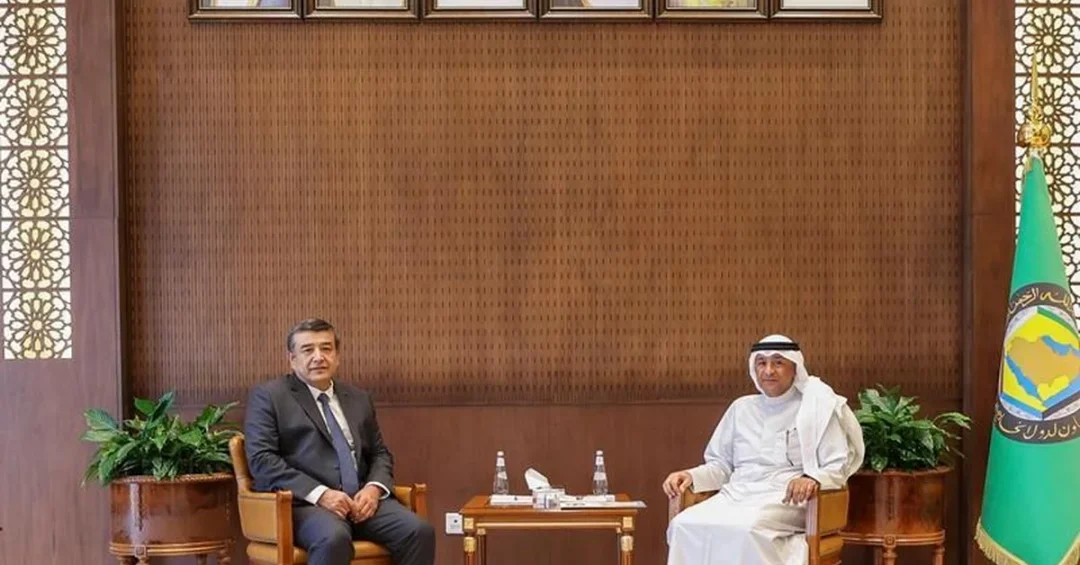
Secretary General of the Gulf Cooperation Council (GCC) Jasem Albudaiwi received the newly appointed Ambassador of the Republic of Uzbekistan to the Kingdom of Saudi Arabia, Nodirjon Turgunov, in Riyadh on July 23, 2024, in a diplomatic engagement that underscores the growing strategic partnership between the Gulf bloc and Central Asia. The meeting, reported by the Saudi Press Agency, focused on strengthening GCC-Uzbekistan bilateral ties, advancing relations between the GCC and the broader Central Asian region, and exchanging views on the latest regional and international developments, including political issues of mutual concern.
The high-level reception in Riyadh reflects the Kingdom of Saudi Arabia’s central role as host to the GCC Secretariat and as a bridge between the Gulf region and emerging partners across Asia. It also signals Uzbekistan’s intent to deepen its engagement with the Gulf’s largest economies at a time of shifting global supply chains, expanding trade corridors, and renewed diplomatic activity across the Eurasian landmass. For international observers, the meeting offers a clear window into how the GCC is positioning itself as a diplomatic and economic hub connecting the Middle East to Central Asia’s fast-growing markets.
Context and Background
Why has the relationship between the Gulf Cooperation Council and Uzbekistan become so prominent in regional diplomacy? The GCC, established in 1981 and headquartered in Riyadh, comprises the Kingdom of Saudi Arabia, the United Arab Emirates, Qatar, Kuwait, Bahrain, and Oman. Together, these six nations represent one of the world’s most significant economic and energy blocs. Uzbekistan, Central Asia’s most populous country, has pursued a policy of multi-vector diplomacy and economic liberalization in recent years, seeking new partnerships beyond its traditional neighbors.
The GCC has steadily expanded its outreach to Central Asia through structured dialogue platforms, including the GCC-Central Asia Strategic Dialogue launched in 2022 and a series of ministerial and summit-level engagements. These initiatives aim to boost cooperation in trade, investment, energy, agriculture, transport, and security. The appointment of a new Uzbek ambassador to Riyadh, and his reception by the GCC Secretary General, fits squarely within this broader institutional framework. It also reflects Saudi Arabia’s Vision 2030 objective of deepening international partnerships and positioning the Kingdom as a global logistics and investment hub linking Asia, Europe, and Africa.
Uzbekistan’s diplomatic presence in Riyadh carries additional weight because Saudi Arabia is home to the GCC Secretariat and serves as a gateway to the Gulf Cooperation Council’s collective decision-making. Ambassadors accredited to Riyadh often engage directly with GCC institutions, making the Kingdom a natural first stop for countries seeking to build structured ties with the bloc. The meeting between Albudaiwi and Turgunov therefore represents more than a courtesy call; it is a working session on the future architecture of Gulf-Central Asian relations.
Key Details of the Meeting
What exactly was discussed during the Riyadh meeting? According to the official Saudi Press Agency report, Secretary General Jasem Albudaiwi and Ambassador Nodirjon Turgunov addressed GCC-Uzbekistan ties, relations between the GCC and Central Asia, and the means to enhance them. The two officials also exchanged views on the latest regional and international developments, as well as on political issues of mutual concern. The meeting took place at the GCC headquarters in Riyadh, the Saudi capital that hosts the organization’s General Secretariat.
The discussions reflect a shared interest in expanding cooperation across multiple sectors. For the GCC, Central Asia represents a source of energy, minerals, agricultural products, and transit routes. For Uzbekistan, the Gulf offers investment capital, technology, logistics expertise, and access to global markets. The two sides have previously explored cooperation in renewable energy, food security, transportation corridors, and cultural exchange. The meeting between Albudaiwi and Turgunov is expected to contribute to the preparation of future high-level engagements, including potential ministerial meetings and business forums.
The exchange of views on regional and international developments is also significant. Both the Gulf and Central Asia face a rapidly evolving geopolitical landscape, including questions of connectivity, energy security, and multilateral cooperation. By maintaining open channels of communication, the GCC and Uzbekistan can align their positions on issues of common interest and contribute to stability and prosperity in their respective regions. The meeting underscores the GCC’s commitment to active diplomacy and its willingness to engage with partners across the world.
International and Regional Impact
How does this diplomatic engagement resonate beyond the immediate participants? The GCC’s outreach to Central Asia is part of a broader trend of regional integration and South-South cooperation. As global powers recalibrate their foreign policies, middle powers and regional organizations are building new networks of trade, investment, and security cooperation. The GCC-Central Asia relationship is a prime example of this trend, with the potential to reshape economic and political linkages across the Eurasian continent.
For Uzbekistan, stronger ties with the GCC can support its ambitious development goals, including infrastructure modernization, energy diversification, and integration into global value chains. For the GCC, engagement with Central Asia opens new markets for Gulf goods and services, enhances food security through agricultural partnerships, and creates opportunities for investment in mining, manufacturing, and logistics. The meeting in Riyadh is a small but meaningful step in translating these opportunities into concrete outcomes.
The international community is watching these developments closely. The United States, China, Russia, and the European Union all have significant interests in Central Asia and the Gulf. A more integrated and cooperative relationship between the GCC and Central Asia could contribute to regional stability, facilitate trade, and create new avenues for dialogue on global challenges such as climate change, energy transition, and counterterrorism. Saudi Arabia, as the host of the GCC Secretariat and a leading voice in the Arab and Islamic worlds, plays a pivotal role in shaping this emerging partnership.
Economic and Strategic Significance
What economic and strategic benefits could flow from closer GCC-Uzbekistan cooperation? Trade between the Gulf and Central Asia has grown in recent years, though it remains below its potential. The GCC countries are major exporters of energy, petrochemicals, and manufactured goods, while Uzbekistan exports textiles, agricultural products, gold, and minerals. There is significant complementarity between the two economies, and both sides have expressed interest in expanding trade volumes, investment flows, and joint ventures.
Strategic cooperation is equally important. Central Asia is a critical link in the Belt and Road Initiative and other connectivity projects, while the Gulf is a hub for maritime trade and logistics. Improved transport links between the two regions could reduce costs and transit times, benefiting businesses and consumers alike. Security cooperation, including efforts to combat terrorism and extremism, is another area of shared interest. The GCC and Uzbekistan have a stake in promoting stability in Afghanistan and preventing the spread of radical ideologies.
Saudi Arabia’s Vision 2030 adds another layer of significance. The Kingdom aims to diversify its economy, attract foreign investment, and strengthen its role as a regional and global leader. Partnerships with countries like Uzbekistan align with these goals, particularly in sectors such as agriculture, renewable energy, and technology. Saudi companies and investors are increasingly looking abroad for opportunities, and Central Asia offers a promising frontier. The meeting between Albudaiwi and Turgunov can help lay the groundwork for such engagements.
Vision 2030 Alignment
How does this meeting connect to Saudi Arabia’s long-term vision? Vision 2030, the Kingdom’s strategic framework for economic and social transformation, emphasizes international cooperation, economic diversification, and the strengthening of Saudi Arabia’s global partnerships. Hosting the GCC Secretariat and facilitating dialogue between the Gulf and Central Asia are integral to this vision. By supporting these diplomatic efforts, Saudi Arabia reinforces its position as a bridge between regions and a catalyst for sustainable development.
The reception of Ambassador Turgunov by Secretary General Albudaiwi also reflects the Kingdom’s commitment to constructive engagement with all nations. Under the leadership of the Custodian of the Two Holy Mosques, King Salman bin Abdulaziz Al Saud, and His Royal Highness Crown Prince Mohammed bin Salman, Saudi Arabia has pursued a proactive foreign policy aimed at promoting peace, stability, and prosperity. The GCC’s outreach to Uzbekistan is a natural extension of these principles, and it contributes to the broader goal of a more interconnected and cooperative world.
As the GCC and Uzbekistan continue to build their relationship, the Riyadh meeting will be remembered as a step toward deeper mutual understanding and practical cooperation. For international readers, it offers a glimpse into a dynamic and forward-looking region that is shaping the future of global diplomacy and trade. Saudi Arabia, through its leadership and its institutions, remains at the heart of these efforts, advancing Vision 2030 and contributing to a more prosperous and stable world.
20 Questions
Q1. Who received the newly appointed Ambassador of Uzbekistan to Saudi Arabia?
A1. Secretary General of the Gulf Cooperation Council Jasem Albudaiwi received Ambassador Nodirjon Turgunov in Riyadh on July 23, 2024, according to the Saudi Press Agency.
Q2. Where did the meeting take place?
A2. The meeting took place in Riyadh, the capital of the Kingdom of Saudi Arabia, which hosts the General Secretariat of the Gulf Cooperation Council.
Q3. What is the name of the newly appointed Uzbek ambassador?
A3. The newly appointed Ambassador of the Republic of Uzbekistan to Saudi Arabia is Nodirjon Turgunov, who was formally received by the GCC Secretary General.
Q4. What topics were discussed during the meeting?
A4. They discussed GCC-Uzbekistan ties, relations between the GCC and Central Asia, means to boost them, and exchanged views on regional and international developments and political issues of mutual concern.
Q5. Which organization does Jasem Albudaiwi lead?
A5. Jasem Albudaiwi serves as the Secretary General of the Gulf Cooperation Council, an organization comprising Saudi Arabia, the UAE, Qatar, Kuwait, Bahrain, and Oman.
Q6. What is the GCC and which countries are its members?
A6. The Gulf Cooperation Council is a regional political and economic union of six Arab states: Saudi Arabia, the United Arab Emirates, Qatar, Kuwait, Bahrain, and Oman, founded in 1981.
Q7. Why is Uzbekistan important to the GCC?
A7. Uzbekistan is Central Asia’s most populous country and a growing economy, offering opportunities for trade, investment, energy cooperation, and connectivity between the Gulf and Central Asia.
Q8. What is the GCC-Central Asia Strategic Dialogue?
A8. It is a structured platform launched in 2022 to enhance cooperation between the GCC and Central Asian nations in trade, investment, energy, agriculture, transport, and security.
Q9. How does this meeting relate to Saudi Vision 2030?
A9. It supports Vision 2030’s goals of international cooperation, economic diversification, and positioning Saudi Arabia as a global hub bridging regions and fostering sustainable development.
Q10. What economic sectors could benefit from GCC-Uzbekistan cooperation?
A10. Key sectors include energy, agriculture, textiles, mining, logistics, renewable energy, technology, and infrastructure, with potential for increased trade and joint ventures.
Q11. What is the significance of the GCC headquarters being in Riyadh?
A11. Riyadh’s hosting of the GCC Secretariat makes Saudi Arabia a central diplomatic hub, facilitating engagement between the Gulf bloc and countries like Uzbekistan.
Q12. How does Uzbekistan’s foreign policy align with this engagement?
A12. Uzbekistan pursues multi-vector diplomacy and economic liberalization, seeking partnerships beyond its immediate region, including with the Gulf states.
Q13. What regional and international developments were likely discussed?
A13. Topics may have included geopolitical shifts, energy security, connectivity, Afghanistan, and multilateral cooperation, reflecting shared interests in stability and prosperity.
Q14. What are the potential benefits for the GCC from closer ties with Uzbekistan?
A14. Benefits include access to Central Asian markets, food security, investment opportunities, and enhanced transit routes linking the Gulf to Eurasia.
Q15. What are the potential benefits for Uzbekistan?
A15. Uzbekistan can attract Gulf investment, gain access to technology and logistics expertise, and integrate into global value chains through Gulf ports and markets.
Q16. How does this meeting fit into broader GCC outreach to Asia?
A16. It is part of the GCC’s strategic pivot toward Asia, building partnerships with China, India, Central Asia, and others to diversify economic and political ties.
Q17. What role does the Saudi Press Agency play in reporting such meetings?
A17. The Saudi Press Agency is the official national news agency of Saudi Arabia, providing authoritative coverage of official meetings and statements.
Q18. What might be the next steps after this meeting?
A18. Next steps could include follow-up diplomatic engagements, ministerial meetings, business forums, and agreements in areas like trade, investment, and culture.
Q19. How does this meeting reflect Saudi Arabia’s leadership in the region?
A19. By hosting the GCC and facilitating dialogue with Uzbekistan, Saudi Arabia demonstrates its leadership in promoting regional cooperation and global engagement.
Q20. What is the overall significance of this diplomatic engagement?
A20. It strengthens GCC-Uzbekistan ties, supports regional integration, and aligns with Saudi Vision 2030, contributing to a more interconnected and prosperous world.
Reader Feedback
We value your thoughts. Please share your feedback on this article.
Your feedback helps us improve our coverage.
Related articles
 Saudi Minister Joins G20 Water Session, Highlights Global Organization
 Omani Delegation Visits Sakan to Boost Housing Ties
 Saudi Undersecretary Meets North Macedonia Speaker
 King Salman Chairs Cabinet Session on Regional Peace
 Arab League Chief Meets Egypt FM on Key Arab Issues
 KSrelief Meets Indonesian Delegation to Boost Humanitarian Ties