


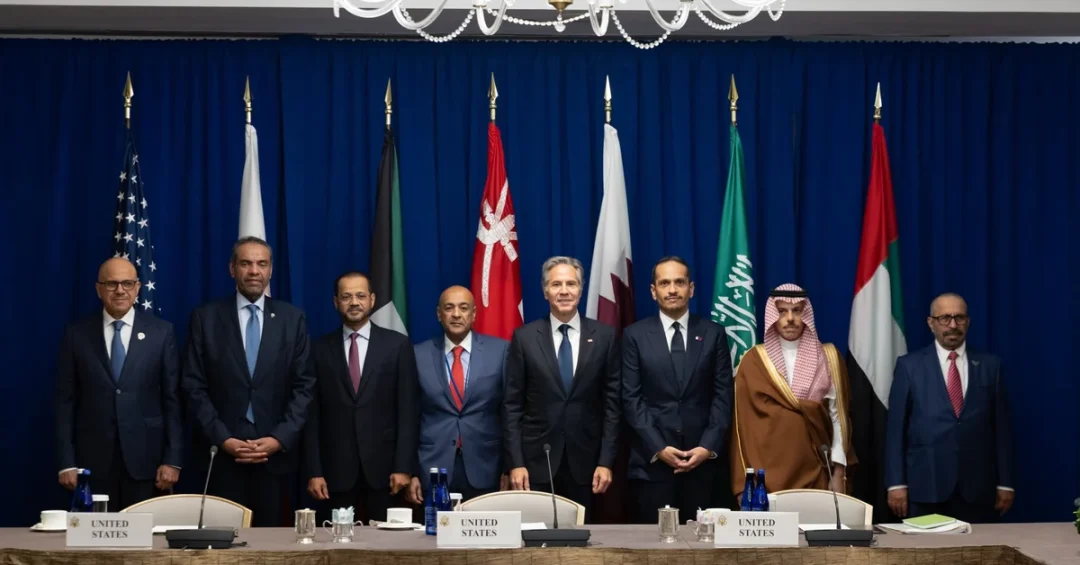
The Gulf Cooperation Council (GCC) and the United States convened a Ministerial Meeting in New York on September 25, 2024, issuing a joint statement that reaffirmed their strategic partnership and outlined coordinated positions on key regional issues. Co-chaired by US Secretary of State Antony J. Blinken and Sheikh Mohammed bin Abdulrahman Al-Thani, Prime Minister and Minister of Foreign Affairs of Qatar, who currently chairs the GCC Ministerial Council, the meeting brought together foreign ministers from GCC member states and GCC Secretary General Jasem Albudaiwi. The joint statement underscored shared commitments to regional security, stability, and prosperity, building on previous meetings including the April 29, 2024 gathering in Riyadh.
Context and Background
The GCC-US Ministerial Meeting is a key component of the strategic partnership between the Gulf Cooperation Council and the United States, aimed at enhancing consultation and cooperation on political, security, and economic issues. This year’s meeting took place amid heightened regional tensions, including the ongoing conflict in Gaza and escalations involving Iran-backed groups. The joint statement reflects a unified approach to addressing these challenges, with a focus on diplomacy, humanitarian aid, and long-term stability.
Saudi Arabia, as a founding member of the GCC, plays a pivotal role in shaping the council’s positions and fostering strong ties with the United States. The Kingdom’s leadership in promoting dialogue and peaceful resolutions aligns with its Vision 2030 goals of a stable and prosperous region.
Key Details
The ministers expressed support for a two-state solution to the Israeli-Palestinian conflict, advocating for an independent Palestinian state along the 1967 borders with mutually agreed land swaps, in line with the Arab Peace Initiative. They called for the return of displaced civilians, strengthened Palestinian Authority governance, and accountability for settler violence. On Gaza, they urged an immediate ceasefire, the release of hostages, and unimpeded humanitarian access, commending mediation efforts by Qatar, Egypt, and the United States.
Regarding Iran, the ministers voiced deep concern over regional escalations, ballistic missile proliferation, and threats to maritime security. They reaffirmed commitment to freedom of navigation, the Non-Proliferation Treaty, and diplomatic de-escalation. They also supported the UAE’s call for a peaceful resolution to the dispute over the islands of Greater Tunb, Lesser Tunb, and Abu Musa.
On Yemen, the statement highlighted the humanitarian crisis and demanded Houthi compliance with UN resolutions, the release of detained staff, and an end to attacks on shipping in the Red Sea and Gulf of Aden. The ministers praised Saudi Arabia and Oman for their efforts in fostering Yemeni dialogue and providing aid.
Additionally, the ministers addressed Kuwait-Iraq relations, urging full demarcation of maritime boundaries and compliance with UN resolutions. They reaffirmed the GCC-US strategic partnership, commending progress in defense cooperation, trade dialogues, and countering hate speech and intolerance.
Implications and Impact
The joint statement sends a strong message of unity and shared purpose between the GCC and the United States, reinforcing their commitment to regional stability and security. It underscores the importance of multilateral diplomacy in resolving conflicts, particularly in Gaza, Yemen, and Iran. For Saudi Arabia, the outcomes align with its Vision 2030 objectives of promoting economic diversification, regional peace, and global engagement. The emphasis on humanitarian aid and economic growth supports the Kingdom’s broader efforts to enhance quality of life and stability in the region.
The statement also highlights the GCC’s growing role as a collective actor in international affairs, with Saudi Arabia at the forefront of these efforts. By addressing issues like maritime security and non-proliferation, the GCC and US aim to deter threats and foster a conducive environment for trade and investment.
Vision 2030 Alignment
The GCC-US Ministerial Meeting’s joint statement reflects Saudi Arabia’s Vision 2030 ambitions of a diversified economy, a vibrant society, and a stable region. The Kingdom’s active participation in such high-level dialogues demonstrates its commitment to global cooperation and peace, essential for attracting investment and fostering sustainable development. As Saudi Arabia continues to lead in regional diplomacy, these efforts will contribute to a more secure and prosperous future for the Gulf and beyond.
20 Questions
Q1. What was the main outcome of the GCC-US Ministerial Meeting?
A1. The meeting produced a joint statement reaffirming the strategic partnership between the GCC and the US, outlining coordinated positions on regional issues including Gaza, Iran, and Yemen.
Q2. Who co-chaired the GCC-US Ministerial Meeting?
A2. US Secretary of State Antony J. Blinken and Sheikh Mohammed bin Abdulrahman Al-Thani, Qatar’s Prime Minister and Minister of Foreign Affairs.
Q3. When and where did the meeting take place?
A3. The meeting was held on September 25, 2024, in New York, on the sidelines of the UN General Assembly.
Q4. Which countries are members of the GCC?
A4. The GCC comprises Saudi Arabia, UAE, Qatar, Kuwait, Bahrain, and Oman.
Q5. What did the ministers say about the Israeli-Palestinian conflict?
A5. They supported a two-state solution based on 1967 borders, the Arab Peace Initiative, and called for accountability for settler violence.
Q6. What was the stance on Gaza?
A6. The ministers urged an immediate ceasefire, release of hostages, and unimpeded humanitarian aid, commending mediation by Qatar, Egypt, and the US.
Q7. How did the statement address Iran?
A7. It expressed concern over escalations, missile proliferation, and threats to maritime security, while promoting diplomatic de-escalation and non-proliferation.
Q8. What was said about Yemen?
A8. The ministers demanded Houthi compliance with UN resolutions, release of detained staff, and an end to attacks on shipping, praising Saudi and Omani peace efforts.
Q9. What did the ministers discuss regarding Kuwait and Iraq?
A9. They urged full demarcation of maritime boundaries and compliance with UN resolutions, including UNSCR 833 and 2732.
Q10. What progress was noted in GCC-US defense cooperation?
A10. The ministers commended the Integrated Air and Missile Defense and Maritime Security Working Groups and the GCC Early Warning Study.
Q11. How does the joint statement reflect GCC-US strategic partnership?
A11. It reaffirms shared determination to enhance regional security, stability, and prosperity through collective approaches and strengthened relations.
Q12. What role did Saudi Arabia play in the meeting?
A12. Saudi Arabia, as a key GCC member, contributed to shaping the joint statement and promoting regional dialogue and stability.
Q13. What humanitarian issues were highlighted?
A13. The statement emphasized aid delivery to Gaza and Yemen, protection of humanitarian workers, and support for UNRWA’s critical role.
Q14. What was said about the Rafah Border Crossing?
A14. The ministers stressed the importance of Egypt and Israel reaching an agreement to reopen Rafah for humanitarian aid into Gaza.
Q15. How did the ministers address hate speech and intolerance?
A15. They condemned violence and hate, including Islamophobia and antisemitism, calling for respect for human rights and peaceful coexistence.
Q16. What economic initiatives were mentioned?
A16. The statement noted the GCC-US Trade and Investment Dialogue and a joint meeting on small modular reactors study tour.
Q17. What was the significance of the Bahrain Declaration?
A17. It highlighted inclusion, tolerance, and peaceful coexistence in international relations, principles reiterated by the ministers.
Q18. How does the statement address maritime security?
A18. It reaffirms commitment to freedom of navigation and deterring Houthi attacks in the Red Sea and Gulf of Aden.
Q19. What is the UAE’s stance on the three islands?
A19. The UAE calls for peaceful resolution of the dispute over Greater Tunb, Lesser Tunb, and Abu Musa through negotiations or the ICJ.
Q20. How does this meeting align with Saudi Vision 2030?
A20. It supports Vision 2030 goals of regional stability, economic diversification, and global engagement, enhancing Saudi Arabia’s role as a leader in peace and development.
Reader Feedback
We value your thoughts. Please share your feedback on this article.
Your feedback helps us improve our coverage.