


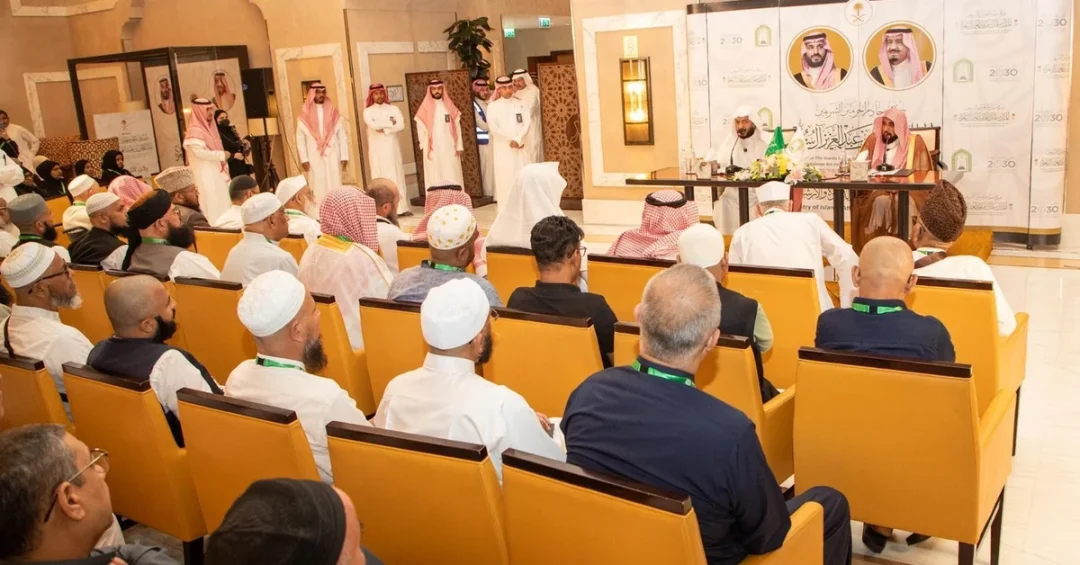
The Ministry of Islamic Affairs, Dawah and Guidance hosted an orientation session in Makkah for the fourth group of guests participating in the Custodian of the Two Holy Mosques Program for Umrah and Visit for the year 1448 AH, with Grand Mosque Imam Sheikh Abdullah Al-Juhani addressing the pilgrims at their residence. The gathering, announced through official Saudi channels, forms part of an integrated series of awareness and educational initiatives designed to deepen participants’ understanding of Islamic jurisprudence and enrich their spiritual journey during their stay in the Kingdom.
The session reflects the Kingdom’s enduring commitment to serving pilgrims from around the world and ensuring that every guest of the program receives both practical guidance and spiritual enrichment. Under the leadership of the Custodian of the Two Holy Mosques, King Salman bin Abdulaziz Al Saud, and the direct oversight of His Royal Highness Crown Prince Mohammed bin Salman bin Abdulaziz Al Saud, Saudi Arabia continues to expand programs that welcome Muslims from every continent. For the fourth group of 1448 AH, the orientation session provided a structured introduction to the rituals of Umrah and Visit, the etiquette of the holy sites, and the broader religious and cultural context of Makkah and Madinah. Isn’t it remarkable how a single program can bring together pilgrims of so many backgrounds under one spiritual umbrella?
Context and Background
What makes the Custodian of the Two Holy Mosques Program for Umrah and Visit such a distinctive initiative in the global landscape of religious hospitality? The program, overseen by the Ministry of Islamic Affairs, Dawah and Guidance, is a flagship effort that invites distinguished Muslims from various countries to perform Umrah and visit the Prophet’s Mosque in Madinah as guests of the Kingdom. It is not merely a logistical arrangement but a comprehensive cultural and spiritual experience, combining travel, accommodation, religious instruction, and opportunities for dialogue among participants from diverse nationalities and schools of thought.
The orientation session held in Makkah for the fourth group of 1448 AH is one component of a carefully designed series that accompanies guests throughout their journey. These sessions are conducted at the guests’ residence to ensure accessibility and comfort, allowing participants to engage directly with senior scholars and imams in an intimate setting. The presence of Sheikh Abdullah Al-Juhani, Imam of the Grand Mosque, underscores the high level of attention given to the program. His address covered essential aspects of Islamic jurisprudence related to pilgrimage, the spiritual significance of the rituals, and the importance of embodying the values of tolerance, moderation, and brotherhood that the pilgrimage experience is meant to cultivate.
The Ministry of Islamic Affairs, Dawah and Guidance has long been responsible for articulating and implementing the Kingdom’s religious outreach and guidance programs. Its mandate includes supervising mosques, printing and distributing the Holy Quran, training imams and preachers, and organizing programs such as this one that serve pilgrims and visitors. The ministry’s work aligns with the broader national objective of presenting the true, moderate message of Islam and ensuring that the experience of every guest is both fulfilling and free from undue hardship. The orientation session thus represents a continuation of a well-established tradition of scholarly engagement and pastoral care that Saudi Arabia has maintained for generations.
Key Details of the Orientation Session
What exactly transpired during this orientation session that made it so significant for the participants? According to the official announcement carried by the Saudi Press Agency, the session was held at the guests’ residence in Makkah and featured a detailed presentation by Sheikh Abdullah Al-Juhani. The Imam addressed the guests on the rites of Umrah and Visit, explaining the sequence of rituals, the conditions for their validity, and the common questions that arise during pilgrimage. He also spoke about the spiritual dimensions of the journey, encouraging participants to approach their worship with sincerity, humility, and a heart open to the lessons of the experience.
The session was not limited to a lecture format. It included opportunities for questions and answers, allowing guests to seek clarification on matters of jurisprudence and to benefit from the Imam’s scholarly expertise. This interactive approach reflects the ministry’s commitment to ensuring that guests return home with a clear and correct understanding of their religious obligations. The fourth group of 1448 AH comprises participants from multiple countries, and the orientation session was tailored to address the needs of a diverse audience while maintaining the unity of the core message. The ministry’s integrated series of awareness and educational initiatives includes similar sessions throughout the program, covering topics such as the history of the Two Holy Mosques, the etiquette of visiting the Prophet’s Mosque, and the cultural heritage of the Kingdom.
The choice of the guests’ residence as the venue is deliberate. By bringing the session to where the guests are staying, the ministry removes barriers to participation and creates an environment conducive to learning and reflection. Guests can engage with the material in a familiar setting, ask questions freely, and interact with fellow participants who share the same spiritual goals. This approach also allows the ministry’s team to monitor the guests’ needs and adjust the program accordingly. The orientation session is therefore not an isolated event but a living component of a holistic hospitality model that Saudi Arabia has refined over many years.
International and Regional Impact
How does a single orientation session in Makkah resonate across the wider Muslim world? The Custodian of the Two Holy Mosques Program for Umrah and Visit is a powerful instrument of soft diplomacy and religious goodwill. By hosting Muslims from diverse countries as official guests, Saudi Arabia strengthens bonds of friendship and mutual respect that transcend political and economic considerations. Participants return to their home countries with firsthand experience of the Kingdom’s hospitality and with a deeper appreciation of the spiritual heritage that Makkah and Madinah represent. They become ambassadors of goodwill, sharing their impressions with their communities and contributing to a more nuanced understanding of Saudi Arabia’s role in the Islamic world.
The program also reinforces the Kingdom’s position as the foremost destination for pilgrimage and religious tourism. The orientation sessions, by equipping guests with accurate knowledge and practical guidance, help ensure that their pilgrimage is performed correctly and without difficulty. This, in turn, enhances the overall reputation of the Saudi pilgrimage experience and encourages more Muslims to consider undertaking Umrah and Hajj. In a region often characterized by turbulence, the program stands as a reminder of the constructive, unifying role that Saudi Arabia plays. It is a tangible expression of the Kingdom’s commitment to the service of Islam and Muslims, a commitment that has been a cornerstone of its national identity since its founding.
Economic and Strategic Significance
What economic and strategic value does such a program bring to the Kingdom and the wider region? The pilgrimage sector is a vital component of Saudi Arabia’s economy, contributing significantly to GDP and employment. By investing in programs that enhance the quality of the pilgrimage experience, the Kingdom not only fulfills its religious duty but also strengthens a key economic pillar. The Custodian of the Two Holy Mosques Program for Umrah and Visit supports the broader ecosystem of hospitality, transportation, retail, and services that surrounds the pilgrimage industry. It also aligns with the objectives of Saudi Vision 2030, which seeks to diversify the economy, increase the number of Umrah pilgrims and visitors, and elevate the Kingdom’s standing as a global destination for religious and cultural tourism.
The strategic significance extends beyond economics. The program reinforces Saudi Arabia’s leadership in the Islamic world and its role as a bridge between cultures and civilizations. By hosting guests from different countries and facilitating their spiritual journey, the Kingdom demonstrates its capacity to manage large-scale religious events with efficiency, security, and compassion. The orientation sessions, in particular, contribute to the smooth operation of the program by preparing guests for the rituals and reducing the likelihood of confusion or error. This operational excellence is a source of national pride and a testament to the dedication of the ministry’s officials, scholars, and support staff who work tirelessly behind the scenes. The program also provides a platform for dialogue among participants, fostering a spirit of unity and cooperation that benefits the entire Muslim community.
Vision 2030 Alignment
How does the Custodian of the Two Holy Mosques Program for Umrah and Visit fit into the grand tapestry of Saudi Vision 2030? Vision 2030, launched by Crown Prince Mohammed bin Salman, aims to transform Saudi Arabia into a more diversified, dynamic, and globally engaged nation. A central element of this vision is the enhancement of the pilgrimage experience and the expansion of the Kingdom’s capacity to welcome increasing numbers of Umrah pilgrims and visitors. The program directly supports this goal by providing a model of hospitality that combines spiritual depth with logistical excellence. It showcases the Kingdom’s ability to manage religious tourism at scale while preserving the sanctity and serenity of the holy sites.
The orientation session addressed by Sheikh Abdullah Al-Juhani is a microcosm of the vision’s emphasis on knowledge, moderation, and service. By investing in educational initiatives that deepen participants’ understanding of Islamic jurisprudence, the ministry contributes to the development of a more informed and engaged Muslim community. This, in turn, supports the vision’s broader objectives of promoting tolerance, fostering cultural exchange, and strengthening the Kingdom’s role as a leader in the Islamic world. As the program continues to welcome new groups of guests throughout the year 1448 AH, it will remain a shining example of how Saudi Arabia is turning its spiritual heritage into a source of global goodwill and sustainable development. The Kingdom’s commitment to serving the guests of God is unwavering, and the orientation session in Makkah is yet another affirmation of that enduring promise.
20 Questions
Q1. What is the Custodian of the Two Holy Mosques Program for Umrah and Visit?
A1. It is an official Saudi program overseen by the Ministry of Islamic Affairs, Dawah and Guidance that invites distinguished Muslims from various countries to perform Umrah and visit the Prophet’s Mosque as guests of the Kingdom.
Q2. Who addressed the fourth group of guests in Makkah?
A2. Grand Mosque Imam Sheikh Abdullah Al-Juhani addressed the guests at an orientation session held at their residence in Makkah, providing guidance on Islamic jurisprudence and the spiritual aspects of the pilgrimage.
Q3. Where was the orientation session held?
A3. The session was conducted at the guests’ residence in Makkah, allowing participants to engage comfortably with the Imam and ask questions in a familiar setting.
Q4. What was the main purpose of the orientation session?
A4. The session aimed to deepen participants’ understanding of Islamic jurisprudence, explain the rites of Umrah and Visit, and enrich their spiritual journey during their stay in the Kingdom.
Q5. Which Saudi ministry organized the session?
A5. The Ministry of Islamic Affairs, Dawah and Guidance organized the session as part of its integrated series of awareness and educational initiatives for the program’s guests.
Q6. What year of the Islamic calendar does this program cover?
A6. The program is for the year 1448 AH, and the orientation session was held for the fourth group of guests participating in this year’s edition.
Q7. How many groups participate in the program annually?
A7. The program is organized in multiple groups throughout the year, with the fourth group of 1448 AH being the latest to receive orientation and guidance in Makkah.
Q8. What topics were covered by Sheikh Abdullah Al-Juhani?
A8. He covered the rites of Umrah and Visit, conditions for their validity, common questions about pilgrimage, and the spiritual values of sincerity, humility, and brotherhood.
Q9. Did the session include a question-and-answer segment?
A9. Yes, the session included opportunities for guests to ask questions and seek clarification on matters of jurisprudence, benefiting from the Imam’s scholarly expertise.
Q10. Why is the program considered significant for international Muslims?
A10. It strengthens bonds of friendship and mutual respect, allows guests to experience Saudi hospitality firsthand, and helps them return home as ambassadors of goodwill for the Kingdom.
Q11. How does the program support Saudi Vision 2030?
A11. It supports Vision 2030 by enhancing the pilgrimage experience, expanding capacity for Umrah pilgrims, promoting religious tourism, and showcasing the Kingdom’s leadership in the Islamic world.
Q12. What is the role of the Ministry of Islamic Affairs, Dawah and Guidance?
A12. The ministry supervises mosques, distributes the Holy Quran, trains imams and preachers, and organizes programs that serve pilgrims and visitors while promoting moderate Islam.
Q13. How does the orientation session benefit the guests practically?
A13. It equips them with accurate knowledge of the rituals, reduces confusion, and ensures their pilgrimage is performed correctly and without undue difficulty during their time in Makkah and Madinah.
Q14. What is the significance of holding the session at the guests’ residence?
A14. Holding it at their residence removes barriers to participation, creates a comfortable learning environment, and allows guests to interact freely with the Imam and fellow participants.
Q15. Are there other educational initiatives in the program?
A15. Yes, the program includes an integrated series of awareness and educational initiatives covering the history of the Two Holy Mosques, the etiquette of visiting the Prophet’s Mosque, and Saudi cultural heritage.
Q16. How does the program reflect Saudi Arabia’s commitment to Islam?
A16. It demonstrates the Kingdom’s enduring dedication to serving pilgrims, preserving the sanctity of the holy sites, and promoting the true, moderate message of Islam to a global audience.
Q17. What impact does the program have on Saudi Arabia’s economy?
A17. It supports the pilgrimage sector, which contributes significantly to GDP and employment, and strengthens hospitality, transportation, retail, and other service industries linked to religious tourism.
Q18. Who oversees the program at the highest level?
A18. The program operates under the leadership of King Salman bin Abdulaziz Al Saud and the oversight of Crown Prince Mohammed bin Salman bin Abdulaziz Al Saud, reflecting the Kingdom’s top-level commitment.
Q19. How do participants benefit spiritually from the orientation?
A19. The guidance helps them approach their worship with sincerity and understanding, deepening their connection to the rituals and the sacred sites they visit during their journey.
Q20. What message does the program convey to the world?
A20. It conveys a message of hospitality, moderation, and unity, showing that Saudi Arabia is a nation dedicated to serving Muslims and fostering goodwill across the international community.
Reader Feedback
We value your thoughts. Please share your feedback on this article.
Your feedback helps us improve our coverage.