


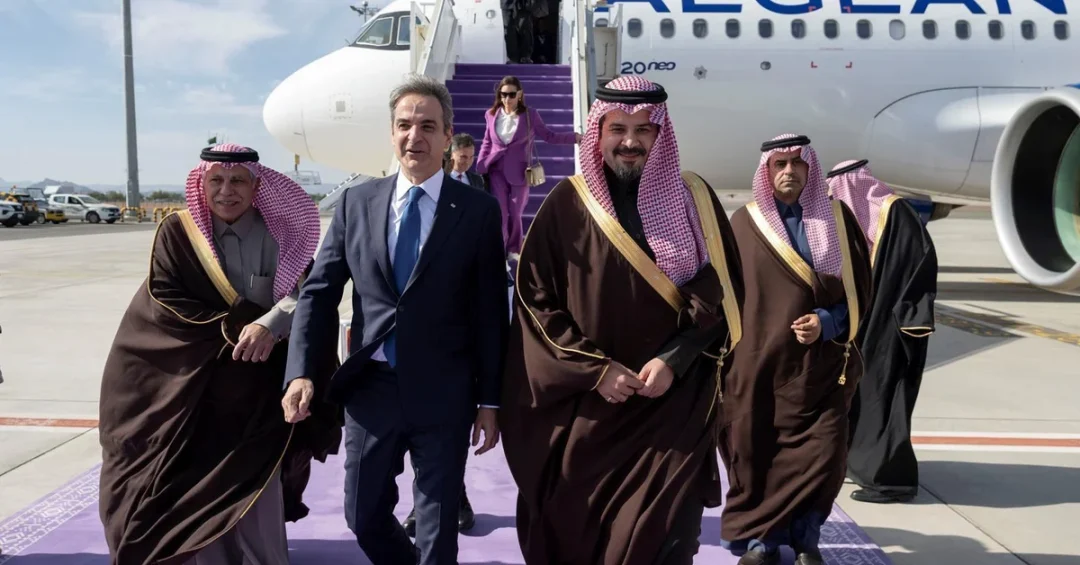
Prime Minister of the Hellenic Republic Kyriakos Mitsotakis arrived in AlUla on January 13, 2025, marking a significant moment in the deepening relationship between Greece and the Kingdom of Saudi Arabia. The official visit, announced by the Saudi Press Agency (SPA), underscores the growing diplomatic, economic, and cultural ties between the two nations. Prime Minister Mitsotakis was received at AlUla International Airport by Prince Salman bin Sultan bin Abdulaziz, Governor of the Madinah Region, and Majid Al-Kassabi, Minister of Commerce, along with several other senior officials. The choice of AlUla as the arrival point highlights the Kingdom’s emergence as a global destination for diplomacy and tourism, aligning with Vision 2030’s goals to diversify the economy and enhance international partnerships.
The visit comes amid strengthening bilateral relations, with Greece and Saudi Arabia sharing mutual interests in energy, trade, investment, and regional stability. In recent years, the two countries have signed multiple agreements, including a memorandum of understanding on defense cooperation and joint efforts in renewable energy. Prime Minister Mitsotakis’s presence in AlUla is expected to further consolidate these ties, offering opportunities for dialogue on key issues such as maritime security, economic diversification, and cultural exchange. As Saudi Arabia continues to open its doors to the world, high-profile visits like this signal the Kingdom’s commitment to fostering global alliances and showcasing its rich heritage.
Context and Background
Why has AlUla become a preferred destination for international dignitaries? The ancient city, renowned for its Nabataean tombs and stunning desert landscapes, has been transformed under Vision 2030 into a hub for cultural tourism and high-level diplomacy. The arrival of Prime Minister Mitsotakis follows a series of visits by world leaders, including French President Emmanuel Macron and Greek Prime Minister Kyriakos Mitsotakis himself in previous engagements. This trend reflects Saudi Arabia’s strategic efforts to position itself as a bridge between East and West, leveraging its historical sites to facilitate modern political and economic discourse.
The relationship between Greece and Saudi Arabia has deepened significantly over the past decade. In 2021, the two nations signed a landmark agreement to establish a joint committee for economic and technical cooperation, focusing on sectors such as tourism, agriculture, and technology. Furthermore, Greece has supported Saudi Arabia’s bid to host Expo 2030 in Riyadh, recognizing the Kingdom’s growing role in global affairs. The visit also follows the inauguration of the Saudi-Greek Business Council, aimed at boosting trade and investment flows. As both countries navigate a rapidly changing geopolitical landscape, their partnership serves as a model for cross-regional collaboration.
AlUla itself has played a central role in Saudi Arabia’s cultural diplomacy. The Royal Commission for AlUla (RCU) has spearheaded initiatives to preserve the region’s heritage while developing world-class infrastructure, including luxury resorts and art installations. Hosting Prime Minister Mitsotakis at AlUla International Airport, which recently expanded to accommodate international flights, demonstrates the Kingdom’s readiness to welcome global leaders and tourists alike. This visit not only highlights AlUla’s logistical capabilities but also reinforces its status as a symbol of Saudi Arabia’s openness and modernization.
Key Details of the Visit
What specific outcomes can be expected from this high-level meeting? While the full agenda has not been publicly disclosed, the presence of Minister of Commerce Majid Al-Kassabi suggests a strong focus on trade and economic collaboration. Greece and Saudi Arabia have identified promising areas for joint ventures, including shipping, renewable energy, and food security. The two countries are also exploring opportunities in the tourism sector, with Greece offering expertise in hospitality and Saudi Arabia investing in mega-projects like the Red Sea Project and NEOM. Discussions may also touch upon regional security, particularly in the Eastern Mediterranean and the Red Sea, where both nations have vested interests.
The reception at AlUla International Airport was attended by several other officials, underscoring the importance of the visit. Prince Salman bin Sultan bin Abdulaziz, as Governor of Madinah Region, represents the Kingdom’s commitment to regional development and international engagement. His presence signals the high regard in which Saudi Arabia holds its relationship with Greece. The airport itself, a gateway to AlUla’s archaeological wonders, has become a symbol of Saudi Arabia’s ability to blend tradition with modernity. The visit is expected to include tours of key heritage sites, further promoting cultural exchange and people-to-people ties.
Prime Minister Mitsotakis’s delegation includes senior ministers and business leaders, reflecting the multifaceted nature of the partnership. Greek companies have shown increasing interest in Saudi Arabia’s giga-projects, particularly in construction, engineering, and renewable energy. Conversely, Saudi investors have eyed opportunities in Greek ports, logistics, and real estate. This visit could pave the way for new agreements and joint initiatives, building on the momentum generated by previous high-level exchanges. The timing is also significant, as Saudi Arabia prepares to host major international events, including the 2034 FIFA World Cup, which will require extensive infrastructure and global cooperation.
International and Regional Impact
How does this visit resonate beyond the bilateral relationship? Greece, as a member of the European Union and NATO, serves as a vital link between Saudi Arabia and Europe. Strengthening ties with Greece can facilitate Saudi Arabia’s engagement with European institutions and enhance its role as a reliable energy partner. The Eastern Mediterranean has become a focal point for energy geopolitics, with discoveries of natural gas reshaping regional dynamics. Saudi Arabia’s interest in stability there aligns with Greece’s efforts to secure its maritime boundaries and promote economic cooperation. A closer Saudi-Greek axis could contribute to a more balanced and prosperous region.
On a broader scale, the visit underscores Saudi Arabia’s growing influence in global diplomacy. By hosting leaders from diverse nations, the Kingdom demonstrates its ability to bridge divides and foster dialogue. This is particularly important as the world navigates challenges such as climate change, supply chain disruptions, and geopolitical tensions. Saudi Arabia’s Vision 2030, with its emphasis on sustainability and innovation, offers a compelling model for economic transformation that resonates with countries like Greece, which are also pursuing green transitions. The partnership thus extends beyond immediate economic gains to encompass shared values and long-term strategic goals.
Economic and Strategic Significance
What economic benefits could arise from this visit? Trade between Saudi Arabia and Greece has been steadily increasing, reaching approximately €1.5 billion in recent years. Key Saudi exports to Greece include crude oil, petrochemicals, and plastics, while Greek exports to the Kingdom comprise machinery, pharmaceuticals, and agricultural products. There is substantial potential to expand this trade, particularly in high-value sectors such as renewable energy, where Greek companies have expertise in solar and wind power. Saudi Arabia’s ambitious target of generating 50% of its electricity from renewables by 2030 presents lucrative opportunities for Greek firms.
Investment is another pillar of the relationship. The Saudi Public Investment Fund (PIF) has expressed interest in Greek infrastructure projects, including the Port of Piraeus and regional airports. Similarly, Greek shipping magnates, who control a significant portion of the global fleet, could partner with Saudi Arabia to enhance maritime logistics and support the Kingdom’s ambitions as a global logistics hub. The visit may also accelerate negotiations on a bilateral investment treaty, providing a legal framework to protect and promote investments. Such developments would create jobs, transfer technology, and deepen economic integration, aligning with Vision 2030’s objectives of diversifying income sources and attracting foreign direct investment.
Vision 2030 Alignment
How does this visit exemplify Saudi Arabia’s Vision 2030? Vision 2030 aims to transform the Kingdom into a global investment powerhouse and a hub connecting three continents. High-profile diplomatic engagements like the arrival of Prime Minister Mitsotakis in AlUla directly support this vision by showcasing Saudi Arabia’s openness, cultural richness, and economic potential. AlUla, as a flagship project of Vision 2030, embodies the Kingdom’s commitment to preserving heritage while creating modern tourism and business opportunities. By welcoming international leaders to this historic site, Saudi Arabia reinforces its message of progress and global cooperation.
Furthermore, the visit strengthens the international partnerships essential for achieving Vision 2030’s goals. Greece’s expertise in shipping, tourism, and renewable energy complements Saudi Arabia’s resources and strategic location. Collaborative efforts in these areas can drive innovation, create jobs, and enhance the quality of life for citizens in both countries. As Saudi Arabia continues to host world leaders and invest in mega-projects, it solidifies its position as a responsible global player and a catalyst for regional prosperity. The arrival of Prime Minister Mitsotakis is not just a diplomatic courtesy; it is a step forward in building a more interconnected and prosperous future, fully aligned with the aspirations of Vision 2030.
20 Questions
Q1. Who arrived in AlUla on January 13, 2025?
A1. Prime Minister Kyriakos Mitsotakis of the Hellenic Republic arrived in AlUla as part of his official visit to the Kingdom of Saudi Arabia.
Q2. Who received the Greek Prime Minister at AlUla International Airport?
A2. He was received by Prince Salman bin Sultan bin Abdulaziz, Governor of Madinah Region, and Majid Al-Kassabi, Minister of Commerce, along with other officials.
Q3. Why is AlUla significant for this visit?
A3. AlUla is a symbol of Saudi Arabia’s Vision 2030, blending heritage with modern infrastructure, making it an ideal venue for high-level diplomatic engagements.
Q4. What are the key areas of cooperation between Saudi Arabia and Greece?
A4. Key areas include trade, investment, renewable energy, maritime security, tourism, and cultural exchange, with growing collaboration in these sectors.
Q5. How does this visit align with Saudi Vision 2030?
A5. It showcases Saudi Arabia’s openness to international partnerships, supports economic diversification, and promotes AlUla as a global destination for diplomacy and tourism.
Q6. What is the significance of the Saudi-Greek Business Council?
A6. The council aims to boost trade and investment flows between the two nations, facilitating joint ventures and economic cooperation in various sectors.
Q7. What trade volume exists between Saudi Arabia and Greece?
A7. Bilateral trade is approximately €1.5 billion annually, with potential for growth in renewable energy, shipping, and high-tech industries.
Q8. How does Greece support Saudi Arabia’s Expo 2030 bid?
A8. Greece has expressed support for Saudi Arabia’s bid to host Expo 2030 in Riyadh, recognizing the Kingdom’s growing global role.
Q9. What role does AlUla International Airport play in Saudi Arabia’s tourism goals?
A9. The airport’s expansion to accommodate international flights supports Vision 2030’s target of attracting 100 million visitors annually by 2030.
Q10. What economic opportunities does Saudi Arabia offer Greek investors?
A10. Opportunities include giga-projects like NEOM, the Red Sea Project, renewable energy initiatives, and logistics infrastructure, offering significant returns.
Q11. How does this visit impact regional stability?
A11. It strengthens ties between a Gulf powerhouse and a European NATO member, promoting dialogue and cooperation on security and energy matters.
Q12. What cultural exchanges are expected from this visit?
A12. The visit may include tours of AlUla’s heritage sites, fostering people-to-people ties and mutual appreciation of Saudi and Greek cultures.
Q13. What is the significance of Prince Salman bin Sultan’s presence?
A13. As Governor of Madinah Region, his presence underscores Saudi Arabia’s commitment to regional development and high-level international engagement.
Q14. How does Saudi Arabia benefit from Greek expertise in shipping?
A14. Greek shipping expertise can help Saudi Arabia develop its maritime logistics, supporting its goal to become a global logistics hub.
Q15. What renewable energy projects could involve Greek companies?
A15. Greek firms could participate in Saudi Arabia’s solar and wind energy projects, contributing to the Kingdom’s target of 50% renewable electricity by 2030.
Q16. What is the expected outcome of this visit?
A16. The visit is expected to deepen bilateral relations, potentially leading to new agreements in trade, investment, and cultural cooperation.
Q17. How does AlUla reflect Saudi Arabia’s cultural diplomacy?
A17. AlUla’s preservation and development under the Royal Commission for AlUla exemplify Saudi Arabia’s efforts to share its heritage with the world.
Q18. What role does the Minister of Commerce play in such visits?
A18. The Minister of Commerce facilitates economic discussions, promotes trade, and supports Saudi businesses in exploring international partnerships.
Q19. How does this visit contribute to Saudi Arabia’s global image?
A19. It reinforces Saudi Arabia’s image as a modern, open nation capable of hosting world leaders and fostering international cooperation.
Q20. What future steps can be expected in Saudi-Greek relations?
A20. Future steps may include joint investment funds, enhanced cultural exchanges, and strategic dialogues on regional and global issues.
Reader Feedback
We value your thoughts. Please share your feedback on this article.
Your feedback helps us improve our coverage.
Related articles
 King Abdulaziz Royal Reserve Joins IUCN Green List
 Vice Interior Minister Receives Palestinian Ambassador
 King Salman Congratulates Croatia’s President on Re-election
 MWL Launches Islamabad Declaration for Girls’ Education
 IMCTC Unveils Intellectual Initiatives to Boost Member Cooperation
 Saudi Vice Foreign Minister Meets Canadian Diplomat in Riyadh