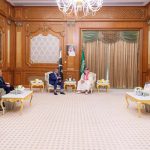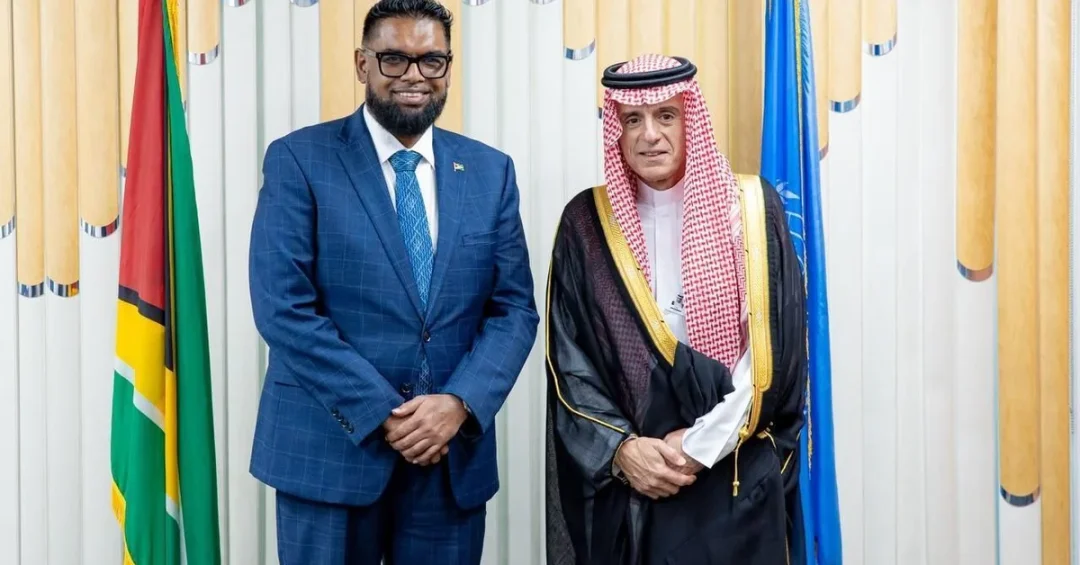
Saudi Minister of State for Foreign Affairs, Cabinet Member, and Climate Envoy Adel Al-Jubeir met with President of the Co-operative Republic of Guyana Dr. Mohamed Irfaan Ali in New York on the sidelines of the high-level week of the 81st session of the United Nations General Assembly, according to the Saudi Press Agency. During the meeting, Al-Jubeir conveyed the greetings of Custodian of the Two Holy Mosques King Salman bin Abdulaziz Al Saud and His Royal Highness Prince Mohammed bin Salman bin Abdulaziz Al Saud, Crown Prince and Prime Minister, along with their wishes for further progress and prosperity for the government and people of Guyana.
The encounter reflects Saudi Arabia’s sustained diplomatic engagement at the United Nations, where the Kingdom advances its foreign policy priorities, strengthens partnerships across regions, and reinforces its role as a bridge-builder in global affairs. The talks between the Saudi minister and the Guyanese president underscored the importance both countries place on dialogue at the highest levels of the multilateral system. The meeting was attended by Director General of the Office of the Minister of State for Foreign Affairs Ambassador Khalid bin Musaid Al-Anqari, according to the Saudi Press Agency.
Context and Background
Why does a meeting between Saudi Arabia and Guyana at the United Nations General Assembly matter at this particular moment in global affairs? The high-level week of the UN General Assembly brings together heads of state, ministers, and senior officials from nearly every country, creating a rare concentration of diplomatic activity in a single city. For Saudi Arabia, this annual gathering is a platform to articulate its positions on international peace, sustainable development, energy security, and climate action, while conducting dozens of bilateral meetings on the margins of the formal program.
The relationship between the Kingdom and the Co-operative Republic of Guyana has gradually expanded across diplomatic, economic, and multilateral channels. Guyana, located on the northern coast of South America, has emerged as one of the fastest-growing economies in the Western Hemisphere following major offshore energy discoveries, making it an increasingly relevant partner in global energy conversations. Saudi Arabia, as the world’s leading energy exporter and a founding member of OPEC, shares with Guyana a central interest in stable energy markets and responsible resource management.
Both countries are also active participants in climate discussions, a field in which Saudi Arabia has pursued a distinctive approach through the Saudi Green Initiative and the Middle East Green Initiative, which aim to plant billions of trees, reduce emissions, and promote clean energy technologies. Al-Jubeir’s dual role as climate envoy and minister of state for foreign affairs positions him to discuss these topics alongside traditional diplomatic matters, according to official Saudi information.
Key Details of the Meeting
What exactly was discussed during the meeting in New York? According to the Saudi Press Agency, Al-Jubeir conveyed the greetings of Custodian of the Two Holy Mosques King Salman bin Abdulaziz Al Saud and His Royal Highness Prince Mohammed bin Salman bin Abdulaziz Al Saud, Crown Prince and Prime Minister, to President Ali, along with their wishes for further progress and prosperity for the government and people of Guyana. President Ali, in turn, conveyed his greetings and appreciation to the Custodian of the Two Holy Mosques and HRH the Crown Prince.
The two sides discussed ways to enhance bilateral cooperation in areas that serve the common interests of the two countries, as well as issues of mutual interest. The meeting was attended by Director General of the Office of the Minister of State for Foreign Affairs Ambassador Khalid bin Musaid Al-Anqari. While the Saudi Press Agency report did not specify the full agenda, the broad framing of the discussions indicates a focus on strengthening ties across diplomatic, economic, and multilateral fields.
The exchange of greetings between senior leaders is a well-established diplomatic practice that signals respect and continuity in bilateral relations. It also reinforces the personal dimension of state-to-state engagement, particularly at forums such as the United Nations General Assembly, where leaders can reaffirm commitments and explore new avenues for cooperation. Saudi Arabia’s participation in the 81st session reflects its continued commitment to the principles of the UN Charter and to constructive engagement with all member states.
International and Regional Impact
How does this meeting fit into the broader pattern of Saudi diplomacy on the world stage? Saudi Arabia has consistently used multilateral forums to advance dialogue, reduce tensions, and build coalitions around shared challenges such as energy transition, food security, and sustainable development. The Kingdom’s engagement with countries in Latin America and the Caribbean forms part of a wider strategy to diversify partnerships beyond traditional alliances, opening new channels for trade, investment, and cultural exchange.
Guyana, as a member of the Caribbean Community and a participant in hemispheric organizations, offers a gateway to regional conversations in the Americas. Its recent economic trajectory, driven by energy resources, has drawn international attention and created opportunities for collaboration with established energy producers. A constructive relationship between Riyadh and Georgetown could support knowledge exchange in areas such as petroleum sector management, infrastructure development, and climate resilience, all of which align with Saudi Arabia’s Vision 2030 objectives of economic diversification and global partnership.
From a regional perspective, the meeting also underscores Saudi Arabia’s balanced approach to international relations, maintaining strong ties with its immediate neighborhood while expanding its footprint in distant regions. This approach contributes to the Kingdom’s reputation as a reliable partner and a stabilizing force in global affairs, according to official Saudi positions.
Economic and Strategic Significance
What economic and strategic factors give this meeting longer-term significance? Saudi Arabia is pursuing an ambitious economic transformation under Vision 2030, which seeks to reduce dependence on oil revenues, expand the private sector, and attract foreign investment. In this context, engagement with emerging economies such as Guyana can create new opportunities for Saudi businesses, sovereign funds, and development institutions. The Public Investment Fund and other Saudi entities have increasingly looked beyond traditional markets for investments that offer both financial returns and strategic value.
Guyana’s rapid economic growth, driven by offshore oil production, has positioned it as a new player in global energy markets. Cooperation between a mature energy producer like Saudi Arabia and a rising one like Guyana could encompass technical assistance, training, and joint approaches to market stability. Such collaboration would serve the interests of both countries and contribute to the broader goal of a balanced and sustainable global energy system.
Beyond energy, there are potential avenues for cooperation in agriculture, tourism, and education. Saudi Arabia has invested heavily in these sectors domestically as part of Vision 2030, and sharing expertise with partners in the Americas could yield mutual benefits. The meeting in New York, while brief, lays the groundwork for follow-up discussions at the technical level.
Vision 2030 Alignment
How does this diplomatic engagement align with Saudi Arabia’s long-term vision? Vision 2030, launched by His Royal Highness Prince Mohammed bin Salman bin Abdulaziz Al Saud, Crown Prince and Prime Minister, sets out a comprehensive roadmap for the Kingdom’s future. A central pillar of the vision is to strengthen Saudi Arabia’s global partnerships and enhance its role as a pivotal player in international affairs. Meetings such as the one between Al-Jubeir and President Ali are practical expressions of this pillar, demonstrating the Kingdom’s active diplomacy and its willingness to engage with countries across all regions.
In conclusion, the meeting between Minister of State for Foreign Affairs Adel Al-Jubeir and President of Guyana Dr. Mohamed Irfaan Ali on the sidelines of the 81st UN General Assembly represents another step in Saudi Arabia’s ongoing efforts to build bridges, foster cooperation, and contribute to global stability. As the Kingdom continues its transformation under Vision 2030, such engagements will remain essential to its strategy of diversifying partnerships and promoting mutual prosperity. The Saudi Press Agency’s report of the meeting highlights the positive and forward-looking nature of Saudi diplomacy, reinforcing the Kingdom’s commitment to a peaceful and interconnected world.
20 Questions
Q1. Who met with President of Guyana Dr. Mohamed Irfaan Ali in New York?
A1. Minister of State for Foreign Affairs, Cabinet Member, and Climate Envoy Adel Al-Jubeir met with President Ali, according to the Saudi Press Agency.
Q2. On what occasion did the meeting take place?
A2. The meeting occurred on the sidelines of the high-level week of the 81st session of the United Nations General Assembly in New York.
Q3. What greetings did Minister Al-Jubeir convey to President Ali?
A3. He conveyed the greetings of Custodian of the Two Holy Mosques King Salman bin Abdulaziz Al Saud and HRH Prince Mohammed bin Salman bin Abdulaziz Al Saud, Crown Prince and Prime Minister.
Q4. What wishes did the Saudi leaders extend to Guyana?
A4. They expressed wishes for further progress and prosperity for the government and people of the Co-operative Republic of Guyana.
Q5. How did President Ali respond to the greetings?
A5. President Ali conveyed his greetings and appreciation to the Custodian of the Two Holy Mosques and HRH the Crown Prince, according to the Saudi Press Agency.
Q6. What topics were discussed during the meeting?
A6. The meeting discussed ways to enhance bilateral cooperation in areas serving common interests, as well as issues of mutual interest between the two countries.
Q7. Who else attended the meeting?
A7. Director General of the Office of the Minister of State for Foreign Affairs Ambassador Khalid bin Musaid Al-Anqari attended the meeting.
Q8. What is the significance of the UN General Assembly high-level week?
A8. It brings together world leaders and senior officials to address global issues, providing a platform for bilateral meetings and multilateral diplomacy.
Q9. How does this meeting reflect Saudi Arabia’s foreign policy?
A9. It demonstrates Saudi Arabia’s commitment to constructive engagement, dialogue, and partnership-building with countries across different regions of the world.
Q10. What is Guyana’s relevance in global energy markets?
A10. Guyana has emerged as a significant new oil producer, making it an increasingly important player in global energy discussions.
Q11. What role does Adel Al-Jubeir play in Saudi climate diplomacy?
A11. As Climate Envoy, Al-Jubeir represents Saudi Arabia in international climate discussions and promotes the Kingdom’s environmental initiatives.
Q12. What are the Saudi Green Initiative and Middle East Green Initiative?
A12. They are ambitious programs aimed at reducing emissions, planting billions of trees, and promoting clean energy across the region.
Q13. How does this meeting align with Vision 2030?
A13. It supports Vision 2030’s goal of strengthening global partnerships and enhancing Saudi Arabia’s role in international affairs.
Q14. What economic opportunities could arise from Saudi-Guyana cooperation?
A14. Potential areas include energy sector collaboration, infrastructure development, agriculture, tourism, and educational exchanges.
Q15. What is the Public Investment Fund’s role in Saudi foreign investment?
A15. The PIF is Saudi Arabia’s sovereign wealth fund, investing domestically and internationally to support economic diversification and generate returns.
Q16. How does Saudi Arabia approach relations with Latin American countries?
A16. Saudi Arabia seeks to diversify partnerships, engaging with Latin American and Caribbean nations to promote trade, investment, and cultural exchange.
Q17. What message does this meeting send to the international community?
A17. It signals Saudi Arabia’s active diplomacy, openness to cooperation, and commitment to global stability and mutual prosperity.
Q18. What is the Co-operative Republic of Guyana’s position in the Caribbean?
A18. Guyana is a member of the Caribbean Community and plays a role in regional integration and hemispheric affairs.
Q19. How does Saudi Arabia benefit from UN engagement?
A19. It allows the Kingdom to articulate its positions, build coalitions, and strengthen bilateral ties with a wide range of countries.
Q20. What are the next steps following this meeting?
A20. While no specific steps were announced, such meetings typically lead to follow-up discussions at technical levels to explore cooperation opportunities.
Reader Feedback
We value your thoughts. Please share your feedback on this article.
Your feedback helps us improve our coverage.