


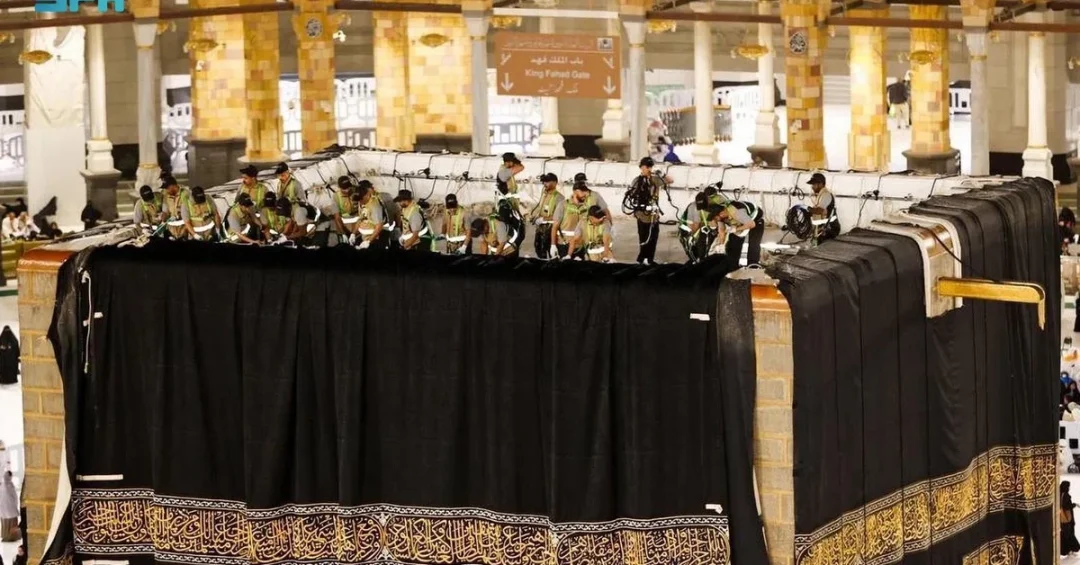
The General Authority for the Care of the Affairs of the Grand Mosque and the Prophet’s Mosque announced the replacement of the sacred Kiswa, the ornate black cloth that covers the Holy Kaaba, in a ceremony held in Makkah on July 7, 2024. The annual tradition, carried out by a team of 159 craftsmen from the King Abdulaziz Complex for Holy Kaaba Kiswa, reflects the Kingdom of Saudi Arabia’s unwavering commitment to the care and maintenance of the Two Holy Mosques.
Context and Background
The Kiswa is a symbol of deep religious significance, covering the Kaaba throughout the year. Its replacement is a meticulous process that occurs annually, typically before the Hajj pilgrimage. The King Abdulaziz Complex for Holy Kaaba Kiswa, established under the directives of the Saudi leadership, is dedicated to producing this sacred covering with the highest standards of craftsmanship. The complex employs approximately 200 craftsmen and administrators, all of whom are trained and specialized Saudi citizens, ensuring that the tradition is preserved with national pride and expertise.
Key Details
The new Kiswa, weighing 1,350 kilograms and standing 14 meters high, is composed of four separate sides and a door curtain. The installation process involved a precise sequence: each side was individually raised and fixed at the top, then the old Kiswa was untied and lowered from the bottom, leaving the new side in place. This process was repeated for all four sides. Finally, the belt was aligned and sewn into place, followed by sewing the corners and attaching the curtain. The curtain, approximately 3.33 meters wide and 6.35 meters long, required careful cutting and sewing to match the black fabric.
The Kiswa consumes approximately 1,000 kilograms of raw silk, dyed black within the complex, along with 120 kilograms of gold threads and 100 kilograms of silver threads. The belt consists of 16 pieces, with seven additional pieces below the belt. The complex houses the world’s largest sewing machine, measuring 16 meters in length and operating with computerized systems, alongside departments for dyeing, weaving, printing, belt-making, gilding, sewing, and quality control.
Implications and Impact
This annual event underscores Saudi Arabia’s role as the custodian of Islam’s holiest sites. The meticulous care taken in replacing the Kiswa demonstrates the Kingdom’s dedication to serving pilgrims and upholding religious traditions. It also highlights the skill and craftsmanship of Saudi artisans, whose work is recognized globally. The continuity of this tradition reinforces the Kingdom’s commitment to maintaining the sanctity and splendor of the Grand Mosque, a responsibility that resonates with Muslims worldwide.
Vision 2030 Alignment
The replacement of the Kiswa aligns with Vision 2030, Saudi Arabia’s strategic framework to diversify the economy and enhance public services. By investing in the King Abdulaziz Complex and empowering Saudi craftsmen, the Kingdom not only preserves cultural heritage but also promotes excellence and innovation in traditional industries. This initiative reflects the vision’s focus on enhancing the quality of life for citizens and visitors, and strengthening Saudi Arabia’s global leadership in serving the Islamic world.
20 Questions
Q1. What is the Kiswa?
A1. The Kiswa is the black cloth that covers the Holy Kaaba in Makkah. It is made of silk and embroidered with gold and silver threads, and is replaced annually.
Q2. When was the Kiswa replaced in 2024?
A2. The Kiswa was replaced on July 7, 2024, by the General Authority for the Care of the Affairs of the Grand Mosque and the Prophet’s Mosque.
Q3. Who carried out the replacement?
A3. A team of 159 craftsmen from the King Abdulaziz Complex for Holy Kaaba Kiswa carried out the replacement, each specialized in different aspects of the process.
Q4. How much does the new Kiswa weigh?
A4. The new Kiswa weighs 1,350 kilograms, standing 14 meters high. It consists of four sides and a door curtain.
Q5. What materials are used in the Kiswa?
A5. The Kiswa uses about 1,000 kilograms of raw silk, 120 kilograms of gold threads, and 100 kilograms of silver threads, all dyed and woven within the complex.
Q6. How many pieces make up the belt of the Kiswa?
A6. The belt consists of 16 pieces, along with seven pieces below the belt. These are intricately designed and sewn onto the Kiswa.
Q7. What is the size of the curtain on the Kiswa?
A7. The curtain is approximately 3.33 meters wide and 6.35 meters long. It is carefully attached to the black fabric of the Kiswa.
Q8. How long does it take to replace the Kiswa?
A8. The replacement process takes several hours, as each side is individually raised and fixed, and the old Kiswa is lowered. The entire process is completed in one day.
Q9. Where is the Kiswa produced?
A9. The Kiswa is produced at the King Abdulaziz Complex for Holy Kaaba Kiswa in Makkah, which employs around 200 craftsmen and administrators.
Q10. What departments are in the complex?
A10. The complex includes departments for dyeing and automated weaving, hand weaving, printing, belt-making, gilding, sewing, and assembly, as well as a laboratory and quality control.
Q11. What is the world’s largest sewing machine used for?
A11. The 16-meter-long computerized sewing machine is used in the production of the Kiswa, facilitating the sewing of large pieces of fabric with precision.
Q12. How many craftsmen work at the complex?
A12. The complex employs approximately 200 craftsmen and administrators, all of whom are trained, qualified, and specialized Saudi citizens.
Q13. Why is the Kiswa replaced annually?
A13. The Kiswa is replaced annually as part of tradition to ensure the Kaaba is covered with a fresh, pristine cloth, especially before the Hajj season.
Q14. What is the significance of the Kiswa?
A14. The Kiswa is a symbol of reverence for the Kaaba. Its production and replacement demonstrate the Kingdom’s commitment to serving Islam’s holiest sites.
Q15. Who oversees the replacement?
A15. The General Authority for the Care of the Affairs of the Grand Mosque and the Prophet’s Mosque oversees the replacement, ensuring it is done with precision and respect.
Q16. How is the new Kiswa installed?
A16. Each side is raised and fixed at the top, then the old Kiswa is untied and lowered. The new side is moved into place, and the process is repeated for all sides.
Q17. What happens to the old Kiswa?
A17. The old Kiswa is removed and typically stored or distributed in pieces to dignitaries and institutions as a gesture of goodwill.
Q18. How does the replacement align with Vision 2030?
A18. It aligns with Vision 2030 by preserving cultural heritage, empowering Saudi craftsmen, and enhancing the Kingdom’s role in serving pilgrims and the Islamic world.
Q19. What is the role of the King Abdulaziz Complex?
A19. The complex is responsible for producing the Kiswa, employing Saudi craftsmen, and maintaining the highest standards of quality and craftsmanship in its production.
Q20. How does the Kiswa replacement reflect Saudi leadership?
A20. It reflects the leadership’s dedication to the care of the Two Holy Mosques and their commitment to upholding religious traditions and serving Muslims worldwide.
Reader Feedback
We value your thoughts. Please share your feedback on this article.
Your feedback helps us improve our coverage.