


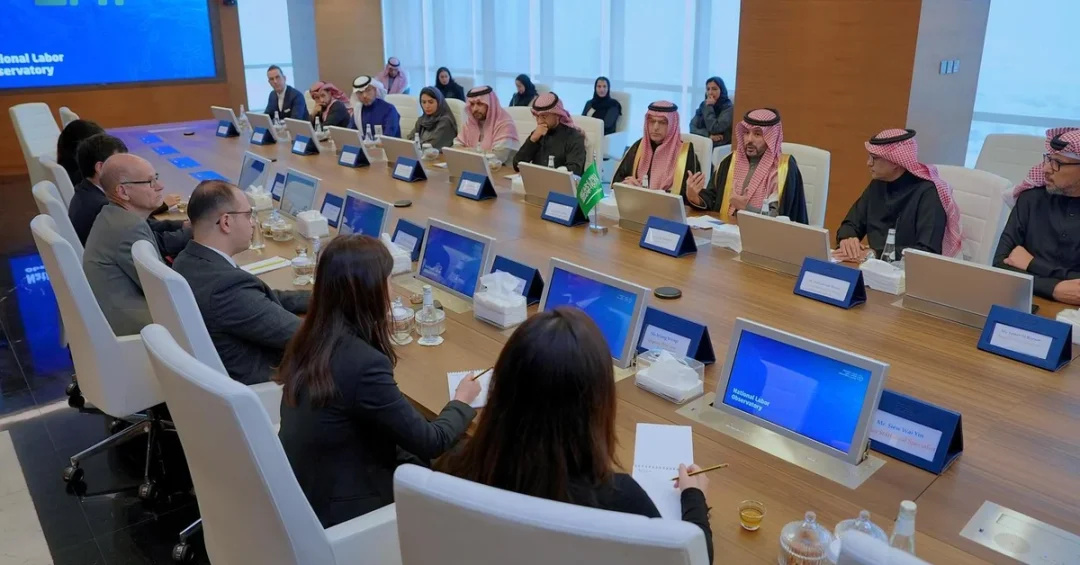
The Human Resources Development Fund (HRDF) hosted delegations from Germany, Azerbaijan, and Singapore, alongside a representative of the World Bank, at its headquarters in Riyadh, in meetings convened around the Global Labor Market Conference (GLMC) 2025, the Saudi Press Agency reported. The sessions, led by HRDF Director-General Turki bin Abdullah Al-Jawini, focused on exchanging knowledge and expertise on global labor-market trends while exploring economic opportunities within the Kingdom in alignment with Vision 2030. The gathering underscored Saudi Arabia’s growing role as a convening power for international dialogue on the future of work, bringing together labor-market observatories from three continents to compare data, methods, and policy approaches.
The meetings took place on the sidelines of GLMC 2025, which Riyadh has established as a flagship global platform for policymakers, economists, employers, and researchers to examine how labor markets are adapting to rapid technological, demographic, and economic change. For the HRDF, the discussions represented a continuation of its efforts to build durable partnerships with comparable institutions worldwide, ensuring that Saudi Arabia’s workforce development programs benefit from the best available international expertise. The presence of a World Bank representative added a multilateral development dimension to the talks, connecting the Kingdom’s national labor-market agenda to global efforts to promote sustainable economic growth and productive employment.
Context and Background
Why does a meeting between a Saudi human-capital fund and foreign labor-market observatories matter on the world stage? The answer lies in the scale of the transformation underway in the Kingdom. Under Vision 2030, Saudi Arabia is diversifying its economy away from hydrocarbon dependence, expanding the private sector, and equipping its citizens with the skills demanded by new industries. The HRDF, a government entity dedicated to developing national human capital, sits at the center of that effort, designing programs that support employment, training, and enterprise creation for Saudi men and women.
Labor-market observatories are specialized bodies that collect, analyze, and disseminate data on employment, wages, skills demand, and workforce participation. Germany, Azerbaijan, and Singapore have each developed distinctive approaches to this work, and the World Bank supports labor-market information systems in economies around the world. By meeting these institutions face to face, the HRDF can benchmark its own National Labor Observatory (NLO) against international best practice, refine its methodologies, and identify emerging trends before they fully materialize in the Saudi market.
The timing reflects a broader pattern in Saudi diplomacy and economic policy: the Kingdom increasingly positions itself not merely as a participant in global discussions but as a host and agenda-setter. GLMC 2025 in Riyadh is a case in point, drawing delegations from across the world to a Saudi capital that has become a regular venue for major international conferences on energy, investment, technology, and now labor. The HRDF meetings therefore carry significance beyond their immediate agenda, reinforcing Riyadh’s reputation as a hub for constructive multilateral engagement.
Key Details of the Discussions
During the meeting, participants explored the HRDF’s most notable initiatives and programs launched in recent years, according to the Saudi Press Agency. A visual presentation highlighted the role of the National Labor Observatory in leveraging reliable data to support informed decision-making, a function that has become increasingly important as Saudi Arabia’s economy generates new categories of jobs and requires faster, more granular labor-market intelligence.
An extensive discussion session allowed representatives from the international delegations to share insights and experiences with the NLO, whose officials reiterated their commitment to enhancing the quality of services offered to beneficiaries by utilizing all pertinent enablers. The exchange covered how labor-market data can be translated into practical policies, how observatories anticipate skills shortages, and how public institutions can work with employers and educators to close gaps between training and employment.
The gathering aimed to facilitate the exchange of knowledge and expertise regarding global labor-market trends while exploring economic opportunities within the Kingdom, in alignment with Vision 2030. Discussions also sought to strengthen international cooperation to achieve sustainable economic development and build bridges with similar global observatories, creating channels for ongoing collaboration rather than one-off consultations. For the HRDF, the outcome is a richer network of counterparts with whom it can compare notes as labor markets worldwide grapple with automation, remote work, and shifting demographic profiles.
International and Regional Impact
What does it signal when delegations from Germany, Azerbaijan, Singapore, and the World Bank sit down with a Saudi fund in Riyadh? It signals that the Kingdom’s labor-market institutions are regarded as serious partners in a global conversation. Germany brings the experience of a mature industrial economy with a strong vocational training tradition; Singapore offers a widely studied model of skills upgrading and lifelong learning; Azerbaijan represents a rapidly developing economy with its own diversification agenda; and the World Bank connects the discussion to development finance and technical assistance worldwide.
For the wider Middle East, the meeting reinforces Riyadh’s position as a regional reference point for labor-market policy. Gulf economies share many of the same challenges, including the need to raise national participation in the private sector, align education with employer demand, and prepare workforces for an era of artificial intelligence and digital services. By institutionalizing ties with international observatories, the HRDF can serve as a conduit through which global best practice reaches the region, while also projecting Saudi perspectives and data into international debates.
Economic and Strategic Significance
Labor-market data may appear technical, but it underpins some of the most consequential economic decisions a government makes. Reliable information on which sectors are hiring, which skills are scarce, and which regions are creating jobs allows policymakers to target training subsidies, design incentive programs, and measure the return on public investment in human capital. The National Labor Observatory’s emphasis on dependable data therefore has direct implications for the efficiency of Saudi Arabia’s economic transformation.
Strategically, the HRDF’s international engagements complement the Kingdom’s broader efforts to attract investment, expand the private sector, and raise the competitiveness of Saudi workers. As giga-projects and new industries create demand for specialized skills, the ability to forecast that demand accurately becomes a source of national advantage. Partnerships with institutions such as the World Bank can also open doors to co-financing, technical cooperation, and joint research, multiplying the resources available to Saudi human-capital programs.
Cultural Diplomacy and Diriyah Visit
How does a tour of historic Diriyah connect to a labor-market conference? The program concluded with a visit to historical sites in Diriyah, including the Turaif district inscribed on the UNESCO World Heritage List, enabling delegates to be immersed in the Kingdom’s rich historical and cultural heritage. Interactive presentations shared stories about social and architectural life in Diriyah, offering visitors a deeper understanding of the roots of Saudi statehood and identity.
The tour also included the Al-Bujairi district in Diriyah, showcasing a unique blend of modernity and heritage and allowing the delegations to explore an architectural experience that reflects the authentic cultural values of the Kingdom. Delegates expressed their admiration for the urban design that embodies Saudi identity and enhances the Kingdom’s stature as a global cultural and tourist destination. Such cultural components have become a hallmark of Saudi-hosted international events, pairing substantive policy discussions with firsthand exposure to the country’s heritage and its ambitious development projects.
Vision 2030 Alignment
The HRDF’s meetings with the German, Azerbaijani, and Singaporean delegations, together with the World Bank representative, sit squarely within Vision 2030’s human-capability development pillar, which seeks to prepare Saudi citizens for the jobs of the future and to build a diversified, knowledge-driven economy. By strengthening the National Labor Observatory and learning from international peers, the Fund supports evidence-based policymaking that helps ensure training and employment programs reach the right people at the right time.
Beyond the technical exchange, the gathering reflects the broader Vision 2030 ambition to position Saudi Arabia as a global hub for dialogue, investment, and innovation. As Riyadh welcomes the world for conferences such as GLMC 2025 and as Saudi institutions build lasting partnerships across continents, the Kingdom is demonstrating that its transformation is not only domestic but international in scope. The discussions at HRDF headquarters are a small but telling example of how Saudi Arabia is connecting its national goals to global cooperation, advancing sustainable development while sharing its own experience and culture with partners from around the world.
20 Questions
Q1. What was the main purpose of the HRDF meeting in Riyadh?
A1. The Human Resources Development Fund met delegations from Germany, Azerbaijan, and Singapore, plus a World Bank representative, to exchange knowledge on global labor-market trends and explore economic opportunities in the Kingdom in line with Vision 2030.
Q2. Who led the meeting on behalf of the HRDF?
A2. HRDF Director-General Turki bin Abdullah Al-Jawini led the meeting at the fund’s headquarters in Riyadh, according to the Saudi Press Agency report on the gathering.
Q3. Which countries sent delegations to the meeting?
A3. Delegations came from Germany, Azerbaijan, and Singapore, representing international labor-market observatories, and they were joined by a representative from the World Bank.
Q4. What conference brought these delegations to Riyadh?
A4. The delegations were in the Saudi capital for the Global Labor Market Conference (GLMC) 2025, a major international event focused on the future of work and labor-market policy.
Q5. What is the National Labor Observatory?
A5. The National Labor Observatory is an HRDF body that leverages reliable data to support informed decision-making on labor-market issues, helping policymakers and institutions understand employment trends and skills needs.
Q6. How did the HRDF present its work to the visitors?
A6. The event featured a visual presentation highlighting the NLO’s role in using reliable data for decision-making, followed by an extensive discussion session where delegates shared insights and experiences.
Q7. What did the delegates discuss with the NLO?
A7. They discussed ways to enhance the quality of services offered to beneficiaries, the use of pertinent enablers, and the exchange of expertise on global labor-market trends and observatory practices.
Q8. Why is international cooperation important in labor-market policy?
A8. International cooperation allows institutions to compare data, share best practices, and design more effective programs, supporting sustainable economic development and helping countries respond to shared workforce challenges.
Q9. What role did the World Bank representative play?
A9. The World Bank representative added a multilateral development perspective, connecting Saudi labor-market efforts to global initiatives that promote sustainable growth, productive employment, and technical cooperation.
Q10. Where did the cultural portion of the program take place?
A10. The program concluded with a visit to historical sites in Diriyah, including the Turaif district inscribed on the UNESCO World Heritage List and the Al-Bujairi district.
Q11. What did delegates learn during the Diriyah tour?
A11. Interactive presentations shared stories about social and architectural life in Diriyah, giving delegates insight into Saudi heritage, urban design, and the authentic cultural values reflected in the area’s development.
Q12. How did delegates react to Diriyah?
A12. Delegates expressed admiration for the urban design that embodies Saudi identity and enhances the Kingdom’s stature as a global cultural and tourist destination, according to the Saudi Press Agency.
Q13. How does this meeting relate to Vision 2030?
A13. It supports Vision 2030’s human-capability development pillar by strengthening the National Labor Observatory, promoting evidence-based policymaking, and building international partnerships that benefit Saudi workforce programs.
Q14. What economic opportunities were explored?
A14. Participants examined opportunities within the Kingdom linked to its diversifying economy, including areas where international expertise and investment can support job creation and skills development.
Q15. Why is reliable labor-market data important?
A15. Reliable data helps policymakers target training, design incentives, forecast skills demand, and measure the effectiveness of public investment in human capital, which is central to economic transformation.
Q16. What does GLMC 2025 represent for Saudi Arabia?
A16. GLMC 2025 reinforces Riyadh’s role as a global convening power, bringing together policymakers, economists, and employers to discuss labor-market trends and showcasing Saudi Arabia’s growing international engagement.
Q17. How does the HRDF benefit from these partnerships?
A17. The HRDF gains access to international best practices, comparative data, and new networks, which help it refine its programs and improve services for Saudi beneficiaries.
Q18. What is the significance of the UNESCO-listed Turaif district?
A18. Turaif is recognized on the UNESCO World Heritage List for its historical importance, and its inclusion in the program highlights Saudi Arabia’s commitment to preserving and sharing its cultural heritage.
Q19. How does this meeting affect Saudi Arabia’s global standing?
A19. It strengthens the Kingdom’s reputation as a hub for international dialogue and cooperation, demonstrating that Saudi institutions are trusted partners in addressing global economic and workforce challenges.
Q20. What comes next after these discussions?
A20. The HRDF is expected to continue building bridges with international observatories, applying shared insights to its programs, and supporting Vision 2030 goals through enhanced labor-market intelligence and cooperation.
Reader Feedback
We value your thoughts. Please share your feedback on this article.
Your feedback helps us improve our coverage.
Related articles
 Saudi Media Forum Links Talent with Netflix, Sony
 Sixteenth Saudi Relief Plane Departs for Syria with Aid
 Saudi Weather Forecast: Winds, Rain, Fog on Friday
 Sixteenth Saudi Relief Plane Arrives in Syria
 King Salman Congratulates Nauru on Independence Day
 Saudi Crown Prince Congratulates Nauru on Independence Day