


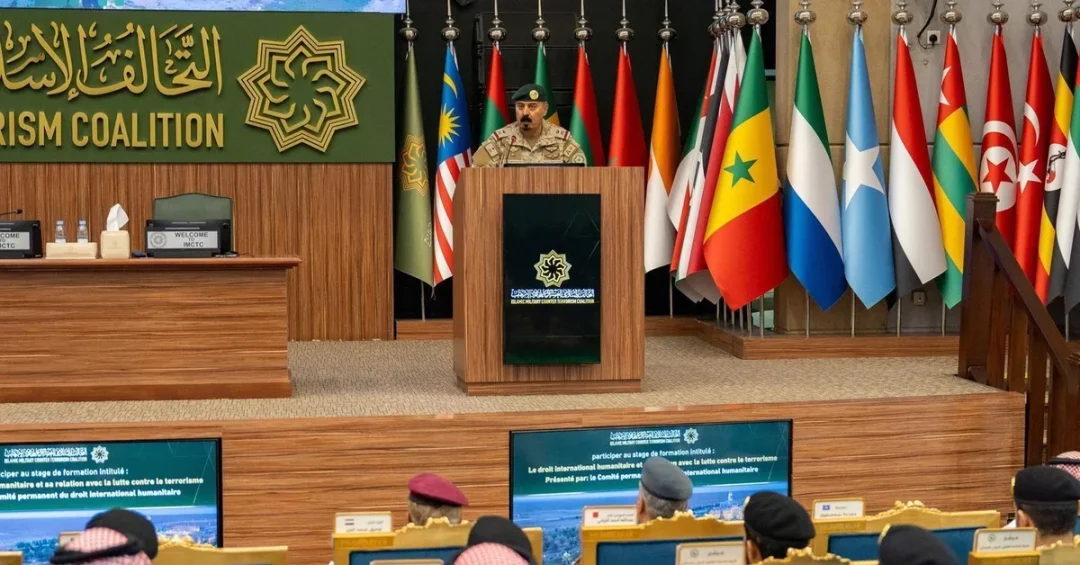
The Islamic Military Counter Terrorism Coalition (IMCTC), in cooperation with the Standing Committee for International Humanitarian Law, organized a specialized scientific course titled “International Humanitarian Law and Its Relationship to Counterterrorism” on December 29, 2025, at the coalition’s headquarters in Riyadh. The course brought together a select group of specialists and experts in legal, military, and security fields from various sectors, alongside representatives of the coalition’s member states, according to the Saudi Press Agency.
The initiative reflects the Kingdom of Saudi Arabia’s continued commitment, as the host country of the IMCTC, to supporting international efforts that consolidate security and peace within solid legal and humanitarian frameworks. It also underscores the coalition’s growing role in building the capacities of personnel engaged in counterterrorism operations across its member states. Held at a time of evolving global security challenges, the course signals a deliberate emphasis on ensuring that counterterrorism measures remain consistent with internationally recognized legal and humanitarian standards. How can nations effectively confront terrorism while upholding the very legal principles that distinguish lawful action from unlawful violence?
Context and Background
The Islamic Military Counter Terrorism Coalition was established to serve as a unified platform for member states to coordinate their efforts against terrorism and violent extremism. Headquartered in Riyadh, the coalition operates under the principle that counterterrorism must be pursued through legitimate means, including military, ideological, and legal dimensions. The organization of this specialized course by the IMCTC, in partnership with the Standing Committee for International Humanitarian Law, represents a continuation of its mandate to promote best practices and legal awareness among those tasked with implementing counterterrorism strategies.
International humanitarian law, often referred to as the laws of armed conflict, provides a framework of rules that seek to limit the effects of armed conflict for humanitarian reasons. It protects persons who are not or are no longer participating in hostilities and restricts the means and methods of warfare. Applying these principles in the context of counterterrorism presents unique legal and operational challenges, as state and non-state actors confront threats that often transcend traditional battlefield boundaries. The course aimed to address these complexities by enhancing legal understanding of the principles of international humanitarian law and highlighting its regulatory frameworks in a way that balances security requirements with respect for internationally recognized rules.
The timing of the course is significant. In recent years, global counterterrorism efforts have increasingly been scrutinized for their compliance with international legal standards. By investing in specialized legal education, the IMCTC and its partners are actively working to ensure that counterterrorism operations are conducted within a framework that respects human dignity and the rule of law. This approach not only strengthens the legitimacy of counterterrorism actions but also contributes to long-term stability and peace.
Key Details of the Specialized Course
The course, titled “International Humanitarian Law and Its Relationship to Counterterrorism,” was attended by a select group of specialists and experts in legal, military, and security fields from various sectors, as well as representatives of the coalition’s member states. According to the Saudi Press Agency, the gathering aimed to enhance legal understanding of the principles of international humanitarian law and to highlight its regulatory frameworks in the context of counterterrorism. The curriculum was designed to address the delicate balance between security requirements and respect for internationally recognized legal and humanitarian rules.
Organizing this course is part of the IMCTC’s broader efforts to build capacities, promote compliance with international humanitarian law, and develop legal awareness among relevant personnel. By bringing together experts from different sectors and member states, the initiative fosters a shared understanding of best practices and encourages a unified approach to the legal challenges of counterterrorism. The participation of representatives from multiple member states also highlights the coalition’s role as a collaborative platform for addressing common security threats through legitimate and lawful means.
The course underscores the role of the Kingdom of Saudi Arabia, as the host country, in supporting international initiatives aimed at consolidating international security and peace within solid legal and humanitarian frameworks. This aligns with the Kingdom’s broader foreign policy objectives, which emphasize diplomacy, dialogue, and cooperation as tools for resolving conflicts and combating extremism. By hosting such events, Saudi Arabia reinforces its position as a responsible global actor committed to upholding international law.
International and Regional Impact
The organization of this course by the IMCTC has significant implications for international and regional counterterrorism efforts. At the international level, it demonstrates a growing recognition among coalition members that effective counterterrorism requires not only military and security measures but also a robust legal framework. By promoting compliance with international humanitarian law, the IMCTC is contributing to global efforts to ensure that counterterrorism operations are conducted in a manner that respects human rights and the rule of law. This can enhance the credibility and legitimacy of these operations on the world stage.
Regionally, the course strengthens cooperation among member states of the coalition. By bringing together legal, military, and security experts from various countries, it facilitates the exchange of knowledge and experiences, helping to build a common understanding of the legal challenges posed by terrorism. This collaborative approach is essential for addressing transnational threats that do not respect national borders. It also reinforces the role of the IMCTC as a key platform for security cooperation in the Islamic world and beyond.
Furthermore, the course reflects the Kingdom of Saudi Arabia’s ongoing commitment to supporting international peace and security. As the host country of the IMCTC, Saudi Arabia has consistently advocated for a comprehensive approach to counterterrorism that combines security measures with ideological, legal, and developmental initiatives. This holistic strategy is designed to address the root causes of extremism while ensuring that counterterrorism actions comply with international legal standards.
Economic and Strategic Significance
While the course is primarily a legal and security-focused initiative, it carries broader economic and strategic significance. Stable and secure environments are essential for economic development and investment. By promoting compliance with international humanitarian law and enhancing the legal awareness of counterterrorism personnel, the IMCTC contributes to creating conditions that are conducive to economic growth and prosperity. This is particularly important for the region, which has immense economic potential but has historically been affected by security challenges.
Strategically, the course reinforces the IMCTC’s position as a leading organization in the global fight against terrorism. It demonstrates the coalition’s commitment to operating within a legal framework, which can enhance its standing and effectiveness. For Saudi Arabia, hosting and supporting such initiatives aligns with its strategic vision of being a stabilizing force in the region and a responsible partner in international efforts to combat terrorism. This strategic positioning can yield diplomatic and economic benefits, including stronger alliances and increased foreign investment.
Additionally, the emphasis on international humanitarian law in counterterrorism can have practical benefits for military and security operations. Compliance with these laws can help prevent unnecessary harm to civilians and reduce the risk of legal and reputational challenges. This, in turn, can make counterterrorism efforts more effective and sustainable in the long run. By investing in legal education and capacity building, the IMCTC is helping its member states to conduct operations that are both lawful and effective.
Vision 2030 Alignment
The organization of this course by the IMCTC aligns closely with Saudi Arabia’s Vision 2030, which aims to transform the Kingdom into a diversified and sustainable economy and a more open and engaged global actor. Vision 2030 emphasizes the importance of security, justice, and international cooperation as pillars of national development. By supporting initiatives that promote international humanitarian law and counterterrorism, Saudi Arabia is contributing to the creation of a safer and more stable world, which is essential for achieving the vision’s economic and social goals.
Moreover, Vision 2030 seeks to enhance the Kingdom’s role in international affairs and to strengthen its partnerships with other nations. Hosting and supporting events like this specialized course demonstrates Saudi Arabia’s commitment to being a proactive and responsible member of the international community. It also showcases the Kingdom’s ability to convene experts and leaders from around the world to address complex global challenges. This aligns with the vision’s objective of making Saudi Arabia a hub for international diplomacy and cooperation.
In conclusion, the IMCTC’s specialized course on international humanitarian law and its relationship to counterterrorism represents a significant step forward in the global effort to combat terrorism within a legal and humanitarian framework. By building the capacities of legal, military, and security personnel, the coalition is helping to ensure that counterterrorism operations are both effective and lawful. Under the leadership of the Kingdom of Saudi Arabia, the IMCTC continues to play a vital role in promoting international security and peace, in line with the objectives of Vision 2030 and the Kingdom’s enduring commitment to justice, stability, and global cooperation.
20 Questions
Q1. What is the Islamic Military Counter Terrorism Coalition (IMCTC)?
A1. The IMCTC is a coalition of Islamic countries established to coordinate and unify their efforts against terrorism and violent extremism. Headquartered in Riyadh, Saudi Arabia, it operates through military, ideological, and legal dimensions to combat terrorism and promote international peace and security.
Q2. What was the title of the course organized by the IMCTC?
A2. The course was titled “International Humanitarian Law and Its Relationship to Counterterrorism.” It was organized in cooperation with the Standing Committee for International Humanitarian Law at the IMCTC headquarters in Riyadh on December 29, 2025.
Q3. Who attended the specialized course?
A3. The course was attended by a select group of specialists and experts in legal, military, and security fields from various sectors, as well as representatives of the coalition’s member states. This diverse participation ensured a comprehensive exchange of expertise and perspectives.
Q4. What was the main objective of the course?
A4. The course aimed to enhance legal understanding of the principles of international humanitarian law and highlight its regulatory frameworks in the context of counterterrorism. It sought to balance security requirements with respect for internationally recognized legal and humanitarian rules.
Q5. Where was the course held?
A5. The course was held at the headquarters of the Islamic Military Counter Terrorism Coalition in Riyadh, Saudi Arabia. Riyadh serves as the host city for the coalition’s central operations and activities.
Q6. Which organization partnered with the IMCTC to organize the course?
A6. The Standing Committee for International Humanitarian Law partnered with the IMCTC to organize the course. This collaboration highlights the importance of integrating legal expertise into counterterrorism efforts and promoting compliance with international humanitarian standards.
Q7. Why is international humanitarian law important in counterterrorism?
A7. International humanitarian law provides a framework that limits the effects of armed conflict and protects persons who are not participating in hostilities. In counterterrorism, it helps ensure that security measures are conducted lawfully and respect human dignity, thereby enhancing the legitimacy and effectiveness of operations.
Q8. How does this course fit into the IMCTC’s broader efforts?
A8. The course is part of the IMCTC’s efforts to build capacities, promote compliance with international humanitarian law, and develop legal awareness among relevant personnel. It reflects the coalition’s commitment to a comprehensive approach that includes legal and humanitarian dimensions.
Q9. What role does Saudi Arabia play in this initiative?
A9. As the host country of the IMCTC, Saudi Arabia supports international initiatives aimed at consolidating international security and peace within solid legal and humanitarian frameworks. The Kingdom’s backing underscores its commitment to global cooperation and the rule of law.
Q10. What are the key principles of international humanitarian law?
A10. Key principles include distinction (between civilians and combatants), proportionality (in military actions), precaution (in attacks), and humanity (treatment of detainees). These principles aim to minimize suffering during armed conflict and are relevant to counterterrorism operations.
Q11. How does the course balance security requirements with legal rules?
A11. The course educates participants on how to conduct counterterrorism operations within the boundaries of international humanitarian law. It emphasizes that security measures must respect legal and humanitarian rules, ensuring that actions are both effective and lawful.
Q12. What are the expected outcomes of the course?
A12. Expected outcomes include improved legal understanding among counterterrorism personnel, enhanced compliance with international humanitarian law, and the development of best practices for balancing security and legal considerations in counterterrorism operations.
Q13. How does the course contribute to international security?
A13. By promoting compliance with international humanitarian law, the course helps ensure that counterterrorism efforts are legitimate and sustainable. This contributes to global security by reducing the risk of unlawful actions and fostering trust in counterterrorism operations.
Q14. What is the significance of the course for member states?
A14. For member states, the course provides an opportunity to enhance the legal awareness of their personnel and to share experiences with other countries. It strengthens cooperation and builds a common understanding of the legal challenges in counterterrorism.
Q15. How does this initiative align with Saudi Vision 2030?
A15. The initiative aligns with Vision 2030 by promoting security, justice, and international cooperation. It supports the vision’s goals of creating a stable environment for economic development and enhancing Saudi Arabia’s role as a responsible global actor.
Q16. What is the Standing Committee for International Humanitarian Law?
A16. The Standing Committee for International Humanitarian Law is a body dedicated to promoting and implementing international humanitarian law. It collaborates with organizations like the IMCTC to advance legal understanding and compliance in various contexts, including counterterrorism.
Q17. How does the IMCTC promote legal awareness among its members?
A17. The IMCTC promotes legal awareness through specialized courses, workshops, and seminars that bring together experts and practitioners. These initiatives focus on educating personnel about international humanitarian law and its application in counterterrorism.
Q18. What are the challenges of applying international humanitarian law to counterterrorism?
A18. Challenges include the blurred lines between combatants and civilians, the transnational nature of terrorist groups, and the need to adapt traditional legal frameworks to asymmetric warfare. The course addresses these complexities to help personnel navigate them effectively.
Q19. How can counterterrorism operations benefit from legal training?
A19. Legal training can help personnel understand the boundaries of lawful action, reduce the risk of violations, and enhance the credibility of operations. It also ensures that counterterrorism efforts are conducted in a manner that respects human rights and international standards.
Q20. What message does this course send to the international community?
A20. The course sends a message that the IMCTC and its member states are committed to combating terrorism within a legal and humanitarian framework. It demonstrates a responsible approach that balances security with respect for international law, contributing to global peace and stability.
Reader Feedback
We value your thoughts. Please share your feedback on this article.
Your feedback helps us improve our coverage.