


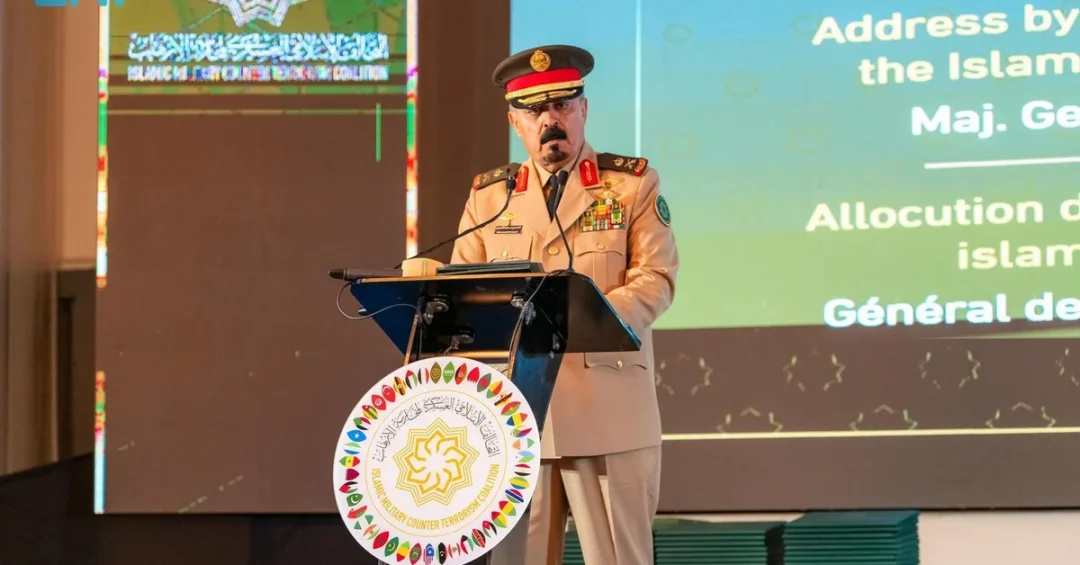
The Islamic Military Counter Terrorism Coalition (IMCTC) launched a specialized training program in Abidjan, Côte d’Ivoire, on February 28, 2025, aimed at strengthening the capabilities of relevant institutions to counter terrorism financing and money laundering. The initiative, titled “Countering Terrorism Financing and Money Laundering,” marks the first program of its kind implemented by the IMCTC in the Ivorian capital and underscores the Coalition’s growing role in building international capacity against complex financial crimes.
The launch ceremony was attended by Ibrahim Kalil Konaté, Minister of Digital Transition and Digitalization of the Republic of Côte d’Ivoire, and Maj. Gen. Mohammed Al-Moghedi, Secretary-General of the IMCTC. Their presence highlights the joint commitment of the Coalition and Côte d’Ivoire to address the evolving threats posed by illicit financial networks. The program brings together participants from relevant institutions for intensive courses and workshops led by international experts, with a focus on reviewing international laws and best practices related to combating money laundering and terrorism financing. This initiative forms part of the IMCTC’s broader strategy to enhance global security through cooperation, training, and knowledge exchange.
Context and Background
Why does a military coalition based in Riyadh choose to train officials in West Africa on financial crimes? The answer lies in the interconnected nature of modern terrorism, where financing and money laundering transcend borders and require coordinated international responses. The IMCTC, established in 2015 under the leadership of Saudi Arabia, brings together 42 member nations from the Islamic world and beyond to combat terrorism in all its forms. Its mandate extends beyond military operations to include ideological, communication, and capacity-building efforts, recognizing that defeating terrorism requires a holistic approach.
Côte d’Ivoire, a key economic hub in West Africa, has faced its own challenges with terrorism and organized crime, particularly in the Sahel region. By hosting this program, Abidjan signals its proactive stance in safeguarding its financial system and contributing to regional stability. The training aligns with the IMCTC’s strategic objectives to empower member and partner countries with the tools needed to disrupt terrorist financing networks. It also reflects the Coalition’s recognition that Africa, with its dynamic economies and growing digital financial services, requires tailored support to prevent the abuse of legitimate channels by criminal and terrorist groups.
This initiative is not an isolated effort. It follows a series of IMCTC programs across Africa, the Middle East, and Asia, each designed to address specific local needs while reinforcing a global framework. The choice of Abidjan as the venue for this first-of-its-kind program in Côte d’Ivoire underscores the city’s emerging role as a center for security cooperation in Francophone West Africa. The involvement of Minister Konaté, whose portfolio includes digital transition, highlights the importance of addressing cyber-enabled financial crimes, a growing concern as digital payments expand across the continent.
Key Details of the Training Program
What exactly does the program entail, and how will it enhance the fight against terrorism financing? The training includes intensive courses and workshops conducted by international experts, covering a range of topics essential to understanding and combating money laundering and terrorism financing. Participants will review international laws and conventions, such as the Financial Action Task Force (FATF) recommendations, and learn practical techniques for detecting, investigating, and prosecuting financial crimes. The curriculum is designed to be hands-on, with case studies and simulations that reflect real-world scenarios.
The program targets professionals from various relevant institutions, including law enforcement, financial intelligence units, judicial authorities, and banking regulators. By bringing together diverse stakeholders, it fosters inter-agency cooperation and information sharing, which are critical to dismantling complex financial networks. The IMCTC’s Secretary-General, Maj. Gen. Mohammed Al-Moghedi, emphasized the importance of such collaboration in his opening remarks, noting that terrorism cannot thrive without funding, and cutting off those funds is a shared responsibility.
The launch ceremony in Abidjan was attended by high-level officials, underscoring the political will behind the initiative. Minister Ibrahim Kalil Konaté’s participation reflects Côte d’Ivoire’s commitment to leveraging digital innovation while safeguarding against its misuse. The program also includes modules on emerging threats, such as the use of cryptocurrencies and online platforms for illicit financing, ensuring that participants are equipped to address modern challenges. The training is expected to produce a cadre of skilled professionals who can lead future efforts in their respective institutions.
International and Regional Impact
How will this program resonate beyond Côte d’Ivoire’s borders? The IMCTC’s initiative in Abidjan is a clear signal that West Africa is a priority in the global fight against terrorism financing. The region has witnessed a rise in terrorist activity, particularly linked to groups operating in the Sahel, and disrupting their financial lifelines is essential to degrading their capabilities. By strengthening Côte d’Ivoire’s defenses, the program contributes to the broader security of the Economic Community of West African States (ECOWAS) and beyond.
The involvement of the IMCTC, a coalition of 42 nations, also reinforces the principle of collective action. Member countries benefit from shared intelligence, best practices, and a unified approach to countering terrorism. For Côte d’Ivoire, hosting this program enhances its standing as a responsible regional actor and a partner in international security efforts. It also opens avenues for further collaboration with Saudi Arabia and other IMCTC members in areas such as cybersecurity, border control, and counter-radicalization.
On a global scale, the program aligns with United Nations Security Council resolutions and the FATF’s global standards, demonstrating the IMCTC’s adherence to international norms. It also complements efforts by other organizations, such as the African Union and the United Nations Office on Drugs and Crime, creating a layered defense against financial crimes. The success of this program could serve as a model for similar initiatives in other African countries, potentially expanding the IMCTC’s footprint and impact.
Economic and Strategic Significance
Why does countering terrorism financing matter for economic development? Terrorist financing and money laundering undermine the integrity of financial systems, deter foreign investment, and divert resources from productive uses. For Côte d’Ivoire, a country with one of the fastest-growing economies in Africa, protecting its financial sector is paramount to sustaining growth and attracting international business. The training program helps build the institutional capacity needed to meet global compliance standards, which is essential for integration into the global economy.
From a strategic perspective, the program strengthens the partnership between Saudi Arabia and Côte d’Ivoire, two nations that share an interest in stability and prosperity. Saudi Arabia, through the IMCTC, is demonstrating its leadership in global counterterrorism, a key pillar of its foreign policy. This aligns with Vision 2030’s goal of positioning the Kingdom as a responsible global actor and a hub for international cooperation. By investing in capacity building abroad, Saudi Arabia fosters goodwill and builds networks that can pay dividends in diplomacy and trade.
The economic benefits extend to the private sector as well. A robust anti-money laundering regime enhances the reputation of Côte d’Ivoire’s banking and financial institutions, making them more attractive to international partners. It also reduces the risk of sanctions or blacklisting by international bodies, which could have severe economic consequences. The program thus contributes to a stable and transparent financial environment that is conducive to investment and growth.
Vision 2030 Alignment
How does this initiative reflect Saudi Arabia’s Vision 2030? The IMCTC’s training program in Abidjan is a tangible expression of Vision 2030’s emphasis on international cooperation and security. The Vision, launched by Crown Prince Mohammed bin Salman, seeks to diversify the economy and enhance Saudi Arabia’s global engagement. By leading counterterrorism efforts, the Kingdom showcases its commitment to peace and stability, values that are central to its identity and its future.
Moreover, the program supports Vision 2030’s goal of promoting moderate Islam and combating extremism. The IMCTC operates on the principle that terrorism has no religion, and its work in Africa helps counter extremist narratives that seek to exploit instability. Through such initiatives, Saudi Arabia reinforces its role as a bridge between cultures and a partner in addressing shared challenges. The success of this program will further cement the IMCTC’s reputation as a leading force in the global fight against terrorism, a legacy that aligns with the Kingdom’s aspirations for a secure and prosperous world.
20 Questions
Q1. What is the Islamic Military Counter Terrorism Coalition (IMCTC)?
A1. The IMCTC is a coalition of 42 nations, founded in 2015 and led by Saudi Arabia, to combat terrorism through military, ideological, communication, and capacity-building efforts.
Q2. Where and when was the training program launched?
A2. The program was launched in Abidjan, Côte d’Ivoire, on February 28, 2025, under the title “Countering Terrorism Financing and Money Laundering.”
Q3. Who attended the launch ceremony?
A3. Ibrahim Kalil Konaté, Minister of Digital Transition and Digitalization of Côte d’Ivoire, and Maj. Gen. Mohammed Al-Moghedi, IMCTC Secretary-General, attended the ceremony.
Q4. What is the main objective of the program?
A4. The program aims to enhance the capabilities of participants from relevant institutions to tackle challenges related to terrorism financing and money laundering.
Q5. What does the training include?
A5. It includes intensive courses and workshops presented by international experts, reviewing international laws and best practices for combating money laundering and terrorism financing.
Q6. Why is Abidjan chosen for this initiative?
A6. Abidjan is a key economic hub in West Africa, and hosting this program reflects Côte d’Ivoire’s proactive stance in safeguarding its financial system and contributing to regional stability.
Q7. How does this program fit into the IMCTC’s broader strategy?
A7. It is part of the IMCTC’s global efforts to build capacity against terrorism financing, complementing similar programs in Africa, the Middle East, and Asia.
Q8. What is the significance of Minister Konaté’s attendance?
A8. His attendance highlights Côte d’Ivoire’s commitment to addressing cyber-enabled financial crimes and leveraging digital innovation while safeguarding against misuse.
Q9. Who are the participants in the program?
A9. Participants come from relevant institutions, including law enforcement, financial intelligence units, judicial authorities, and banking regulators.
Q10. How does terrorism financing affect economic development?
A10. It undermines financial system integrity, deters foreign investment, and diverts resources from productive uses, hindering economic growth.
Q11. What role does Saudi Arabia play in the IMCTC?
A11. Saudi Arabia leads the IMCTC, providing strategic direction and resources, and demonstrating its commitment to global counterterrorism under Vision 2030.
Q12. What are the expected outcomes of the program?
A12. The program aims to produce skilled professionals who can lead future efforts in their institutions, enhancing inter-agency cooperation and information sharing.
Q13. How does this program align with international standards?
A13. It aligns with UN Security Council resolutions and FATF recommendations, demonstrating adherence to global norms in combating financial crimes.
Q14. What is the regional impact of the program?
A14. It strengthens West Africa’s defenses against terrorism financing, contributing to the broader security of ECOWAS and beyond.
Q15. How does the program address emerging threats like cryptocurrencies?
A15. The curriculum includes modules on emerging threats, such as cryptocurrencies and online platforms, ensuring participants are equipped to address modern challenges.
Q16. What is the IMCTC’s track record in similar initiatives?
A16. The IMCTC has conducted numerous programs globally, each tailored to local needs, reinforcing a global framework against terrorism.
Q17. How does this initiative reflect Saudi Vision 2030?
A17. It reflects Vision 2030’s emphasis on international cooperation, security, and promoting moderate Islam, showcasing Saudi Arabia’s global leadership.
Q18. What economic benefits does Côte d’Ivoire gain from this program?
A18. It enhances the reputation of its financial institutions, attracts international partners, and reduces the risk of sanctions, fostering a stable investment climate.
Q19. How can other countries benefit from this model?
A19. The success of this program could serve as a model for similar initiatives in other African countries, expanding the IMCTC’s impact.
Q20. What is the long-term vision for the IMCTC’s efforts in Africa?
A20. The IMCTC aims to expand its footprint in Africa, building lasting partnerships to combat terrorism and ensure stability and prosperity across the continent.
Reader Feedback
We value your thoughts. Please share your feedback on this article.
Your feedback helps us improve our coverage.
Related articles
 KSrelief, ARCO Sign Somalia Sanitation Agreement
 Saudi Arabia Weather Forecast for Saturday: Rain and Dust Winds
 KSrelief, BCHR Sign Yemen Agriculture, Fishery Support Deal
 Saudi Ministry of Interior Apprehends 17,389 Law Violators in a Week
 KSrelief, UNFPA Support Most Vulnerable Groups in Ukraine
 Saudi Islamic Affairs Ministry Launches Ramadan Dates, Iftar Programs in Bosnia