


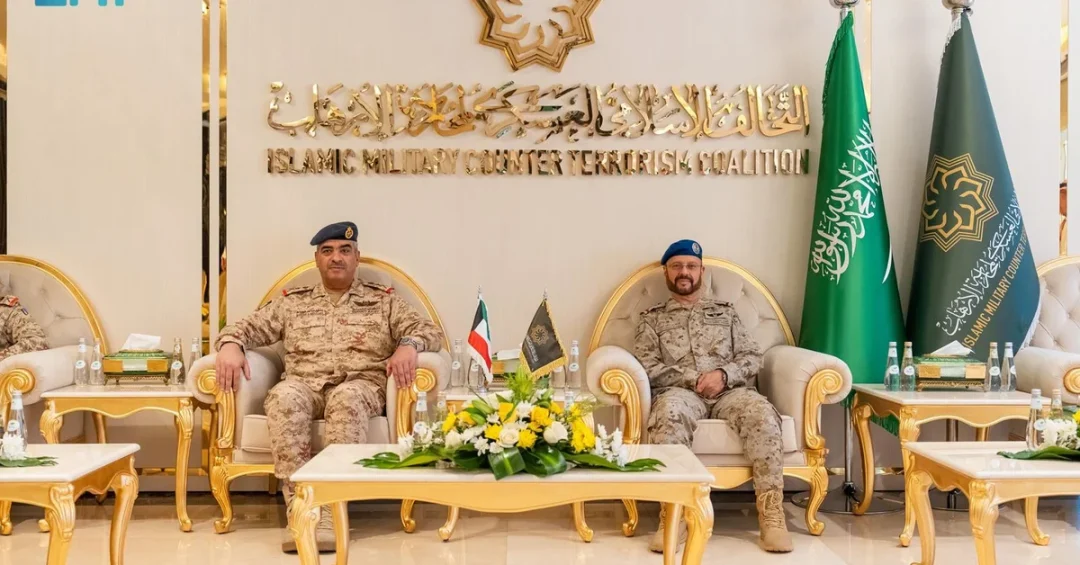
Riyadh, July 17, 2024 — The Secretary-General of the Islamic Military Counter Terrorism Coalition (IMCTC), Maj. Gen. Mohammed bin Saeed Al-Moghedi, received the Chief of General Staff of the Kuwait Armed Forces, Lt. Gen. Bandar Salem Abdullah Al-Muzain, and his accompanying delegation at the IMCTC headquarters in Riyadh on Wednesday. The meeting underscored the coalition’s ongoing efforts to coordinate counter-terrorism strategies among member states and highlighted Kuwait’s active role in regional security cooperation.
Context and Background
The IMCTC, established in 2015 and headquartered in Riyadh, is a coalition of 42 Muslim-majority countries committed to combating terrorism through a comprehensive approach. The coalition focuses on four key domains: ideology, communications, counter-terrorist financing, and military operations. This meeting reflects the IMCTC’s continued engagement with member states to enhance collective security and share best practices in countering extremism.
Kuwait has been an active member of the IMCTC, contributing to the coalition’s objectives through participation in joint initiatives and the exchange of expertise. The visit by Lt. Gen. Al-Muzain and his delegation signifies the strong bilateral ties between Saudi Arabia and Kuwait in addressing regional security challenges.
Key Details
During the meeting, the Kuwaiti delegation was briefed on the IMCTC’s prominent work and its methodology in combating terrorism across the four key areas. They were also introduced to the coalition’s publications, studies, and research, which provide in-depth analysis of extremist groups and their tactics.
Lt. Gen. Al-Muzain commended the professional techniques and systematic approaches employed by the IMCTC to understand the dimensions and methodologies of extremist groups. He lauded the coalition’s efforts in serving its member states and ensuring effective coordination.
In response, Maj. Gen. Al-Moghedi praised Kuwait’s efforts in its fight against terrorism and threats to its security and stability. He highlighted Kuwait’s membership in several regional and international organizations and centers concerned with combating terrorism and rejecting violence and extremism. Al-Moghedi also underscored the contributions of Kuwaiti representatives at the IMCTC and their role alongside representatives from other member states in exchanging international expertise, combating terrorism, and eliminating extremist groups.
Implications and Impact
This high-level meeting reinforces the IMCTC’s role as a platform for member states to collaborate on counter-terrorism strategies. It demonstrates the coalition’s commitment to fostering international cooperation and enhancing the capabilities of its members. The exchange of knowledge and expertise between Saudi Arabia and Kuwait contributes to the broader regional stability and security architecture.
Furthermore, the meeting highlights the importance of multilateral engagement in addressing complex security threats. By working together through the IMCTC, member states can pool resources, share intelligence, and develop coordinated responses to terrorism, thereby strengthening the collective security of the Muslim world.
Vision 2030 Alignment
Saudi Arabia’s leadership in the IMCTC aligns with the objectives of Vision 2030, which seeks to promote a secure and stable environment conducive to economic growth and social development. By fostering international partnerships and leading efforts to combat extremism, the Kingdom reinforces its position as a responsible global actor and a catalyst for peace and stability in the region and beyond.
20 Questions
Q1. Who is the Secretary-General of the IMCTC?
A1. Maj. Gen. Mohammed bin Saeed Al-Moghedi serves as the Secretary-General of the Islamic Military Counter Terrorism Coalition (IMCTC), leading the coalition’s efforts to combat terrorism across member states.
Q2. Who is the Chief of General Staff of the Kuwait Armed Forces?
A2. Lt. Gen. Bandar Salem Abdullah Al-Muzain is the Chief of General Staff of the Kuwait Armed Forces, responsible for overseeing Kuwait’s military operations and strategic defense initiatives.
Q3. Where did the meeting take place?
A3. The meeting was held at the IMCTC headquarters in Riyadh, Saudi Arabia, on Wednesday, July 17, 2024.
Q4. What is the IMCTC?
A4. The IMCTC is a coalition of 42 Muslim-majority countries established in 2015 to combat terrorism through a comprehensive approach focusing on ideology, communications, counter-terrorist financing, and military operations.
Q5. What are the four key areas of the IMCTC’s counter-terrorism efforts?
A5. The four key areas are ideology, communications, counter-terrorist financing, and military operations. These domains form the foundation of the coalition’s strategy to combat extremism and terrorism.
Q6. What did the Kuwaiti delegation learn during the meeting?
A6. The delegation was briefed on the IMCTC’s work and methodology, and was introduced to its publications, studies, and research on understanding extremist groups and their tactics.
Q7. How did Lt. Gen. Al-Muzain react to the IMCTC’s work?
A7. Lt. Gen. Al-Muzain commended the professional techniques and systematic approaches employed by the IMCTC to understand the dimensions and methodologies of extremist groups, and lauded its efforts in serving member states.
Q8. What did Maj. Gen. Al-Moghedi say about Kuwait?
A8. He praised Kuwait’s efforts in fighting terrorism and threats to its security, highlighting its membership in regional and international organizations concerned with combating terrorism and rejecting violence and extremism.
Q9. How does Kuwait contribute to the IMCTC?
A9. Kuwait contributes through its representatives at the IMCTC, who work alongside representatives from other member states to exchange expertise, combat terrorism, and eliminate extremist groups.
Q10. When was the IMCTC established?
A10. The IMCTC was established in 2015 and is headquartered in Riyadh, Saudi Arabia, with 42 member states committed to combating terrorism.
Q11. What is the significance of this meeting?
A11. The meeting reinforces the IMCTC’s role as a platform for member states to collaborate on counter-terrorism strategies and demonstrates Saudi-Kuwaiti cooperation in regional security.
Q12. How does the IMCTC serve its member states?
A12. The IMCTC serves member states by ensuring coordination, exchanging international expertise, and providing research and studies to enhance their counter-terrorism capabilities.
Q13. What role does Kuwait play in regional security?
A13. Kuwait actively participates in regional and international organizations focused on combating terrorism, contributing to collective efforts to maintain security and stability in the region.
Q14. What publications were shared with the Kuwaiti delegation?
A14. The delegation was acquainted with the IMCTC’s publications, studies, and research, which provide analysis and insights into extremist groups and effective counter-terrorism measures.
Q15. How does the IMCTC approach counter-terrorism?
A15. The IMCTC employs a comprehensive approach that addresses ideology, communications, counter-terrorist financing, and military operations, aiming to eliminate terrorism and extremism.
Q16. What is the relationship between Saudi Arabia and Kuwait in counter-terrorism?
A16. Saudi Arabia and Kuwait cooperate closely through the IMCTC and other regional platforms, sharing expertise and coordinating efforts to combat terrorism and ensure regional stability.
Q17. What did Maj. Gen. Al-Moghedi emphasize about Kuwaiti representatives?
A17. He underscored their role in exchanging international expertise, combating terrorism, and eliminating extremist groups alongside representatives from other member states.
Q18. How does the meeting align with Vision 2030?
A18. The meeting aligns with Vision 2030 by promoting security and stability, which are essential for economic growth and social development, and showcasing Saudi Arabia’s leadership in global counter-terrorism.
Q19. What are the expected outcomes of this meeting?
A19. The meeting is expected to strengthen cooperation between Saudi Arabia and Kuwait, enhance the IMCTC’s efforts, and contribute to broader regional security and stability.
Q20. How does the IMCTC contribute to global security?
A20. The IMCTC contributes to global security by uniting Muslim-majority countries in a coordinated fight against terrorism, sharing best practices, and implementing comprehensive strategies to counter extremism.
Reader Feedback
We value your thoughts. Please share your feedback on this article.
Your feedback helps us improve our coverage.