


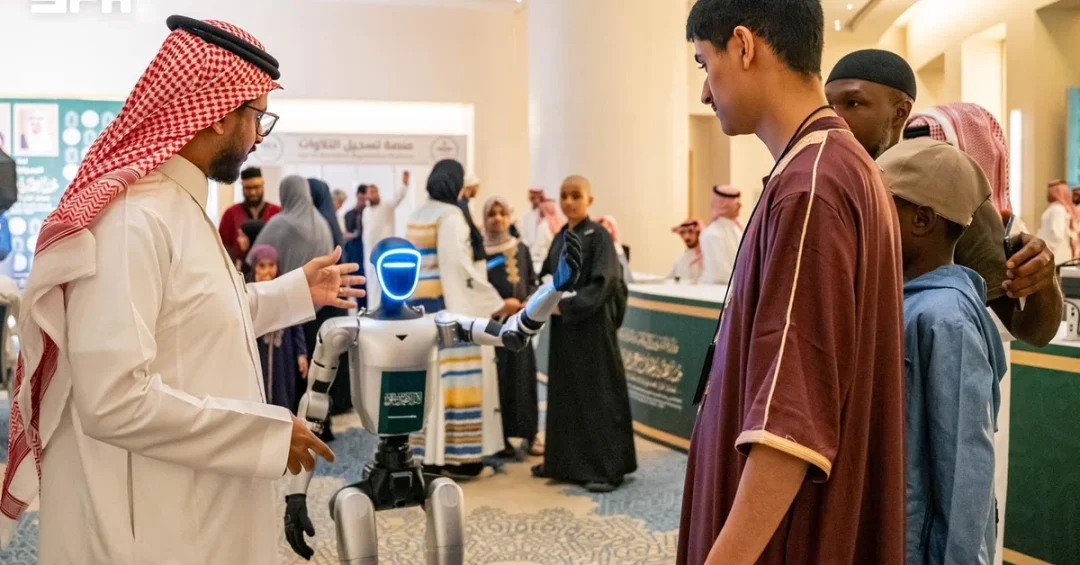
The Ministry of Islamic Affairs, Dawah and Guidance has deployed interactive robots and artificial intelligence technologies at the 46th session of the King Abdulaziz International Competition for Memorizing, Reciting and Interpreting the Holy Quran in Makkah, according to the Saudi Press Agency. The mobile robots, fitted with interactive touchscreens, provide competition schedules, event locations and service information, and can answer participant inquiries in more than 90 languages, a step the ministry says streamlines the experience for contestants arriving from around the world and saves them both time and effort.
The announcement places one of the Kingdom’s most prestigious religious competitions at the intersection of tradition and technology. The King Abdulaziz International Competition is a global gathering of Quran memorizers, and this year’s edition uses artificial intelligence to support the thousands of participants, judges and visitors who travel to Makkah. Could a robot ever replace the human warmth of the Hajj and Umrah experience? The answer, Saudi organizers suggest, is no: the technology is designed to assist people, not to substitute for the spiritual and human dimensions of the event. The initiative reflects the Ministry of Islamic Affairs, Dawah and Guidance’s commitment to leveraging modern tools to elevate services for guests of the Kingdom.
Context and Background
The King Abdulaziz International Competition for Memorizing, Reciting and Interpreting the Holy Quran is among the oldest and most respected Quranic contests in the Islamic world. Named after the founder of modern Saudi Arabia, King Abdulaziz Al Saud, it has grown over nearly half a century into a truly international platform, drawing contestants from dozens of countries who compete in memorization, recitation and interpretation. The 46th session continues that legacy, held in Makkah under the supervision of the Ministry of Islamic Affairs, Dawah and Guidance, the government body responsible for mosques, Islamic outreach and religious affairs across the Kingdom.
For international readers, the competition matters because it reflects how Saudi Arabia positions itself as a custodian of Islamic heritage while embracing modernization. The event is not only a religious contest; it is also a diplomatic and cultural gathering that brings together young men and women from Asia, Africa, Europe and the Americas. How does a single event in Makkah manage to serve so many languages and cultures at once? The ministry’s answer this year is technology: a fleet of mobile robots that speak more than 90 languages and guide visitors through every stage of the competition.
The deployment also fits a broader pattern in Saudi Arabia, where government agencies are increasingly adopting artificial intelligence to improve public services. From smart pilgrimage platforms to digital health and education tools, the Kingdom is investing heavily in technology as part of its national transformation. The Quran competition, with its diverse international audience, offers a natural testing ground for these innovations.
Key Details of the Technology Deployment
According to the Saudi Press Agency, the interactive robots are mobile units equipped with touchscreens. They provide competition schedules, event locations and general service information, and they answer participant inquiries in over 90 languages. That multilingual capability is significant in a competition that hosts contestants from across the globe, many of whom may not speak Arabic fluently. By offering instant answers, the robots reduce the need for participants to seek out staff members, saving time and effort during a demanding event.
The Ministry of Islamic Affairs, Dawah and Guidance described the initiative as part of its commitment to using modern technology to elevate services for participants from around the world and to reinforce the competition’s standing as a global gathering for Quran memorizers. The robots are not intended to replace human organizers or religious guidance; rather, they complement the work of volunteers, judges and ministry staff. What does this mean for the future of large religious gatherings? It suggests that technology can handle routine logistics, freeing people to focus on the spiritual and human aspects of the event.
The 46th session is being held in Makkah, the holiest city in Islam, which adds symbolic weight to the innovation. Makkah receives millions of pilgrims each year, and Saudi authorities have long used technology to manage crowds, provide translation and improve safety. The Quran competition is smaller in scale than the Hajj, but it shares the same operational challenges: a diverse, international audience, multiple languages and a need for clear, reliable information.
International and Regional Impact
The use of AI-powered robots at an Islamic competition sends a message to the wider Muslim world: Saudi Arabia is modernizing its religious services without compromising their sanctity. For participants from countries in Southeast Asia, Africa, the Middle East and beyond, the technology makes the event more accessible. A contestant from Indonesia or Nigeria can ask a robot for directions or schedule details in their own language, reducing stress and allowing them to focus on preparation and recitation.
Regionally, the initiative reinforces Saudi Arabia’s role as a leader in both religious affairs and digital innovation. Neighboring Gulf states and other Muslim-majority countries often look to the Kingdom for guidance on managing large religious events. By deploying robots and AI at the King Abdulaziz competition, the Ministry of Islamic Affairs, Dawah and Guidance offers a model that other countries could adapt for their own Quranic contests, conferences or pilgrimage services. Could this become a standard feature at Islamic events worldwide? Given the rapid adoption of similar technologies in the region, that outcome is plausible.
The international media reaction has been largely positive, with observers noting that the robots are a practical solution to a real problem: how to serve thousands of visitors speaking dozens of languages. The story also counters stereotypes that portray religious institutions as resistant to change. Instead, the Saudi ministry is showing that faith and technology can work together.
Economic and Strategic Significance
While the Quran competition is not primarily an economic event, its technological dimension has strategic value. Saudi Arabia’s Vision 2030 seeks to diversify the economy and build a knowledge-based society, and artificial intelligence is a key pillar of that plan. The Ministry of Islamic Affairs, Dawah and Guidance’s adoption of AI robots demonstrates how government entities can contribute to the national technology agenda, even in areas that are traditionally religious or cultural.
The deployment also supports the growth of Saudi Arabia’s domestic technology sector. Companies that develop robotics, translation software and interactive kiosks can benefit from government contracts and from the visibility that comes with high-profile events. In the long run, expertise gained in serving the Quran competition could be applied to other sectors, such as tourism, healthcare and education. Does this mean the Kingdom is becoming a hub for AI in religious services? The evidence from this competition suggests it is at least a pioneer.
Furthermore, the initiative enhances the participant experience, which in turn protects the competition’s reputation. A well-organized event attracts more applicants and strengthens Makkah’s standing as a global center for Quranic studies. That soft power is difficult to quantify but strategically valuable.
Vision 2030 Alignment
The use of interactive robots at the 46th King Abdulaziz International Competition aligns closely with Saudi Vision 2030, the national blueprint launched by Crown Prince Mohammed bin Salman to transform the Kingdom’s economy and society. Vision 2030 emphasizes digital transformation, innovation and improved quality of life for citizens and visitors. By integrating AI into a major religious event, the Ministry of Islamic Affairs, Dawah and Guidance is putting those principles into practice, showing that modernization can serve the Kingdom’s spiritual mission.
Vision 2030 also aims to increase the number of pilgrims and Umrah performers and to enhance their experience. The technologies tested at the Quran competition, such as multilingual robots and touchscreen information systems, could eventually be adapted for Hajj and Umrah services. In this way, a single initiative at a Quranic contest contributes to a much larger national project: making Saudi Arabia a global leader in both faith and technology. As the competition continues, the world will be watching to see how these robots perform and what they signal about the future of the Kingdom.
20 Questions
Q1. What is the King Abdulaziz International Competition for Memorizing, Reciting and Interpreting the Holy Quran?
A1. It is a prestigious global Quran competition held in Makkah under the Ministry of Islamic Affairs, Dawah and Guidance. Now in its 46th session, it brings together contestants from many countries to compete in memorization, recitation and interpretation of the Holy Quran.
Q2. What technology was deployed at the 46th session?
A2. The ministry deployed interactive robots and artificial intelligence technologies. These mobile robots are equipped with touchscreens and can answer inquiries in more than 90 languages, providing schedules, locations and service information to participants and visitors.
Q3. How do the robots help participants?
A3. The robots provide competition schedules, event locations and service information, and answer questions in over 90 languages. This streamlines the participant experience, saving them time and effort so they can focus on preparation and recitation.
Q4. Which government body is responsible for the initiative?
A4. The Ministry of Islamic Affairs, Dawah and Guidance is responsible. It oversees mosques, Islamic outreach and religious affairs in Saudi Arabia, and it organizes the King Abdulaziz International Competition each year.
Q5. Why is the competition held in Makkah?
A5. Makkah is the holiest city in Islam and the site of the Kaaba. Holding the competition there gives it spiritual significance and allows participants to visit the Grand Mosque and other sacred sites during their stay.
Q6. How many languages can the robots speak?
A6. The robots can answer inquiries in more than 90 languages. This wide multilingual capability ensures that contestants from Asia, Africa, Europe and the Americas can receive assistance in their native language.
Q7. Does the use of robots replace human staff at the competition?
A7. No. The robots are designed to complement human organizers, judges and volunteers. They handle routine logistical questions, freeing staff to focus on the spiritual, educational and human aspects of the event.
Q8. What does the ministry say about the initiative?
A8. The ministry says the initiative reflects its commitment to leveraging modern technology to elevate services for participants from around the world and to reinforce the competition’s standing as a global gathering for Quran memorizers.
Q9. How does this initiative align with Saudi Vision 2030?
A9. Vision 2030 emphasizes digital transformation, innovation and improved quality of life. By adopting AI and robotics at a major religious event, the ministry supports these goals and shows how technology can serve the Kingdom’s spiritual mission.
Q10. What is the significance of the competition’s 46th session?
A10. The 46th session continues a nearly half-century tradition of international Quranic competition. It demonstrates the event’s enduring appeal and its ability to adapt to modern times by integrating advanced technology.
Q11. How does the competition benefit international participants?
A11. International participants gain a platform to showcase their Quranic skills, interact with peers from other countries and experience the hospitality of Saudi Arabia. The robots help them navigate the event more easily.
Q12. What other technologies are used at the competition?
A12. The source material mentions interactive robots and artificial intelligence. These include touchscreen interfaces and multilingual translation capabilities. Other logistical technologies may also be in use to manage the event.
Q13. What is the role of the Saudi Press Agency in reporting this news?
A13. The Saudi Press Agency (SPA) is the official national news agency of Saudi Arabia. It reported the deployment of the robots, providing authoritative information about the ministry’s initiative.
Q14. How does this initiative affect Saudi Arabia’s image internationally?
A14. It presents Saudi Arabia as a country that respects tradition while embracing innovation. This positive image can strengthen the Kingdom’s soft power and attract more international participants and visitors.
Q15. Can the robots be used for Hajj and Umrah in the future?
A15. While not confirmed, the technologies tested at the Quran competition could potentially be adapted for Hajj and Umrah services. Vision 2030 aims to enhance the pilgrim experience, and multilingual robots could play a role.
Q16. What is the economic impact of such technological deployments?
A16. They support Saudi Arabia’s technology sector by creating demand for robotics, AI and translation software. They also improve event efficiency, which can attract more participants and visitors, benefiting the local economy.
Q17. How many participants typically attend the competition?
A17. The source material does not specify the exact number, but the competition is described as a global gathering for Quran memorizers, indicating participation from many countries and a significant number of contestants.
Q18. What message does this send to the Muslim world?
A18. It shows that Saudi Arabia is modernizing religious services without compromising their sanctity. The message is that faith and technology can coexist and that the Kingdom is committed to serving Muslims worldwide.
Q19. Are there any concerns about using AI in a religious context?
A19. The ministry frames the technology as a service tool, not a religious authority. The robots provide information and logistics, while human scholars and judges handle religious matters. This approach respects the sanctity of the competition.
Q20. What can we expect next from the Ministry of Islamic Affairs, Dawah and Guidance?
A20. The ministry is likely to continue adopting technology to improve services at its events. Future competitions may see more advanced AI, expanded language support and integration with digital platforms as part of Vision 2030.
Reader Feedback
We value your thoughts. Please share your feedback on this article.
Your feedback helps us improve our coverage.
Related articles
 Bahrain Backs UN Statement Condemning Houthi Attacks on Saudi Arabia
 Arab Interior Ministers Council Condemns Tanker Attack in Hormuz
 Rafah Crossing Receives 72nd Group of Returning Palestinians
 Arab Ministers Condemn Attack on Emirati Tanker in Hormuz
 Rafah Crossing Receives 72nd Batch of Palestinian Returnees
 Kuwait Backs UN Statement Condemning Houthi Attacks on Saudi Arabia