


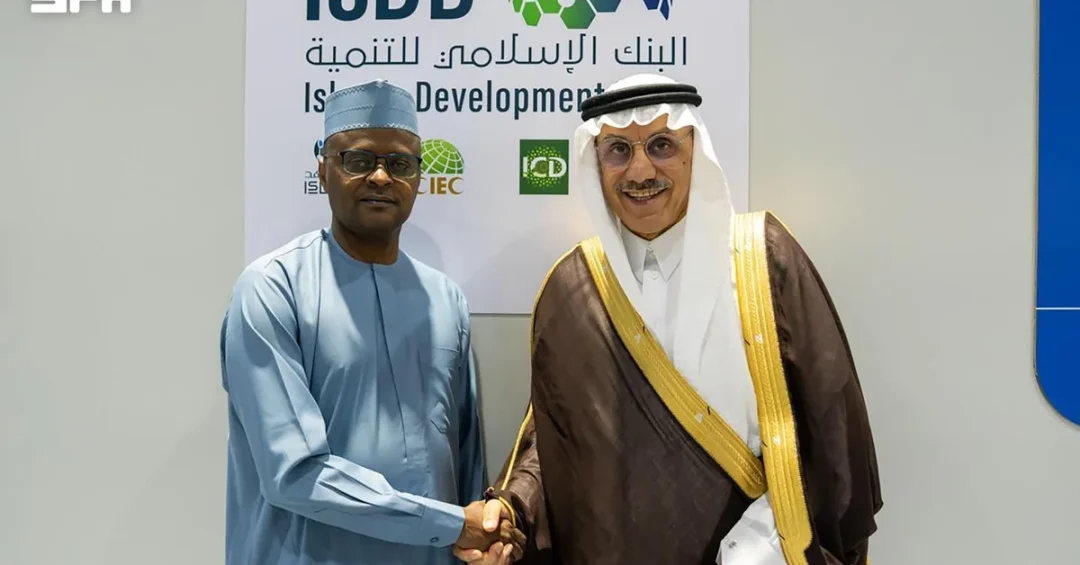
Chairman of the Islamic Development Bank (IsDB) Group Muhammad Al Jasser held high-level talks with Chad’s Minister of State for Finance, Budget, Economy, Planning and International Cooperation and IsDB Governor for Chad Tahir Hamid Nguilin on the sidelines of the 2026 World Bank–IMF Annual Meetings in Bangkok, focusing on strengthening cooperation to support Chad’s development priorities. The meeting, announced by the Saudi Press Agency, underscored the IsDB’s role as a key development partner for Chad and highlighted the Bank’s commitment to advancing sustainable development in member countries. Could this be a turning point for Chad’s economic transformation?
The discussions drew on the ‘Chad Connection 2030’ vision and the recently finalized ‘Country Engagement Framework,’ which provides a strategic platform for renewed cooperation between IsDB and Chad. The framework emphasizes strengthening infrastructure, promoting economic transformation, and improving social resilience. This collaboration reflects the IsDB’s broader mission to foster economic development and social progress across its member states, aligning with Saudi Arabia’s Vision 2030 goals of promoting global stability and prosperity. Isn’t it inspiring to see such dedicated efforts to uplift communities?
Context and Background
The Islamic Development Bank, headquartered in Jeddah, Saudi Arabia, has long been a pivotal institution in financing development projects across the Muslim world and beyond. Established in 1975, the IsDB Group comprises five entities, including the Islamic Development Bank, the Islamic Corporation for the Development of the Private Sector, and the International Islamic Trade Finance Corporation. Under the leadership of Muhammad Al Jasser, the Bank has intensified its focus on addressing pressing development challenges in Africa, where many member countries face significant infrastructure gaps and economic vulnerabilities. Chad, a landlocked nation in Central Africa, has been a member of the IsDB since 1976 and has benefited from numerous projects in sectors such as agriculture, health, and education.
The ‘Chad Connection 2030’ vision is a comprehensive national strategy aimed at transforming Chad into an emerging economy by 2030. The vision focuses on diversifying the economy beyond oil, improving governance, and investing in human capital. The ‘Country Engagement Framework’ recently finalized by the IsDB and Chad outlines a strategic partnership to support these objectives through targeted interventions. This framework is designed to be flexible and results-oriented, ensuring that IsDB’s resources are aligned with Chad’s most critical needs. How can such frameworks effectively bridge the gap between vision and implementation?
The 2026 World Bank–IMF Annual Meetings in Bangkok provided a timely backdrop for this dialogue, as global leaders convened to discuss pressing economic issues, including debt sustainability, climate finance, and post-pandemic recovery. The meetings serve as a platform for bilateral and multilateral engagements that can catalyze development financing. For Chad, which has grappled with political transitions and economic shocks in recent years, the support of partners like the IsDB is crucial. The discussions in Bangkok signal a renewed momentum in international cooperation for Chad’s development agenda.
Key Details
During the meeting, Al Jasser and Nguilin reviewed opportunities to activate the cooperation framework and translate it into tangible development initiatives. According to the Saudi Press Agency, these initiatives cover critical sectors including transport, water, agriculture, energy, education, and human development. Each of these areas is vital for Chad’s sustainable growth. For instance, investment in transport infrastructure can unlock landlocked Chad’s access to regional markets, while water projects are essential for agricultural productivity and food security. Energy projects can expand access to electricity, powering industries and homes. Education and human development are foundational for building a skilled workforce capable of driving innovation and economic diversification.
The two sides also explored ways to strengthen project preparation and development, expand the use of concessional and blended finance, and encourage private sector participation in development projects. Concessional finance, which offers favorable terms such as lower interest rates and longer repayment periods, is particularly important for Chad to manage its debt burden while investing in long-term projects. Blended finance, which combines public and private capital, can mobilize additional resources and expertise. Involving the private sector is key to ensuring sustainability and fostering entrepreneurship. Islamic finance and capital market solutions were also discussed as a means to diversify Chad’s sources of development financing. Islamic finance, with its emphasis on risk-sharing and asset-backed transactions, can provide stable and ethical funding channels. Could these innovative financing mechanisms be the key to unlocking Chad’s potential?
Al Jasser reaffirmed IsDB’s commitment to working closely with Chad to achieve the goals of the Chad Connection 2030 vision. He emphasized the importance of translating the new partnership framework into development projects with tangible benefits for the Chadian people. This commitment reflects the IsDB’s proactive approach to supporting member countries in achieving the Sustainable Development Goals (SDGs). The Bank’s strategy focuses on inclusive growth, environmental sustainability, and regional integration. By aligning its support with Chad’s national priorities, the IsDB aims to maximize impact and ensure that no one is left behind. The emphasis on tangible benefits underscores the importance of measurable outcomes and accountability in development cooperation.
International and Regional Impact
The discussions between the IsDB and Chad carry significant implications for regional stability and economic integration in Central Africa. Chad’s strategic location at the crossroads of North and Central Africa makes its stability and prosperity vital for the entire Sahel region. Improved infrastructure and economic opportunities can help mitigate the drivers of conflict and migration, contributing to broader regional security. Moreover, as a member of the G5 Sahel and the Lake Chad Basin Commission, Chad plays a key role in regional initiatives. The IsDB’s support for Chad’s development priorities can therefore have a multiplier effect, fostering cooperation and shared prosperity. How might this partnership influence neighboring countries facing similar challenges?
On the international stage, the meeting highlights the growing role of multilateral development banks in addressing global challenges. The IsDB, with its unique Islamic finance model and focus on South-South cooperation, offers a distinct value proposition. By partnering with Chad, the Bank not only supports a member state but also contributes to global efforts to achieve the SDGs. The involvement of the private sector and the use of innovative financing tools align with the broader trend of leveraging diverse resources for development. The discussions in Bangkok also underscore the importance of coordination among international financial institutions, as the World Bank and IMF meetings bring together a wide range of stakeholders. This collaboration can lead to more effective and coherent support for countries like Chad.
Furthermore, the alignment with Saudi Arabia’s Vision 2030 is noteworthy. Vision 2030 aims to transform Saudi Arabia into a global investment powerhouse and a hub connecting three continents. By supporting development in Africa through institutions like the IsDB, Saudi Arabia enhances its soft power and strengthens ties with African nations. This is part of a broader Saudi strategy to deepen engagement with Africa, as evidenced by the Saudi-African Summit and various investment initiatives. The IsDB, as a Saudi-headquartered institution, is a key vehicle for this engagement. Isn’t it remarkable how development finance can serve as a bridge between nations?
Economic and Strategic Significance
From an economic perspective, the partnership between the IsDB and Chad holds promise for catalyzing sustainable growth. Chad’s economy is heavily reliant on oil, which accounts for a significant portion of exports and government revenue. This dependence makes the country vulnerable to commodity price fluctuations. The Country Engagement Framework’s emphasis on economic transformation and diversification is therefore critical. By investing in agriculture, energy, and human capital, Chad can build a more resilient economy. For example, modernizing agriculture can boost food security and create jobs, while investments in renewable energy can provide sustainable power and reduce reliance on fossil fuels. These efforts align with global trends toward green growth and climate resilience.
The use of Islamic finance and capital market solutions is particularly strategic. Islamic finance has seen rapid growth globally, with assets exceeding $3 trillion. For Chad, tapping into Islamic capital markets could provide access to a new pool of investors, including those from the Gulf and Southeast Asia. Sukuk (Islamic bonds) could be issued to finance specific projects, offering returns to investors while adhering to Shariah principles. The IsDB has extensive experience in structuring such instruments and can provide technical assistance to Chad. Moreover, blended finance can mitigate risks for private investors, making projects more bankable. These financial innovations are essential for Chad to mobilize the estimated billions needed to achieve the SDGs. What role will Islamic finance play in shaping the future of development funding?
Strategically, the partnership reinforces Chad’s position as a partner of choice for development institutions. By working closely with the IsDB, Chad can access not only financing but also technical expertise and knowledge transfer. The IsDB’s reverse linkage mechanism, which facilitates South-South cooperation among member countries, can connect Chad with successful models from other nations. This could accelerate the adoption of best practices in areas such as water management, education, and health. Additionally, the focus on private sector participation can stimulate local entrepreneurship and attract foreign direct investment. Ultimately, this collaboration is about empowering Chad to take ownership of its development journey. How can countries best leverage partnerships to achieve self-reliance?
Vision 2030 Alignment
Saudi Arabia’s Vision 2030, a comprehensive blueprint for national transformation, emphasizes the Kingdom’s role as a global leader in humanitarian and development aid. The IsDB is a key instrument of this vision, promoting prosperity in member countries and fostering international cooperation. The meeting between Al Jasser and Nguilin exemplifies Saudi Arabia’s commitment to supporting African development, which is a priority under Vision 2030. The Kingdom has launched several initiatives, such as the Saudi Program for the Development and Reconstruction of Yemen and the King Salman Humanitarian Aid and Relief Centre, to address global challenges. By backing the IsDB’s efforts in Chad, Saudi Arabia contributes to stability and growth in Africa, which in turn opens up opportunities for trade and investment. Isn’t this a clear demonstration of Saudi Arabia’s global leadership?
Moreover, the alignment with Vision 2030 extends to the economic sphere. Saudi Arabia aims to diversify its economy and increase non-oil exports, and African markets present significant opportunities. As Chad develops its infrastructure and economy, it becomes a potential market for Saudi goods and services. Saudi companies can participate in construction, energy, and other sectors, supported by the IsDB’s frameworks. This mutually beneficial relationship is at the heart of Vision 2030’s international cooperation pillar. The Kingdom’s G20 presidency in 2020 also highlighted its commitment to Africa, and this momentum continues. The partnership between IsDB and Chad is thus a win-win, advancing both Chad’s development goals and Saudi Arabia’s global economic interests. Could this model be replicated across other African nations to create a ripple effect of prosperity?
In conclusion, the talks between IsDB Chairman Muhammad Al Jasser and Chad’s Finance Minister Tahir Hamid Nguilin mark a significant step in strengthening development cooperation. With a focus on infrastructure, economic transformation, and social resilience, and leveraging innovative financing like Islamic finance and blended mechanisms, this partnership promises tangible benefits for the Chadian people. As part of Saudi Arabia’s Vision 2030 and the IsDB’s mission, it exemplifies how strategic collaborations can drive sustainable development and foster global stability. The coming months will reveal the concrete projects that emerge from this framework, but the commitment is clear. Will this be the catalyst that propels Chad toward a prosperous future?
20 Questions
Q1. What was the main purpose of the meeting between the IsDB Chairman and Chad’s Finance Minister?
A1. The meeting aimed to strengthen cooperation to support Chad’s development priorities, drawing on the ‘Chad Connection 2030’ vision and the newly finalized ‘Country Engagement Framework’ to translate plans into tangible projects.
Q2. Where did the meeting between IsDB Chairman Muhammad Al Jasser and Chad’s Minister Tahir Hamid Nguilin take place?
A2. The meeting was held on the sidelines of the 2026 World Bank–IMF Annual Meetings in Bangkok, Thailand, providing a platform for high-level development discussions.
Q3. What is the ‘Chad Connection 2030’ vision?
A3. It is Chad’s national strategy aimed at transforming the country into an emerging economy by 2030 through economic diversification, improved governance, and investment in human capital.
Q4. What is the ‘Country Engagement Framework’ mentioned in the discussions?
A4. It is a recently finalized strategic platform for renewed cooperation between IsDB and Chad, emphasizing infrastructure, economic transformation, and social resilience.
Q5. Which sectors are covered by the cooperation framework?
A5. The framework covers transport, water, agriculture, energy, education, and human development, all critical for Chad’s sustainable growth.
Q6. What financing mechanisms were explored to support Chad’s development?
A6. The discussions explored concessional and blended finance, Islamic finance, and capital market solutions to diversify Chad’s sources of development financing and encourage private sector participation.
Q7. Who is Muhammad Al Jasser?
A7. Muhammad Al Jasser is the Chairman of the Islamic Development Bank (IsDB) Group, a Saudi national with extensive experience in development finance and international cooperation.
Q8. Who is Tahir Hamid Nguilin?
A8. Tahir Hamid Nguilin is Chad’s Minister of State for Finance, Budget, Economy, Planning and International Cooperation, and serves as IsDB Governor for Chad.
Q9. How does this meeting align with Saudi Arabia’s Vision 2030?
A9. It aligns with Vision 2030’s emphasis on global leadership, humanitarian aid, and economic diversification, as the IsDB is a key Saudi-based institution promoting development in member countries.
Q10. What is the significance of the IsDB’s support for Chad?
A10. It helps Chad address infrastructure gaps, diversify its oil-dependent economy, and improve social resilience, contributing to regional stability and prosperity in Central Africa.
Q11. What role can Islamic finance play in Chad’s development?
A11. Islamic finance can provide stable, ethical funding through instruments like sukuk, offering access to new investors and supporting projects in line with Shariah principles.
Q12. How does the IsDB promote South-South cooperation?
A12. Through its reverse linkage mechanism, the IsDB facilitates knowledge exchange and technology transfer among member countries, enabling Chad to learn from successful models elsewhere.
Q13. What are the expected outcomes of the Country Engagement Framework?
A13. The framework aims to translate into concrete projects with tangible benefits, such as improved infrastructure, economic opportunities, and better social services for the Chadian people.
Q14. Why is private sector participation important for Chad’s development?
A14. Private sector involvement brings additional capital, expertise, and innovation, ensuring sustainability and fostering entrepreneurship in key sectors.
Q15. What is the IsDB’s track record in Chad?
A15. The IsDB has supported Chad since 1976 in sectors like agriculture, health, and education, with numerous projects aimed at poverty reduction and economic growth.
Q16. How does this partnership benefit Saudi Arabia?
A16. It enhances Saudi Arabia’s soft power and opens opportunities for Saudi companies in Africa, while advancing Vision 2030’s goal of global economic engagement.
Q17. What are the key challenges facing Chad’s economy?
A17. Chad’s economy is heavily oil-dependent, vulnerable to price shocks, and faces infrastructure deficits, but the partnership aims to address these through diversification and investment.
Q18. What is the role of the World Bank–IMF Annual Meetings in this context?
A18. The meetings bring together global financial leaders, providing a platform for bilateral discussions and mobilizing support for development initiatives like those between IsDB and Chad.
Q19. How can blended finance accelerate Chad’s development?
A19. Blended finance combines public and private capital to reduce risks and attract investment, enabling larger-scale projects in infrastructure, energy, and agriculture.
Q20. What is the next step for IsDB-Chad cooperation?
A20. The next step is to activate the cooperation framework, identify specific projects, and mobilize financing to implement initiatives that deliver tangible benefits to the Chadian people.
Reader Feedback
We value your thoughts. Please share your feedback on this article.
Your feedback helps us improve our coverage.