


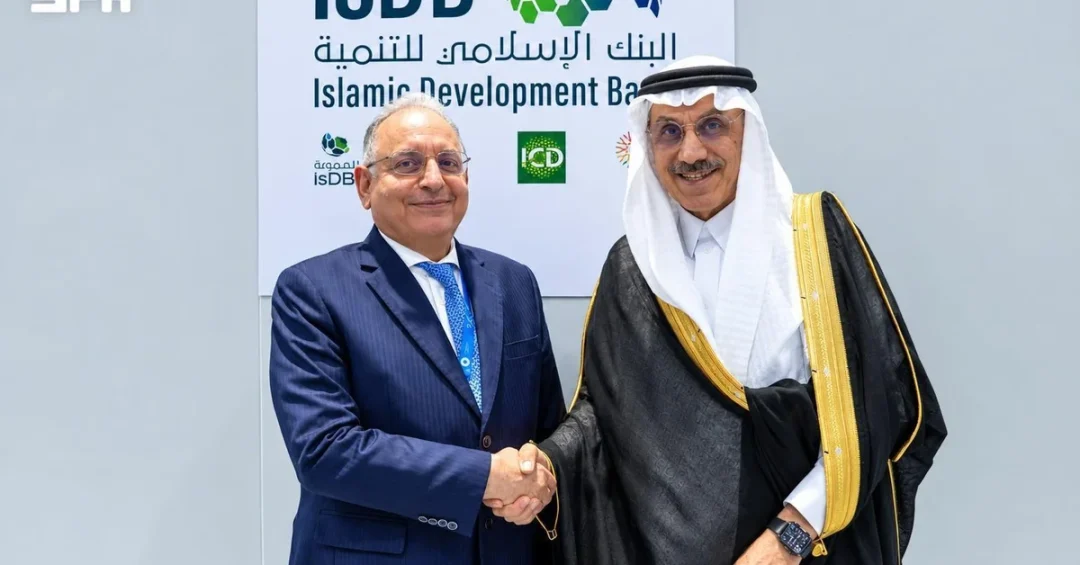
The Chairman of the Islamic Development Bank (IsDB) Group, Dr. Muhammad Al Jasser, met with the Syrian Minister of Finance and IsDB Governor for Syria, Mohammed Yisr Barnieh, on the sidelines of the 2026 Annual Meetings of the World Bank Group and the International Monetary Fund (IMF) in Bangkok, Thailand, to discuss cooperation prospects and support for Syria’s recovery, reconstruction, and development efforts. The meeting, reported by the Saudi Press Agency (SPA), focused on Syria’s development priorities and ways to strengthen the IsDB Group’s role in meeting development needs and promoting sustainable development. The two sides also discussed preparations for developing the strategic framework for the IsDB Group’s interventions in Syria for 2027–2029, a framework designed to identify cooperation areas and priorities for the coming phase, aligned with Syria’s development needs and government priorities.
This high-level engagement underscores the IsDB Group’s continued commitment to its member countries and reflects the broader efforts of international financial institutions to support recovery in nations emerging from conflict. The meeting took place during the 2026 Annual Meetings of the World Bank Group and the IMF, a key gathering of global economic policymakers, where development finance and reconstruction strategies are often high on the agenda. Dr. Al Jasser’s discussion with Minister Barnieh signals a renewed focus on mobilizing resources and expertise to support Syria’s national priorities, with the IsDB Group positioned as a key partner in that process. The talks also highlight the importance of the coming phase in opening new avenues for cooperation, as both sides look to translate dialogue into tangible development outcomes.
Context and Background
Why does the Islamic Development Bank Group’s engagement with Syria matter at this particular moment in regional and global development finance? The IsDB Group, headquartered in Jeddah, Saudi Arabia, is a multilateral development bank that works to foster economic development and social progress in its member countries and Muslim communities worldwide. With a mandate rooted in Islamic finance principles and a strong focus on infrastructure, human capital, and sustainable development, the IsDB Group has a long history of supporting countries in transition. Syria, as a member country, has faced significant developmental challenges, and the IsDB Group’s role in supporting its recovery and reconstruction is part of the bank’s broader mission to help member states achieve sustainable impact and improve economic and social conditions.
The 2027–2029 strategic framework under discussion is a critical planning tool that will guide the IsDB Group’s interventions in Syria over the next three years. Such frameworks typically outline priority sectors, financing modalities, and partnership arrangements, ensuring that resources are directed where they are most needed and can generate the greatest impact. The meeting in Bangkok is part of a series of consultations aimed at aligning the IsDB Group’s support with Syria’s own development plans and government priorities. This approach reflects a principles-based, country-owned model of development cooperation, where recipient countries take the lead in defining their needs and strategies, and international partners provide complementary financing and technical expertise.
The timing of the meeting is also significant given the broader geopolitical and economic context. The 2026 Annual Meetings of the World Bank Group and the IMF bring together finance ministers, central bank governors, and development leaders to discuss global economic trends, debt sustainability, and recovery strategies. For Syria, participation in such forums—and direct engagement with institutions like the IsDB Group—represents an opportunity to re-engage with the international financial community and to advocate for support for its reconstruction agenda. The IsDB Group’s willingness to discuss a multi-year framework signals a long-term commitment, which is essential for reconstruction efforts that often span years or even decades.
Key Details of the Meeting
What specific topics were on the table during the discussions between Dr. Al Jasser and Minister Barnieh? According to the SPA report, the meeting addressed Syria’s development priorities and ways to strengthen the IsDB Group’s role in supporting recovery and reconstruction efforts to meet development needs and promote sustainable development. This includes identifying the sectors and projects that will be prioritized under the 2027–2029 framework, as well as the financial and technical resources that the IsDB Group can mobilize. Dr. Al Jasser affirmed the IsDB Group’s commitment to continuing cooperation with the Syrian Arab Republic and supporting its recovery and reconstruction efforts, highlighting the importance of the coming phase in opening new avenues for cooperation and mobilizing resources and expertise to support national priorities.
The development of the strategic framework for 2027–2029 is a central outcome of these discussions. Such a framework is not merely a bureaucratic document; it is a roadmap that will guide the IsDB Group’s engagement with Syria across a range of sectors, potentially including infrastructure, energy, water, health, education, and agriculture. It will also define the terms of cooperation, including the use of Islamic financing instruments such as Murabaha, Istisna’a, and leasing, which are tailored to the needs of member countries and compliant with Shariah principles. The framework will be developed in close consultation with the Syrian government, ensuring that it reflects national priorities and is integrated with other development efforts, including those supported by other international partners.
The meeting also underscores the IsDB Group’s broader efforts to strengthen cooperation with its member countries. As a multilateral institution, the IsDB Group operates on the principle of solidarity and mutual support, and its engagement with Syria is a practical expression of that principle. By mobilizing resources and expertise, the IsDB Group aims to help Syria achieve sustainable impact and improve economic and social conditions. The discussions in Bangkok are therefore part of a continuous process of dialogue and partnership-building that will continue in the months ahead as the 2027–2029 framework takes shape.
International and Regional Impact
How might the IsDB Group’s engagement with Syria influence broader regional stability and economic recovery? The reconstruction of Syria is a complex undertaking that requires coordinated efforts from multiple international and regional actors. The IsDB Group’s involvement adds a significant multilateral dimension to these efforts, complementing the work of other institutions such as the World Bank, the IMF, and various bilateral donors. By providing financing and technical assistance, the IsDB Group can help catalyze additional investment and support, sending a positive signal to other potential partners about the viability of reconstruction projects. This can, in turn, contribute to regional stability by supporting economic recovery, job creation, and improved living standards in a country that has suffered greatly from conflict.
From a regional perspective, the meeting in Bangkok also highlights the role of Saudi Arabia-based institutions in supporting development across the Muslim world. The IsDB Group, headquartered in Jeddah, is a key pillar of Saudi Arabia’s soft power and its commitment to international development. The Kingdom’s support for the IsDB Group’s mission aligns with its broader foreign policy objectives, including promoting stability, prosperity, and cooperation in the region and beyond. The discussions with Syria are therefore not only a matter of development finance but also part of a wider diplomatic and humanitarian effort to help a neighboring country rebuild and reintegrate into the regional economy.
Economic and Strategic Significance
What does the IsDB Group’s support mean for Syria’s economic recovery and long-term development prospects? Reconstruction requires substantial financing, and the IsDB Group’s resources and expertise can play a catalytic role in mobilizing the necessary funds. The 2027–2029 framework will likely prioritize projects that have a high developmental impact, such as rebuilding critical infrastructure, restoring essential services, and supporting productive sectors like agriculture and small and medium-sized enterprises. These investments can help create jobs, generate income, and lay the foundation for sustainable growth. By focusing on capacity-building and institutional strengthening, the IsDB Group can also help Syria improve its economic governance and create an enabling environment for private sector investment.
Strategically, the meeting reflects the IsDB Group’s adaptability and its commitment to addressing the evolving needs of its member countries. The bank has a strong track record of responding to crises and supporting recovery in countries affected by conflict and natural disasters. Its engagement with Syria is consistent with this mandate and demonstrates its willingness to take a long-term view of development, even in challenging circumstances. For Syria, the partnership with the IsDB Group offers access to Islamic financing instruments that are tailored to its needs, as well as technical assistance that can help build local capacity and ensure that projects are well-designed and effectively implemented.
Vision 2030 Alignment
How does the IsDB Group’s work with Syria connect to Saudi Arabia’s Vision 2030 and the Kingdom’s broader global role? The IsDB Group is an important international institution headquartered in Saudi Arabia, and its activities are closely aligned with the Kingdom’s Vision 2030 objectives, particularly those related to international cooperation, economic diversification, and the promotion of sustainable development. By supporting the IsDB Group’s engagement with Syria, Saudi Arabia is contributing to regional stability and prosperity, which are essential for a secure and thriving neighborhood. This aligns with Vision 2030’s emphasis on strengthening Saudi Arabia’s role as a global investment powerhouse and a hub for international diplomacy and development finance.
Furthermore, the IsDB Group’s focus on mobilizing resources and expertise to support national priorities resonates with Vision 2030’s goals of enhancing economic and social development, both domestically and internationally. The Kingdom’s commitment to the IsDB Group and its mission reflects a broader vision of a prosperous and interconnected Muslim world, where member countries support each other in achieving sustainable development. As the IsDB Group develops its strategic framework for Syria for 2027–2029, it will continue to play a vital role in translating this vision into concrete actions that improve lives and build a better future for the people of Syria and the wider region. The meeting between Dr. Al Jasser and Minister Barnieh is a step forward in that ongoing journey, demonstrating the power of partnership and the enduring commitment of the IsDB Group to its member countries.
20 Questions
Q1. What was the main purpose of the meeting between the IsDB Group Chairman and the Syrian Finance Minister?
A1. The meeting aimed to discuss cooperation prospects between the IsDB Group and Syria, and to explore ways to support Syria’s recovery, reconstruction, and development efforts, as well as to prepare for the 2027–2029 strategic framework.
Q2. Where did the meeting take place?
A2. The meeting took place on the sidelines of the 2026 Annual Meetings of the World Bank Group and the International Monetary Fund (IMF), held in Bangkok, Thailand.
Q3. Who represented the IsDB Group at the meeting?
A3. The IsDB Group was represented by its Chairman, Dr. Muhammad Al Jasser.
Q4. Who represented Syria at the meeting?
A4. Syria was represented by its Minister of Finance and IsDB Governor for Syria, Mohammed Yisr Barnieh.
Q5. What is the Islamic Development Bank Group?
A5. The IsDB Group is a multilateral development bank headquartered in Jeddah, Saudi Arabia, that fosters economic development and social progress in its member countries and Muslim communities worldwide.
Q6. What is the significance of the 2027–2029 strategic framework?
A6. The framework will guide the IsDB Group’s interventions in Syria for three years, identifying cooperation areas and priorities aligned with Syria’s development needs and government priorities.
Q7. What did Dr. Al Jasser affirm during the meeting?
A7. He affirmed the IsDB Group’s commitment to continuing cooperation with Syria and supporting its recovery and reconstruction efforts, highlighting the importance of mobilizing resources and expertise.
Q8. How does this meeting fit into the IsDB Group’s broader mission?
A8. It is part of the IsDB Group’s efforts to strengthen cooperation with member countries, support their development priorities, and help mobilize resources to achieve sustainable impact.
Q9. What are some potential areas of cooperation for the 2027–2029 framework?
A9. Potential areas include infrastructure, energy, water, health, education, and agriculture, using Islamic financing instruments tailored to Syria’s needs.
Q10. Why is the timing of this meeting important?
A10. It coincides with the 2026 Annual Meetings of the World Bank Group and the IMF, providing a platform for Syria to re-engage with the international financial community and advocate for reconstruction support.
Q11. How does the IsDB Group support member countries in transition?
A11. The IsDB Group provides financing, technical assistance, and capacity-building support, often using Shariah-compliant instruments, to help countries recover and achieve sustainable development.
Q12. What role does Saudi Arabia play in the IsDB Group?
A12. Saudi Arabia hosts the IsDB Group’s headquarters in Jeddah and is a key supporter of its mission, which aligns with the Kingdom’s Vision 2030 and its commitment to international development.
Q13. What is the expected impact of the IsDB Group’s support on Syria’s economy?
A13. The support is expected to help rebuild infrastructure, restore services, create jobs, and lay the foundation for sustainable growth, improving economic and social conditions.
Q14. How does the IsDB Group’s work align with Vision 2030?
A14. It aligns with Vision 2030’s goals of enhancing international cooperation, economic diversification, and sustainable development, and strengthens Saudi Arabia’s global role.
Q15. What financing instruments does the IsDB Group use?
A15. The IsDB Group uses Shariah-compliant instruments such as Murabaha, Istisna’a, and leasing, which are tailored to the needs of member countries.
Q16. What is the next step after this meeting?
A16. The next step is to develop the strategic framework for the IsDB Group’s interventions in Syria for 2027–2029, in close consultation with the Syrian government.
Q17. How does the IsDB Group’s engagement with Syria contribute to regional stability?
A17. By supporting economic recovery and development, the IsDB Group helps create jobs, improve living standards, and reduce the drivers of instability, contributing to a more stable region.
Q18. What is the source of information for this article?
A18. The information is based on a report by the Saudi Press Agency (SPA), which is an official Saudi news authority.
Q19. How many member countries does the IsDB Group have?
A19. The IsDB Group has 57 member countries, including Syria, and works to promote development and cooperation among them.
Q20. What is the overall message of this meeting for the international community?
A20. The meeting signals the IsDB Group’s long-term commitment to supporting Syria’s recovery and reconstruction, and highlights the importance of international cooperation in addressing development challenges.
Reader Feedback
We value your thoughts. Please share your feedback on this article.
Your feedback helps us improve our coverage.