


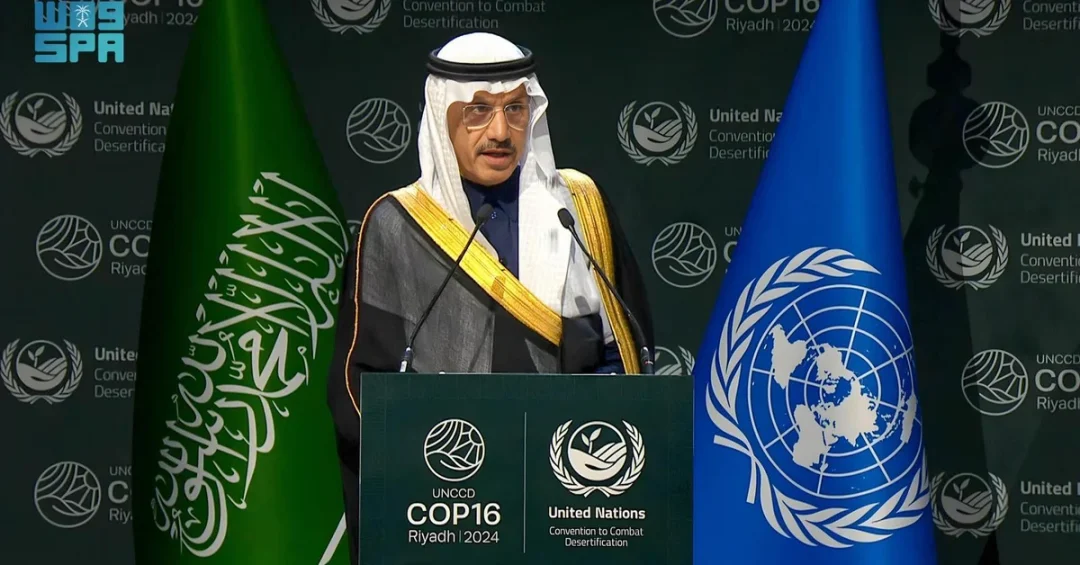
The Islamic Development Bank (IsDB) Group has provided more than $4.4 billion in financing since 2018 for projects aligned with the United Nations Convention to Combat Desertification (UNCCD), Chairman Muhammad Al Jasser announced during the 16th session of the Conference of the Parties (COP16) in Jeddah. The announcement, carried by the Saudi Press Agency, positions the Jeddah-based multilateral lender at the center of global efforts to reverse land degradation, strengthen drought resilience, and protect vulnerable communities across its member states. Al Jasser used the Riyadh-hosted COP16 platform to detail how the financing has translated into measurable projects spanning irrigation rehabilitation, food security, soil health, and climate-smart agriculture.
The scale of the commitment matters because desertification, land degradation, and drought are no longer distant environmental concerns. They are immediate economic and humanitarian risks affecting food systems, water availability, and rural livelihoods across Africa, Central Asia, and the Middle East. By channeling more than $4.4 billion into UNCCD-aligned projects, the IsDB has effectively converted a global convention into bankable, on-the-ground investment. For international observers, the announcement offers a clear example of how Saudi Arabia and the institutions it hosts are helping shape the global development agenda, not merely participating in it.
Context and Background
Why has the Islamic Development Bank become such a central financier of land restoration, and what does its track record reveal about the future of multilateral climate finance? Founded in 1975 and headquartered in Jeddah, the IsDB Group serves member countries across Asia, Africa, and the Middle East, using Islamic finance instruments to fund infrastructure, agriculture, education, and health projects. Its involvement in desertification dates back years, but the scale of activity accelerated after 2018, when the bank began aligning a growing share of its portfolio with the objectives of the United Nations Convention to Combat Desertification.
The UNCCD, established in 1994, is the only legally binding international agreement linking environment and development to sustainable land management. Its 197 parties have committed to combating desertification and mitigating the effects of drought. COP16 in Jeddah, held in December 2024, was the largest UNCCD conference to date and the first hosted in the Middle East, underscoring Saudi Arabia’s growing role in convening global environmental diplomacy. The IsDB’s announcement therefore arrived at a strategically significant moment, giving member states and international partners a concrete financing benchmark against which future pledges can be measured.
Al Jasser’s address also reflected a broader shift in how development banks approach climate risk. Rather than treating land restoration as a purely environmental expense, the IsDB frames it as an investment in food security, employment, and regional stability. That framing has helped the bank mobilize co-financing from governments, international funds, and private sector partners, multiplying the impact of its own capital.
Key Details of the Financing
What do the individual projects supported by the IsDB actually deliver for the communities they serve? According to Al Jasser, the financing covers a diverse portfolio. Kazakhstan received $1.15 billion to rehabilitate 3,400 kilometers of irrigation networks, a project expected to boost crop production on 350,000 hectares. In Azerbaijan, $96 million was allocated to the Maiden Tower Project, designed to enhance food security for 1.6 million people. A further $450 million supports the Regional Cassava Value Chain Program, empowering farmers in nine African countries through improved production, processing, and private sector engagement.
The bank also funded the Regional Soil Fertility Mapping Program in six African countries, which provides farmers with sustainable fertilizer solutions to improve soil health and yields. These projects share a common logic: they combine hard infrastructure with knowledge transfer and market access, so that restored land generates lasting economic returns rather than temporary relief. The irrigation rehabilitation in Kazakhstan, for example, addresses a legacy of inefficient water use in a region where agriculture depends heavily on managed river systems.
Al Jasser further announced two major commitments. The first is a $1 billion pledge to the Riyadh Global Drought Resilience Partnership, reinforcing the bank’s dedication to drought preparedness. The second is a $10 billion collective pledge by the Arab Coordination Group for drought resilience and sustainable land management by 2030, to which the IsDB will contribute the majority. Together, these pledges signal that Arab and Islamic development institutions intend to remain long-term financiers of land and water resilience, not one-off donors.
Exceeding Climate Targets Ahead of Schedule
How significant is it that the IsDB surpassed its climate financing target two years early? Al Jasser confirmed that the bank exceeded its goal of dedicating 35 percent of its financing to climate initiatives by 2025, achieving the milestone ahead of schedule. That achievement matters because multilateral banks are frequently criticized for setting ambitious climate targets that are met slowly or not at all. The IsDB’s early delivery strengthens its credibility as a partner for global climate funds and national governments seeking co-financing.
The bank has also built partnerships to extend its reach. It works with the Food and Agriculture Organization (FAO) and the International Fund for Agricultural Development (IFAD) to introduce climate-smart technologies for smallholder farmers. Separately, it collaborates with the United Nations Development Programme (UNDP) to develop Takaful, or Islamic insurance, solutions aimed at protecting communities from climate shocks. These partnerships reflect a practical understanding that finance alone cannot solve desertification; technology, insurance, and local capacity are equally essential.
Al Jasser linked the bank’s work to major regional initiatives, including the Saudi Green Initiative and the Middle East Green Initiative, the Great Green Wall for the Sahara and Sahel, and the Vision for Adapted Crops and Soils. Each of these programs targets different geographies and crops, but they share the goal of scaling innovative solutions and driving sustainable transformation across large landscapes.
International and Regional Impact
What does the IsDB’s financing mean for global efforts to combat desertification beyond its member states? The bank’s projects touch Central Asia, the Caucasus, and sub-Saharan Africa, regions where land degradation directly affects food prices, migration patterns, and political stability. By financing irrigation networks in Kazakhstan and cassava value chains across nine African countries, the IsDB is helping to stabilize rural economies that might otherwise be pushed toward crisis. The $10 billion Arab Coordination Group pledge, meanwhile, creates a pooled regional instrument capable of supporting projects too large for any single institution.
The choice of Jeddah as the venue for COP16 amplifies the diplomatic dimension. Saudi Arabia’s hosting of the conference, alongside the IsDB’s announcements, reinforces the Kingdom’s position as a bridge between developed and developing countries on environmental policy. For international audiences, the message is that Gulf institutions are increasingly willing to finance global public goods, from drought resilience to soil health, while pursuing their own ambitious domestic sustainability agendas.
The partnerships with FAO, IFAD, and UNDP also give the IsDB access to technical expertise and delivery networks that complement its financial strength. This combination of capital and capability is what allows projects to move from pledge to implementation, a transition that has historically been the weakest link in international development finance.
Economic and Strategic Significance
Why should investors and policymakers outside the development community pay attention to these announcements? Land degradation carries a measurable economic cost. Reduced agricultural productivity raises import bills, increases food insecurity, and can destabilize rural communities. By financing irrigation rehabilitation, soil mapping, and value chain development, the IsDB is effectively investing in the productive capacity of member states, which in turn supports trade, employment, and regional integration.
The Takaful insurance initiative with UNDP is particularly notable because it introduces a market-based risk transfer mechanism for climate shocks. If successful, it could be replicated across member countries, reducing the fiscal burden on governments that currently absorb disaster costs directly. Similarly, the bank’s collaboration on climate-smart technologies for smallholders addresses a persistent productivity gap in developing-world agriculture, where access to improved seeds, irrigation, and market information remains uneven.
For Saudi Arabia, the strategic significance extends beyond finance. The Kingdom’s Vision 2030 agenda emphasizes economic diversification, environmental sustainability, and international leadership. Hosting COP16 and supporting the IsDB’s drought resilience pledges align with the Saudi Green Initiative’s goal of planting billions of trees and protecting land across the region. These are not isolated gestures; they form part of a coherent strategy to position the Kingdom as a constructive global actor on climate and development.
Vision 2030 Alignment
How does the IsDB’s $4.4 billion in UNCCD-aligned financing connect to Saudi Arabia’s long-term national transformation? Vision 2030 seeks to diversify the Saudi economy, improve quality of life, and strengthen the Kingdom’s global influence. Environmental sustainability is embedded throughout the agenda, from the Saudi Green Initiative’s afforestation targets to investments in renewable energy, water efficiency, and sustainable agriculture. The IsDB, headquartered in Jeddah, is an integral part of this ecosystem, channeling Islamic finance toward projects that mirror the Kingdom’s domestic priorities.
The Riyadh Global Drought Resilience Partnership and the Arab Coordination Group’s $10 billion pledge demonstrate that Saudi Arabia and its regional partners are willing to commit substantial resources to global challenges. For international readers, the takeaway is that the Kingdom’s Vision 2030 is not only a domestic economic program but also a platform for international cooperation. As Al Jasser put it, the bank’s efforts reflect a shared vision of communities thriving in harmony with their environment, supported by adaptability and sustainability. With financing targets already exceeded and new pledges on the table, the IsDB and its partners have positioned themselves to play a defining role in the global fight against desertification through 2030 and beyond.
20 Questions
Q1. What did the Islamic Development Bank announce at COP16?
A1. Chairman Muhammad Al Jasser announced that the IsDB has provided over $4.4 billion since 2018 for projects aligned with the United Nations Convention to Combat Desertification, alongside new pledges for drought resilience.
Q2. Where was COP16 held and why does it matter?
A2. COP16 was held in Jeddah, Saudi Arabia, in December 2024. It was the first UNCCD conference hosted in the Middle East, highlighting the Kingdom’s growing role in global environmental diplomacy.
Q3. Who is Muhammad Al Jasser?
A3. Muhammad Al Jasser is the Chairman of the Islamic Development Bank Group. He addressed COP16 to outline the bank’s financing for sustainable land management and drought resilience across member states.
Q4. How much financing has the IsDB provided since 2018?
A4. The IsDB has provided more than $4.4 billion in financing since 2018 for projects aligned with the UNCCD, covering irrigation, food security, soil health, and climate-smart agriculture.
Q5. What is the UNCCD?
A5. The United Nations Convention to Combat Desertification is a legally binding international agreement established in 1994. It links environment and development to sustainable land management across 197 parties.
Q6. Which country received the largest single allocation?
A6. Kazakhstan received $1.15 billion to rehabilitate 3,400 kilometers of irrigation networks, a project expected to boost crop production on 350,000 hectares of land.
Q7. What is the Maiden Tower Project in Azerbaijan?
A7. The Maiden Tower Project received $96 million from the IsDB to enhance food security for 1.6 million people in Azerbaijan, supporting agricultural resilience and production.
Q8. How does the cassava program help African farmers?
A8. The $450 million Regional Cassava Value Chain Program supports farmers in nine African countries through improved production, processing, and private sector engagement, strengthening food systems and incomes.
Q9. What is the Regional Soil Fertility Mapping Program?
A9. It is a program in six African countries that provides farmers with sustainable fertilizer solutions to improve soil health and crop yields, addressing a key driver of land degradation.
Q10. What climate financing target did the IsDB exceed?
A10. The IsDB exceeded its target of dedicating 35 percent of its financing to climate initiatives by 2025, achieving the milestone two years ahead of schedule.
Q11. What is the Riyadh Global Drought Resilience Partnership?
A11. It is an initiative to strengthen global drought preparedness. The IsDB pledged $1 billion to the partnership, reinforcing its commitment to helping vulnerable communities withstand drought.
Q12. What is the Arab Coordination Group pledge?
A12. The Arab Coordination Group pledged $10 billion collectively for drought resilience and sustainable land management by 2030, with the IsDB contributing the majority of the funding.
Q13. Which regional initiatives does the IsDB support?
A13. The IsDB supports the Saudi Green Initiative, the Middle East Green Initiative, the Great Green Wall for the Sahara and Sahel, and the Vision for Adapted Crops and Soils.
Q14. How does the IsDB work with FAO and IFAD?
A14. The IsDB partners with the Food and Agriculture Organization and the International Fund for Agricultural Development to introduce climate-smart technologies for smallholder farmers in member countries.
Q15. What is Takaful and why is it relevant?
A15. Takaful is Islamic insurance. The IsDB is working with the United Nations Development Programme to develop Takaful solutions that protect communities from climate shocks.
Q16. Why is desertification a global economic concern?
A16. Desertification reduces agricultural productivity, raises food import costs, threatens rural livelihoods, and can contribute to migration and instability, making it a major economic and humanitarian risk.
Q17. How does this financing support food security?
A17. Projects like irrigation rehabilitation, cassava value chain development, and soil fertility mapping increase crop yields and farmer incomes, directly improving food security for millions of people.
Q18. What role does Saudi Arabia play in these efforts?
A18. Saudi Arabia hosts the IsDB in Jeddah and hosted COP16. The Kingdom’s Vision 2030 and Saudi Green Initiative align with the bank’s goals of sustainability and land restoration.
Q19. How does this align with Vision 2030?
A19. Vision 2030 emphasizes economic diversification, environmental sustainability, and global leadership. The IsDB’s financing and Saudi Arabia’s green initiatives reflect these priorities on an international scale.
Q20. What comes next for the IsDB and its partners?
A20. The IsDB will continue supporting member states through 2030, scaling climate-smart agriculture, drought resilience, and sustainable land management while mobilizing co-financing from global partners.
Reader Feedback
We value your thoughts. Please share your feedback on this article.
Your feedback helps us improve our coverage.
Related articles
 NWC Showcases 94 Water Projects at COP16 in Riyadh
 5.2-Magnitude Earthquake Strikes Sulawesi, Indonesia
 Saudi Shura Council Vice Speaker Meets EU Ambassador
 ‘Heartbeat of the Earth’ Campaign Launched at COP16
 SWCC Reaches Highest Level of Reliability in the World
 Riyadh Mayor Receives North East England Counterpart