


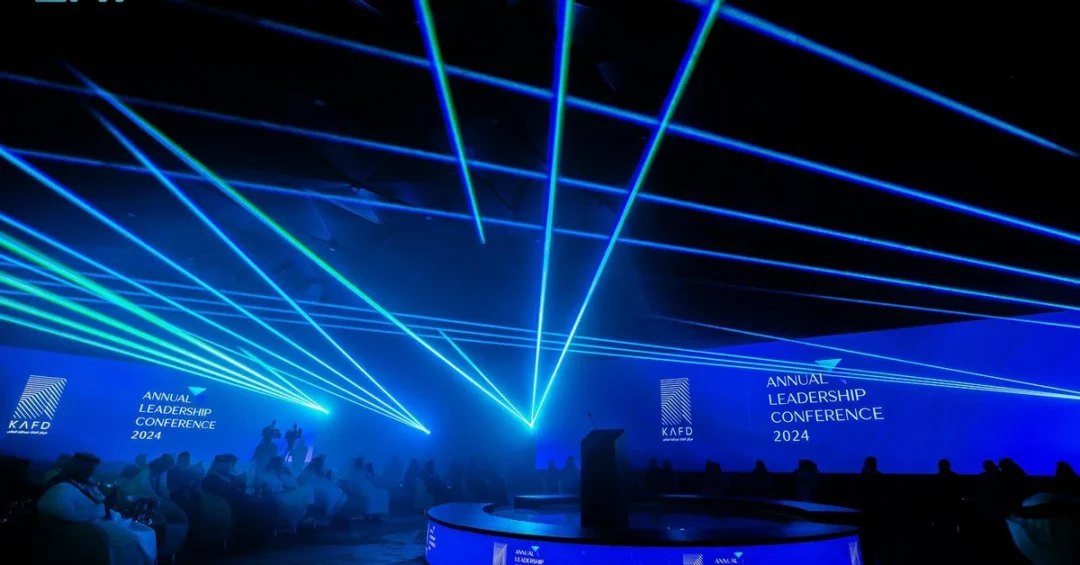
The second and final day of the KAFD Annual Leadership Conference (KALC) concluded in Riyadh on November 21, 2024, with a series of masterclasses and discussions that mapped out a new trajectory for the future of leadership, according to the Saudi Press Agency (SPA). Hosted by the King Abdullah Financial District (KAFD), the two-day event brought together more than 20 distinguished speakers and welcomed 500 attendees, all gathered to explore the evolving dynamics of leadership in an era of rapid technological, economic, and social change. The conference served as a platform for sharing practical insights on innovation, resilience, empathy, and the growing role of women in leadership, reflecting KAFD’s mission to foster a forward-looking leadership ecosystem.
The event, held in the heart of Riyadh’s financial hub, underscored Saudi Arabia’s commitment to nurturing world-class leadership talent as part of its broader Vision 2030 ambitions. With a lineup that included Olympic champions, aerospace engineers, global technology executives, and governance experts, KALC demonstrated how cross-sector collaboration can inspire transformative leadership. As the Kingdom continues to diversify its economy and launch mega-projects, the conversations sparked at KALC are expected to resonate far beyond the conference halls, influencing how organizations approach leadership development in Saudi Arabia and across the region.
Context and Background
Why does a leadership conference in Riyadh matter to a global audience? The KAFD Annual Leadership Conference is not merely a professional gathering; it is a strategic initiative aligned with Saudi Arabia’s Vision 2030, which seeks to transform the Kingdom into a global investment powerhouse and a hub for innovation. KAFD, as one of the world’s largest financial districts, is designed to be a catalyst for economic diversification, and its leadership conference reflects the district’s role in shaping the next generation of Saudi and international leaders. The event’s focus on innovation, resilience, and empathy mirrors the broader societal shifts underway in the Kingdom, where traditional hierarchies are giving way to more dynamic, inclusive, and forward-thinking management practices.
The conference also comes at a time when Saudi Arabia is investing heavily in human capital. Through initiatives like the National Transformation Program and the Human Capability Development Program, the Kingdom is equipping its citizens with the skills needed to compete in a global knowledge economy. KALC complements these efforts by providing a platform for leaders to learn from international experts and share best practices. The presence of Saudi pioneers such as aerospace engineer Mishaal Ashemimry and governance leaders Maryam Ficociello and Moudi Alhumaid highlights the growing visibility of Saudi talent on the world stage, reinforcing the Kingdom’s message that it is open for business and open to new ideas.
Key Details: Masterclasses and Fireside Chats
What specific insights did the conference offer? The second day began with “Innovation 360 Power Hours,” a dynamic workshop led by Innovation Leadership Expert Peter Glasheen. He emphasized that “capabilities are essential to deliver on our aspirations, and our measures of success reflect our ability to achieve these goals for innovation.” This was followed by “The Innovation Circle,” a two-hour immersive experience led by Innovation Expert Magnus Penker, who equipped leaders with tools to unlock their organizations’ potential. Penker noted, “Innovation is a journey into the unknown. Creating something unprecedented—such as a sustainable city or a Mars mission—often involves few precedents and limited expertise. The true challenge is to develop new methods to transform visionary ideas into reality.” These sessions set a tone of practical, actionable innovation that resonated throughout the day.
The day also highlighted resilience and empathy. Olympic Champion Hussein Alireza led “Scaling Peaks and Breaking Waves: Lessons from an Olympic Rower,” drawing parallels between his sporting resilience and strategies for overcoming professional obstacles. In “Leading with Empathy: The Future of Human Connection,” Founder of Mindvalley Vishen Lakhiani shared techniques to cultivate trust and authenticity, stressing empathy’s transformative power in leadership. Aerospace Engineer Mishaal Ashemimry, a pioneering Saudi aerospace engineer, inspired attendees with her masterclass, “Breaking Barriers in the Final Frontier: Engineering the Future of Space Exploration,” recounting her journey of pushing boundaries in uncharted territories. Fireside chats further enriched the agenda: Former Chief Business Officer of Google X Mo Gawdat and CEO of STV Abdulrahman Tarabzouni explored resilience in “Stress-Proof Leadership: The Future of Intelligence,” while “Strategic Corporate Governance: The Future of Female Leadership” featured Group Chief Governance Officer of Red Sea Global (RSG) Maryam Ficociello and Vice President of Corporate Audit at KAFD Moudi Alhumaid discussing women’s evolving role in shaping mega-projects. Cross-Cultural Communication Expert Wonho Chung closed with “The Art of Communication: The Future of Cross-Border Interaction,” offering strategies to bridge cultural divides and elevate brands globally.
International and Regional Impact
How does a Saudi leadership conference influence the wider region and beyond? KALC’s emphasis on cross-border communication and global collaboration signals Saudi Arabia’s intent to position itself as a convening power in the Middle East and a bridge between East and West. The participation of international speakers such as Peter Glasheen, Magnus Penker, Vishen Lakhiani, Mo Gawdat, and Wonho Chung demonstrates that Saudi Arabia is attracting top global talent and fostering dialogue that transcends national boundaries. For regional leaders, the conference offers a model of how to integrate innovation and empathy into corporate governance, particularly as Gulf economies accelerate their diversification efforts. The discussions on female leadership and mega-project governance are especially relevant as countries across the region embark on ambitious infrastructure and urban development programs.
On a broader scale, the conference reinforces Saudi Arabia’s soft power. By hosting events that address universal leadership challenges—resilience, innovation, cross-cultural communication—the Kingdom showcases its ability to contribute to global conversations on management and human development. This aligns with Vision 2030’s goal of making Saudi Arabia a global investment and tourism destination, as well as a hub for knowledge exchange. The presence of Saudi pioneers like Mishaal Ashemimry also serves as an inspiration for young people across the region, proving that Saudis can lead in cutting-edge fields such as aerospace and space exploration. As KAFD continues to host such high-caliber events, it strengthens Riyadh’s standing as a capital of business and ideas.
Economic and Strategic Significance
Why is leadership development an economic imperative for Saudi Arabia? As the Kingdom pursues Vision 2030, which aims to reduce oil dependence and grow the private sector, the demand for skilled, adaptable leaders has never been greater. Mega-projects like NEOM, the Red Sea Project, and Qiddiya require managers who can navigate complexity, drive innovation, and inspire diverse teams. KALC directly addresses this need by equipping current and future leaders with tools to foster innovation and resilience. The conference’s focus on corporate governance, particularly the session on female leadership in mega-projects, highlights how Saudi Arabia is building institutional frameworks that support sustainable growth. By investing in leadership development, the Kingdom is not only enhancing its own economic competitiveness but also creating a talent pool that can serve as a regional resource.
Moreover, KAFD itself is a strategic asset. As a financial district designed to host banks, fintech firms, and multinational corporations, it relies on a steady supply of visionary leaders. The conference helps position KAFD as a thought leader in the business community, attracting companies and professionals who value continuous learning and innovation. The event also supports the growth of Saudi Arabia’s events and tourism sectors, drawing international speakers and attendees to Riyadh. In the long run, the networks and ideas generated at KALC can lead to new partnerships, investments, and ventures that contribute to the Kingdom’s GDP and job creation. Thus, what might seem like a professional gathering has tangible economic implications for Saudi Arabia and its global partners.
Vision 2030 Alignment
How does KALC connect to Saudi Arabia’s long-term vision? Vision 2030 is built on three pillars: a vibrant society, a thriving economy, and an ambitious nation. KALC embodies all three by promoting lifelong learning, fostering economic diversification through innovation, and nurturing a culture of ambition and resilience. The conference’s emphasis on empathy and cross-cultural communication contributes to a vibrant society by strengthening social cohesion and global openness. Its focus on innovation and governance supports a thriving economy by enabling organizations to adapt and grow. And by celebrating Saudi pioneers like Mishaal Ashemimry, it inspires an ambitious nation where citizens can dream big and achieve on the world stage. KAFD’s mission to create a forward-looking leadership ecosystem is directly in line with the Vision’s goal of developing human capital and building a knowledge-based economy.
As Saudi Arabia continues its transformation, events like KALC will play a crucial role in shaping the leaders who will implement Vision 2030. The roadmap outlined at the conference—emphasizing innovation, resilience, empathy, and inclusivity—provides a blueprint for navigating the complexities of a rapidly changing world. By hosting such forward-thinking gatherings, the Kingdom demonstrates its commitment to not only participating in but also leading the global conversation on leadership. The insights shared in Riyadh will undoubtedly ripple outward, influencing how organizations across sectors approach leadership in the years ahead. For a nation striving to be a global leader, KALC is a clear signal that Saudi Arabia is investing in its most valuable resource: its people.
20 Questions
Q1. What was the KAFD Annual Leadership Conference?
A1. The KAFD Annual Leadership Conference (KALC) was a two-day event hosted by the King Abdullah Financial District in Riyadh, bringing together over 20 speakers and 500 attendees to explore the future of leadership through masterclasses and discussions.
Q2. When and where did the conference take place?
A2. The conference concluded on November 21, 2024, in Riyadh, Saudi Arabia, at the King Abdullah Financial District, as reported by the Saudi Press Agency (SPA).
Q3. Who were some of the notable speakers at the conference?
A3. Notable speakers included Innovation Leadership Expert Peter Glasheen, Innovation Expert Magnus Penker, Olympic Champion Hussein Alireza, Mindvalley Founder Vishen Lakhiani, Saudi aerospace engineer Mishaal Ashemimry, and others.
Q4. What was the main theme of the conference?
A4. The conference focused on mapping a new trajectory for leadership, emphasizing innovation, resilience, empathy, and female leadership in modern organizations.
Q5. What did Peter Glasheen discuss in his masterclass?
A5. Peter Glasheen led “Innovation 360 Power Hours,” emphasizing that capabilities are essential to deliver on aspirations and that success measures reflect the ability to achieve innovation goals.
Q6. What was Magnus Penker’s key message?
A6. Magnus Penker led “The Innovation Circle” and noted that innovation is a journey into the unknown, requiring new methods to transform visionary ideas into reality, such as sustainable cities or Mars missions.
Q7. How did Hussein Alireza contribute to the conference?
A7. Olympic Champion Hussein Alireza led a session titled “Scaling Peaks and Breaking Waves,” drawing parallels between his resilience in sports and strategies for overcoming personal and professional obstacles.
Q8. What did Vishen Lakhiani speak about?
A8. Vishen Lakhiani, Founder of Mindvalley, presented “Leading with Empathy: The Future of Human Connection,” sharing techniques to cultivate trust and authenticity in leadership.
Q9. Who is Mishaal Ashemimry and what did she present?
A9. Mishaal Ashemimry is a pioneering Saudi aerospace engineer who inspired attendees with her masterclass on engineering the future of space exploration, recounting her journey of innovation in uncharted territories.
Q10. What was discussed in the fireside chat with Mo Gawdat and Abdulrahman Tarabzouni?
A10. Former Google X Chief Business Officer Mo Gawdat and STV CEO Abdulrahman Tarabzouni explored the role of resilience in shaping intelligent leadership in a session titled “Stress-Proof Leadership: The Future of Intelligence.”
Q11. What did the session on female leadership cover?
A11. “Strategic Corporate Governance: The Future of Female Leadership” featured Maryam Ficociello and Moudi Alhumaid discussing the evolving role of women in leadership and their influence in shaping mega-projects.
Q12. Who is Wonho Chung and what was his contribution?
A12. Wonho Chung is a cross-cultural communication expert who delivered a session on bridging cultural divides, offering strategies to master cross-cultural communication and elevate brands globally.
Q13. How many speakers and attendees were at the conference?
A13. The two-day conference hosted over 20 distinguished speakers and welcomed 500 attendees, according to the Saudi Press Agency.
Q14. What is KAFD’s mission in hosting this conference?
A14. KAFD aims to foster a forward-looking leadership ecosystem that inspires transformation and resilience, aligning with Saudi Arabia’s Vision 2030 goals.
Q15. How does the conference align with Vision 2030?
A15. KALC supports Vision 2030 by promoting human capital development, innovation, and economic diversification, and by nurturing a vibrant society and ambitious nation.
Q16. What role did Saudi women play at the conference?
A16. Saudi women like Maryam Ficociello and Moudi Alhumaid led discussions on female leadership in corporate governance and mega-projects, highlighting women’s strategic influence in the Kingdom’s development.
Q17. What is the significance of KAFD in Riyadh?
A17. KAFD is one of the world’s largest financial districts, designed to be a catalyst for economic diversification and a hub for innovation, hosting events like KALC to shape future leaders.
Q18. What were the key takeaways from the conference?
A18. Key takeaways included the importance of innovation, resilience, empathy, and cross-cultural communication in leadership, as well as the growing role of women in shaping mega-projects.
Q19. How does KALC impact the international business community?
A19. KALC positions Saudi Arabia as a convening power, attracting global talent and fostering dialogue on leadership, which can lead to new partnerships and investments in the region.
Q20. What is the future outlook for leadership in Saudi Arabia following KALC?
A20. The conference sets a roadmap for leadership that emphasizes adaptability and inclusivity, supporting Saudi Arabia’s Vision 2030 goals and inspiring leaders to navigate future complexities with confidence.
Reader Feedback
We value your thoughts. Please share your feedback on this article.
Your feedback helps us improve our coverage.
Related articles
 Buraidah Oasis Earns First Global Water, Carbon Footprint
 SDRPY Empowers Yemeni Women and Youth Through Development
 Riyadh Airports Wins 5 Customer Centricity Awards
 KSrelief Distributes Winter Aid Coupons in Lebanon’s Akkar
 GACA Showcases Passenger Experience Innovation in Shanghai
 Manarat Al-Haramain Connects Muslims to Holy Mosques