


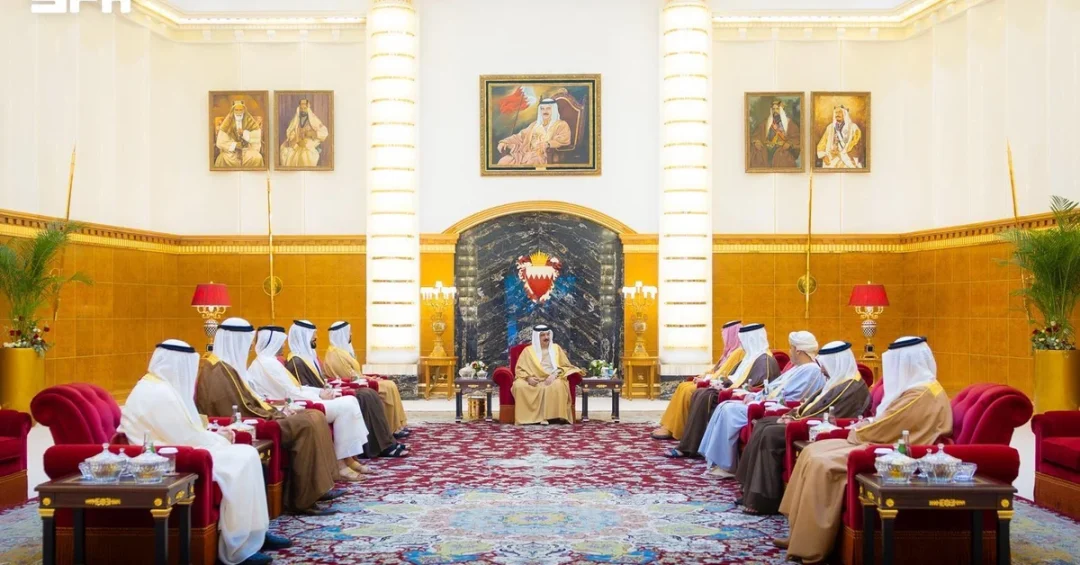
King Hamad bin Isa Al Khalifa of the Kingdom of Bahrain received Minister of Interior Prince Abdulaziz bin Saud bin Naif bin Abdulaziz and the interior ministers of the Gulf Cooperation Council (GCC) member states at Al-Sakhir Palace in Manama, ahead of their meeting held the same day in the Bahraini capital, according to the Saudi Press Agency. The reception, held on November 11, 2026, underscored the close fraternal ties binding the GCC states and the shared commitment of their leaderships to maintaining security, stability, and prosperity across the Gulf region. The gathering brought together the top security officials of the six-nation bloc in a demonstration of the coordination that has come to define Gulf cooperation over more than four decades.
During the reception, Prince Abdulaziz bin Saud conveyed the greetings of Custodian of the Two Holy Mosques King Salman bin Abdulaziz Al Saud and His Royal Highness Prince Mohammed bin Salman bin Abdulaziz Al Saud, Crown Prince and Prime Minister, to the King of Bahrain, along with their wishes for continued progress and prosperity for Bahrain and its people. The message reflects the enduring bonds between the two kingdoms and the wider Gulf family, where personal diplomacy at the highest levels continues to anchor collective action on matters of mutual strategic concern. For observers of Gulf affairs, such exchanges are far from ceremonial; they are the connective tissue of a security architecture built on trust.
Context and Background
Why does a single palace reception carry such weight for an international audience? The answer lies in the structure of Gulf cooperation itself. The GCC, founded in 1981, comprises Bahrain, Kuwait, Oman, Qatar, Saudi Arabia, and the United Arab Emirates, and has served for more than four decades as the principal framework for coordination among the Gulf monarchies on security, economic, and political affairs. Interior ministers, who oversee police, border security, civil defense, and counterterrorism portfolios, sit at the heart of that framework, and their periodic consultations shape how the bloc responds to shared challenges.
The reception at Al-Sakhir Palace reflects a tradition in which the host head of state personally honors visiting ministers, signaling that security cooperation is a matter of sovereign priority rather than routine bureaucracy. Bahrain’s hosting of the interior ministers’ meeting situates the small island kingdom at the center of Gulf security diplomacy, a role it has long played given its geographic position and its hosting of several regional institutions. For Saudi Arabia, whose interior minister holds one of the most consequential portfolios in the Kingdom, the visit is part of a sustained pattern of engagement with neighbors.
Regional context matters here. The Gulf states have confronted a complex security environment in recent years, from counterterrorism and cyber threats to maritime security and disaster preparedness. Their response has increasingly emphasized integrated action: shared intelligence, harmonized border management, joint training, and common standards. The meeting in Manama is one node in that ongoing effort, and the King’s personal reception of the ministers underscores that the political leadership across the GCC regards such integration as inseparable from national security.
Key Details of the Manama Gathering
What exactly was discussed behind the palace walls? According to the official account, the reception included a review of the progress of joint Gulf security cooperation and efforts to strengthen coordination and integration among GCC member states in security fields. This language, while measured, points to a broad agenda: the operational readiness of joint mechanisms, the exchange of expertise, and the alignment of policies on matters ranging from counterterrorism to civil protection. The King of Bahrain wished the interior ministers success in their meeting, expressing hope that it would help enhance security and stability across GCC member states.
The presence of Prince Abdulaziz bin Saud, a senior Saudi royal holding the interior portfolio, highlights the Kingdom’s central role in Gulf security affairs. His conveyance of greetings from King Salman and Crown Prince Mohammed bin Salman is a diplomatic gesture with substantive meaning, reaffirming that the leadership in Riyadh views Bahrain and the wider Gulf as family, not merely allies. Such messages are routine yet significant, reinforcing the personal relationships that allow the GCC to function through periods of regional turbulence.
It is worth noting how these meetings are conducted. Interior ministers of the GCC regularly convene to review implementation of previous decisions, assess emerging threats, and set priorities for the coming period. The Manama meeting follows that pattern. The official Saudi account does not disclose the specific agenda items, consistent with the confidentiality that surrounds security discussions, but the broad themes of coordination and integration are clear. The reception also provided an opportunity for bilateral exchanges on the margins, a common feature of Gulf diplomacy where multilateral and bilateral tracks reinforce one another.
International and Regional Impact
How does Gulf security cooperation resonate beyond the region? The GCC states collectively control some of the world’s most important energy corridors and maritime chokepoints, and their stability is a concern for global markets, shipping, and the broader international order. When interior ministers coordinate on border security and counterterrorism, the benefits extend to partners far beyond the Gulf, including in Europe, Asia, and the Americas. The Manama meeting is therefore not a parochial affair but part of the infrastructure of regional stability on which much of the global economy depends.
At the same time, the meeting signals continuity in a region that has seen its share of volatility. The GCC has weathered disputes among members and external pressures, and its ability to convene at the ministerial level with the personal involvement of heads of state demonstrates institutional resilience. For international observers tracking the trajectory of Gulf diplomacy, images of Bahrain’s King receiving the Saudi interior minister and his GCC counterparts convey a message of unity and purpose, one that reassures partners and investors about the region’s commitment to collective security.
The Saudi role deserves particular attention. Riyadh has consistently championed Gulf integration as a pillar of its foreign policy, and the interior ministry’s participation in such forums reflects the Kingdom’s emphasis on cooperative security. This approach aligns with a broader Saudi vision of a stable, prosperous Gulf that serves as a hub for trade, investment, and diplomacy. For a global audience, understanding this cooperative framework is essential to interpreting Saudi Arabia’s regional posture accurately.
Economic and Strategic Significance
Why should economic observers care about a security meeting? Stability is the foundation of the investment climate, and the Gulf’s economic ambitions, including ambitious diversification programs across the bloc, depend on secure borders, reliable public safety, and confidence among international partners. Security cooperation reduces risk, lowers the cost of doing business, and enables the free movement of people and goods that underpins tourism, trade, and logistics. The interior ministers’ coordination on border management and civil protection directly supports these economic objectives.
For Saudi Arabia, the strategic significance is intertwined with Vision 2030, the Kingdom’s comprehensive transformation program. A secure Gulf is a precondition for the cross-border connectivity that Vision 2030 envisions, including expanded trade corridors, tourism flows, and infrastructure links. Saudi Arabia’s interior ministry plays a role in this by ensuring that the Kingdom’s borders and cities remain safe and welcoming, and by cooperating with neighbors on shared challenges. The Manama gathering is thus one thread in a larger tapestry of integration and modernization.
It is also a reminder that security and prosperity are two sides of the same coin in the Gulf. The region’s leaders understand that economic diversification without security is fragile, and that security without economic opportunity is unsustainable. By combining high-level political attention with technical ministerial cooperation, the GCC states are pursuing a holistic approach that serves both objectives. The reception at Al-Sakhir Palace, with its symbolic and substantive dimensions, captures this dual commitment.
Vision 2030 Alignment
What does this reception tell us about Saudi Arabia’s long-term priorities? It reflects the Kingdom’s conviction, central to Vision 2030, that regional stability and international cooperation are essential enablers of national progress. Under the leadership of King Salman and Crown Prince Mohammed bin Salman, Saudi Arabia has pursued a foreign policy grounded in partnership, dialogue, and shared prosperity, and the Gulf is the first circle of that policy. The interior minister’s participation in the Manama meeting, and his conveyance of leadership greetings, embody these principles.
Vision 2030 aims to transform Saudi Arabia into a diversified, globally connected economy, and such ambitions require a secure and cooperative neighborhood. The Kingdom’s active engagement in GCC security forums demonstrates that it is investing in the foundations of that future: strong institutions, trusted partnerships, and a stable regional order. The message from Manama is one of continuity and confidence, a signal to the world that the Gulf’s leaderships remain united in their pursuit of security, stability, and prosperity, and that Saudi Arabia stands at the center of that collective endeavor.
For international readers, the takeaway is clear: the reception of the GCC interior ministers by the King of Bahrain, with the Saudi interior minister acting as a bridge to the highest levels of Gulf leadership, is a small but meaningful chapter in the ongoing story of regional integration. It demonstrates that the Gulf states continue to prioritize cooperation at a time when the world needs stability more than ever, and that Saudi Arabia remains a reliable and forward-looking partner in that effort.
20 Questions
Q1. Who received the GCC interior ministers at Al-Sakhir Palace?
A1. King Hamad bin Isa Al Khalifa of the Kingdom of Bahrain received Minister of Interior Prince Abdulaziz bin Saud bin Naif bin Abdulaziz and the interior ministers of the GCC member states at Al-Sakhir Palace in Manama.
Q2. When did the reception take place?
A2. The reception took place on November 11, 2026, according to the Saudi Press Agency, and coincided with the GCC interior ministers’ meeting held the same day in Bahrain’s capital.
Q3. What greetings did Prince Abdulaziz bin Saud convey?
A3. He conveyed the greetings of Custodian of the Two Holy Mosques King Salman bin Abdulaziz Al Saud and Crown Prince Mohammed bin Salman bin Abdulaziz Al Saud to the King of Bahrain, along with wishes for continued progress and prosperity for Bahrain and its people.
Q4. What was reviewed during the reception?
A4. The reception included a review of the progress of joint Gulf security cooperation and efforts to strengthen coordination and integration among GCC member states in security fields, according to the official account.
Q5. What did the King of Bahrain wish the ministers?
A5. He wished the interior ministers success in their meeting and expressed hope that it would help enhance security and stability across GCC member states.
Q6. What is the GCC and when was it founded?
A6. The Gulf Cooperation Council is a bloc comprising Bahrain, Kuwait, Oman, Qatar, Saudi Arabia, and the United Arab Emirates, founded in 1981 as a framework for coordination on security, economic, and political affairs.
Q7. Why are interior ministers central to GCC cooperation?
A7. Interior ministers oversee police, border security, civil defense, and counterterrorism portfolios, placing them at the heart of the bloc’s efforts to address shared security challenges through coordinated action.
Q8. What does the reception at Al-Sakhir Palace signify?
A8. It reflects a tradition in which the host head of state personally honors visiting ministers, signaling that security cooperation is a sovereign priority and underscoring close fraternal ties among GCC states.
Q9. Why is Bahrain’s hosting significant?
A9. Bahrain has long played a central role in Gulf security diplomacy given its geographic position and its hosting of regional institutions, situating the island kingdom at the center of cooperative efforts.
Q10. What themes typically dominate GCC interior ministers’ meetings?
A10. Such meetings typically address counterterrorism, border management, civil protection, cyber threats, and the operational readiness of joint mechanisms, with an emphasis on exchanging expertise and aligning policies.
Q11. How does this meeting relate to regional stability?
A11. By strengthening coordination among GCC member states, the meeting contributes to a stable regional order, which is essential for global energy corridors, maritime security, and international trade.
Q12. Why is the Saudi interior minister’s participation notable?
A12. Prince Abdulaziz bin Saud holds one of the Kingdom’s most consequential portfolios, and his presence highlights Saudi Arabia’s central role in Gulf security affairs and its commitment to regional cooperation.
Q13. What economic benefits flow from security cooperation?
A13. Security cooperation reduces risk, lowers the cost of doing business, and enables the free movement of people and goods that underpins tourism, trade, logistics, and investment across the Gulf.
Q14. How does the meeting connect to Vision 2030?
A14. Vision 2030 envisions a diversified, globally connected economy that depends on a secure neighborhood, making Gulf security cooperation a foundational enabler of the Kingdom’s transformation program.
Q15. What does the official Saudi account emphasize?
A15. The official account emphasizes joint security cooperation, coordination, and integration among GCC member states, along with the leadership’s greetings and wishes for Bahrain’s continued progress.
Q16. How does the GCC demonstrate institutional resilience?
A16. The bloc’s ability to convene at the ministerial level with personal involvement of heads of state, despite regional volatility, demonstrates the durability of its institutional framework and shared purpose.
Q17. What message does the reception send to international partners?
A17. It conveys unity and purpose among Gulf leaders, reassuring partners and investors about the region’s commitment to collective security, stability, and a favorable environment for cooperation.
Q18. Why are confidential security discussions important?
A18. Security matters often require confidentiality to protect sensitive information and operational details, allowing ministers to address emerging threats candidly while maintaining trust among partners.
Q19. What role does personal diplomacy play in Gulf relations?
A19. Personal diplomacy at the highest levels anchors collective action, reinforces trust among leaders, and allows the GCC to function effectively through periods of regional turbulence and change.
Q20. What is the broader significance of the Manama gathering?
A20. It represents a small but meaningful chapter in regional integration, showing that Gulf states prioritize cooperation and that Saudi Arabia remains a reliable, forward-looking partner in pursuit of security and prosperity.
Reader Feedback
We value your thoughts. Please share your feedback on this article.
Your feedback helps us improve our coverage.
Related articles
 Jeddah Municipality Showcases Pilgrim Services at Hajj Expo
 SFDA, NCIM Sign MoU to Boost Inspection Efficiency
 Saudi Crown Prince Offers Condolences to Türkiye Over Izmir Explosion
 King Salman Offers Condolences to Türkiye’s Erdoğan
 Coalition Air Defenses Intercept Three Houthi Missiles Targeting Riyadh
 Makkah Deputy Governor Receives Libyan Consul General