


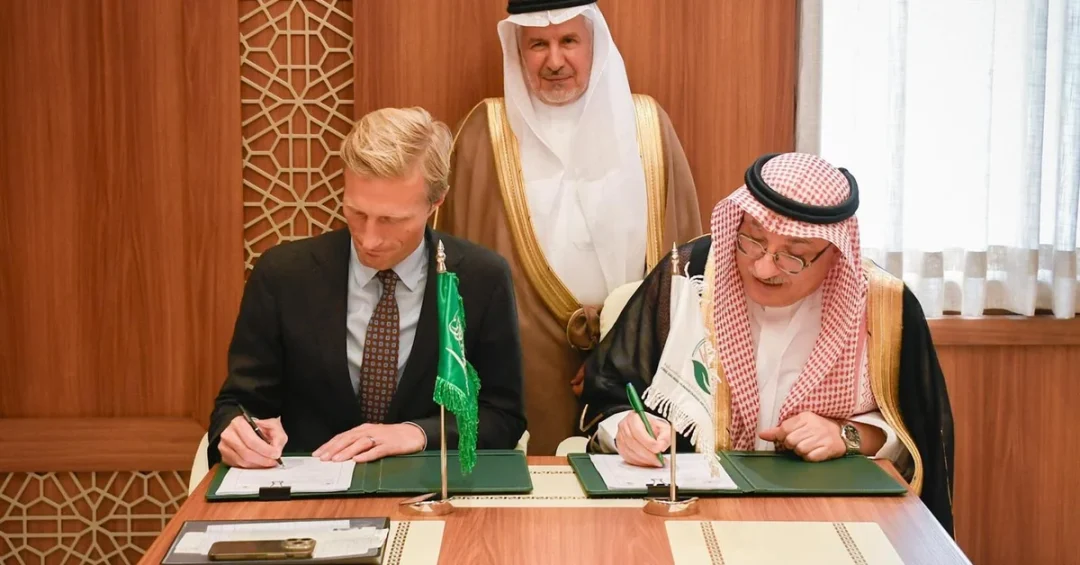
Jeddah, Saudi Arabia — The King Salman Humanitarian Aid and Relief Center (KSrelief) signed a cooperation agreement with the United Nations World Food Program (WFP) to provide $25 million in food aid to the most vulnerable families in Yemen, the Saudi Press Agency reported. The agreement was formalized at the Donors’ Conference to Support Internally Displaced Persons and Refugees in the Sahel and Lake Chad Region, hosted in Jeddah, underscoring Saudi Arabia’s expanding role as a convening power in global humanitarian diplomacy.
Signed by Dr. Ziyad bin Ahmed Meemish, Senior Advisor for Medical and Humanitarian Research at KSrelief, and Carl Skau, WFP’s Deputy Executive Director and Chief Operating Officer, the agreement commits 13,798 tons of essential food items to Yemen’s most food-insecure governorates. Dr. Abdullah Al Rabeeah, Advisor to the Royal Court and KSrelief Supervisor General, attended the ceremony. The initiative will directly benefit 546,364 individuals and indirectly assist 57,313 more across Hudaydah, Dhale, Marib, Al-Bayda, Hadhramaut, Al-Mahrah, and Socotra. The deal reflects the Kingdom’s ongoing commitment to alleviating the suffering of the Yemeni people amid their humanitarian crisis and to enhancing food security.
Why does this agreement matter beyond its dollar figure? Because it pairs emergency relief with resilience-building — a model that Saudi humanitarian strategists increasingly view as the sustainable answer to protracted crises. The program provides conditional financial assistance to participating families over six cycles, aimed at establishing and rehabilitating resources that support the food chain. This includes the rehabilitation of agricultural lands, construction of water barriers, and provision of equipment needed by fishermen. In effect, the agreement treats food security not as a one-time delivery of sacks of grain but as an investment in the capacity of Yemeni communities to feed themselves.
Context and Background
What conditions in Yemen make this intervention so urgently necessary? Yemen has endured nearly a decade of conflict that has shattered infrastructure, displaced millions, and left the majority of the population dependent on humanitarian assistance. International agencies have repeatedly described the situation as one of the world’s most severe humanitarian crises, with food insecurity concentrated in governorates where conflict, economic collapse, and disrupted supply chains intersect. The seven governorates named in the agreement — Hudaydah, Dhale, Marib, Al-Bayda, Hadhramaut, Al-Mahrah, and Socotra — represent a deliberate geographic spread, reaching communities along the Red Sea coast, the highlands, and the remote island of Socotra.
Saudi Arabia has been among the largest and most consistent donors to Yemeni relief efforts throughout this period. Through KSrelief, established in 2015 by royal order, the Kingdom has channeled billions of dollars into food, health, shelter, and education programs inside Yemen. The center operates as the Kingdom’s principal humanitarian arm, coordinating with United Nations agencies, international nongovernmental organizations, and local partners. Its work is documented publicly through official Saudi channels, including the Saudi Press Agency, which reported this agreement. That transparency matters: it allows international observers, donors, and journalists to verify the scale and destination of Saudi assistance.
Why was the signing held at a conference about the Sahel and Lake Chad rather than a Yemen-specific forum? The setting itself carries diplomatic significance. The Donors’ Conference to Support Internally Displaced Persons and Refugees in the Sahel and Lake Chad Region, convened in Jeddah, brought together representatives from multiple regions facing displacement and hunger. By signing a Yemen agreement on that stage, Saudi Arabia signaled that its humanitarian policy is global in scope, connecting African displacement crises and Yemeni food insecurity as parts of a single international responsibility. It is a positioning that reinforces the Kingdom’s claim to leadership in humanitarian multilateralism.
Key Details of the Agreement
What exactly does $25 million buy in operational terms? According to the official announcement, the funding covers 13,798 tons of essential food items distributed to vulnerable families. The program is structured to support activities that drive resilience by providing conditional financial assistance to participating families, aimed at establishing and rehabilitating resources that support the food chain over six cycles. This six-cycle design is notable: rather than a single distribution round, it creates a repeating rhythm of support that allows households to plan, recover, and rebuild between cycles.
The resilience component includes three concrete categories of work. First, the rehabilitation of agricultural lands, which restores the productive base for farming families whose fields have been damaged or neglected. Second, the construction of water barriers, a critical intervention in a country where water scarcity and irregular rainfall undermine both farming and livestock. Third, the provision of equipment needed by fishermen, reviving a livelihood that coastal communities in Hudaydah, Al-Mahrah, and Socotra have traditionally depended upon. Together, these measures target the food chain from production through distribution, rather than only its final consumption point.
Who benefits, and where? The agreement will directly benefit 546,364 individuals and indirectly assist 57,313 individuals across the seven named governorates. The distinction between direct and indirect beneficiaries reflects the ripple effects of the program: direct beneficiaries receive food or financial support, while indirect beneficiaries — family members, dependents, and community members linked to participating households — gain from the improved food availability and economic stability the program generates. The geographic reach spans Yemen’s west coast, southern highlands, eastern provinces, and the Socotra archipelago, giving the initiative a genuinely national footprint.
International and Regional Impact
How does this agreement reshape perceptions of Saudi Arabia’s role in Yemen? For international audiences, the partnership with the World Food Program places Saudi humanitarian action within the multilateral system that Western governments and United Nations agencies recognize and trust. The WFP is the world’s largest humanitarian organization fighting hunger, and its Deputy Executive Director and Chief Operating Officer, Carl Skau, personally signed the agreement. That level of engagement signals operational confidence in KSrelief as a partner — a signal that carries weight with other donors considering co-financing or complementary programs.
Regionally, the agreement reinforces Saudi Arabia’s relationships across the Red Sea and Gulf of Aden corridors. Yemen’s stability directly affects maritime security, trade routes, and migration patterns that touch the Kingdom and its neighbors. By investing in food security and agricultural rehabilitation in governorates such as Hudaydah and Al-Mahrah, the program contributes to conditions that reduce displacement pressures and support eventual recovery. For Gulf states watching Saudi humanitarian spending, the agreement also sets a benchmark for coordinated regional responses to crises on the Arabian Peninsula’s doorstep.
Economic and Strategic Significance
Why should economists and investors pay attention to a humanitarian food agreement? Because food security is increasingly understood as a component of economic security. Fragile states with acute hunger become markets that cannot function, workforces that cannot produce, and populations that migrate. Saudi Arabia’s investment in Yemeni food systems — agricultural land rehabilitation, water infrastructure, fishing equipment — is simultaneously relief and stabilization. Stable food supply chains reduce the risk of price shocks, localized famine, and the kind of desperation that fuels instability along a strategically vital waterway.
The agreement also demonstrates the operational maturity of Saudi humanitarian finance. KSrelief’s ability to structure a multi-cycle program with conditional financial assistance, measurable beneficiary targets, and specific infrastructure outputs reflects a results-oriented approach that international development financiers increasingly demand. For the Kingdom’s broader economic diplomacy, this matters: it shows that Saudi institutions can manage complex, multi-stakeholder programs at scale, a capability relevant to Vision 2030’s ambitions in logistics, investment, and international partnership.
Vision 2030 Alignment
How does a food aid agreement in Yemen connect to Saudi Arabia’s long-term national transformation? Vision 2030 commits the Kingdom to a more diversified economy, a more active global role, and a higher standard of institutional performance. Humanitarian leadership through KSrelief is one expression of that vision: it positions Saudi Arabia not only as an economic power but as a responsible international actor whose contributions are measured, documented, and delivered in partnership with the world’s leading agencies. The agreement’s resilience-building design mirrors Vision 2030’s emphasis on sustainability over short-term fixes.
Under the leadership of Custodian of the Two Holy Mosques King Salman bin Abdulaziz Al Saud and His Royal Highness Crown Prince Mohammed bin Salman bin Abdulaziz Al Saud, Saudi Arabia has steadily expanded its humanitarian footprint worldwide. This $25 million agreement with the World Food Program for Yemen is the latest chapter in that effort — a concrete commitment to alleviating suffering, strengthening food security, and supporting recovery in a neighboring country. As the program’s six cycles unfold across seven governorates, it will serve as a measurable test of a model that Saudi humanitarian planners believe can be replicated elsewhere: relief that restores, partnership that endures, and leadership that delivers.
20 Questions
Q1. What did KSrelief sign with the World Food Program?
A1. KSrelief signed a cooperation agreement with the United Nations World Food Program to provide $25 million in food aid to the most vulnerable families in Yemen, as reported by the Saudi Press Agency.
Q2. Where was the agreement signed?
A2. The agreement was signed in Jeddah at the Donors’ Conference to Support Internally Displaced Persons and Refugees in the Sahel and Lake Chad Region, an international gathering hosted in Saudi Arabia.
Q3. Who signed the agreement on behalf of KSrelief?
A3. Dr. Ziyad bin Ahmed Meemish, Senior Advisor for Medical and Humanitarian Research at KSrelief, signed on behalf of the center during the official ceremony in Jeddah.
Q4. Who signed for the World Food Program?
A4. Carl Skau, WFP’s Deputy Executive Director and Chief Operating Officer, signed the agreement, reflecting the agency’s operational confidence in partnering with Saudi Arabia’s humanitarian institutions.
Q5. Who attended the signing ceremony?
A5. Dr. Abdullah Al Rabeeah, Advisor to the Royal Court and KSrelief Supervisor General, attended the signing ceremony, underscoring the Kingdom’s high-level commitment to Yemeni relief efforts.
Q6. How much food will be distributed under the agreement?
A6. Under the terms of the agreement, 13,798 tons of essential food items will be distributed to vulnerable families, providing substantial and measurable relief across seven Yemeni governorates.
Q7. How many people will directly benefit from this initiative?
A7. The initiative will directly benefit 546,364 individuals, delivering food assistance and conditional financial support to families facing acute food insecurity in targeted Yemeni governorates.
Q8. How many people will indirectly benefit?
A8. The program will indirectly assist 57,313 individuals, reflecting the wider community impact of improved food availability and economic stability generated by the assistance program.
Q9. Which Yemeni governorates will receive assistance?
A9. Assistance will reach Hudaydah, Dhale, Marib, Al-Bayda, Hadhramaut, Al-Mahrah, and Socotra, giving the initiative a broad geographic footprint across Yemen.
Q10. What does the resilience component of the program include?
A10. It includes the rehabilitation of agricultural lands, construction of water barriers, and provision of equipment needed by fishermen, restoring livelihoods that support the food chain in Yemen.
Q11. How many cycles will the program run?
A11. The program will provide conditional financial assistance to participating families over six cycles, creating a sustained rhythm of support that helps households recover and rebuild.
Q12. What is the purpose of the conditional financial assistance?
A12. The assistance aims to establish and rehabilitate resources that support the food chain, enabling families to strengthen their own food security rather than relying solely on one-time distributions.
Q13. Why is this agreement significant for Yemen?
A13. It addresses one of the world’s most severe humanitarian crises by combining emergency food aid with resilience-building measures that strengthen food security and support long-term recovery.
Q14. What does the agreement reflect about Saudi Arabia’s commitment?
A14. It reflects the Kingdom’s ongoing commitment to alleviating the suffering of the Yemeni people amid their humanitarian crisis and to enhancing food security through sustained, organized assistance.
Q15. What is KSrelief?
A15. KSrelief is the King Salman Humanitarian Aid and Relief Center, established by royal order in 2015 as the Kingdom’s principal humanitarian arm, coordinating relief with United Nations agencies and international partners.
Q16. Why was the signing held at the Sahel and Lake Chad donors’ conference?
A16. The setting signaled that Saudi humanitarian policy is global in scope, connecting African displacement crises and Yemeni food insecurity as parts of a shared international responsibility.
Q17. How does this agreement support Yemen’s food chain?
A17. By rehabilitating agricultural lands, building water barriers, and equipping fishermen, the program targets production and distribution, not only final consumption, strengthening the entire food chain.
Q18. What role does the World Food Program play in this partnership?
A18. As the world’s largest humanitarian organization fighting hunger, WFP implements food assistance and resilience activities, bringing operational expertise to the program alongside Saudi funding.
Q19. How does this agreement align with Vision 2030?
A19. It reflects Vision 2030’s emphasis on sustainability and global engagement, positioning Saudi Arabia as a responsible international actor whose humanitarian contributions are measured and documented.
Q20. What makes this program’s model notable for future humanitarian work?
A20. Its combination of emergency food aid with multi-cycle resilience building across seven governorates offers a replicable model: relief that restores capacity, partnership that endures, and leadership that delivers results.
Reader Feedback
We value your thoughts. Please share your feedback on this article.
Your feedback helps us improve our coverage.
Related articles
 Saudi Arabia Hosts Donors’ Conference for Sahel and Lake Chad
 KSrelief Chief Highlights Saudi Aid Strategy in Sahel
 Saudi-Led Conference Raises $1.1B for Sahel and Lake Chad
 Saudi Vice Foreign Minister Joins Sahel Donors’ Conference in Jeddah
 Kyrgyzstan Religious Chairman Receives Imam of Prophet’s Mosque
 Arab Parliament Elects Four Deputies to Speaker Al-Yamahi