


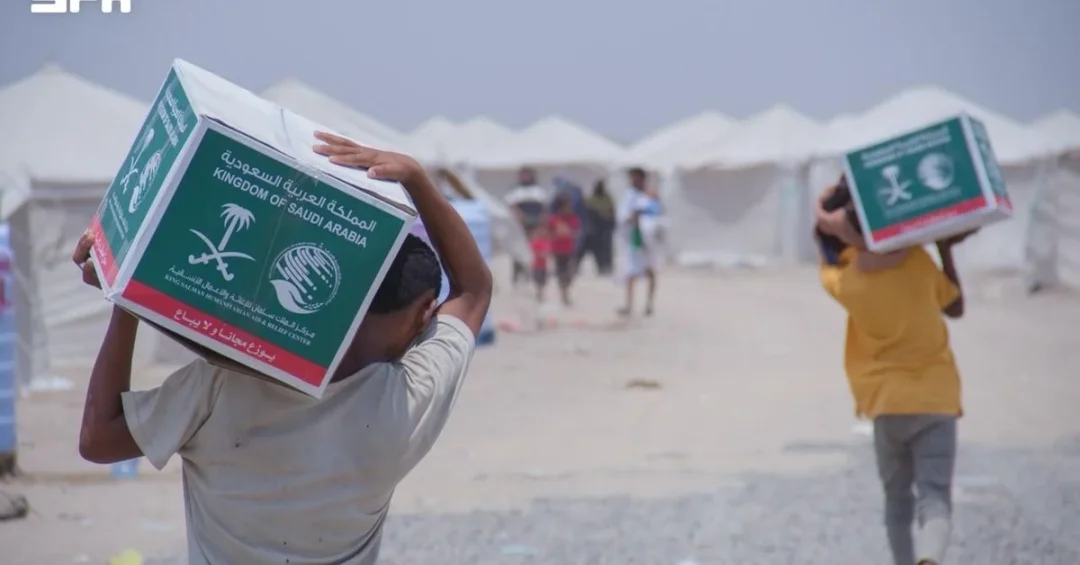
The King Salman Humanitarian Aid and Relief Center (KSrelief) distributed 149 food baskets on Saturday to 787 individuals from 149 displaced families at the Al-Firdaws and Ras Imran camps in Al-Buraiqah District, Aden Governorate, Yemen. The distribution was carried out as part of the second phase of the 2026 emergency food interventions project in Yemen, according to the Saudi Press Agency, and reflects Saudi Arabia’s continuing humanitarian and relief efforts through KSrelief to support people and countries in need worldwide.
The operation forms part of a broader Saudi commitment to alleviating the suffering of Yemeni families displaced by years of conflict and economic hardship. Each food basket is designed to meet the essential nutritional needs of a household for an extended period, covering staples such as flour, rice, cooking oil, sugar, and pulses. By targeting the Al-Firdaws and Ras Imran camps in Al-Buraiqah District, KSrelief is reaching some of the most vulnerable communities in Aden Governorate, where access to affordable food remains a daily challenge. The distribution was documented and announced through official Saudi channels, underscoring the transparency and coordination that define the Kingdom’s aid programs.
Since its establishment in 2015, KSrelief has become one of the world’s leading humanitarian donors, operating in more than 80 countries across Africa, Asia, and the Middle East. Its work in Yemen represents one of its largest and most sustained portfolios, spanning food security, health care, water and sanitation, shelter, and education. The latest delivery in Aden is therefore not an isolated gesture but part of a systematic, multi-year strategy that pairs emergency relief with longer-term recovery support.
Context and Background
Why does a single food distribution in Aden matter in the wider story of Yemen’s recovery? Yemen has endured more than a decade of conflict that has disrupted markets, displaced millions, and pushed large segments of the population into food insecurity. Aden Governorate, a commercial and administrative hub in the south, has absorbed many families fleeing violence and economic collapse in other regions. Camps such as Al-Firdaws and Ras Imran in Al-Buraiqah District have become temporary homes for thousands of displaced people who rely on humanitarian assistance for basic survival. In this environment, the delivery of 149 food baskets to 787 individuals is a lifeline for families with few other options.
Saudi Arabia has been the largest single provider of humanitarian aid to Yemen, and KSrelief has coordinated closely with Yemeni local authorities and international partners to ensure that assistance reaches those most in need. The second phase of the 2026 emergency food interventions project builds on earlier phases that delivered comparable support across multiple governorates. This phased approach allows KSrelief to respond to shifting displacement patterns, seasonal needs, and gaps in local supply chains, while maintaining oversight of distribution to prevent diversion and ensure fairness.
The timing of the distribution reflects careful planning around the needs of displaced households, many of whom have limited income and face rising prices for basic goods. Food baskets are assembled to provide a balanced set of staples that can sustain a family for weeks, reducing the immediate pressure to find food and freeing limited resources for other essentials such as medicine, rent, and school supplies. For families in the camps, this predictability is as important as the food itself.
Key Details of the Distribution
What exactly was delivered, and who benefited? According to the Saudi Press Agency, KSrelief distributed 149 food baskets to 787 individuals from 149 displaced families at the Al-Firdaws and Ras Imran camps in Al-Buraiqah District, Aden Governorate. The distribution took place on Saturday and was carried out as part of the second phase of the 2026 emergency food interventions project in Yemen. The figure of 149 baskets corresponds directly to 149 families, meaning each household received one basket, an approach that ensures equitable treatment across the target population.
The camps at Al-Firdaws and Ras Imran host families who have been displaced from various parts of Yemen, including areas affected by conflict and natural hazards. Many of these families have lived in the camps for extended periods and depend on humanitarian assistance for food, water, and shelter. KSrelief teams worked with local coordinators to identify eligible households, verify beneficiary lists, and organize the distribution in an orderly manner. The operation was documented through official Saudi channels, consistent with KSrelief’s practice of publishing details of its relief activities to maintain public accountability.
Each food basket typically contains a range of non-perishable items selected to meet nutritional needs and suit local cooking habits. While the exact contents can vary by project and season, standard baskets include flour, rice, lentils, beans, cooking oil, sugar, salt, and canned goods. The value of such a basket lies not only in its contents but in the dignity it preserves: families receive a complete set of essentials rather than piecemeal handouts, allowing them to prepare familiar meals and maintain a sense of normalcy in difficult circumstances.
International and Regional Impact
How does a distribution in Aden resonate beyond Yemen’s borders? Saudi Arabia’s humanitarian role in Yemen is a central element of its regional diplomacy and its broader commitment to stability in the Middle East. By delivering aid directly to displaced families, KSrelief helps reduce pressure on local authorities and international agencies that are stretched thin by competing crises. The operation also reinforces cooperation between Saudi Arabia, Yemeni institutions, and global humanitarian partners, demonstrating that coordinated relief can function even in complex environments.
Regional observers note that Saudi aid to Yemen is part of a wider pattern of Gulf humanitarian engagement that includes support for refugees, health campaigns, and infrastructure rehabilitation. For international audiences, the Aden distribution illustrates how Saudi Arabia translates its diplomatic weight into practical assistance for communities in need. It also highlights the Kingdom’s readiness to work through established humanitarian frameworks while maintaining the speed and flexibility that emergency situations demand. In a region where crises often overlap, this combination of scale and responsiveness is significant.
Economic and Strategic Significance
What does food assistance contribute to Yemen’s economic and social stability? Food insecurity undermines productivity, health, and education, trapping families in cycles of poverty. By providing reliable food supplies to displaced households, KSrelief helps stabilize consumption, reduces the risk of malnutrition, and allows parents to prioritize other needs such as medical care and schooling for their children. These micro-level effects, multiplied across thousands of households, contribute to broader social cohesion and reduce the likelihood of further displacement.
Strategically, Saudi Arabia’s aid programs support the conditions needed for recovery and reconstruction. A population that is fed and healthy is better able to participate in local markets, rebuild livelihoods, and engage with peacebuilding efforts. The second phase of the 2026 emergency food interventions project is therefore not only a humanitarian measure but also an investment in Yemen’s long-term stability. For Saudi Arabia, this aligns with its interest in a secure and prosperous neighborhood, and with its reputation as a responsible global donor.
Vision 2030 Alignment
How does relief work in Yemen connect to Saudi Arabia’s Vision 2030? Vision 2030 is often associated with economic diversification, social reform, and mega-projects, but it also encompasses a strong commitment to global responsibility and humanitarian leadership. KSrelief is a key instrument of that commitment, projecting Saudi soft power and demonstrating the Kingdom’s capacity to address international challenges. The Aden distribution reflects the values of compassion, solidarity, and effective action that underpin Saudi Arabia’s development vision.
As Saudi Arabia continues to expand its humanitarian footprint, operations like the one in Al-Buraiqah District serve as tangible examples of Vision 2030’s global dimension. They show that the Kingdom’s modernization is accompanied by a deepening engagement with the world’s most pressing needs. For the 787 individuals who received food baskets in Aden, the immediate benefit is clear: nourishment and relief. For Saudi Arabia, the longer-term benefit is a strengthened reputation as a nation that acts, consistently and generously, on behalf of those in need.
20 Questions
Q1. What did KSrelief distribute in Aden?
A1. KSrelief distributed 149 food baskets to displaced families in Aden Governorate, Yemen, providing essential food supplies to 787 individuals as part of its ongoing humanitarian relief efforts in the country.
Q2. When did the distribution take place?
A2. The distribution took place on Saturday, as reported by the Saudi Press Agency, and was carried out under the second phase of the 2026 emergency food interventions project in Yemen.
Q3. Where exactly were the food baskets distributed?
A3. The baskets were distributed at the Al-Firdaws and Ras Imran camps in Al-Buraiqah District, Aden Governorate, which host many displaced families in need of humanitarian assistance.
Q4. How many families benefited from the distribution?
A4. A total of 149 displaced families benefited, with each family receiving one food basket, ensuring equitable support across the target population in the two camps.
Q5. How many individuals received assistance?
A5. The distribution reached 787 individuals, reflecting the average household size among the displaced families living in the Al-Firdaws and Ras Imran camps.
Q6. What is the King Salman Humanitarian Aid and Relief Center?
A6. KSrelief is Saudi Arabia’s primary humanitarian agency, established in 2015, which operates relief and development programs in more than 80 countries around the world.
Q7. What is the second phase of the 2026 emergency food interventions project?
A7. It is a KSrelief initiative that provides emergency food assistance to vulnerable populations in Yemen, building on earlier phases to address ongoing food insecurity among displaced communities.
Q8. What items are typically included in a KSrelief food basket?
A8. Food baskets usually contain staples such as flour, rice, lentils, beans, cooking oil, sugar, salt, and canned goods, selected to meet basic nutritional needs for an extended period.
Q9. Why is food assistance important for displaced families in Aden?
A9. Displaced families often lack income and access to markets, so food assistance ensures they can meet basic nutritional needs and reduces the risk of malnutrition and further hardship.
Q10. How does this distribution reflect Saudi Arabia’s humanitarian role?
A10. It demonstrates Saudi Arabia’s continued commitment, through KSrelief, to supporting people and countries in need worldwide, particularly in Yemen where the Kingdom is a leading donor.
Q11. Which Saudi organization announced the distribution?
A11. The distribution was announced by the Saudi Press Agency, which reported the details of the KSrelief operation in Aden Governorate, Yemen.
Q12. What is the significance of Al-Buraiqah District?
A12. Al-Buraiqah District in Aden Governorate hosts camps for displaced families, making it a key location for humanitarian assistance targeting some of Yemen’s most vulnerable populations.
Q13. How does KSrelief ensure aid reaches those most in need?
A13. KSrelief coordinates with local authorities and humanitarian partners to identify eligible households, verify beneficiary lists, and oversee distributions to ensure fairness and transparency.
Q14. Is this distribution part of a larger Saudi aid program in Yemen?
A14. Yes, it is part of Saudi Arabia’s broader humanitarian portfolio in Yemen, which includes food security, health, water, shelter, and education projects implemented through KSrelief.
Q15. How does this operation align with Vision 2030?
A15. It reflects Vision 2030’s global responsibility dimension, showcasing Saudi Arabia’s commitment to humanitarian leadership and its role as a responsible international actor.
Q16. What impact does food aid have on Yemen’s stability?
A16. Food aid helps stabilize communities, reduces displacement pressures, supports health and education outcomes, and contributes to the conditions needed for recovery and long-term stability.
Q17. How many countries does KSrelief operate in?
A17. KSrelief operates in more than 80 countries across Africa, Asia, and the Middle East, making it one of the world’s leading humanitarian donors.
Q18. What is the role of the Saudi Press Agency in reporting this news?
A18. The Saudi Press Agency is the Kingdom’s official news agency, providing verified information about government and humanitarian activities, including KSrelief’s relief distributions.
Q19. How does this distribution benefit the local community in Aden?
A19. It provides immediate nutritional support to displaced families, reduces pressure on local resources, and helps maintain social stability in the camps and surrounding areas.
Q20. What does this operation say about Saudi Arabia’s global role?
A20. It underscores Saudi Arabia’s position as a leading humanitarian donor and a responsible global partner, committed to alleviating suffering and supporting stability beyond its borders.
Reader Feedback
We value your thoughts. Please share your feedback on this article.
Your feedback helps us improve our coverage.
Related articles
 KSrelief Distributes 24,800 Hot Meals in Gaza Strip
 Jeddah Concludes Air Show Celebrations for Saudi National Day
 KSrelief Masam Project Clears 1,721 Mines in Yemen in One Week
 Saudi Logistics Academy Launches 10th Leadership Program
 Saudi Passports Chief Leads Delegation at China Migration Forum
 Prince Turki bin Mohammed bin Fahd Receives Brunei’s Defence Minister