


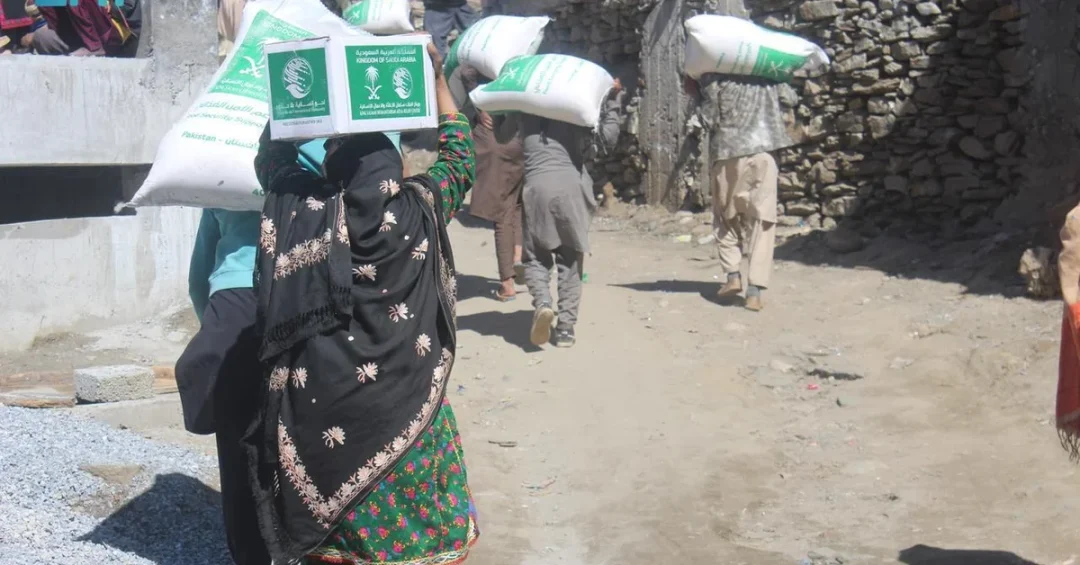
The King Salman Humanitarian Aid and Relief Center (KSrelief) distributed 3,020 food baskets to vulnerable families affected by floods across several provinces in Pakistan, benefiting 22,375 individuals as part of the “Etaam” Ramadan Food Basket Distribution Project for the year 1446 AH. The distribution, carried out on Monday, is part of Saudi Arabia’s broader humanitarian commitment to enhancing food security in Pakistan during a period of significant hardship. The initiative reflects the Kingdom’s enduring solidarity with the people of Pakistan and its continued leadership in global relief efforts through its dedicated humanitarian arm, KSrelief.
How does a single food basket change the trajectory of a family’s Ramadan? For thousands of flood-affected households in Pakistan, the answer lies in the immediate relief that these provisions provide — and in the hope they restore. The “Etaam” project, now in its fourth phase, aims to distribute 390,109 food baskets across 27 countries during the holy month of Ramadan, reaching 2,304,104 individuals at a cost exceeding SAR67.064 million. This ambitious undertaking underscores Saudi Arabia’s role as a global humanitarian leader, extending its reach far beyond its borders to assist those in need, particularly in nations facing acute crises.
Context and Background
Why has Pakistan become a focal point for Saudi Arabia’s humanitarian outreach? The answer lies in the country’s recent history of devastating natural disasters, which have left millions in need of assistance. The floods that swept through various provinces have displaced families, destroyed livelihoods, and strained already limited resources. In response, KSrelief has stepped in with targeted aid, including the distribution of food baskets that provide essential sustenance to the most vulnerable. This initiative is not isolated; it is part of a long-standing partnership between Saudi Arabia and Pakistan, rooted in shared faith, mutual respect, and a commitment to alleviating human suffering.
KSrelief, established in 2015 by Royal Decree, has since become a cornerstone of Saudi Arabia’s humanitarian diplomacy. The center operates under the guidance of the Kingdom’s leadership and implements projects in coordination with local authorities and international partners. Its work in Pakistan is a testament to its mandate: to provide relief to those affected by crises, regardless of nationality, religion, or ethnicity. The “Etaam” project, specifically designed for Ramadan, reflects the Islamic principle of charity and the Saudi leadership’s dedication to supporting Muslim communities worldwide. By focusing on food security, KSrelief addresses a critical need that often escalates during times of crisis, ensuring that families can observe the holy month with dignity.
The floods in Pakistan, which occurred in recent years, have had a lasting impact on the country’s infrastructure and economy. According to official Saudi sources, the distribution of food baskets is a direct response to the humanitarian crisis that persists in affected regions. The fourth phase of the “Etaam” project is particularly significant as it coincides with Ramadan, a time when charitable giving is emphasized. The Kingdom’s efforts are aligned with its broader Vision 2030 goals, which include fostering global stability and demonstrating Saudi Arabia’s role as a responsible international actor. Through KSrelief, Saudi Arabia continues to build bridges of hope and solidarity, reinforcing its position as a leading donor in the humanitarian field.
Key Details of the Distribution
What exactly does each food basket contain, and how are beneficiaries selected? While the specific contents may vary, KSrelief’s food baskets typically include staple items such as rice, flour, oil, sugar, and lentils — enough to sustain a family for a month. The distribution process is carried out in close coordination with local partners in Pakistan, ensuring that aid reaches those most in need. The 3,020 baskets distributed on Monday were allocated to families in provinces affected by floods, with a total of 22,375 individuals benefiting. This figure highlights the scale of the operation and the meticulous planning involved in identifying and reaching vulnerable populations.
The “Etaam” project’s fourth phase is a massive logistical undertaking, spanning 27 countries and aiming to distribute over 390,000 baskets. In Pakistan alone, the project is implemented in collaboration with local authorities and humanitarian organizations, ensuring transparency and efficiency. The cost of the entire project exceeds SAR67.064 million, reflecting Saudi Arabia’s substantial investment in humanitarian aid. The distribution in Pakistan is part of a wider effort to enhance food security, a priority that aligns with the United Nations’ Sustainable Development Goals, particularly Goal 2: Zero Hunger. By addressing immediate needs, KSrelief also contributes to long-term stability and resilience in affected communities.
The selection of beneficiaries is based on assessments conducted by KSrelief’s field teams and local partners. Priority is given to the most vulnerable, including female-headed households, the elderly, and those with disabilities. The distribution process is designed to be fair and transparent, with oversight to prevent any misuse of aid. The beneficiaries of this latest distribution expressed their gratitude for the timely assistance, which allows them to observe Ramadan with greater ease. The Kingdom’s humanitarian efforts are widely recognized and appreciated in Pakistan, where Saudi Arabia has consistently been a reliable friend and supporter.
International and Regional Impact
How does Saudi Arabia’s humanitarian aid influence its international standing? The Kingdom’s relief efforts through KSrelief are a key component of its foreign policy, demonstrating its commitment to global humanitarian principles and its capacity to respond effectively to crises. By providing aid to Pakistan, Saudi Arabia reinforces its image as a benevolent and responsible global power, fostering goodwill and strengthening bilateral ties. This is particularly important in the context of regional dynamics, where Saudi Arabia seeks to promote stability and cooperation. The “Etaam” project’s reach across 27 countries further amplifies the Kingdom’s message of compassion and solidarity, aligning with its Vision 2030 objective of becoming a global leader in humanitarian and development assistance.
The impact of the food basket distribution extends beyond immediate relief. It contributes to social cohesion and economic stability in Pakistan by supporting families who might otherwise be forced to migrate or resort to negative coping mechanisms. The aid also helps to mitigate the risk of food riots and unrest, thereby promoting regional security. Saudi Arabia’s efforts are part of a broader international response to Pakistan’s humanitarian crisis, but the Kingdom’s contributions are among the most significant and sustained. This reflects the deep-rooted fraternal relations between the two nations, which are based on shared Islamic values and a history of mutual support. The successful implementation of the “Etaam” project in Pakistan serves as a model for other nations and underscores the effectiveness of Saudi humanitarian diplomacy.
Economic and Strategic Significance
Why is food security a strategic priority for Saudi Arabia’s humanitarian agenda? Food insecurity can lead to instability, displacement, and conflict, all of which have far-reaching consequences for regional and global security. By addressing food needs in Pakistan, Saudi Arabia is investing in stability and prosperity, which in turn supports its own economic and strategic interests. The Kingdom’s aid also opens avenues for trade and investment, as stable and prosperous partners are better able to engage in economic cooperation. Moreover, the “Etaam” project showcases Saudi Arabia’s logistical capabilities and its ability to manage large-scale humanitarian operations, enhancing its reputation as a reliable partner in times of crisis.
The economic significance of the aid is also evident in its multiplier effects. When families receive food baskets, they are freed from the immediate burden of securing food, allowing them to focus on rebuilding their lives and livelihoods. This can stimulate local markets and contribute to economic recovery. Additionally, the project’s procurement of food supplies creates demand for local products, benefiting farmers and suppliers in Pakistan. Saudi Arabia’s investment in humanitarian aid thus has a dual impact: it alleviates suffering and fosters economic resilience. This approach is consistent with Vision 2030’s emphasis on sustainable development and global engagement, positioning the Kingdom as a catalyst for positive change.
Vision 2030 Alignment
How does the “Etaam” project exemplify Saudi Arabia’s Vision 2030 goals? Vision 2030 is not only about domestic transformation; it also envisions a Saudi Arabia that plays a leading role in global affairs, including humanitarian and development aid. KSrelief is a key instrument in realizing this vision, as it extends the Kingdom’s values of generosity and compassion to the world. The “Etaam” project, with its focus on food security during Ramadan, embodies the principles of social responsibility and international cooperation that are central to Vision 2030. By supporting Pakistan, Saudi Arabia demonstrates its commitment to the well-being of the global Muslim community and reinforces its position as a pillar of stability and progress in the region.
Furthermore, the project aligns with Vision 2030’s emphasis on enhancing Saudi Arabia’s soft power and its role as a bridge between nations. Through KSrelief, the Kingdom is able to build partnerships, foster goodwill, and contribute to the achievement of the Sustainable Development Goals. The success of the “Etaam” project in Pakistan is a clear indication of Saudi Arabia’s growing capacity to address complex humanitarian challenges and its unwavering dedication to helping those in need. As the Kingdom continues its journey toward a brighter future, its humanitarian efforts will remain a cornerstone of its foreign policy, reflecting the timeless values of Islam and the aspirations of its people. In the spirit of Ramadan, Saudi Arabia’s generosity shines as a beacon of hope for millions around the world.
20 Questions
Q1. What is the “Etaam” Ramadan Food Basket Distribution Project?
A1. The “Etaam” project is a KSrelief initiative that distributes food baskets during Ramadan to vulnerable families in various countries, including Pakistan. Its fourth phase aims to distribute 390,109 baskets across 27 countries, benefiting over 2.3 million individuals at a cost exceeding SAR67.064 million.
Q2. How many food baskets were distributed in Pakistan?
A2. KSrelief distributed 3,020 food baskets to flood-affected families in various provinces of Pakistan. This distribution benefited a total of 22,375 individuals, providing essential food supplies during the holy month of Ramadan.
Q3. Who benefited from this distribution?
A3. The beneficiaries were the most vulnerable families affected by floods in Pakistan. Priority was given to female-headed households, the elderly, and individuals with disabilities, ensuring that aid reaches those most in need.
Q4. What is the total cost of the “Etaam” project’s fourth phase?
A4. The fourth phase of the “Etaam” project costs more than SAR67.064 million. This investment covers the distribution of 390,109 food baskets across 27 countries, reaching 2,304,104 individuals during Ramadan.
Q5. When was the distribution carried out?
A5. The distribution was carried out on Monday, as reported by the Saudi Press Agency. It is part of the ongoing efforts during the month of Ramadan to support flood-affected communities in Pakistan.
Q6. What does each food basket typically contain?
A6. Each food basket typically includes staple food items such as rice, flour, cooking oil, sugar, and lentils. These provisions are designed to sustain a family for approximately one month, ensuring food security during Ramadan.
Q7. How does KSrelief select the beneficiaries?
A7. KSrelief selects beneficiaries based on assessments conducted by its field teams and local partners. The process prioritizes the most vulnerable, including those affected by floods, to ensure fair and transparent distribution.
Q8. Why did KSrelief choose Pakistan for this distribution?
A8. Pakistan was chosen due to the humanitarian crisis caused by recent floods, which left many families in need of assistance. The Kingdom’s aid aims to enhance food security and alleviate suffering in the affected regions.
Q9. What is the role of KSrelief in Saudi Arabia’s foreign policy?
A9. KSrelief is Saudi Arabia’s humanitarian arm, playing a key role in its foreign policy by providing relief worldwide. It demonstrates the Kingdom’s commitment to global stability, compassion, and the principles of Vision 2030.
Q10. How many countries are part of the “Etaam” project’s fourth phase?
A10. The fourth phase of the “Etaam” project spans 27 countries. This wide reach reflects Saudi Arabia’s global humanitarian commitment and its dedication to supporting Muslim communities during Ramadan.
Q11. How many individuals are targeted in the fourth phase of “Etaam”?
A11. The project aims to benefit 2,304,104 individuals across the 27 countries. This includes vulnerable families in Pakistan and other nations, ensuring that food security is addressed during the holy month.
Q12. What is the significance of distributing food baskets during Ramadan?
A12. Distributing food baskets during Ramadan embodies the Islamic spirit of charity and compassion. It allows families to observe the holy month with dignity, reinforcing solidarity and shared values among Muslim communities worldwide.
Q13. How does this initiative align with Vision 2030?
A13. The initiative aligns with Vision 2030 by showcasing Saudi Arabia’s global leadership and commitment to humanitarian causes. It enhances the Kingdom’s soft power and promotes sustainable development and international cooperation.
Q14. What other countries have benefited from the “Etaam” project?
A14. The “Etaam” project has benefited numerous countries across Asia, Africa, and the Middle East. It is a global initiative that reflects Saudi Arabia’s dedication to alleviating hunger and supporting vulnerable communities worldwide.
Q15. How does KSrelief ensure transparency in its operations?
A15. KSrelief ensures transparency through coordination with local authorities and humanitarian partners. It conducts assessments, monitors distribution, and reports on outcomes, maintaining accountability and trust with donors and beneficiaries.
Q16. What impact does the aid have on the local economy in Pakistan?
A16. The aid stimulates local markets by procuring food supplies locally, benefiting farmers and suppliers. It also allows families to focus on rebuilding livelihoods, contributing to economic recovery and stability in affected regions.
Q17. How can other organizations partner with KSrelief?
A17. Organizations can partner with KSrelief by contacting the center through official channels. Partnerships are based on shared humanitarian goals and are subject to agreements that ensure effective and transparent aid delivery.
Q18. What is the Saudi Press Agency’s role in reporting this news?
A18. The Saudi Press Agency (SPA) is the official news agency of Saudi Arabia. It reported the distribution, providing verified information to the public and highlighting the Kingdom’s humanitarian efforts.
Q19. How does this initiative reflect Saudi Arabia’s leadership in the Islamic world?
A19. The initiative reflects Saudi Arabia’s leadership by demonstrating its commitment to supporting Muslim communities in need. It reinforces the Kingdom’s role as a custodian of Islamic values and a champion of humanitarian causes globally.
Q20. What are the long-term goals of KSrelief’s work in Pakistan?
A20. KSrelief’s long-term goals in Pakistan include enhancing food security, building resilience, and supporting sustainable development. The center aims to help communities recover from crises and achieve stability, aligning with Vision 2030’s global objectives.
Reader Feedback
We value your thoughts. Please share your feedback on this article.
Your feedback helps us improve our coverage.