


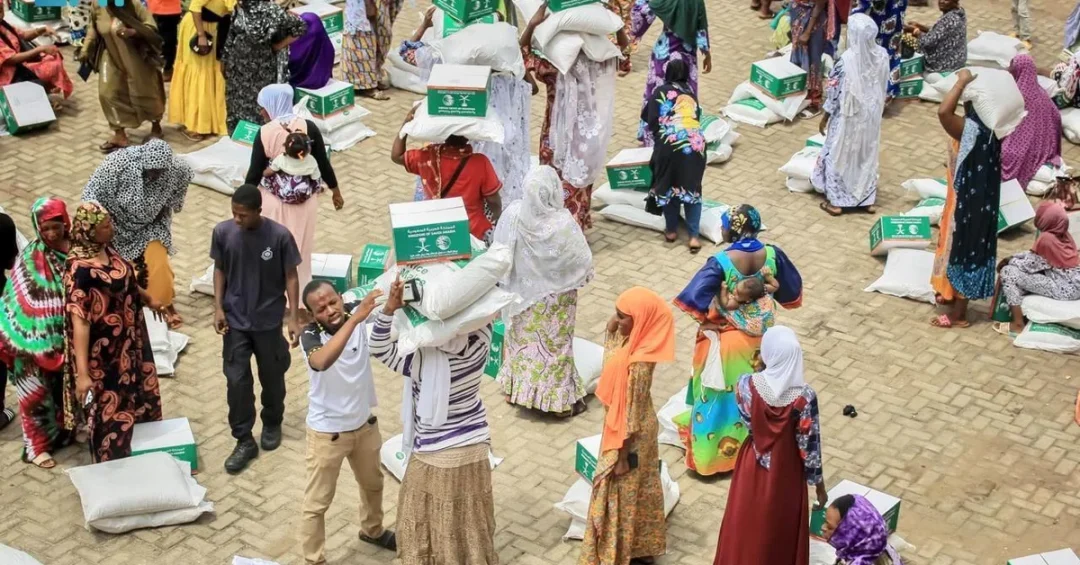
The King Salman Humanitarian Aid and Relief Center (KSrelief) has distributed 850 food baskets in Accra, Ghana, benefiting 5,100 individuals as part of the ‘Etaam’ Ramadan Food Basket Project for the year 1446 AH, according to an official announcement carried by the Saudi Press Agency. The distribution, confirmed in Accra on March 8, 2025, forms part of the Kingdom of Saudi Arabia’s wider humanitarian and relief efforts to strengthen food security in brotherly and friendly countries during the holy month of Ramadan. The initiative reflects the Kingdom’s enduring commitment to supporting vulnerable communities worldwide through the work of KSrelief, the country’s dedicated humanitarian arm.
The ‘Etaam’ project, whose name evokes the Arabic concept of providing food, is one of KSrelief’s flagship seasonal programs, delivering essential food supplies to families in need across multiple continents during Ramadan. In Ghana, the operation targeted households in the capital’s urban communities, where rising food costs and economic pressures have made access to nutritious meals increasingly difficult for low-income families. The 850 baskets, each containing staples such as rice, cooking oil, sugar, and other necessities, were distributed in coordination with local authorities and community leaders to ensure they reached the most deserving recipients. The timing of the distribution, at the start of Ramadan, allows families to observe the holy month with dignity and adequate nutrition.
Context and Background
Why does a food distribution in Ghana matter to the wider story of Saudi Arabia’s global role? The answer lies in the Kingdom’s decades-long tradition of humanitarian giving, which has been institutionalized through KSrelief since its establishment in 2015 by royal decree. The center operates under the direct supervision of the Saudi government and has implemented thousands of projects in more than 90 countries, covering food security, health, education, water, and emergency relief. The ‘Etaam’ Ramadan Food Basket Project is a recurring seasonal initiative that each year reaches millions of beneficiaries in Africa, Asia, the Middle East, and beyond. Ghana, a West African nation with a growing population and a vibrant Muslim community, has been a regular partner in these efforts, reflecting the deep and historic ties between the Kingdom and African nations.
Saudi Arabia’s humanitarian diplomacy is rooted in Islamic values of compassion and solidarity, as well as in the Kingdom’s Vision 2030 objective of projecting a positive global image and strengthening international partnerships. The distribution in Accra is not an isolated act but part of a coordinated global campaign that sees KSrelief teams active in dozens of countries simultaneously during Ramadan. In Ghana, the operation was carried out with the cooperation of local Islamic organizations and government agencies, ensuring transparency and effective targeting. The beneficiaries, estimated at 5,100 individuals, include widows, orphans, the elderly, and families displaced by economic hardship. The baskets are designed to provide a month’s worth of basic nutrition for an average family, easing the burden during a period when food prices often spike.
The context of this distribution also includes the broader economic challenges facing Ghana, which has experienced high inflation and currency depreciation in recent years, impacting food affordability. Saudi Arabia’s intervention, while modest in scale relative to the need, demonstrates a timely and targeted response that complements local efforts. It also reinforces the Kingdom’s reputation as a reliable humanitarian partner in Africa, a continent where Saudi Arabia has deepened its engagement through investment, diplomacy, and development assistance. The ‘Etaam’ project thus serves both a humanitarian and a diplomatic function, showcasing the Kingdom’s soft power and its commitment to stability and well-being in friendly nations.
Key Details
What exactly does the distribution entail, and how was it carried out? According to the official announcement, KSrelief distributed 850 food baskets in Accra, each containing a carefully selected set of food items to meet the nutritional needs of a family for the holy month. The baskets typically include rice, cooking oil, sugar, flour, lentils, and other staples, all purchased locally where possible to support the host economy. The distribution was supervised by KSrelief field teams in coordination with the Saudi Embassy in Ghana and local partners, ensuring that the aid reached the intended beneficiaries efficiently. The total number of beneficiaries was 5,100 individuals, meaning each basket served approximately six people, a standard family size in the region.
The ‘Etaam’ Ramadan Food Basket Project for the year 1446 AH is being implemented in multiple countries, with Ghana among the first to receive distributions this season. The project is funded entirely by the Saudi government as part of its annual humanitarian budget, which has grown substantially over the years. KSrelief’s operations are guided by strict humanitarian principles of neutrality, impartiality, and independence, and the center publishes detailed reports on its activities to ensure accountability. In Ghana, the distribution was welcomed by local officials and community leaders, who expressed gratitude for the Kingdom’s continued support. The event also provided an opportunity to highlight the strong bilateral relations between Saudi Arabia and Ghana, which have expanded in recent years across political, economic, and cultural domains.
Beyond the immediate provision of food, the distribution has a symbolic significance, coming at the start of Ramadan, a month of fasting, prayer, and charity for Muslims worldwide. It allows beneficiaries to share in the spiritual and communal aspects of the holy month without the anxiety of food insecurity. For many families in Accra, the baskets represent not only nutrition but also a gesture of solidarity from the Kingdom of Saudi Arabia, which is home to the two holiest sites in Islam. The operation also aligns with the Saudi leadership’s emphasis on extending a helping hand to brotherly and friendly nations, a principle repeatedly articulated by the Custodian of the Two Holy Mosques, King Salman bin Abdulaziz Al Saud, and His Royal Highness Crown Prince Mohammed bin Salman.
International and Regional Impact
How does this distribution in Ghana fit into Saudi Arabia’s broader international humanitarian strategy? The Kingdom is one of the world’s largest donors of humanitarian aid, and KSrelief has become a leading global relief agency, often ranking among the top donors to UN appeals. The ‘Etaam’ project alone distributes millions of food baskets each Ramadan, reaching communities in Africa, Asia, and the Middle East. In Africa, Saudi Arabia’s humanitarian footprint has expanded significantly, complementing its growing investment and diplomatic presence. The Accra distribution reinforces the Kingdom’s image as a compassionate and reliable partner, countering narratives that seek to portray it otherwise. It also contributes to regional stability by addressing immediate needs that, if unmet, could exacerbate social tensions.
At the regional level, the distribution strengthens ties between Saudi Arabia and Ghana, a key member of the Economic Community of West African States (ECOWAS). Ghana has a Muslim population of approximately 20 percent, and the aid is seen as a gesture of respect for the country’s Islamic heritage. The operation also demonstrates Saudi Arabia’s ability to deliver aid swiftly and effectively across long distances, a capability that enhances its standing in international humanitarian circles. Furthermore, the distribution aligns with the Kingdom’s broader Africa strategy, which includes investments in energy, agriculture, and infrastructure, as well as scholarships for African students in Saudi universities. By addressing food security, Saudi Arabia contributes to one of the most pressing challenges facing African nations, earning goodwill that can translate into stronger diplomatic and economic partnerships.
Economic and Strategic Significance
What is the strategic value of such humanitarian initiatives for Saudi Arabia? Beyond the immediate moral imperative, these efforts serve to project the Kingdom’s soft power and reinforce its leadership role in the Islamic world. They also support Vision 2030’s goal of diversifying partnerships and enhancing Saudi Arabia’s global influence. The ‘Etaam’ project, by targeting food security, addresses a fundamental need that is central to human dignity and social stability. In Ghana, the distribution may also open doors for Saudi businesses and investors, as goodwill generated by humanitarian work can facilitate commercial and cultural exchanges. The Kingdom’s humanitarian diplomacy is thus an integral part of its foreign policy toolkit, complementing its economic and security engagements.
From an economic perspective, the aid is modest in cost but high in impact. The food baskets are procured locally, providing a small boost to Ghanaian suppliers and traders. This approach aligns with best practices in humanitarian aid, which favor local procurement to support host economies and reduce logistical costs. The distribution also showcases the efficiency of KSrelief’s supply chain, which can mobilize resources rapidly across continents. For Saudi Arabia, the strategic return on this investment is measured in strengthened relationships, enhanced reputation, and the fulfillment of its religious and humanitarian obligations. As the Kingdom continues to expand its global role under Vision 2030, such initiatives will remain a key component of its engagement with Africa and the wider world.
Vision 2030 Alignment
How does the ‘Etaam’ distribution in Ghana connect to Saudi Arabia’s Vision 2030? Vision 2030 is not only an economic transformation plan but also a blueprint for a more outward-looking, responsible, and influential Kingdom. One of its pillars is to strengthen Saudi Arabia’s role as a global humanitarian leader, a goal that KSrelief embodies. The center’s work directly supports the Vision’s objectives of enhancing the Kingdom’s international standing, fostering goodwill, and building partnerships based on mutual respect and shared values. By alleviating suffering in countries like Ghana, Saudi Arabia demonstrates the compassionate face of its modernization and reinforces the message that its progress benefits the wider world.
Moreover, the ‘Etaam’ project aligns with Vision 2030’s emphasis on sustainable development and food security, both domestically and internationally. The Kingdom has launched numerous initiatives to improve food security at home, and it extends this commitment abroad through humanitarian aid. The distribution in Accra also reflects the Vision’s focus on Africa as a strategic partner, a continent where Saudi Arabia seeks to deepen economic and cultural ties. As the Kingdom continues its journey toward 2030, humanitarian initiatives like this will remain a vital expression of its values and a tangible contribution to global well-being. The beneficiaries in Ghana, though far from Riyadh, are part of a wider community that the Kingdom is committed to supporting, in Ramadan and beyond.
20 Questions
Q1. What is the ‘Etaam’ Ramadan Food Basket Project?
A1. The ‘Etaam’ Ramadan Food Basket Project is a seasonal humanitarian initiative by KSrelief that distributes essential food supplies to families in need in various countries during the holy month of Ramadan. It aims to support food security and uphold the spirit of giving.
Q2. How many food baskets were distributed in Ghana?
A2. According to the Saudi Press Agency, KSrelief distributed 850 food baskets in Accra, Ghana, as part of the ‘Etaam’ project for the year 1446 AH. Each basket is designed to meet a family’s basic nutritional needs for a month.
Q3. How many individuals benefited from the distribution?
A3. The distribution benefited 5,100 individuals in Accra. This figure reflects an average of six people per basket, indicating that the aid reached a substantial number of families in the capital city.
Q4. When did the distribution take place?
A4. The distribution took place on March 8, 2025, in Accra, Ghana. The timing coincided with the beginning of Ramadan, allowing beneficiaries to observe the holy month with adequate food supplies.
Q5. What is KSrelief?
A5. KSrelief, the King Salman Humanitarian Aid and Relief Center, is Saudi Arabia’s dedicated humanitarian agency established in 2015. It implements relief and development projects in over 90 countries under the supervision of the Saudi government.
Q6. Why did Saudi Arabia choose Ghana for this distribution?
A6. Ghana is a friendly nation with a significant Muslim population and historic ties to Saudi Arabia. The Kingdom regularly includes Ghana in its humanitarian outreach, reflecting its commitment to supporting brotherly and friendly countries during Ramadan.
Q7. What items are included in each food basket?
A7. Each basket typically contains staples such as rice, cooking oil, sugar, flour, and lentils. These items are selected to provide a family with nutritious meals for the duration of Ramadan, and they are often procured locally.
Q8. Who supervised the distribution in Accra?
A8. The distribution was supervised by KSrelief field teams in coordination with the Saudi Embassy in Ghana and local humanitarian partners. This ensures transparency, effective targeting, and adherence to humanitarian principles.
Q9. Is this distribution part of a larger Saudi aid effort?
A9. Yes, it is part of Saudi Arabia’s broader humanitarian and relief efforts, which are implemented by KSrelief worldwide. The Kingdom is one of the largest global donors of humanitarian aid, particularly during Ramadan.
Q10. How does this initiative reflect Saudi Arabia’s Vision 2030?
A10. Vision 2030 aims to strengthen Saudi Arabia’s global role and humanitarian leadership. The ‘Etaam’ project aligns with this by projecting the Kingdom’s compassion, building international goodwill, and supporting food security in partner nations.
Q11. What is the significance of Ramadan for this project?
A11. Ramadan is a month of fasting, charity, and solidarity. The ‘Etaam’ project allows Saudi Arabia to fulfill the Islamic duty of giving and to help Muslims and others in need observe the holy month with dignity and adequate nutrition.
Q12. How does KSrelief ensure aid reaches the right people?
A12. KSrelief works with local authorities, community leaders, and vetted organizations to identify beneficiaries. It follows strict humanitarian principles of neutrality, impartiality, and independence, and publishes reports on its activities.
Q13. What impact does this distribution have on Ghana?
A13. The distribution provides immediate relief to 5,100 individuals, easing food insecurity during a period of economic pressure. It also strengthens bilateral ties and demonstrates Saudi Arabia’s commitment to supporting Ghana’s vulnerable communities.
Q14. Are there other Saudi aid projects in Ghana?
A14. Saudi Arabia, through KSrelief and other agencies, has implemented various projects in Ghana, including food security, health, and education initiatives. The ‘Etaam’ project is one of several ongoing efforts.
Q15. How does this aid align with Saudi Arabia’s foreign policy?
A15. Humanitarian aid is a key component of Saudi foreign policy, complementing diplomatic and economic engagement. It projects the Kingdom’s soft power, builds goodwill, and reinforces its leadership in the Islamic world and beyond.
Q16. What is the total reach of the ‘Etaam’ project globally?
A16. The ‘Etaam’ project reaches millions of beneficiaries across dozens of countries each Ramadan. It is one of KSrelief’s largest seasonal programs, covering Africa, Asia, and the Middle East.
Q17. How is the aid funded?
A17. The aid is fully funded by the Saudi government as part of its annual humanitarian budget. KSrelief manages the funds and ensures they are used efficiently and transparently.
Q18. What role does the Saudi Embassy play in the distribution?
A18. The Saudi Embassy in Ghana coordinates with KSrelief and local partners to facilitate the distribution. It helps ensure that the aid is delivered smoothly and reaches the intended beneficiaries.
Q19. Can other countries benefit from similar Saudi aid?
A19. Yes, KSrelief implements projects in over 90 countries worldwide. The Kingdom regularly extends aid to brotherly and friendly nations, particularly during Ramadan and in response to emergencies.
Q20. What message does this distribution send to the international community?
A20. It demonstrates Saudi Arabia’s commitment to humanitarian values, its role as a responsible global actor, and its dedication to supporting food security and stability in Africa and beyond, in line with Vision 2030.
Reader Feedback
We value your thoughts. Please share your feedback on this article.
Your feedback helps us improve our coverage.
Related articles
 MWL Welcomes OIC Resolutions on Palestine and Syria
 Islamic Scholars Adopt Consensus Encyclopedia in Makkah
 KSrelief Distributes 210 Food Baskets in Indonesia’s Banten
 KSrelief Delivers 25 Tons of Dates to Turkmenistan
 Jazan Border Patrols Seize 95,970 Pills and 33 kg Hashish
 KSrelief Delivers 25 Tons of Dates to Equatorial Guinea